
Love and Grief

Grief is a way of loving what has slipped from view. Love is a way of grieving what has not yet done so. They need each other in order to be themselves.     

 —Stephen Jenkinson

The appearance of COVID has changed everything. We’ve wandered from independence, personal protection and material support to broken food supply chains and communal support. Jobs disappeared while we were trying to integrate new rules and practices into thoroughly disrupted lives. Accurate information was and continues to be muddied by politics. There is a vast gulf between the promise of a vaccine (magical thinking?) and practical everyday precautions.

An unprecedented uprising for racial justice re-appeared nationally and globally. We continue to swim in deeply uncertain times in which political and social institutions are under attack, hopelessness courses like a deadly undercurrent with cynicism, opportunism and nihilism jumping on for the ride. The path that got us here is washed out and there’s no going back. Yet a powerful new solidarity has also appeared, providing compelling fuel for birthing a new national story. As Valarie Kaur likes to say, we are in transition: “Breath and push.”  Yet, out of shock and loss and even out of revolutionary optimism, what opportunities are we missing, and what is suddenly available?

Realizing we are not going back to a familiar normal, we await the arrival of the new. There is deep deprogramming underway as the unconscious gives up its secrets, bringing hidden motivations and desires to the surface in a tumultuous display of community-building and compassion, yet also extremism, fear, tribalism and aggression. This is a moment of extreme neural reprogramming. We can decide what we want and create it as we awaken to the pervasive messaging of white plutocratic dominion, the transfiguration of culture and a global push toward humane alternatives. This self-awareness is emerging as critical moments of choice to relinquish assumptions and to transform worldviews as we kneel and bow in this bardo of becoming. 

We’re not at all sure who we will become and many are determined to cloak the present in anything resembling the familiar. Yet some of the outlines of a different world are coming into view. How will we sustain ourselves spiritually, socially, materially and according to what values? Where or what is our refuge? Are we to resign to the political theater emanating from the centers of power? Are we to be ruled by fear and paranoia? Is there a pathway to confidence in a threatening world heading for collapse? Most of all, orienting to the grief of this time is a central challenge.

What of this grief—this persistent presence? It is not solely part of the apparition of ‘me.’ Whatever grief I feel is not strictly ‘mine’. It is a collective condition. It’s not a manifestation of the primacy or imagined indelibility of a solitary ‘me.’ It’s the elemental nature of being at this moment. I do not stand alone at the top of the pyramid of my life. I stand within. We are not the containers of our lives; we are the contained in the ongoing unstoppable process of living and dying that has always existed and never stopped.

Standing at the threshold of the Anthropocene, my outlook is not of fullness and promise. I am more aware of the losses, of being among those whose mistakes, hubris and arrogance, entitlement and recklessness have brought our progeny to the most dangerous moment of human history. The future is already lost.

The persistence of COVID is changing our outlook and personal practices; how we maintain a level of equanimity and easy connection with others. I am already rendered fragile by a personal health condition. Call it a pre-existing condition. Yet such fragility—and the shifting feeling that comes with it–is not weakness. It is the virtue of being affected, of still being able to feel at all. It is a form of strength in which mutability, resilience and adaptation form a capacity to bend without breaking. In the cracks of what decreases me lie what increases me.

Then there is the sense of a great unwinding—or, more accurately, unraveling–an exhaustion of neo-liberal economics and the accompanying desperation of its priesthood (and remarkably oblivious entitlement) who have brought us to the brink of extinction. How could anyone look upon this—even if it’s largely unconsciously—without noticing the suffering and dislocation nearly everywhere?
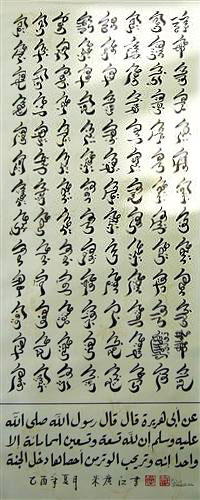
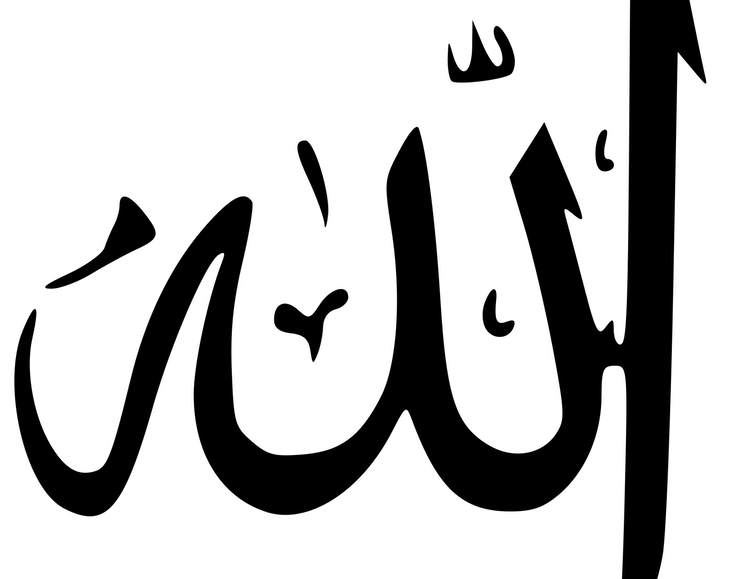
99 Names of God-Chinese.

Parallel to the ongoing nature of COVID, the progression and demands of the personal condition are also very uncertain. There are no clear signs of resolution, no hints as to my personal longevity nor any probability of recovery. Restoring and sustaining meaning is my primary focus. Generally, in this atmosphere of official denial, the severity of the infection being downplayed, the most sensible path to recovery is rejected. Clinging more desperately to the past and continuing to isolate from the world in its response, the centers of power in America are shutting their eyes to the inevitable. We sit on an edge of anxiety and resolve. There is so much more at stake now than ever before.

Even so, in the enveloping pall of personal loneliness and perpetual fragility, how can self-sustaining practices adapt to these circumstances? I rarely acknowledge my own fragility. I cover it and compensate. But it’s always there. Where shall I go for equanimity? Shifting away from what has worked in the past is not an answer. Turning to heart-based practice, noticing the appearance of grasping, despair and isolation, not retreating or succumbing, choosing a path of passion, recovering spontaneity and taking refuge in unity and dignity is the path of the present just as it has been in the past. Only now, our resolve must be even greater.

My personal awareness of loss and the general compassion I feel for others are parallel processes. What I have personally lost–a measure of freedom, a measure of abandon, the luxury of mindlessness, living with only an abstract comprehension of mortality and an incomplete and muddled notion of agency leave no residue of regret. They give way to a renewed and acute sense of the massive inertia of culture, the durability of systems of power, of being only one outlaw among a massive cadre who see the task ahead.

Having the curtain removed between the abstraction of death and the reality of its approach is not a loss. It has been more of a gain. I have gained focus and resolve. I am creating time even as an expansive future is diminished. A bottomless reservoir of gratitude has been tapped. An appreciation for the smallest gifts prevails. I have re-localized, attending to the minutiae of thought and interaction. This is not loss.

The full meaning of reciprocity with the natural world appears as we realize our subordinate place in the biosphere. The presence of extinction and the prospect of personal death luck among us. I am connected more closely to the experience everyone, if they’re lucky, will have sooner or later, the past and future omnipresent on the bumpy ride of now. Yet the recurring awareness of endings is also a source of energy; an enveloping presence of finality reviving appreciation for this world, the impulse to discover what more can be done, to grieve what has been lost, to love life as it is, beyond approval, beyond promises or expectations.

If there is a core of any sustained grief, it would be a sense of my own limitations.  It is the younger generations who’ve been robbed of their future, not me. My grief and love is for them and for the impossibly complex, incomparable beauty and perpetual emergence of life of which I am only a tiny nested part. Grief has not diminished me. I expand into it as a part of the perpetual astonishment of existence. What emerges is productive action. I am enveloped in life, reaching my arms around its every dimension. 

Zombie America

America is under racist assault. It has been this way for centuries—as though a cult of the undead, the empty dispossessed can only see the world in one way—Us vs Them. Purposeful demolition is the foremost objective of the undead—led by the First Family of Destruction. The zombie ideologues now get their news from the Family, its enablers, sycophants and its media amplifiers. There’s no more capacity for the undead to change than there is for a jellyfish to float against the currents. Yes, the undead are the jellyfish of the logo-sphere and they carrying a nasty sting. 

There’s no aspiration, no value, no commitment or connection to the collective, only to a their narrow view of entitlement.  There’s been no event, no sacred passage, no period of trial or transition, no foundation for their actions other than domination, jealousy, greed, anger and vengeance. There’s been no transition, no developmental progress, no entrée into a wiser way of seeing based in reality instead of wish-fulfillment.

Traditional initiation crosses a threshold to join the continuous stream of birthing and dying, with all the triumph and adversity, love and suffering in between. Emerging successfully from an initiation would mean walking with our feet on the ground and our heads in the clouds (not the reverse), holding a natural connection with our selves, others and with the land. 

Traditional cultures whose initiations were integral to the continuity of their communities prescribed these rites on the cusp of adulthood. They require a separation, a death, an awakening to essence (or soul), a time of rebirth and a return. An initiation is a second birth, having grown up dependent on family and community, the initiate is prepared to establish a separate life, to be guided by a core vision and to live out a full investment in the community according to that vision. 

Initiation is also a rooting experience, a gesture of coming home in the body-mind of the initiate. The body of the initiate is infused with the land and the spirits of the land. They become One.  This is the indigenous experience of initiation. Imagining a shred of anything similar in the American racist zombie cult is a laughable fantasy. We are diminished by all of it—for 400 years. We, as a nation, have been the undead, lost. Sadly, on the issue of race, we are as homeless as the ones sleeping in doorways.

I am of a people who, historically, had no land. The cultural lore is of temporary residence and history has tragically proven the validity of that outlook. We were not nomads, unless you count wandering in the desert for 40 years after escaping slavery in Egypt. That was the original initiation of the Jewish people. As the story goes, we received not only land after the struggle, but a rebirth in that land blessed by the God of that land. True or not, the history of the Jewish people has been one of being landless—until the establishment of the State of Israel. Overlooking the injustice of that creation for the moment (and all the suffering it has unleashed), that land remains the State of Israel in the hearts of many Jews whether they live there or not. 

Even so, tracing my own roots in the Jewish diaspora over the last 150 years, I can say I’m a citizen of America. I could even say I own land or I might trace my life in America for four generations, but I do not have a place in the same sense in which I describe it above. Rural Americans do; urban/suburban Americans don’t. As Stephen Jenkinson has said, we have learned to make do with portable gods. I personally have by conventional definition been a nomad. The deeper yearning to be of a place remains. 

My advantage, my privilege, is that I was not ripped from my ancestral home and transported against my will to this land. And beyond the mass kidnapping and enslavement, the American tradition of making others landless in the course of claiming this land continues to this day. This ideology is, under Trump particularly, delivered every day by the occupying force of police and ICE whose job it has become to enforce the message: you do not belong here. You have no claim to this place. It is ours and will never be yours. 

My personal bond connecting my history and cultural memory to Israel has been severed by the racist apartheid policies of that government. But in my adopted home, zombie white supremacy, an increasingly visible, dangerous and aggressive segment of this nation of white European immigrants, staking a claim to this land above anyone else, is now with rising brutality resuscitating and delivering a murderous message of ownership with a knee to the neck, further severing my bond to this land in the process.

Looking at the American republic, dangling as it is now between the life and death, the racist undead, led by the foremost zombie of our time, Donald Trump, remind us of an incomplete national initiation. There is nothing about Trump to suggest any history of formative, let alone transformative development, no true home, allegiance to anything or any distraction from singleminded and empty devotion to personal gain. And likewise, his most ardent followers feel entitled to demand and accept nothing less than unobstructed freedom of their personal choices without much suggestion of a commitment to anything other than that freedom–such as the common interest. 

America’s initiation on the issue of race is entering the encounter-with-death phase. Trump’s zombie cult, the uninitiated, reflect to the rest of us how severed we are from our ancestor’s bones. America is still way behind the curve of truly becoming Emma Lazarus’s home to the many. It’s primarily a home to the few whose dominance depends on successfully claiming—and selling—the idea of America as their exclusive home. The message delivered to communities of color are that they are temporary residents with shallow roots at best, at constant risk of being attacked, marginalized, incarcerated, exploited, oppressed, exported, discarded and finally, if necessary, killed. America is now being dragged into the mud of history by the undead. The world looks on in horror.

The racist undead have never been alive in the sense of recognizing interdependence as a primal reality of existence. Nor do they recognize or consider themselves beholden to any resident spirits. Even their god is homeless. Grounding to a place and to all people is not embedded in modern American culture; thus, no common vision exists of what it means to live in the full flower of diversity we represent. Our roots are too shallow; our gods are foreign. We are driven by the ideology of self-interest. And if Trump’s ascendance is any indication, the zombies are winning.

What is so disturbing and ironic in these times is that those who claim to be Most American, the ones claiming ownership and to being the ‘true’ keepers of the only legitimate version of America, the ones lugging automatic weapons into statehouses, to polling places and into the street proclaiming their ‘freedom,’ the ones acting least like they believe in the promise of this nation, have the least invested in making sure all people share and contribute to the struggle of thriving together, most likely because it is they themselves who have been hollowed out and discarded by the America they claim to love. They are our zombie chickens coming home to roost, leaning into the nihilism of the chief zombie, Donald Trump.

Things I Can No Longer Do #1

There is nothing further left for me in data-heavy climate tracts. I have to turn away now. I don’t want to know—at least not in the cognitive sense of knowing–because I already know.

I’ve reached the end of the line. There is nothing left for me in the latest morning-after mainstream media. I have to turn away. Yes, I’m fascinated, but I don’t really want to know—at least not in the cognitive sense of knowing–because I already know. I can’t even activate the part of my brain necessary to process an argument or anything purporting to be reasonable or logical or scientific, trying to convince…anyone… that this or that event is “directly related to climate change.” Nothing but futility and dissonance arise in the very first paragraph of such material. Where does anyone still get the idea that this does any good? Who still clings to the notion that deniers or ‘low information voters’ can be convinced otherwise? Who still imagines this particular event will constitute the critical nugget for some fence-sitter out there? Do such persons even exist? 

Popular treatment of climate issues has become performative journalism, going through the motions in service to a dying ritual of “providing a public service.” Who can stand this anymore? Numbness invariably accompanies reading such stories. They are space-fillers. As long as their vocabularies include the specialized terminologies of science, divorced from every somatic signal, gesture or sense-making faculty connecting us to the natural world, they no longer serve a purpose. There is no longer any refuge in being right. I have become a fugitive from this form of engagement. That fugitivity, as Bayo Akomolafe would say, is the definition of post-activism.

What is the root of a belief in continuing the activist debate? It’s the same dualistic ethic with centuries of baggage accompanying our estrangement from the natural world. The paradox of language is that resorting to reason as a way of propagating the conclusion that we humans have lost our way is part of the disease itself. As has become so clear in recent years, the way we react to the problem is often part of the problem. Reinforcing binaries is itself a form of distancing from our direct experience of the more-than-human world, reinforcing the dissociation at the heart of our headlong advance toward extinction.

What is more disturbing is remembering when I myself might have used words in that way, using (limited) tools of persuasion at my disposal, imperfectly, earnestly and mindlessly. But the very act of switching into that mode of communication is a betrayal. Sure, we all communicate in this way. Yes, we regularly appeal to reason and rationality, brandishing logic, evidence and data in our communications. Yet, at the end of this long trail of tears and deepening anguish, with humanity coming face to face with the self-destructive nature of our values and behavior, and mostly not comprehending, even with yet another book by the most erudite and passionate spokesperson appearing on behalf of coming to our senses, these efforts are now ringing dreadfully false and futile because, as someone living closer to my gut, the tears are already just below the surface anyway. And that feeling never goes away.  

I can view photos, arresting, disruptive, body-shaking invasions, images without any words at all, the ones that break through the most recent fragile emotional repair, images like the surgically tortured, dissected and harvested tar sands landscapes of Alberta, Chris Jordan’s photos of plastic-filled corpses of sea birds on Midway Island or the solitary orangutan fighting a bulldozer in a Sumatran rainforest or the Amazonian fires or rivers of ice-melt surging to the sea in Greenland, grayed and lifeless coral reefs or the abandoned tarpits of Ecuador. These images belong to me….and I belong to them.

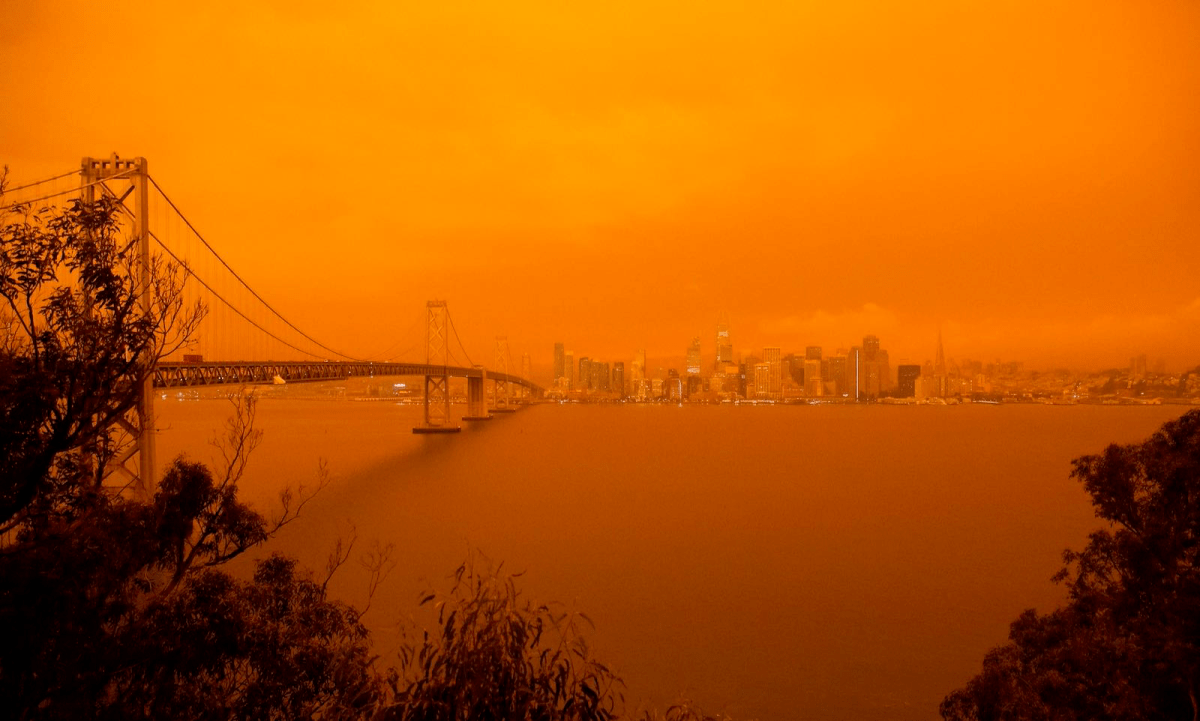
Who would dare publish nothing but photos of the most recent evidence of distorted human values and behavior? Where will we find pictures of the California firestorms with no story? The pictures of the orange sky above the Golden Gate Bridge spoke louder than any words ever could, as would typhoon devastation, denuded glacial moraines, bulldozed rainforest, dry riverbeds, open-pit lithium mines or the translucent shells of deep-sea mollusks that can no longer find sufficient accessible calcium.

Yes, I can still look at (some) graphs. But I already know what they say. Just save me from the words. That part of my brain is already exhausted. I can speak to you from my body. There I can wander with the desperate migrations of species, dream with the giants of the seas. I can listen to the land, soar with the last endangered condor searching for home. Just don’t ask me to process the words any more. It’s like eating cardboard and expecting to be nourished.

Stray Thoughts

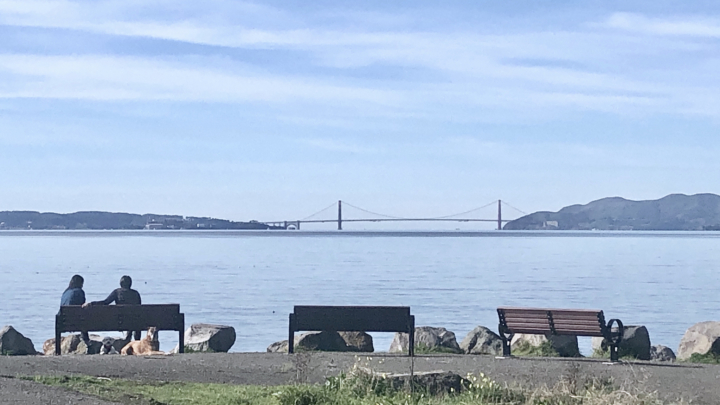
Here by the water the only constant
is the wind, the waves behave as if they
couldn’t be bothered to make themselves known

against the rock. A fellow nearby looks intently
at The Gate while his beloved sits in silence,
chin in hand, waiting for the answer that should come

to her at any moment. This bench is dedicated to the
public service of a city councilman, who from this spot
shall look upon the Bay forever, contemplating the

shifting nature of the world he left behind.
This is the day I will record the argot of the shaman
preparing his evening magic by a low fire,

a squirrel rising up from a rocky windbreak,
the clatter of small drums,
the snap of kite tails and unintelligible

harmonies celebrating sunshine. Ballooned yachts
criss-cross the horizon, white sails whipping halyards
taut — a flock of gulls straddling the updrafts–

white wings, distant whitecaps, a white cotton
candy sky, a white dog passing,
the white socks of the walkers,

the white lace gown you wore last night,
the bed a Rohrschach in white.
The Buddha never shifts his gaze.

Gratitude

Gratitude, I am your listening post,
perched on the shoulders of mountains,
in the grasses, in your granite faces,
reclining in the long valleys of your body.
.
Send me your chariots, your champion angels,

warriors of the spirit, whose love rises in speech,
in gesture, in wordless looks,
bathed in sublime rose waters;
even in anguish for the suffering of others.

Send me your thoroughbreds, heavy with bridle;
I will race alongside you, breathing my thanksgiving
for the idealism of youth, for the wild and holy power
of the earnest novitiate;

for conversations between fathers, mothers,
sons and daughters, blooming in the
rising cumulus of purity and courage, in
the altitudes of high regard, the vitality of innocence,
the awakening of inquiry.

Let me travel beside you,
raining down with the pounding hooves
of your galloping love.


No Time To Lose

Reading Andrew Harvey’s 1994 book, The Way of Passion, about Rumi’s relationship with his teacher Shams i-Tabriz is a riveting and enlightening dive into the poetry Rumi produced from that time.

Reading Andrew Harvey’s 1994 book, The Way of Passion, about Rumi’s relationship with his teacher Shams i-Tabriz, is a riveting and enlightening dive into the poetry Rumi produced from that time. Why would I read this? Because devoted to my Buddhist niche as I may be, it’s dry in comparison to the ecstatic and explosively awakened passion of Sufism. Continue reading “No Time To Lose”

This Time

In this time of Covid, economic upheaval, the climate monster bearing down on us, unrest and uncertainty, many are suffering. And many, both citizens and entire foreign nations, are watching in horror as American democracy is dismantled by the madman, abetted by his entire party. Joanna Macy’s spiral approach to being present in this world (gratitude, honoring our pain for the world, seeing with new eyes and going forth) is not merely playing out in our imaginations or in private retreats or zoom gatherings. There’s no such abstraction here. It’s playing out in real time, every day as we struggle to grasp the pace of change, how to stay grounded and engaged and not overwhelmed by circumstances beyond our control.

The pace of change draws us more deeply into the present moment. The past evaporates like volatile liquid exposed to the atmosphere. The future is ever more uncertain. We are left awash in the feelings and sensations of the immediate moment. And that immediacy demands a response. On one hand we can dwell on loss. And there are many reasons to do so because so much is being lost—or at least suspended. Lives are being lost, biodiversity is being lost, polar ice, human trust. The rule of law and the social contract are under attack.

Rilke says it best in one of Joanna’s favorite sonnets:

Let This Darkness Be a Bell Tower

Quiet friend who has come so far,

feel how your breathing makes more space around you.
Let this darkness be a bell tower
and you the bell. As you ring,

what batters you becomes your strength.
Move back and forth into the change.
What is it like, such intensity of pain?
If the drink is bitter, turn yourself to wine.

In this uncontainable night,
be the mystery at the crossroads of your senses,
the meaning discovered there.

And if the world has ceased to hear you,
say to the silent earth: I flow.
To the rushing water, speak: I am.

Sonnets to Orpheus II, 29

We are losing our resolve to address the advancing disaster of climate change. We are seeing our political agency being undermined and incrementally destroyed. We are seeing dissent being suppressed combined with the promotion of outrageously bizarre versions of truth. All the trappings of fascism are building into a wave that threatens to sweep away all we hold dear. Every day I am drawn into that loss, perhaps only for moments; but at least daily, at

times even hourly. I descend into agony, beating back and forth from grief to passion, from annihilation to liberation, each fueling the other. Maybe it was Martin Prechtel who said, ‘grief is the womb of art,’ or maybe it was me, I’m not sure. Every day is a transition, swinging from brief regeneration in the soil of grief, being tenderized and motivated to go forth once more with new eyes, an awakened and softened heart, being able to listen and feel what is right on the surface in moments of rededicating myself to possibility.

….but when I lean over the chasm of myself,
it seems my god is dark
and like a web: a hundred roots silently drinking.

This is the ferment I grow out of.
More I don’t know because my branches

rest in deep silence,
stirred only by the wind.

–Rilke

The creative moment is right in front of me. I have left behind all urgency. I am operating in a different time where urgency no longer exists. And I have all the time I need. To make haste is to be driven by a fantasy that may never appear. The fullness of this time is what some Buddhists call the bardo of everyday life, a time of embodying life and death in equal measure, living your dying in every moment, embracing life and being open to the awakening potential of each.

Widening Circles

I live my life in widening circles
that reach out across the world.
I may not complete this last one
but I give myself to it.

I circle around God, around the primordial tower.
I’ve been circling for thousands of years
and I still don’t know: am I a falcon,
a storm, or a great song?

If I could choose, I would be that great song, written while standing in the eye of the storm we are living through right now.


Emergence

Whatever else it might mean, emergence implies the most intimate character of life, a constant unfolding of arising and disappearing, creation and destruction, beyond rationality, transcending origins, judgment, intent or outcome. Tuning our view and receptive experience to this level of phenomena requires us to slow down, measuring and matching its pace, to align more intimately with an effervescent ebb and flow, to the way things really are, adjusting consciousness to the most elemental nature of nature.

That true nature, if we were to look more closely into it, is an ongoing process of life and death, each releasing into its opposite, arising and ceasing, appearing and disappearing. Nothing is fixed. Everything is less encumbered, simultaneously more connected and never still.

Emergence, at the innermost sanctuary of biological essence, lies at the neurochemical ground of being, in the transition of form to formlessness and vice versa, the nexus of conception and realization. It is the most delicate and easily injured wrapping of our existence, the pia mater, the ‘tender mother’ holding everything. It is the truest and deepest home of connection, compassion and forgiveness, where we are always alone, never lonely and in full communion with all life. In the most subtle recess where true belonging resides, the absolute belonging of no body and no-self, we give ourselves up to Inter-Being with no agenda, no grasping, no past and no future.

Unceasing change is the driving and dominant principle of emergence. Radical Impermanence is the Law. This is also a core principle of Dzogchen Buddhism. There is no true substance to anything, nor, ultimately, is there anything other than materiality. At this level, there are no values to be assigned to phenomena. Everything is simultaneously real and also apparition, including, of course, you and me in every moment.

Beneath the continuous and tenuous dynamic of birth and death is a deeper reality of unceasing stillness in which nothing is gained or lost. Everything is apparent and also continuously shifting. Any possible source or cause is beyond definition, beyond being teased out for identification or examination. There is no linearity, no progression nor any apparent reason, only an equality of opposites bound together in unceasing change. Only a self-propelled consciousness exists, a spontaneous internal intelligence based on impossibly complex systems processing information directly and immediately derived from ongoing performance, having no goal, no direction and no imperative other than to continue.

Right and wrong are less certain in this realm as the unceasing momentum of emergence cannot be definitively assigned to any single event. In fact, in absolute terms, all phenomena exist beyond any meaningful polarity and are regarded as equal. This is very difficult to grasp rationally, but every value we place on thought and action, all form, is entirely projection.  Hovering at this nexus of appearance and apparition gives rise to a quality of freedom, which can only be defined as compassionate intent, the ethical and moral engine for all action. To withdraw from the imperative of compassionate intent is to violate the mandate of life and to descend into meaninglessness, nihilism.

In the realm of emergence, nothing is containable, especially imagining a  fixed presence, such as a Self, expressing a principle of radical impermanence. Paradoxically, emergence becomes a sanctuary of birth and decay, of rapid and unending change, where safety is upended, where all reification goes to die.

At the emergent level of life, we belong to ourselves, to each other and to something vastly greater, beyond imagination. We do not belong to each other as mere ripples on the surface of life. That is the extent of the limited realm of psychology. The reason we can do to the earth and to each other what we do on a routine basis is because we do not fully belong to ourselves, and are not sufficiently mindful of how we belong to each other. What the totality of earth systems are doing now, because they cannot do otherwise, is reflect back to us what we have lost.

We are made and remade in realms of spirit and myth. In emergence, we realize our mutual dependence. In healing the rifts that separate us, we become more available to a greater sphere of belonging. If we dwelt only on the surface, we would miss the vast ocean sustaining all and to which all belongs. The internal healing process overcoming fragmentation, the dominance of subjectivity to the exclusion of full communion, is crucial to our maturation into eco-beings, cosmic citizens.

As for somatic experience itself, we are more than feelings and sensations. We are earth bodies, even though we may default to conceptual reflection–because that’s what (western) humans do. That’s what distinguishes humans from the rest of the non-human world. But this comes at great cost. The transition under way is not strictly about feelings or heart opening. It is about erotic embodiment, re-inhabiting our earth bodies, recovering the vocabulary for different ways of knowing, communicating, assessing and restoring the languages for relationship and community.

The somatic experience of emergence is happening so fast now we can’t process all of it in our bodies. Trauma, at its heart, is elementally expressed as opposing muscular action within the human system, the repression of expression contained by opposing neuromuscular conditions, the conflicting influence of opposing hormones, neurotransmitters at the fundamental level of physical mediation of incoming stimuli: the autonomic nervous system, the lizard brain. Over time, unaddressed, the sensitivity of the system increases, rendering us increasingly reactive to triggering stimuli, with all the attending memory and feelings. In emergent mind, the material of conflict becomes more accessible; the resolution of this conflict is a return to a lower baseline of sensitivity.

We can all sense the acceleration of change, making the processing of deliverance from social and historical and environmental trauma fast upon us more difficult. The depth of multiple traumas such as racism, privilege, complicity and the extractive economy are opening into full awareness. The violence at the center of the Growth Imperative, the colonization of peoples and our very capacity for critical thought are ever more apparent. The tools and pathways redefining our relationships, many though there are, are still under construction.

The vestiges of feeling ourselves as solitary are tenacious. Isolation and alienation are routine features of post-modern life. In our narrow self-oriented explorations, most of us carry memories of exclusion or marginalization. These are primal wounds of feeling excluded and separate, striking deeply into the psyche, particularly in these unsteady times.

Beneath that we cling to our identities, as if such a thing as a separate self exists in any ultimate sense. We each have varying skillsets for seeking and creating connection, the fields of intimacy meeting our needs. But due to our continued immaturity in relation to the world, many do not routinely experience union at all. Our attachment to a separate self is a fundamental source of suffering. Loneliness, the deepest wound of all, is dependent on this very principle.

One could spend all day detailing the minutiae of the typical persistently depressive longing for belonging, the pandemic of modern alienation, dislocation and dissociation from the natural world, the creeping and equally persistent solastalgia arising with the daily degradation of our common home. The effect is deep, subtle, pervasive and increasingly corrosive. All of which makes it increasingly important to decelerate and find refuge in the pace of emergence.

But when one drops beneath the conventional, asking again what we belong to or how we experience belonging, the easy definitions dissolve. The boundaries disappear and the reality of belonging simultaneously on multiple levels takes shape. While belonging may imply gaining something, part of the greater process requires we continuously acknowledge loss. It has been said that if we do not grieve properly, then that which we have lost was never truly alive. So we grieve. We grieve for what was alive in us, with us and for us. If we grieve properly, then we must also praise what is alive right now.

Resolving trauma, integrating feeling and restoring fully expressive neuromuscular function restores our pure creative impulse: eros. Emergence is the raw, un-nameable realm in which we contact this primal principle, where possibility expands beyond measure, where we meet the timeless wisdom of compassionate intent.

My Lineage

My lineage is the vast space of Longchenpa,
the precision of Jigme Lingpa, the tickster
Patrul Rinpoche and heart of Dilgo Kyentse.

My lineage is the perpetual union of all opposites,
the devotional music wafting through the
thick silence of a Rishikesh dawn.

My lineage is Durga the Invincible,
Kali, the Dancer of Destruction,
Parvati, the messenger of Love and Devotion.

My lineage is the lost language of the Algonquin,
the Mohican and the Miwok. It is the shining eyes
of a Lisu girl, the radiant gaze of a stranger
at the Maha Bodhi temple.

My lineage is the woolen robes collapsed like
ghosts on the benches of Shugsep nunnery,
the mountain peasants standing in line to
enter Samye monastery.

My lineage is tears of surrender on the cheeks
of pilgrims, whirling prayer wheels and wooden floors
worn by the prostrations of the devoted.

My lineage is the half-blind old woman greeting
me at the doorway of Gangri Tokar,
love beyond measure emanating from
a single ancient eye

My lineage is the morning mists of Gangtok,
the sanctuaries of Bagan, the lanterns hung
by the river at Hoi An.

My lineage is the master calligraphers of ancient Islam,
the Wailing Wall, the cathedral at Reims.

My lineage is the whales singing their
song across a thousand miles of ocean,
never singing an oldie, always a new song.

My lineage is slipping into the deep chill of the Yuba River,
diving the blue-green depths of Lake Tahoe,
climbing the trails of Devil’s Postpile
and the cliffs of Kalalau.

My lineage is egrets dive-bombing for frogs in the
rice paddies of Bali, a glistening web
hanging in a redwood forest, the wetlands, the badlands,
the white birch, the alpine, the Douglas fir
and the mighty sequoia.

My lineage is Rilke’s falcon, circling in a great storm,
the heart of Joanna Macy, the ecstatic passion
of Andrew Harvey, the mythic stories of Michael Meade
and the linguistic jail-break of Bayo Akomolafe,
voices of longing, resilience, illumination,
messiness and trouble; koans of entanglement.

My lineage is the relentlessly curious, the rule-breakers,
the sense makers, the light revealers,
travelers of the transverse, sentinels of the timeless,
fugitives of rationality, non-doers in a world of doing,
outlaws, burning and bursting through
the crumbling walls of every Jericho.

At Sea

A portal appears. I am bathed in light, warm, soft, welcoming, forgiving, familiar. It fills me with a reminder of what has always been true. What I have known, what I have misunderstood, what I have dared to wish for, what I have forgotten, all emerges unexpectedly, like a musical styling never heard before, now returning.

The teachers always say to relax. But such a thing can only be achieved or expected to a limited degree. This quality of relaxation cannot be constructed. We cannot simply relax out of our human frame of reference, leaping beyond ego to see from an entirely different reference point. Attempting to do so relies on the very mental activities responsible for our blindness, the very behaviors we have used to climb the illusory ladder, the gradual path, to arrive here in the first place. To circumvent them now, not merely ignoring them, would be to see through them as if they no longer exist.

And that’s the point, is it not? To extinguish the very idea of a reference point? Perhaps trekchod (cutting through) is nothing so dramatic after all. Perhaps it’s simpler than it’s made out to be, more accessible than imagined. How does one “make space” for this? How can one make space for…something so elusive as this? That is the mystery. Perhaps I’m receiving an answer. The shift from ‘normal’ mental activity to a condition of relaxation, ‘cutting through,’ dropping through or ‘making space’ for a different way of seeing is quite subtle. But it truly is a relaxation. Not in the familiar sense in which we understand deliberate relaxation, doing so from within the fortress of ego. Such an approach is actually a mis-direction, a distraction. The nature of this relaxation is not even really a physical experience, though physical relaxation is a by-product. In this case, the activity of ‘thinking mind’ is cast in a wholly different and fresh light.

One cannot merely sweep away the activity of mind as if it’s some Herculean task, moving mountains of manure, searching or foraging into the most remote corners of consciousness with a mental broom or shovel, only to be overtaken by the relentless appearance of More. No, not at all. The task is to deconstruct the stable itself. Not relaxing the mind exactly; relaxing the thinker, the one entranced by the activity of mind.

But specifically, not in any deliberate way. As long as the mind is regarded as an object, as Other, and especially as Self, by the originator of that mind, attempting to relax thoughts will forever be an exhausting and ultimately misdirected task. ‘Relaxing the mind’ means relaxing the structure of mind, turning off the entrancement, allowing the entire architecture housing thought, the very idea of ‘my’ mind, to collapse. The dualistic view one has about mind as a phenomenon collapses into an awareness of Mind, infinite spaciousness not limited or contained in any way. Non-meditation.

It feels like stepping out; stepping out of thinking, out of identity, even the undoing of that identity, stepping away from the entire drama of being someone, a personality with a history, an agenda, a need to continue, to be perceived, to perceive oneself in a certain way. Such an experience highlights the random nature of all events, the appearance and disappearance of all things. And thus, wherever attention is drawn, beginning with inhabiting the structure of identity itself to the most minute and fleeting objects of attention, is determined by karma. Unless we become truly able to arrest that process, we cannot simply look away.

Everything before me, all thoughts, sensations, emotions, are only one thing: emanations from nothing, originating as nothing, unconditioned, becoming nothing; each a tiny wave upon a vast and gentle ocean. I am held, lifted and aroused, born by the mystery and the familiarity, the variety, simplicity and purity of everything being just as it is, unique, unchanging, and also being nothing whatsoever, appearing, disappearing and leaving no trace.

There is nothing to renounce; nothing to attain. There is only supreme relaxation, a surprisingly accessible, easy and straightforward condition, which is really no condition at all, only a subtle side step from ordinary awareness, without fanfare or drama, without a director and without consequence. No coming or going. Emptiness, dhamakaya, at the heart of all, fullness in the heart of all, without words or messages; nothing to do or be. Is this space? Is this the nature of what has no nature, the heart essence of the Beloved? Is this the time of having no time?

pebbles-in-a-pond-blog

Superimposed on this essence, this condition of being unconditioned, is the vividness of lucidity, sambhogakaya, an innate brightness without source. It is the limitless expanse defying categorization, Being enjoying itself, the frequency of vibration intrinsic to all space. And beyond lucidity is the manifest nature of becoming a ‘thing,’ an ongoing ‘event’ level of Being, nirmanakaya, the realm of unnamable presence, which has nothing but absence at its heart. This is the nature of the three kayas, distinct yet non-existent, in unity, separately. Not layers, not even organs of differing functions, they are distinguishable, yet inseparable. Things are not things independent of them. Yet also, because of them, things are not things at all.

So it’s come to this. All the searching, striving, study, assimilation, conjecture, telling myself the story I want to hear, breaking open, closing again, remembering, forgetting, a lifetime of compliance within a field of wandering, constructing my boat, testing myself, riding waves, winds according to impulse or duty, it all comes to this moment; falling open.

I consume pita chips without awareness just now because I’m hungry, yet am also consumed by an inner quiet. No outward motion or need, no compulsion or mechanical adherence to random inner commands can disturb me. These are the mechanics of life, of the body, all understood, accepted, un-judged, even humorous in their urgency. All are included, regarded equally, experienced and allowed to disappear like pebbles sinking beneath the surface of a pond, momentary disturbances of an otherwise implacable and impeccable presence. Or like bubbles, once distinct and magical, bursting on my open palm.