Featured

Just This!

If the human drama were a spaghetti western, non-duality and duality would meet on a dusty street in the center of a ghost town under a blistering sun. Duality would think, ‘This town isn’t big enough for both of us.’ Non-duality would feel just the opposite. ‘I see you,’ she says to herself. Sweat glistens. A trumpet wails of missed opportunities and final reckonings. In perpetual duel, duality, in his arrogance, thinks non-duality must die. Non-duality feels no threat. She is not defensive in the least. She has no gun, no bullets.

Reweaving a World in Crisis

The world is in spiritual crisis, a destabilizing social, political and ecological storm. These are the self-inflicted wounds of separability, rationalism, materialism and individualism, the ontology of ‘shoot first’ instead of surrendering.

Beyond ideology, supremacy and the self-made fortress of an objectified world lies a new vision. Just This! explores the micro-and the macro experience of non-duality as the weave of a different world. Non-duality is the seamless, relational attunement of the whole. It transcends binaries, hierarchies, and the hallucinations of modernity. Non-duality is the nature of nature, our nature. Its openness is vast, inclusive and suffused with compassion.

A responsive and responsible culture of life is the only sustainable path to livable future. Just This! looks through the eyes of non-dual ‘tough love’ to address law, sovereignty, migration, property, finance and development in the Anthropocene. An ecozoic era will grow out of dualistic capture to rituals of recovery, to breathing with planetary rhythms, and a transformation of global institutions. A thousand generations await. Let us be ancestors worthy of their regard. 

Table of Contents                                                                                
I. The Dismemberment of Culture                             
II The Spell of Becoming                                             
III Getting There & Being There                               
IV  Seeing Through Duality                                          
V     The Nature of Nature                                                 
VI   The Listening Body                                                
VII The Architecture of Wholeness                           
VIII Kali’s Totem: The Anthropocene                          
IX   Water, Space & Light                                         
X    Law as Tensional Integrity          
XI   Migration: Humans Being Illegal                         
XII  Naturalizing the Human                                         
XIII Property as Rupture                                               
XIV Development’s Double Bind                       

*************

Introduction (excerpt):

If the human drama were a spaghetti western, non-duality and duality would meet on a dusty street in the center of a ghost town under a blistering sun. Duality would think, ‘This town isn’t big enough for both of us.’ Non-duality would feel just the opposite. ‘I see you,’ she says to herself. Sweat glistens. A trumpet wails of missed opportunities and final reckonings. In perpetual duel, duality, in his arrogance, thinks non-duality must die. Non-duality feels no threat. She is not defensive in the least. She has no gun, no bullets. She holds duality blameless for his violent tendencies. If duality should fire, the bullet boomerangs. Non-duality is unscathed. The truth dawns: duality, noticing his wound, realizes it is self-inflicted. Beneath patterns of thought, attachment and denial, this drama is repeated many times a day in the bodies and institutions of modernity. We are just beginning to realize what we have inflicted upon ourselves. But deep inside, we know. By shooting first instead of surrendering, we defeat ourselves. Yet still, we bear the wound, desperately wanting to heal. 

This is a book about some of duality’s bullets, fired in so many circumstances that the hail is ongoing, confusing, blinding, and painful. Each bullet is a contraction into a worldview that has reached its limit and now unravels in plain sight. The root of the deepening political, ecological and mental health crises now threatening civilization is the bullet of separation: dualism. Dualism has brought us so many wounds that we now stand in a storm of distress, fear and delusion we call the meta-crisis. A counter-narrative of a world in profound relational order is rising in response to the cognitive confinement of Anglo-European modernity.1 ‘Order’ is perhaps not the most appropriate word to put next to ‘relational’ because the relational view I speak of is unconditional. It is non-dual. The non-dual order is relational in disorderly fashion. Its process is not so easily captured by the word order because its ‘stability’ is paradoxical, a coherence of incoherence, uncertain, impermanent. 

We will walk through the narratives of dualism and engage with the transformative openness of the non-dual response. As the global zeitgeist shifts away from capital’s harms, modernity remains incapable of taking a serious look at itself. Instead, the news is full of its increasingly invasive, violent and controlling gestures as it grasps for continuity. The hyper-rational bullets of technocratic competency, financial hegemony and cultural dominance sustain the modern dream, as if governance believes it can lock in the social order in the same manner as an algorithm is stamped on a microchip. This is the vision of AI, to quantify, manage and control all interactions through hyper-miniaturized arrangements of Earth minerals. This worldview never seems to wonder if the minerals are programming us. America’s willful blindness to planetary crises combined with its own bullets of military adventures, economic abuse and diplomatic overreach follow the identical ideology, repeating past errors while continuing to claim innocence. Its unshakeable faith in human exceptionalism and its denial of Earth’s limits remain its prime directives. 

The Western order is the most extreme expression of dualism as it anchors the world-as-object and the illusion of human control. It lives in a polar universe populated by binaries within linear time. It depends on the infrastructure of certainty and unreflective gestures of aggrandizement. Above all, the image of humanity’s ultimate ascent beyond complexity and conflict is so woven into consciousness and language that not much else can grow. The economic system pursues yield in ever more aggressive, intrusive and extractive ways to achieve growth at the deepening expense of equality, rights, relations, health, safety and ecological resilience. Material commitments to future generations find no footing here. Living systems either approach irreversible tipping points or are already past them. The drumbeat of collapse meets increasingly rigid, shrill, aggressive and authoritarian denial. 

Where is sanctuary to be found? Countering the violence of the self-terminating worldview is a radically departure, one that lives in the indeterminacy of relational flux, in a fluid field of discovery, where boundaries are mutable and certainty is non-existent. The relational flux steps outside linear time, beyond the categorizations of race, gender, ethnicity, nationality, and even species. In this domain, we are woven together in intra-active evolutionary emergence, a subtle interpenetration in a field of mutuality. Just this! is the call of the moment. Conventional boundaries become permeable membranes in which personal, ethnic and national identities are thin categorizations that serve but do not separate. The most significant property of this novel emergence is the tangible sense that love is its origin and its infrastructure, the connective tissue of all existence. Can such a vision revitalize a world so removed from nature, from its own nature? Who must we become to grow into the seamless nature of existence? 
The Price of Money: Grief & Loss

The most common relationship between money and grief is well-known. Within a family, the loss of financial stability in the wake of a death are inescapable. There is also a documented relationship between the loss of a loved one and excessive spending that becomes a form of self-care. There is a world of coping mechanisms to find our way through the crushing experience that comes with such losses. 

There is another form of grief which has become a widely recognized psychological health issue for society at large and especially among indigenous groups, displaced communities, younger generations and especially those directly impacted by climate change: ecological grief, what is also called solastalgia

This form of grief may not be universal, but as the effects of climate disruption become more intense, more widespread and more frequent, human distress syndromes are increasing as well. It’s a response to the loss of biodiversity, displacement from the natural world due to the expansion of built civilization, species extinction, global pollution, and the general erosion of planetary life support systems. We see the future eroding before our eyes. It’s as visceral a feeling as any other, perhaps even deeper, existential. It’s a nagging anxiety, a feeling of helplessness and a sense that we are losing something that can never be replaced.

The sources of that feeling are many. It could be withering crops, declining fish supplies, the transformation of weather and water cycles, a flood or unprecedented heat. More generally, we can point to deforestation: 10,000 acres per day in the Amazon including in Ecuador, Colombia, Peru, Bolivia, Venezuela and Brazil. Other major areas of deforestation include the Mekong basin, Indonesia, Borneo and New Guinea, Central & Sub-Saharan Africa. We can also point to a lengthening list of major cities rapidly sinking due to subsidence and anthropogenic climate change: Bangkok, Dhaka, Amsterdam, Ho Chi Minh City, Houston, Miami, New Orleans, and Venice, to name a few, together totaling fifty million people.

Since we’re at it, let’s not forget Jakarta, another eleven million. The Indonesian government plans to re-locate the capital of Indonesia, one of the most congested, polluted and earthquake-prone cities in the world, eight hundred miles away to Borneo, where rainforest will be leveled, hundreds of species will be destroyed, and an entire planned city will be erected. Our guts tell us this is wrong, to compound the damage already visited upon Jakarta by destroying more rainforest, further diminishing biodiversity, and displacing indigenous populations.

We can point to rising temperatures causing accelerated melting of the glacial coverage throughout the Hindu-Kush Himalaya, which exacerbates a positive feedback loop.

Approximately 2 billion people rely on the rivers that flow from these mountain ranges. As well as providing a water supply for humans, livestock and wildlife in the region, freshwater originating in the cryosphere is essential for agriculture, hydropower, inland navigation, spiritual and cultural uses.

While the solar buildout in China is advancing at great speed, China still relies on coal-fired power plants to cover for losses of hydropower from the Yellow and Yangtse River basins (fed by Himalayan runoff). So China is also building new dams further upstream to meet rising electricity demand. We can point to falling groundwater levels or deepening drought across the 25% of humanity occupying South and Central Asia, Southeast Asia as well as central and northern China.

Martin Prechtel, in his book, The Smell of Rain on Dust, writes about money and grief in a startling and clarifying way. For him, money is the measure of our collective grief for the losses it represents. For every monetary gain, especially from interest on property and business development loans, there is an environmental loss. Money is the measure of our dissociation from those losses. Its appeal may be universal, yet it doesn’t change the reality of loss that quietly takes up more and more space in our awareness, to which we respond like a textbook version of addiction: more. Money is the drug that sustains our delusions, covers our denial and, unless checked, foretells our demise. The ecological anxiety at the heart of that denial is like a phantom limb, a nagging pain continuously reminding us that the loss is ongoing and that the blessings of our natural wealth are disappearing. Capital drives it all.

It may seem extreme or even absolutist to say this story of rising and spreading grief must be told, that we must awaken from the ‘numbing trance of having channeled our un-grieved sorrows’ into ever more destructive choreographies of torturing the Mother (and ourselves). Since the second Industrial Revolution, what we are witnessing is the way money saves us from having to metabolize that grief while causing untold damage for profit—and then doubling down on immeasurable future damage for the sake of servicing the loans that created that profit.

Business is using the weight of the wreckage of the past, of unmetabolized sorrow as an exchange for goods and services in the present, and investment for gain to escape the debts of the past in the present and to blast into the future. —-Martin Prechtel

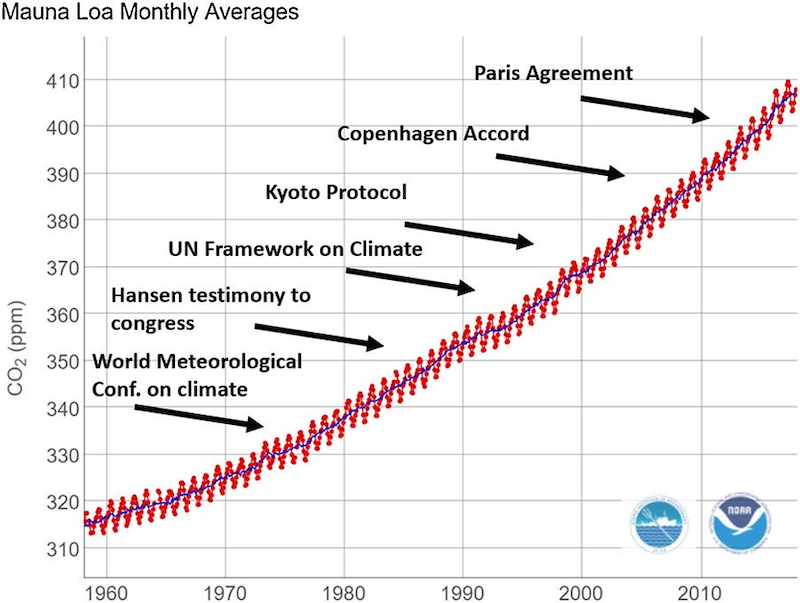
Looking at money this way, we can quantify and even visualize our grief for a world that is disappearing.

A direct relationship between the parts per million of carbon dioxide and the plutocratic pronouncements about how we humans are going to change our ways is clear. At the same time, we avoid even the suggestion that the growth of money and debt driving that measurement might in any way be disguising the reality of our losses. To fully experience that ocean of grief would require the termination of the driver of growth: debt. Mostly, we are captured, mesmerized by the convenience of money, the ubiquity of it, perhaps never quite connecting its presence as a reflection of a visceral sense of absence, the disappearance of the true wealth it represents. ‘Wealth is grief deferred.’ (Prechtel) Instead of realizing what we are losing by the ongoing game of debt-driven non-renewable resource extraction, the seductions of money blinds us to the advancing environmental losses as well as to other ways money substitutes for relationships, community and belonging.

The measure of that grief is depicted as the level of carbon dioxide in the atmosphere, which today, as I write, is 429 ppm. It’s quite an appropriate measure as carbon dioxide emissions record our lack of restraint as we burn the future in the present. The crisis is a consequence of our combined dependence on non-renewable energy sources with the accumulation of massive global debt to fuel economic growth, continuing in the absence of a coordinated global response to mitigate the consequences already upon us.

Table

Description automatically generated

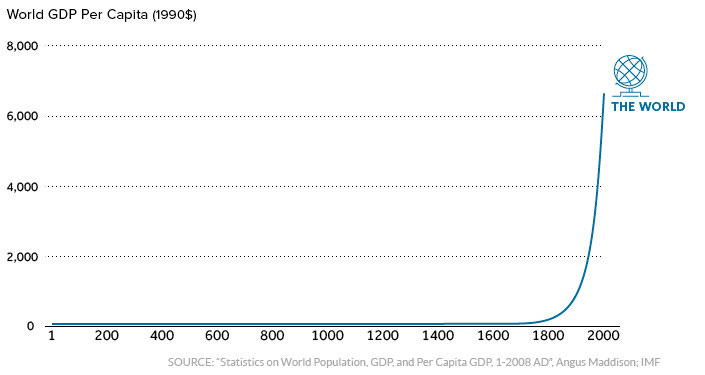
There is no argument that the discovery and deployment of fossil fuels has generated a more dramatic change in GDP and economic benefit per capita since the beginning of the common era than at any other time in human history. The correlation between energy consumption and the growth of GDP (Global Demolition Potential?) is clear and compelling. We also sense, without even looking at the data, that the extractive economic system, of which climate change is only one manifestation, is heading toward its apotheosis.

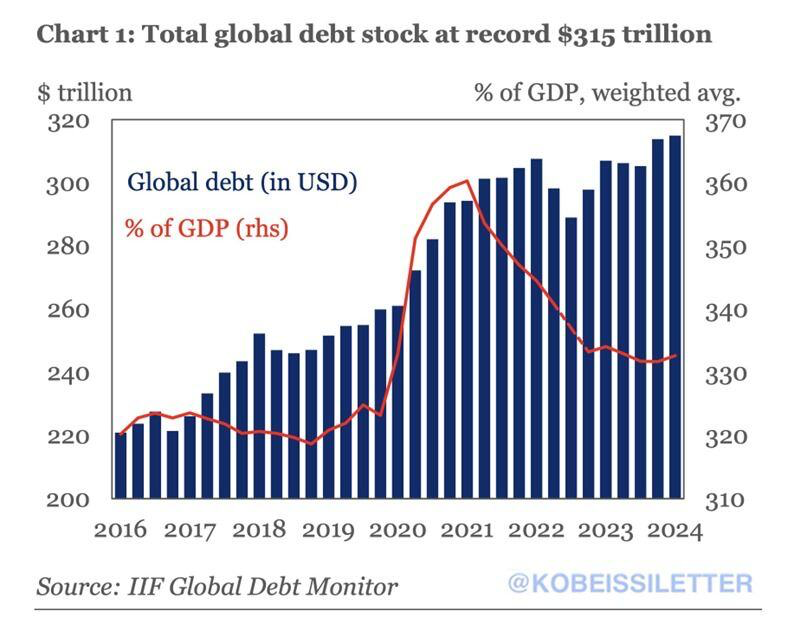
The imperative of the current economic model is growth, fueled by the creation of money that did not previously exist. Every issuance of debt is a promise to the future that the progressive amputation of limbs from the global body turned into money, will continue. And yet the global debt-to-growth ratio has been degrading for some time. More and more debt does not produce the growth it once did. Since 1980, the ratio of global debt ($303 trillion) to GDP peaked at 360% in 2021 and now stands at 335%.

Renewables now represent the great majority of new energy sources, which might seem like the way to balance accounts with grief, but fossil fuels overall will continue to be the predominant source for many years to come. A belief that renewables are now replacing fossil fuel use on anything even remotely close to a 1:1 basis is a myth not only because demand for legacy energy continues to grow, but renewables must also account for their own emissions in the manufacturing process. Even though the growth of renewable energy sources is impressive, it is not now on a path to overtake our reliance upon non-renewable sources before 2050. The mitigation of our existential grief is not happening fast enough to make a difference.

The current per-capita debt of the Unites States alone is now almost $106,000. In the era of Modern Monetary Theory, in which money is created out of thin air, this figure may have little meaning. The global debt to GDP ratio (depicted above) may rise to 400% or even 500%. But it cannot rise to 600% or 700% without radical readjustment because the cost-benefit of that debt will continue to fall due to the limitations of the resource base. More money cannot create more resources, whether it’s fossil fuels or copper, lithium, or steel.

A graph of oil production by source

Description automatically generated

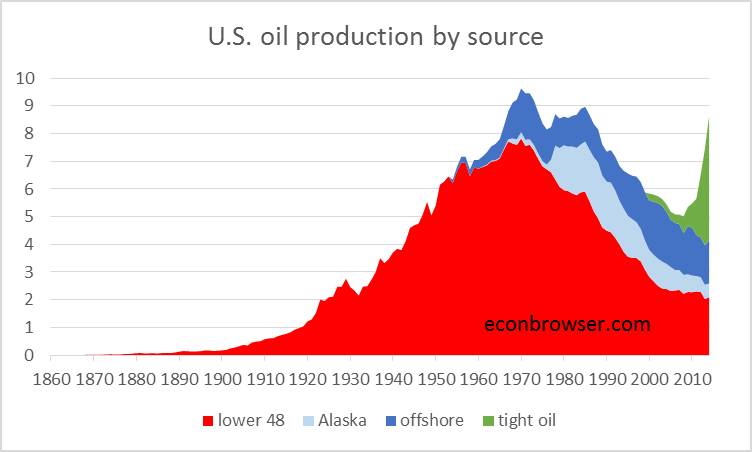
The United States reached peak oil production in 1970, validating Hubbert’s 1956 prediction. Despite being the world’s largest producer now, the US has never recovered its peak capacity. As the figure above indicates, nearly 90% of all the increased production in the US since 2005 has been from fracking and is the only reason total US production approaches the 1970 peak. Of the eight main fracking fields, seven will likely peak by 2025. Beyond that point, the US capacity to respond to any other interruptions of supply (geopolitics) by using domestic production will become increasingly difficult. Considering normal fluctuations in domestic, not to mention global demand, and in the absence of new supply coming online in the near term (such as from Trump’s imperialist Venezuelan escapade), prices for gasoline and all other petroleum products could march upwards. But global demand is not meeting expectations, and American oil majors are balking at investing 100s of billions of dollars in Venezuela to recover an expensive product that cannot be profitable at current price levels.

Using debt to compensate for the increased cost of extracting non-renewables is an avoidance tactic. It pulls consumption forward, creating an illusion of abundance to the average consumer and to the average elected official. More of the resource is consumed more rapidly than if financing was reduced (or became impossible). Policy follows that illusion by facilitating more extraction, which generates the ever-increasing gap between debt and production, depleting the resource supply more rapidly and driving the desire for even more debt to further pull consumption forward and sustain the illusion of cheap energy and/or abundant mineral resources. This is how our grief gets kicked down the road.

Economies will only grow if they can borrow money. But we’ve been consuming beyond our means for more than 50 years. The cost of energy (and the cost of financing) has risen because the energy derived from production compared to the cost of production (the energy return on investment, EROI) is on a long and slow descent into single digits. Demand continues to push discovery and drilling enough to increase pricing while EROI continues to trend downward. As the costs of exploration rise while EROI falls, rising risk will raise the cost of money because profit is no longer guaranteed. Measures to hide our grief from ourselves will become ever more extreme.

As the mad rush to renewables continues, especially in Europe, China, Canada, Japan, North Africa, and the Middle East, sinking more capital into conventional oil, oil sands and tight oil development may extend global supply on a teetering plateau for a few more years, maybe even all the way to 2040. However, Dellonoy et al (2021), modeled an all-oil peak in the next 5-10 years. The most significant finding was that by 2050, half of all gross energy production will be ‘engulfed’ by the costs of production. That works out to an EROI of 2! When EROI drops to 1, taking one barrel’s worth of oil to produce a new barrel of oil, it’s game over. That will be the moment when growth, debt and grief will achieve singularity. That will be the moment when the value of money will have eroded so much that we will face an imperative to finally metabolize the grief that was so long stored in that value.

The [earth], in hopes of being heard, tries to adjust her temperature and temperament to help fill all the holes, wounds and insults to her over-generous self, rents and tears caused by a non-praising mentality of some desperate humans who keep opting for more power and the increased temporary cleverness of technology, to escape nature’s inevitable confrontation. A confrontation made necessary by our uncaring earth-ravaging actions, thoughts and pared-down language of people who will not even kneel in front of what gives them life.                                        

—-Martin Prechtel

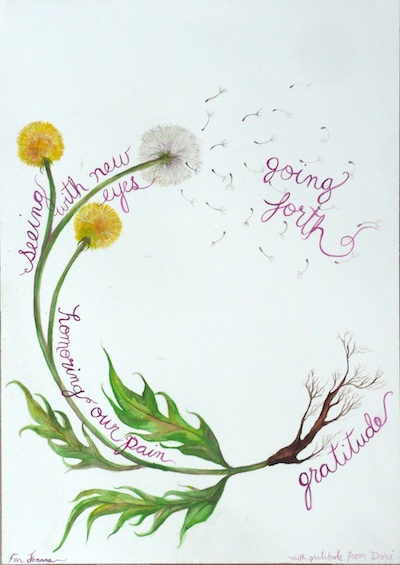
Tribute to Joanna Macy

The Great Lady of Deep Ecology Has Left Us

A drawing of dandelions with words

AI-generated content may be incorrect.

Let This Darkness Be a Bell Tower

Quiet friend who has come so far,

feel how your breathing makes more space around you.

Let this darkness be a bell tower and you the bell.

As you ring, what batters you becomes your strength.

Move back and forth into the change.

What is it like, such intensity of pain?

If the drink is bitter, turn yourself to wine.

In this uncontainable night,

be the mystery at the crossroads of your senses,

the meaning discovered there.

And if the world has ceased to hear you,

say to the silent earth: I flow.

To the rushing water, speak: I am.

Reiner Maria Rilke

I awoke for no reason at 11:45 on Saturday night, July 19, just as the message notifying us of her passing landed in my inbox. But it wasn’t until the next morning, opening the Caring Bridge thread, now with over 130,000 visits, that I had a good and solid cry…for her loss, for the world without her, for a moment of feeling utterly bereft and so profoundly alone, as if I had lost my footing and was now falling into empty space; tears of resolve to embody the Turning; tears of grief and tears of healing. Tears of love given new footing.

How do we live with such great loss? The same way Joanna encouraged us to meet every issue, every new beginning, every setback. First with gratitude, for life, for all we have, for all that is not lost. Second, by honoring our pain for the world, going into it, meeting it, allowing ourselves to be enveloped, not only by personal pain, but by the universal pain of all sentient beings, witnessing the contortions of climate and all the social and psychological dislocation that has already occurred and all that is yet to unfold. Finding compassion for the one who is in such pain, for the multitudes struggling with fear, uncertainty and their own losses, recalling our kinship with all life, a path forward begins to appear.

Gradually, our eyes open to new possibility. Joanna often expressed the three possible responses to the crisis: throwing our bodies into the gears of the Machine, creating new institutions, and changing our own consciousness. Here, we mostly see blossoming evidence of new institutions and increasingly sophisticated strategies to resist the capitalist expansion. Woven throughout those initiatives is the continuously awakening and highly articulate refinements of consciousness that must accompany everything else. Indeed, it is consciousness that drives the creativity we see here.

With that new awareness, with every breath of effort to disengage from the narratives of empire, we meet ourselves, cracking the egg that now limits our growth, birthing a new vision. As Joanna put it, seeing with new eyes.

Chogyam Trungpa famously said, ‘Dharma is the realization that ending is not possible.’ To put it another way, Buddhism continuously negates arrival because at the completion of the Path, there is no ‘place’ to arrive and no ‘one’ to be there. There can be no finality. The entire Buddhist path is about perpetually arriving at a non-existent destination. 

Joanna embodied the union of Path and Result, the awakened nature of love itself. Being with her, there was no distraction, no retreat into ego, nothing to defend. The only attachment possible was to that love and to share it naturally, fully. With her, we stepped into the spell of becoming love for the world.

The disappearing destination puts identity on very shaky ground, just where it belongs! The paradox of there being no there there lays bare the modern world’s desperate pursuit of permanence in a vast field of impermanence. Everything must end, yet existence & non-existence are coexistent, entwined as lovers, as often depicted in Tibetan iconography, reciprocally transforming, reminding us that transformation comes through the union. There is no solitary path. To embody this is beyond path, beyond destination, beyond conventional activism or advocacy. This is the paradoxical essence of disappearing presence. The bodhisattva must leave for us to occupy our own nature more completely. An unresolvable koan!

Joanna, a shining being, even in her absence, becomes more present. This was her final gift—to reveal the ambiguity of being/not-being, the forever fragile home of the deepest grief, the greatest love and the most profound compassion. To live in that ambiguity with the same compassion that flowed from the heart of her being becomes our charge. Our gratitude and love for the gifts she so generously offered, and now for her presence/absence is as deep as her love for this world.

Chaos, Complexity & Emergence II

Subscribe to continue reading

Subscribe to get access to the rest of this post and other subscriber-only content.

Chaos, Complexity and Emergence

Everyone would agree that the primary imperatives of life (at all levels) are to increase security, reduce threats and reduce unpredictability. Our early upbringing, education and all the adult experience that follows is largely devoted to these objectives. If there’s one thing that motivates us, it’s to avoid chaos. Whether it’s the appearance of threats, insecurity, unexpected obstacles, digression, and breakdown, whether it’s interruption of our plan of the day or being diverted from our life-course — we hate chaos. Every time events start spinning out of control, always a possibility, we are reminded of how easily we can become attached to the expectation of smooth and unimpeded execution of our plans. We are also quite familiar with the choices and the behaviors we find most natural and comforting.  These are the moments when we feel conscious and connected.

Despite all our efforts, chaos and disorder are guaranteed parts of life. We know that if we avoid such turbulence, we can reduce suffering. We spend a great deal of time either attempting to control the appearance of or devising ways of responding to chaos. Because we know our control is limited, that strategy becomes part of our lifetime project of self-improvement, a recurring meditation on how we meet impermanence and loss.

Just because we may find ourselves in the middle of chaos, we don’t have to be chaotic. But no matter what we do, we are always cruising down the river of predictability toward the waterfall of unpredictability throughout life. There is much that reminds us that nothing in life is guaranteed. And yet, no matter our past, our education, our general comfort in life, chaos seems never to be very far away. That’s not such bad news because chaos is a crack in our perfect conception of normal, how the world should be. Trungpa Rinpoche called chaos very good news.

Chaos theory and what we call chaos in our lives may be two different things. Chaos theory says ordered nonlinear processes produce outcomes which are not directly determined by prior events. Causality is unpredictable; it’s inherently indeterminate. This is true at the micro scale of the individual, or the macro scale of the planetary. It is also true at the cellular, atomic, and even the quantum level of phenomena. It says that the smallest changes, events that may be far beneath our direct awareness (or detection) in any system can produce huge changes. The classic illustration of this principle is the butterfly flapping its wings in Argentina causing a tornado in Texas three weeks later (Edward Lorenz, 1963).  That’s the nature of chaos. Moreover, the difficulty in predicting the future is that we don’t know which events determine the outcomes we are most interested in.

Chaos theory is the science of surprises, of the nonlinear and the unpredictable. It teaches us to expect the unexpected. While traditional science deals with supposedly predictable phenomena like gravity, electricity, or chemical reactions, Chaos [and Complexity] Theory deal with nonlinear events that are effectively impossible to predict or control, like turbulence, weather, the stock market, or brain states.—Fractal Foundation

So really, an event that appears to have a direct and identifiable cause may be entirely beyond our capacity to prevent because its root cause is much smaller or much older than what appears before us in the moment. Our efforts to control events cannot take all these hidden ‘causes’ into account and are therefore practically useless. Since chaos theory primarily looks at small-scale systems with a small number of variables, like what happens when a rubber ball is shot against a wall or when a hinged pendulum swings, the pattern of resulting events may seem to lend a predictability to them. In this sense, determinism, the predictability of future events, is also a feature of chaos. Investigations of chaos examine the zones of predictability and randomness in the behavior of such small systems.

Complexity

Complexity theory is concerned with larger systems with many, including unknown, variables. Complex systems are dynamic, meaning there is likely to be feedback between subunits. As demonstrated by chaos theory, small changes in a dynamic system, such as when you force your way up the down escalator in Macys on Christmas Eve, can have larger (and unpredictable) consequences (fisticuffs?)—illustrating the relationship between a small change and the larger outcome.

Examining and predicting events in larger social systems becomes far more complicated because there are so many more variables operating. Most importantly, complexity theory examines the self-organizing nature of ordered nonlinear processes, which is to say, there is a constant expression of intrinsic intelligence, adapting to internal and external influences to achieve equilibrium at a higher order of complexity. Hence, events are unpredictable.

Social systems made of many subunits undergoing a unique evolution are both complex and dynamic. They are deterministic in some sense because some of the underlying systems operate in generally predictable ways, such as human physiology or photosynthesis. Without any perturbations of their operation, evolution might even take a predictable course. But environmental perturbations are occurring all the time, so clutching for predictability is an attempt to reduce a complex unpredictable system to a more deterministic (predictable) system. This is a denial of the intrinsic properties of complex systems to respond to changing conditions and thus (to a degree) determine their own future.

The unique evolutionary path of any individual subunit of a social system follows the constant and unpredictable influence of ‘external’ events, large and small. The evolution of physiology, brain function, and even the physical boundaries (of cells or the skin) of any individual are always under reformation because the variables influencing that system and the automatic decisions made by any sub-systems of that individual are also always adapting and reforming. The complexity of situational and long-term patterns of response render predictability under most circumstances impossible. That’s a good thing because it means that a system is not a machine. It means the diversity of adaptation is not limited by rigid rules. In such a case, the adaptive capacity of the larger system is enhanced.

For the complex, unpredictable nonlinear composite system we call a human, chaos is the unscientific name we might use when uncertainty becomes unmanageable. Circumstances impinging on our survival are going beyond the existing database of adaptive capacities created and embedded over a lifetime. Whatever our dominant patterns of decision-making may be, our secure handholds are lost. We are not in control. There is no default stabilizing act. Immediate adaptation using all our intelligence is required to determine a path forward that appears to restore order. We call this resilience. But such decisions are not guaranteed to work. Adaptation to such instability necessarily becomes a continuous, rapid, ongoing process of trial, error, learning and integration. How successful we are at adaptation is determined by the rewards that follow, unless we already have some record of successful adaptation supported by previous actions. But in every instance of unpredicted unpredictability, past performance is no guarantee of future results.

We are less comfortable with uncertainty and tend not to view the unexpected as an unforeseen opportunity. So, we develop strategies to support our preferred version of reality, reducing the probability of unanticipated events disrupting our plans or expectations. At the same time, trying to improve what is by setting an objective of creating what is not yet is also a complicating factor in the flow of decisions based on the best data we can verify. The deeply embedded social imperative that says we are on a continuous and lifelong trajectory of improvement (a micro version of the macro growth imperative) establishes a pre-existing bias in the way we interpret events. With such a bias, events may appear to be facilitating or blocking our pre-determined objective. The appearance of such randomness in a system is why we give the name chaos to unexpected or unexplained events.

Emergence

Complex systems are very different [from] the systems studied in Chaos Theory.  They contain constituent parts that interact with and adapt to each other over time.  Perhaps the most important feature of complex systems, which is a key differentiator from chaotic systems, is the concept of emergence. Emergence “breaks” the idea of determinism because it means the outcome of some interaction can be inherently unpredictable.  In large systems, macro features often emerge that cannot be traced back to any event or agent.

Nature is a complex system. There are a virtually infinite number of complex subsystems nested within the whole. Nature’s response to the evolutionary challenge of continuous adaptation to environmental stress is to reorganize itself at a higher level of complexity, thereby transcending the immediate condition and expressing the intelligence gained from exposure to those conditions. Emergence is the unpredictable flow of such self-organizing events arising from the ongoing synthesis of predictable interactions at all levels of the natural world. Humans are included in that process, constantly becoming our own versions of emergence. Each adjusted level of organization transcends and includes the previous state. When a flock of birds settled in a tree are suddenly alerted to danger, that all birds will take flight may be predictable. But how the alert is detected and transmitted, which birds lead, which direction they go and how the flock organizes in flight are all subject to ongoing refinement.

The intrinsic nature of emergence is a spontaneous self-organizing interactive expression of intrinsic intelligence. Its most elemental stirrings may not be conscious, but there is no superseding intelligence, no memory, no sense of past or future, no sense of ‘other’ in its application. What we see at all scales of life are creative responses arising from creation knowing itself, acting as itself because it cannot do otherwise. It is the most intimate character of life, a constant flow of resilience, independent of rationality, beyond any specific identifiable cause. Emergence is a spontaneous, natural creative phenomenon. We may identify it in any number of situations involving living entities of all types, from the hot crushing pressures of deep ocean trenches to the rarified atmospheres of icy peaks. Life exhibits all manner of adaptive strategies. But we also empirically understand that unpredictability is inherent to all of it. We may imagine or even sense that whatever we call ‘emergence’ among our fellow humans is a phenomenon beyond reckoning, beyond comprehending, until sometime after the fact. We expend mental, emotional or psychic energy responding to the incomprehensible or to gain insight into the ineffable.

Greg Fisher elaborates the meaning of emergence this way: Physics or chemistry can determine the properties of a single hydrogen or oxygen molecule, but the properties of water cannot be predicted from that knowledge because water is more than the sum of its parts. All living complex systems are more than the sum of their parts. That’s why emergence is even possible. In most cases, ‘reasoning upward’ (predicting the properties of water knowing only the properties of its components) is not possible. Water organizes itself under radically different circumstances in ways that are not predictable merely from the knowledge of its component molecules. As water is central to how all species organize themselves and express adaptive capacities, its presence (or absence) has highly variable long-term effects on social organization and culture as well.

All living systems must adapt to changing conditions of life, from system-level to subsystems, to the microscopic and even the molecular or the atomic level. For many, those adaptations occur at a rate slower than the overall pace of change. But regardless of scale, living systems possess a natural ‘computational capacity,’ a self-reflective capacity to absorb environmental information and determine what is the most advantageous response. In the case of climate change, we may run any number of computational simulations, but the ability of science to predict how humans will adapt to the empirical impacts of climate change or the long-term ingestion of pollutants or micro-toxicities remains rather shallow. Those changes are only now appearing on a mass scale, haunting us with their monstrous portent.

Enjoyment

Awareness of awareness is a blank canvas. It has no qualities. It neither facilitates nor impedes the activity of discursive mind: thinking, feeling or sensation. It does not catalogue; it has no preconceptions, agenda or even capacity to invent anything. It simply is.

There have been periods in which meditation has felt stale, unfocused, lifeless, and boring. As if I’d lost my way. My motivation lags. I devise complex equivocations to delay, shorten or skip my sessions. If meditation is part of your life, perhaps this story is familiar.

I recently discovered something lurking at the edges of awareness. In fact, I don’t recall ever previously recognizing this presence. I realized it was enjoyment. I could not remember the last time I had simply enjoyed my practice or felt joy at completion. I’ve felt many other things including satisfaction, a sense of accomplishment and release. I realize the trap that having an objective can easily become. I am practiced in not having an objective at all. But reason creeps into what is essentially an escape from reason. At the same time, the urge to compose and enact an agenda arises repeatedly by stealth and becomes increasingly vexing until it is recognized and dissolved. Yet however many times that cycle is repeated, I don’t recall ever connecting throwing away the agenda with making room for enjoyment. 

When enjoyment suddenly became accessible, I wondered how I had managed without noticing that enjoyment had been absent. Grounding, revelation, equanimity, peace—many things arrive, but pure enjoyment wasn’t one of them.  There have even been luminous periods of discovery and moments of (seemingly) profound awakening which quickly drew me back to the bench with anticipation and wonder. But even in those times, I barely landed on the unique character of enjoyment. It was always refreshing, awakening, discovering, calming, clarifying, releasing, and maybe a healing leap into wholeness, or even emptiness. 

That was—and remains–the object of meditation, to explore emptiness. And don’t get me wrong, there’s nothing dry about emptiness. It truly is a journey into a brilliant realm of compassion, unity and spontaneity. It’s indelible. Whatever you know of that realm can never be erased. But what is the fruit of practice other than the non-dual view or even an open heart if not also enjoyment?

And it turns out enjoyment is a mere whisper at the edge between being and non-being, appearance and emptiness. Enjoyment has its own distinct qualities, enough to generate an authentic excitement about returning to the bench. But upon noticing all this, the enjoyment I felt was not always tied to the experience itself, but to an observation of the experience by the ego witnessing it. It was tied to an ego judging the quality of the time I spent in contemplation. That is different from discovering a pure enjoyment intrinsic to that state instead of a derivative of it, the identity of me being pleased with myself, congratulating myself for a job well-done.

Having a pleasant experience is certainly OK as long as we recognize the determination of ‘pleasant’ is an ego-state, following directly on the heels of our intention to take a vacation from ego. Indulging in a moment of ego determining whether the time we spend in contemplation is positive or negative seems counterproductive. Someone like Pema Chodron would be the first to say such an indulgence is directly contrary to the cultivation of equanimity, which is knowing that regardless of whether a particular session has pleasant or unpleasant feelings associated with it, that such feelings do not determine the value of that time. To give them any weight is a distraction from our original motivation.

Then what is the quality of enjoyment which is not an ego expression? How is it cultivated, or how do we return to it, even in the darkest of moments? The practice of Vipashyana is where enjoyment lurks, although to go looking directly for it like some hidden treasure is a fool’s errand. The objective of Vipashyana, pervasive or extraordinary seeing, is to establish a non-discriminating, pristine, unself-conscious seeing, learning to look directly at the root of mind itself without any evaluation or analysis. In this case, it is not merely to observe the source of mind, but also to become it. The extinction of the observer would be a great (and unlikely) leap, but it is still possible to observe the activity of discursive mind without being drawn into the drama.

Awareness of awareness is a blank canvas. It has no qualities. It neither facilitates nor impedes the activity of discursive mind: thinking, feeling or sensation. It does not catalogue; it has no preconceptions, agenda or even capacity to invent anything. It simply is. Even without doing anything to sustain this condition, one cannot help but relish it. This is no contrivance, no garden-variety psychological enjoyment; this enjoyment does not derive from ego. In fact, by this view we observe with exquisite bemusement the shifting games by which ego entertains itself, moving through the many games and dance moves attending its survival. 

This is enjoyment which does not dispel or hide or overcome emotion. But it can accompany us into any condition, meeting whatever arises, even what we normally consider to be negative emotions, all obstacles, all circumstances of opposition, even the terror of loss. None of these conditions go away just because we are looking from a different vantage point. We are not indifferent to them whatsoever, because, after all, they are us. But neither do they become paralyzing. The very fact that we can experience and know the possibility of having enjoyment in our pocket, regardless of our passing condition, tickling the edges of awareness, is a kind of refuge in itself, essential to our equanimity. 

Kolam: An Essay in Flour

A kolam may itself be an essay, non-linear and made with the intention of dissolution, but if so, it’s a different species of essay. It is an invocation that embodies history, the soul of a culture, the longing of an individual, the connection of a family, the collective imagery of a community seeing and seeking the divine in everything and externalizing the yearning to be reunited with it.

Kolams are typically made in front of the home. After preparing the ground, sweeping, leveling and dampening so the flour will set and hold better, the woman of the house creates the kolam every day at dawn. Every day. It is sacred, but not static, being wholly subject to weather, rain, wind, and foot traffic. It is an inviting source of food for insects or birds-and deliberately so. Its layered expression is infinitely variable, beautiful, colorful, inspiring, and dramatic…and a lesson in transience.

A kolam might be considered an essay or a poem, a snapshot generating numberless words, an affirmation of harmony, a humble renewal of interconnectedness. It’s a wish and a blessing-changing daily-an altar at which one might contemplate the present moment. Although its borders are defined, it expresses the nature of relationship of everything with everything. Can writing even be equal to a kolam? That question is like asking whether reading a book about modern art is equivalent to walking through a modern art museum: one is a two-dimensional and time-limited artifact; the other, immediate in four dimensions, engaging all your senses, blowing apart your default assumptions about time and space. 

Even though it may be ancient, a kolam, like much of modern art, moves–even while standing still. It skitters through time, culture, rousting sleeping archetypes, connecting past and future, uniting the inside and the outside in timeless postures. It’s often a passageway into deep pictures; evocative, visceral, full of the imagery of one’s personal and tribal or even ancestral history. Unlike a traditional essay, linear, limited by thought, convention, language, having no prescribed ritual of creation, being more individualistic in its place-making, a kolam, through the prescribed ritual of materials, is a more democratic and inclusive expression of an individual or a collective place in time. How could the two be considered equal?

The economy of a written essay is restricted to conveying knowledge by acquaintance. The terms of exchange are limited. In any of its traditional forms, it cannot include a transmission of direct experience. A kolam is not an essay in that sense as it conveys knowledge more directly, connecting the creator to a stream of historical knowledge as well as creating new knowledge in that direct experience. And like any other art object, it’s open to infinite interpretation.

So much is contained within even one photo of a kolam. I don’t believe I’ve written anything that compares to it, other than possibly poetry, taking far fewer words than what is thought of as essay. My essay might describe most everything that a single picture conveys, but it would be doing so in a far less compelling medium, one that might well give words to adolescent simplicity or even practiced adult elegance, like the communal journey of a single kolam. But I don’t recall ever approaching with words what a single image can evoke, a multidimensional direct experience, attracting one’s attention and lighting up multiple centers of conceptual and spiritual response. 

Writing can do that, perhaps. Words cannot truly be distinguished from the writer on any topic, whether the topic be kolam itself, modern art or anything else. Can the act of creating a kolam be distinguished from the maker? Not at all. It is an individualistic expression, yet still infused with the flavors and tangled threads of a long tradition. Is the maker dissolved into the image; or even re-made in its making? Isn’t that the objective, after all? Is a writer ultimately contained, reified within, or disappeared into the after-image of an essay—or is the writing merely an image of the writer—recapitulating the illusion of objectivity? 

The more play there is at the boundaries of each, the more they dissolve. A kolam may itself be an essay, non-linear and made with the intention of dissolution, but if so, it’s a different species of essay. It is an invocation that embodies history, the soul of a culture, the longing of an individual, the connection of a family, the collective imagery of a community seeing and seeking the divine in everything and externalizing the yearning to be reunited with it. It is a visual representation of the integral nature of earth, sky and spirit, not unlike a Buddhist sand mandala.

Can writing become a mandala? A linear process evoking a non-linear experience?  That’s a description of poetry, is it not? A kolam is already such a mandala, in its conception, its making, its conclusion and its ultimate destruction. The symbolism of kolam may not be as complex, but to attempt to convey all of what it is in words risks becoming a sterile derivative of the experience. Can writing become mandala containing the writer, the object of writing, the reader, indistinguishable, in a single flowing fractal as much as an experience of kolam? 

Can a writer become that? Why not? But if such is to be, the act must stretch across boundaries, become pure aspiration, teasing apart in an extended in-breath all the distinct elements and personal images essential to its construction–followed by an out-breath of their ultimate inseparable nature. A successful attempt at such a thing would be immediately apparent, breath-giving and breath-taking.

Trying

When the boundaries of this individual separate body begin to soften and space becomes continuous such that retaining an identity as a separate body becomes an afterthought, what opens is the ubiquity and uniformity of space, even merging with space, accompanied by a profound sense of unity with all phenomena and an undeniable sense of the body as an incidental event.

Meditation, or at least the intention of doing so, can be fraught with seeming contradictions and cognitive quandaries. Without intention one might never enter its labyrinth of mysteries. But at the same time, intention is also the first thing that reifies identity, removing us one step from the discovery of its benefits. By forming intention, we know ourselves. We become ourselves. By means of meditation, we embark on a journey into our true depth. Upon forming an intention, the next step is action. A set of actions might include recalling sensations, mental constructions and physical actions all designed to induce a desired condition, however we might conceptualize it. We become well-practiced in the art of self-induction: setting up a space, adding objects of meaning, determining the conditions of sound and temperature and physical support, and letting distractions fall away. Or so we tell ourselves.

Only then can we sit. And what is next? One of the first things to happen is we become more acutely aware of inner space and outward appearance. My habit is to find a position of comfort for my body, check my breathing, check my body parts, my alignment, my level of relaxation and to settle further into the ground. Many people, myself included, have been trained and inducted into preliminary rituals, recitation, mantra, all of which speak of refuge or supplication on my personal behalf, promises make to myself of what will accomplish in this session or in this lifetime. It’s not a leap to suggest that these very prayers, spoken immediately before entering a space in which we remind ourselves that me our mine have no true existence, impose a structure on the process which is curious at the very least, if not even counter-productive.

Then we get down to the business of meditation which, in the case of Dzogchen, is ultimately devoted to not trying, not constructing, not waiting for something, surely noticing the comings and goings of mental activity, but not stirring the pot. Shamatha, the practice of calm abiding, is often described as watching the arising and disappearing of ripples on the surface of the mind, as if on a mirror. Shamatha segues into Vipashyana, also described as a deeper practice of noticing the movement of thoughts like fish beneath the surface of that pond. Together, these two considerations merge into what Dzogchen literature refers to as contemplation—becoming the mirrorIt is from this contemplative state that a full transition into an experience of immediate intrinsic Awareness becomes accessible.

As we all know, the way to contemplation is littered with antidotes, deliberate acts of correction, more closely associated with the sutra system, a conceptual process of which I daresay I am a master. For a long time, I acted as if the point of meditation was to discover the perfect antidote. They come in clusters from disparate sources, or they arrive singularly with a great and deep ‘aha!’ New ones arrive all the time. Old ones are retired or forgotten. I don‘t even remember most of them now. At times the effect of employing antidotes felt like cutting a diamond, as if one day there I would discover the perfect antidote and thereafter the light would shine effortlessly through me. A different perspective might be that I was gradually wrapping myself in increasingly restrictive garments—collectively becoming a straight-jacket of admonitions—until I was immobilized and nearly void of the most precious resource for continuing–ease. Meditation under these circumstances is neither fun nor effective. 

The irony of this entire process is that only by first identifying oneself as a separate entity in the larger field of phenomena, repeatedly following a specific series of practices and instructions from a teacher, does one even begin to have a chance of entering a state of subjectivity in which the boundaries of self may begin to dissolve and an authentic non-conceptual condition of becoming one with external (objective) phenomena may arise. More than experiencing that Oneness, what previously would be regarded as separate and external phenomena are now perceived as being of our own creation—and, also of being equally created by what the dualistic mind would name as something out there.  

We can only regard this progression of practices as a series of imputed causes and conditions determined to become the foundation of realizing an unconditioned state, that which is uncreated. Much of what we adopt in preliminary meditative practices is the layering of antidotes—progressively conditioning our experience to achieve what we identify as objectives, only much later comprehending the intelligence of eliminating all antidotes, deliberately undressing the layers of mental constructs which obstruct our access to the direct experience of unconditioned reality: emptiness.

Admittedly, the balance between using or discarding antidotes is a delicate and increasingly subtle process. And the very trap intrinsic to that enterprise is to regard it as a process, when in fact, as the truth of unconditioned reality emerges, it’s not subtle. It can be dramatic. And realizing the truth of the unconditioned state, the state in which the very idea of an antidote becomes entirely foreign, is so different, so far removed from anything having to do with antidotes that we might well wonder what we were wasting our time doing for so long when it becomes obvious that what we imagined was so far away, beyond our grasp, is actually right here all the time.

When intimations of dissolution arrive, when the boundaries of this individual separate body begin to soften and space becomes continuous such that retaining an identity as a separate body becomes an afterthought, what opens is the ubiquity and uniformity of space, even merging with space, accompanied by a profound sense of unity with all phenomena and an undeniable sense of the body as an incidental event. Not a random event, nor even co-incidental, but merely a construct associated with this particular consciousness. I am adopting this impermanent form, flawed and wondrous in all its many ways, as a means of transportation, a vehicle of experience, exploration and restoration.  It is my teacher. It is my co-creator. I am its student.

This is surely a transitional state to a global experience of immediate intrinsic Awareness, the Primordial State, a softening into a realm no longer solely nirmanakaya, the form body, also not entirely sambhogakaya, the energetic body, with the full dimension of dharmakaya, the complete dissolution of any boundary between inner and outer awareness, only a breath away. The intimations are of a deeper awakening in which all three kayas are fully distinct even in their inseparability. Not only present, but fully apparent, neither being nor not being. 

Their manifestation is not a matter of doing anything other than relaxing deeper, again and again, at every indication of interruption and intrusion of conceptual process. There is no trying here. In fact, the primary condition is two-fold: relief and confidence. Confidence in the gnosis to which one is introduced, confidence in one’s capacity to recapitulate these conditions, and profound relief in the knowledge that trying no longer serves any purpose. There is only un-trying. There are no longer any antidotes in the gallery of choices. There is no longer a gallery. There is only the panorama of endless, bottom-less and uncreated seamless unity. The inevitable realization appears: with all the trying of the past, what was I ever thinking? 

Wilderness

America is a land originally occupied by casualties, fugitives, dissidents, pirates and radical escapees of the European monarchical and religious order. And ever since, what’s been largely, either inadvertently or deliberately overlooked for three, maybe four hundred years is that the western definition of wilderness was always the property of the invader, the settler, the colonizer.

Wilderness conjures images of foreboding, of desolation, a mythic utopian vision of the undisturbed, uncharted pristine state, a territory beyond imagination, beyond human centrality, unspoiled by human presence and the inevitable resulting abuse until it’s eventually overrun by ‘progress’ and becomes defined-and defiled-by that presence. Only then do we adjust our yearnings, mourn its loss and start looking for another wilderness to relieve us of our angst…or guilt…or to satisfy our insatiable quest for new worlds to tame.

What we imagine there is to gain out of that process is a sense of ownership, perhaps even control. And even though any remaining actual wilderness is long gone, we operate as if there will ever be more, as if our personal inner desolation or pristine nature, our loss of home, is always renewable, can always be recovered, that our sins can always be absolved. Our investment and belief in wilderness, like our belief in imagination itself, is total.

It’s been a universal human trait since the beginning of time to explore the wild, to move outward beyond boundaries, to redefine one’s place, to satisfy a primal urge to seek sustenance in the unknown, to venture onto our own unconscious, to assert personal independence and a renewed sense of belonging to the world. These are the primary extractions. We might include a timeless motivation to escape being relentlessly subsumed into the homogeneity of culture and to reconnect with the heterogeneity of the wild. We explore to know ourselves in re-enacting the imagery of relationship with the unknown and the more-than-human.

What is commonly found in wilderness, or what could now more accurately be called protected lands, in the exploratory process, may enrich our lives, at least temporarily. We may be driven by the dulling of our senses in the urban landscape or an ever-present but barely acknowledged solastalgia, the suffering and grief of being uprooted, homeless. Yet long before there was any such thing as protected land, exploring wilderness, at least in America, also became synonymous with progress. And that progress has brought a world in which every form of wilderness continues to be transformed in ever more sophisticated ways. Ironically, imagining one can escape that commodification (even for just a short time) somehow inevitably leads to its increase.

When the human population was much smaller than its current size, before the carrying capacity of the earth had been exceeded, that wilderness in its iconic state did still truly exist, calling upon the human longing for….what?…a challenge, to continue the indomitable impulse to improve our future, for wholeness? The fulfillment of a narcissistic urge for notoriety, fame, adulation? A purely economic interest? Or just peace and quiet? The relentless commodification of every possible resource, now including attention itself, has always been a dominant motivation. And let’s not overlook the myth of returning to our origin, the original Garden. There’s weight to all of these scenarios.

America is a land originally occupied by casualties, fugitives, dissidents, pirates and radical escapees of the European monarchical and religious order. And ever since, what’s been largely, either inadvertently or deliberately overlooked for three to four hundred years is that the western definition of wilderness was always the property of the invader, the settler, the colonizer. The exploratory enterprise into the vast territories of the Americas was also an enactment of Divine Right, spurred by the Papal Bulls of the 15th and 16th centuries declaring indigenous people to be less than human, fueling the promise of riches with ecclesiastical benediction. If that empire required the eradication of indigenous populations, either by intent or by accident, it never occurred to the occupying force that the territories in question were not wilderness at all to those who lived there, but sovereign territory, the nature and dimensions of which the settlers could not even imagine.

Sustaining the American mythology of wilderness is a solution to something. It gives buoyancy to possibility. Yet modern American culture has never quite satisfied a longing for place, and that wanderlust is both a response to existential homelessness, a sense of not truly belonging to the land, and a temporary escape into actual homelessness that wilderness represents. That escape is ironically motivated by pre-cognitive yearnings for a sense of relatedness to the natural world which we experience at a somatic level, but which has been entirely coopted and twisted by modernity into a reaffirmation of the individualist ethos of America. We may be able to superimpose ‘home’ on what was once wilderness, but what we now call home does not in itself constitute indigeneity. In many respects, home is now a wasteland of the banal, the superficial, in which multinational corporations own the mythology and harvest revenue from it by exploiting our psychic attachment to the idea of wilderness combined with the myth of individualism. The Anthropocene at work.

Your homelessness leads you by the nose to the next solution. So, nobody should be shocked that every solution we come up with deepens the problem the solution was designed to solve.

—-Stephen Jenkinson

Regardless of where the urge to occupy wilderness originated, at some point it morphed into something much more than any original or merely personal reason to go beyond the horizon just to see what’s there. In the face of accumulating encounters with other cultures already embedded in what we (western explorers and American settlers) persisted in calling wilderness, the enterprise became something very different from the original vision.

In what has since become a central tenet of the mobile tableau of modernity, the vision of exploring the unknown is equated with the drive for perpetual growth, a messianic mission promoted with religious fervor to ‘improve’ life for ‘everyone’ while looking away from the true costs. Recruiting enthusiastic compliance with the program has not been entirely successful. Having a dwindling supply of authentic earthly new worlds to conquer, human imagination is captivated with doing more than gazing at the heavens, but actually exploring space–which of course continues largely without human participation, but occasionally goosed by the chest-beating of the uber-wealthy. The mullahs of physics and biology reach into the mysterious territories of sub-molecular function, even into the vast spaciousness of individual atoms where matter and energy are barely distinguishable. The nature of the human mind continues to inspire and baffle.

Preserving the fantasy of European ‘discovery’ has been a key North American enterprise ever since the origins of its nation-states. Erasure of the indigenous equates the encroachment of wilderness with the creation of home and the ethics of growth, as if history only began with the colonial project. And now, as an alternate narrative of what America exactly was before colonial occupation gains firmer footing and takes hold in popular consciousness, powerful backlash comes from those still asserting that America was a natural and cultural wilderness before white men set foot on its shores. For them, anything pre-dating coloniality does not matter nor did it even exist. Imagine the dissociation necessary to deny all of that violence. Colonial America may have been an escape from empire, but it immediately seeded the creation of a new empire, an ongoing occupation of what is still regarded as wilderness in virtually every elementary school in America.

The nomadic vanguard (a term coined by Patrick Turner in this essay in New Critique), is a property of American coloniality essential to America’s creation story. We were born from a nomadic vanguard and America would not be America without one today. The fact that there are no physical wildernesses left doesn’t deter us from endowing the entrepreneurial spirit with the same ethos of coloniality that occupied and exhausted every inch of territory from sea to shining sea, and which now seeks to invade and claim every inch of ‘market’ space as well, either by data management, surveillance or AI.

In that sense, the new explorers are the old explorers reinvented with more sophisticated tools, sales tactics, marketing and lobbying power to stake out economic territory and collect every possible advantage provided by the corporate state. They may even be enacting admirable features of the American Story, but like it or not, they are still extending and deepening the reach of empire, a story of extraction, exploitation and repression which has not changed in any substantial way.

We are confused about wilderness and fighting over what requires preservation and how to do that. We cannot continue to promote a pioneer ethic without recognizing its true consequences and the empty nobility attached to it. The nomadic vanguard of today is attacking the remaining shreds of what should properly be recognized as real wilderness, not the coopted mythical wilderness of yore.

Transraciality

The decolonized body, the intrinsic expression of core relationship & connection, the energetic body of creative awareness, that metabolizes experience continuously without grasping or regret or shame, the expressive body of subjective integrity, is the transracial body.

Anyone taking a serious look at one’s own attitudes about race these days is bound to get into some uncomfortable territory. It’s often said that looking at privilege is not enough or maybe looking at history is not enough. But however we go, we will quickly discover that the story widens far beyond our initial impressions or personal experience. The previous post was a suggestion that a white body is much more than skin deep. Privilege and bias are carried deeply in our ontogenetics, our body imagery, development and movement, the fine tuning of our limbic systems, our internal radar where potential threats and opportunities are processed.

Whiteness isn’t likely to think it needs emancipation from privilege or supremacy any time soon. What we are seeing now is a full-throated backlash against the dismantling of systems of oppression which are essentially class-based. Racist tropes are being used to preserve them. So, on one hand, we can say whiteness is already ‘free’ in some respects while being simultaneously diverted from seeing the class structure of its own oppression. True emancipation must mean emancipation for all, but its connection with race is undeniable. Maybe liberation can be interpreted to indicate the collective beyond racial distinction. Inasmuch as there is a white body, a colonized body, a body conforming to ideology as much as biology, regardless of race/ethnicity, and if we are ready to acknowledge the full implications of it, then liberation is as good a word as any to refer to the deconstruction of systemic oppression, racial or otherwise.

The forces opposing the dismantling of oppression like to say the future of Western Civilization is in the balance, as if that defense overrides any other consideration. I tend to agree. And that’s precisely why we must persist in grinding away at the machinery of narratives, epistemologies and exclusionary tropes of modernity, separating the trash from the recyclable, as it were, the propaganda from the truth. We do that by examining the wide and deep effects of policies, ideologies, social practices. That examination process is what’s being called ‘woke.’ and of course it’s the agents of oppression that hold that term to ridicule.

What’s at stake in this conflict is who gets to decide the nature of truth. How do we avoid following the cycles of the past, ensuring our own collapse on an unprecedented, and possibly terminal, scale? I don’t intend to digress into the origins of Western civilization, but I am reminded that the philosophies, governance, social and mercantile structures of Western Civilization did arise at the edges of desert, spreading to Greece, Rome, northward and and westward from there.

Western (white) thought has brought us modernity, capitalism, systemic exploitation, racism on a global scale, religious oppression, the destruction of the natural world, climate change and is now doubling down on all of it. Among the many effects climate change brings us is the loss of arable land due to desertification as well as what are now also called deserts of the ocean, barren areas of increasing size no longer sustaining thriving ecologies. Dismantling racism is among the reallocation of resources we must accomplish, reclaiming the cognitive desert, before (western) civilization returns to its literal origin.

I previously suggested the cultured body, the colonized body is the objective view, entirely dependent on sustaining the separation of subject and object, perpetuating the Other as a means of cementing identity. Identity is a key feature of the ‘objectivity’ of the colonized body. And to the extent that we continue to think and act according to a reified ‘objective’ view, we sustain our separation from the world as a living, entirely integral, continuously emergent matrix of which we are a (small but powerful) part. As a sustaining principle of the objective view, identity has run its course. I might even say identity, particularly including but not at all limited to white identity, is now an obstacle to our continued survival.

The decolonized body, the intrinsic expression of core relationship/connection, the energetic body of creative awareness, the body that re-members, that metabolizes experience continuously, spontaneously, without grasping or regret or shame, the expressive body of subjective integrity, is the transracial body. This is not the multi-racial body, but something else. The transracial body is a matter of consciousness, not identity, and also not the property of any single race, ethnicity or ideology. The transracial body, a term offered by Bayo Akomolafe, is also not an activist. Transracial awareness, if it can be connected to Liz Koch’s core awareness, is not about doing. It’s also not even really about belonging in the sense it is normally meant.

Unless we are quite clear, the very word ‘belonging’ conjures a binary, defining boundaries, or easily slips into grasping at some distinction between us and them. We ask, to what do we belong? If we see the path as one of returning to subjectivity, then everything, the inanimate, the animate, events, people, thoughts, is us and we are all actors within us no matter what we do or who we are. In this sense, using the word belonging can become an intrinsically flawed linguistic trap. Cultivating the subjective view becomes the portal to the transracial view, collective liberation, belonging to the whole. 

Transracial awareness is not even really about being, not in any fixed sense. But it is about being-with, becoming-with. When we hear indigenous leaders speak, or anyone speaking from the ground of ancient wisdom, when the words resonate somewhere within us other than the thinking mind, when they strike us in the heart or at a level of deep and quiet intuition that still recognizes the truth, when it feels as though the words open up the very earth, it’s because they speak from the subjective view, from a deep and imperturbable (albeit troubled) love as well as an immense heartbreak. Such a person is not an activist in the conventional sense. The indigenous voice, the transracial voice is not the voice of activism as we generally know it. I wouldn’t even say the transracial voice, or the indigenous voice is post-activist in the sense that it is not occupied in opposition to something or someone Out There. 

The indigenous/transracial speaker is not a messenger. They are the message. The transracial voice, the voice of core awareness, is not a teacher or a communicator in any conventional sense. They are the teaching. But those of us who still see the world from the objective view, who still struggle with issues like helplessness, shame, guilt or solidarity, who seek ways to interrupt and dismantle the systemic inertia, those for whom the low-hanging fruit of self-comforting gestures feel discordant, stale and superficial, those of us who have not fully recovered from being captured, conditioned and colonized into objectivity, may regard our recovery as emergence into post-activism. 

The recovery of core awareness and emergence into transracial awareness is accessible to anyone. It is surely more difficult for some than for others to realize, but we don’t have to know our personal lineage or commune with an ancestral group to find it. There may well be right times for allyship or solidarity as we most often think of them. But from the recovery of intrinsic integrity arises an inherent solidarity in the form of recognition beyond color, beyond identity, a resonance with shared reality, shared trauma and shared power. It’s not a tribal thing. It’s a human thing. And your forebears may not have had it. But if they did, or however you discover your own version, the linkage is timeless, unbound by any territory, tribe or cosmology. It is always with us, albeit dormant, because it is our intrinsic nature. It is our birthright. It is what we are indebted to. It is the true seat of agency in this confused and corrupted world.