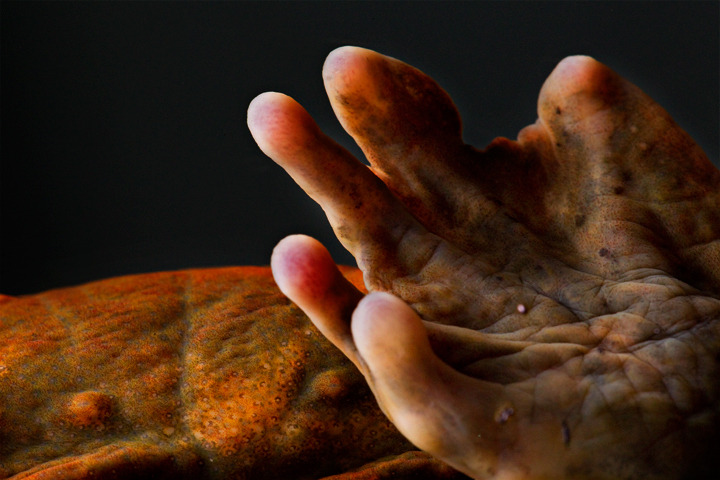
Hellbender Salamander

Tell me again how we all came from the same place.
Where you are here, opening your palm to the shaking

wriggle of worm-force, the blackness, the
soul-less gravity of imperatives watching

your unfolding, the light, the distance overcome
in the waters, the tides, the blood of time,

your age, the warp of your witness,
shadows unfurling into light, your orbit,

your center of iron, blatant divisions that must be
crossed before you can express the inexpressible.

this is love unwound. this is love before it knows itself.
this is love becoming itself, time deciding what is and is not.

this is love casting its shadow upon the deep.
twisting out of its cocoon, bursting through the soil, the night.

The GOP is Not a Cult of Fear. It’s Hero Worship.

When we think of a cult, we think of brainwashing. The members have been brainwashed to believe what the leader wants them to believe. Whatever it is, it’s the opposite of their personal self-interest. Dependency is critical to the success of the leader, reinforced and cultivated in all the messaging to sustain the leader’s power and control.

I won’t deny the current GOP has cult features, but it’s not so much an ideology as a theology. It’s a political philosophy rooted deeply in religious views. Its elected members certainly fear and are dependent on Donald Trump. And it’s also clear the non-elected members holding administration positions, including his children, must also mouth fealty or expect to be quickly shuffled to the curb. And fealty, in this case, includes being willing to break the law without reservation or complaint.

But brainwashed? I don’t think so. To repeat the favored explanation for falling into line no-matter-what due to abject fear of Trump is too simplistic. In fact, it lets the GOP off the hook. No, their allegiance is to something else. They may fear him, but they also admire him. Why? Because he’s doing what they have only dreamed of doing themselves.

Since he’s doing it for them, they’re only too happy to give him unlimited rein to overstep any boundary, test any convention and obstruct any interference. They are completely in his thrall, slack-jawed at his capacity to thumb his nose at anyone in his way.

They want more of that.

All of them, every last one (and barely excepting Mitt Romney in the Senate), including the ones in the House, Kevin McCarthy, Steve Scalise, Doug Collins, Devin Nunes, Jim Jordan, every one, is an authoritarian down to their shoes. Those who don’t have any qualms about expressing that preference either find themselves in leadership positions or becoming mouthpieces for the president.

They don’t have any reservations about lying or helping the president lie. Their deep desire to control everything and everyone, to undermine or destroy democratic institutions, silence the opposition or tolerate and participate in the rising wave  of fascism for the sake of retaining control is on display every day now, and has been for some time.

Is someone controlling Lindsey Graham? I don’t buy it. His true personality has been unleashed by Trump. And consider, anyone not willing to entertain this possibility is clinging to a fantasy, holding out hope for the hopeless.

The impeachment trial simply gave them all a bigger platform. Now that it’s passed, they will happily exercise the punitive inclinations of their collective personality disorder. They are the strict disciplinarians, vengeful gods, and the rest of us are the children to be silenced and led by the nose. Those who stray from the fold must be punished. Trump is sicker than even that, of course, but they are the most useful tools of his disorder he could ask for.

Joe Biden has repeated his belief that there are Republicans he can work with. Except that every day we are witnessing how delusional that position really is. Now the voters are having a chance to let Biden know, among other important reasons, how great is the folly of his clinging to this idea. The DNC also continues to clutch at the idea of a Biden nomination. Even greater folly.

Another Trump personality feature hammering the pleasure centers in the brains of his followers is his victimhood. He excels at being wronged, lost in the woes of enduring the slings and arrows fired upon him from all sides. I can imagine his allies secretly chuckling to themselves at how relentlessly he feigns the embattled saint, elevating the pedestrian victimhood of the Obama-era GOP to high art. Victimhood on steroids. They’re also thinking, “Why didn’t I think of that?”

Trump is such a shocking character in so many ways, the fact that he was always a caricature of himself, even more so now, has flown right over the heads of so many, particularly in the media. They just can’t bring themselves to take him seriously—I mean really seriously, treating him like the Wizard but never willing to draw the curtain.

In this CAT 5 hurricane of self-imposed blindness, the constitution barely stands a chance.

The Doomasphere

Jem Bendell has been criticized for promoting what some call “The Doomasphere,” –a dark vision of the future–though until now I couldn’t have named any of Deep Adaptation’s neighbors in that ‘hood. Is he alone? Who else occupies the Doomasphere? Is that even what he’s doing?

It turns out there are several neighbors; in fact, some very evolved and well-established ones. The premise may not in all cases revolve around a prediction of near-term collapse, but orient around the inherent fragility of modern social and technological infrastructure, which purports to be expanding and integrating continuously, thereby becoming more fragile, more volatile and less predictable. In other words, the very definition of chaotic.

Adding climate change to that mix, and especially because that continuous expansion is driving climate change, there is the recent French TV mini-series called L’Effrondrement, set in the near future and updating Jared Diamond’s Collapse, depicting how easily everything we take for granted may be swept away. It’s based on a 2015 novel promoted as a “manual of collapsologie” for present generations, upending the ideologies of sustainability, a green economy or a smooth energy transition.

Well, we already aren’t (or shouldn’t be) deluded by the notion of any smooth transitions, especially with each passing month of increasingly dire news. In fact, it’s been two decades since we passed the option of a “smooth” anything.

The pendulum of human history swings between moments of our being harmoniously embedded within natural processes and periods of population concentration, political centralization, and an urge to transcend the earth’s resource constraints. We develop economies of scale, agglomerate extractive industry on a grand scale, but ultimately overexploit our natural foundations.

The New York Review of Books

The result is articulated by another occupant of the Doomasphere, David Wallace-Wells’ The Uninhabitable Earth. In the aggregate, the primary strategies of the environmental movement have been a failure. Exxon has won. Not because they didn’t believe the warnings. They knew well before the warnings were issued. The Green New Deal, one of the most recent elaborations on the meaning of Resiliency, according to key figures in the French Doomasphere, is nothing more than a repackaging of the California technological fantasy. Also doomed to be inadequate. One of the earliest members of the Doomapshere is surely the Club of Rome, which produced a landmark report in 1972 called The Limits of Growth, in which the onset of stagnation is predicted in the 2020s. Prescient!

“We must prepare small-scale, resilient bio-regions,” on the scale of only a few thousand inhabitants. Economic circuits must be scaled to local ecosystems and resources, eschewing global supply chains. Visions of the good life that are predicated on unlimited mobility and expanding human wants must be replaced by an ethics of rootedness, the joy of living and working in a defined space.

Yves Cochet

Collapsologie shares a view of the coming world with Deep Adaptation by requiring not only a realization of our true place in the natural world, but a spiritual re-conversion to an ideology of sharing. Their view of “liberty” is also diametrically opposed to the narrow definition of Darwinism adopted by our self-appointed thought (and investment) leaders of economics and politics and the Hobbesian view of life as “nasty, brutish and short.”

While every Conference of Parties since Paris, 2015, has devolved into further finger-pointing and subversion of consensus, the narrowing of any viable environmental strategy has limited rational choices to (among other things) the escalation of resistance to further fossil fuel development, the elimination of global oil subsidies, widespread and radical rollback of income inequality and compensation for the first victims of catastrophe—the global south. All of this while preparing viable strategies to coalesce into regional resilient enclaves.

The existence of a compelling and now 10-year old conversation departing from the mythologies of ‘progress’ and ‘nature’ (why do we even have a word for nature?) resides here at the UK-based Dark Mountain Project. These conversations on the theme of Uncivilization will touch you in profound, surprising and unforeseeable ways, bouncing from head to heart to the deep somatic. There is no prescription here, but rather a litany of “hard truths to help you stay rooted in difficult times,” while building a bridge to a possible future. Dark Mountain is ambitious, illogical, arresting and most of all, real.

Finally, though I’m pretty sure he would object, Charles Eisenstein might be viewed as yet another occupant of the doomasphere simply because he views the issue of human viability as much broader than climate. In his hierarchy, pollution in all its many forms rank higher than climate change, which is about 3rd or 4th. Yet unlike any of the other inhabitants cited above except Deep Adaptation, his is A Revolution of Love, the most daunting prescription of all.


Cold

My shivering spends the last energy I have
to forage a cup of hot chocolate.
Then again, there is the cover on the couch—
the blanket I left rumpled last night in my
desperation for comfort.
I am now lost between purpose,
time and timelessness.

This cold. It comes in waves.
Like the ebb and flow of glaciers,
swinging through the seasons of loss and gain
And yet, each year a little more is lost.

When we speak of acres of ice it means nothing.
When we speak of islands the size of Manhattan
or the state of Connecticut

then my shivering becomes the main event.
There is no solace anymore.
No island in these tropics of denial.
No longer any blast furnace that can warm me.

The arc of my life descends, the edges
fraying now like an old sweater.
I drop to my knees in a non-aggression
pact with the glaciers, to let myself flow with
the continents of ice, the eons of frozen awe.

Elsewhere, the lives of the natural world
still unfold without remorse, without reflection,
shedding no blood for the past.
The integrity. The harmony of the present

brings me to my senses.
The savannah will be my home
–in the next life–
where I will hunt or graze,
water or preen, live or die
with nothing more to say.

 
©gary horvitz, 2017

Is Deep Adaptation Mere Doomsaying?

Is Deep Adaptation simply scary talk? Unscientific hyperbole? Depressing fatalism?

The irony of climate hyperbole is that while many people disappear emotionally and become immobilized, there are also many who believe catastrophe is inevitable. They may believe the science and they may largely understand that scientific modeling has consistently underestimated reality, but they may not grasp the breadth of action required.

Yet, while we ruminate, the predictions for the future are coming true sooner and with greater impact than anticipated.

On the other hand, another form of gloom is to believe Business As Usual cannot be interrupted, no matter how dire the predictions become, because if the last 30 years is any indication, the system is rigged in the interest of the polluters. Greed and corruption trump science.

The more dire those predictions do become, the more dismissive the pushback from the CEO class and those who resist their own straw man of a top-down master plan for civilization and cling to their “liberty” until their last choking and overheated breath. For them, participating in collective action is about as likely as giving up their guns…or tax breaks.

What’s different about Deep Adaptation is that future scenarios are unpacked, differentiated and labeled: social collapse, climate catastrophe, species extinction and everything in between. Each of these terms can be further broken down into real factors and evaluated by bioregion. What is going to break down… and where…and when? And what is required of us? What resources are required to build resilience?

There is a speculative aspect to such predictions, of course, but we already know who is likely to be most impacted and soonest by advancing disaster — because it’s already happening. These domains are all thrown together in the rhetorical reactions to extreme climate futures, rendering them all more abstract and the likelihood of personal impact becoming unrealistically remote.

We also can’t reliably predict where and when the next catastrophe is going to occur, or its nature. We only know the ingredients for such events are in ample supply. This is less predictable than determining where the next avalanche is going to occur on a snow-packed mountain. Yet none of the existing efforts to shift policy, build out renewable networks, upgrade and decentralize energy systems, use resources more efficiently, develop new technologies, educate the public or retrofit infrastructures should be abandoned.

The most appealing aspect to Deep Adaptation is its implication for transforming our relationships. The demand is to determine our values and stop procrastinating. Let’s make the world we want Right Now. If the world is indeed on a path toward social collapse or eventual catastrophe, the human impacts are incalculable in terms of economics, social upheaval, displacement, potential resource conflict, food and water insecurity….the list goes on.

Equal to all these issues will be the impact on mental health, social cohesion, our outlook on the future, finding meaning in existence. We are called upon to define our core values — and value to each other — if we are to survive the magnitude of upheaval on its way.

Refocusing and empowering individuals to develop local emergency resilience strategies, i.e. preparing for social collapse, is something else.

First they have to recognize and break through existing denial. They have to shift out of habitual “me” culture to “we” culture. We have to examine the integrated systems on which we all depend so heavily. Climate impacts are not something that only happens to others. The more local strategies are articulated, the more tools exist to identify and address personal and community resilience, the more people are drawn from their bleacher seats to a place on the field to fully play the game. That also requires empowerment. There’s nothing empowering about doom saying.

Anyone claiming Deep Adaptation is doom saying must believe we can’t walk and chew gum. Even scientists who claim doom saying is not scientifically supported are, in effect, taking the denial position relative to what we already know and have seen with our own eyes.

Doomsayers do not generally have practical agendas nor are they even likely to develop one. Doomsayers have given up.

The cartoon characters standing on the corners holding signs saying, ”The End is Near” are only holding signs. It’s easy to call them crazy because they aren’t offering any practical remedies, no path to resilience, no restorative strategies. Deep Adaptation is doing that, not merely for the sake of giving people something hopeful to cling to, but to save real lives in a real future.

No one is suggesting we all build bomb shelters and stock up on canned goods. But when we start asking the right questions, it turns out there are many practical ways to redefine infrastructure for the sake of local resilience.

The critics of Deep Adaptation appear to believe our greatest hope lies in continuing to deny the magnitude of the problem, to continue believing the myth of perpetual growth and closing our eyes to the degree of our entanglement with each other and the natural world.

We have to examine the steps we’ve trod for 30 years and stop acting as if a different outcome will happen if we simply persist.

Anyone who takes an unfiltered look at the science and the record of popular responses and even long-term organized initiatives on many fronts, would have to conclude the record of success is slim — too little and too late. Which only leaves room for a different approach, a shift toward compensatory measures, getting our hands dirty with the realities of multiple interdependent infrastructures, local resilience, a long-term view, redefining the resource inventory and planning for either an immediate or a phased response.

To those who would claim Deep Adaptation is unsupportable doom saying, I would say many of us are already suffering in deep and mostly unconscious or unaddressed ways. The prime directive of all climate action (even every life) is to relieve suffering.

However we might be suffering as we contemplate a very uncertain future for ourselves and for younger generations cannot be allowed to prevent us from building a thriving, humane, brilliant and creative, life-affirming and resilient world in the midst of advancing disaster. What could be more urgent?

Walking on Lava II

(excerpted from Dark Mountain Manifesto)

It is, it seems, our civilization’s turn to experience the inrush of the savage and the unseen; our turn to be brought up short by contact with untamed reality. There is a fall coming. We live in an age in which familiar restraints are being kicked away, and foundations snatched from under us. After a quarter century of complacency, in which we were invited to believe in bubbles that would never burst, prices that would never fall, the end of history, the crude repackaging of the triumphalism of Conrad’s Victorian twilight – Hubris has been introduced to Nemesis. Now a familiar human story is being played out. It is the story of an empire corroding from within. It is the story of a people who believed, for a long time, that their actions did not have consequences. It is the story of how that people will cope with the crumbling of their own myth. It is our story.

This time, the crumbling empire is the unassailable global economy, and the brave new world of consumer democracy being forged worldwide in its name. Upon the indestructibility of this edifice we have pinned the hopes of this latest phase of our civilization. Now, its failure and fallibility exposed, the world’s elites are scrabbling frantically to buoy up an economic machine which, for decades, they told us needed little restraint, for restraint would be its undoing. Uncountable sums of money are being funneled upwards in order to prevent an uncontrolled explosion. The machine is stuttering and the engineers are in panic. They are wondering if perhaps they do not understand it as well as they imagined. They are wondering whether they are controlling it at all or whether, perhaps, it is controlling them.

Increasingly, people are restless. The engineers group themselves into competing teams, but neither side seems to know what to do, and neither seems much different from the other. Around the world, discontent can be heard. The extremists are grinding their knives and moving in as the machine’s coughing and stuttering exposes the inadequacies of the political oligarchies who claimed to have everything in hand. Old gods are rearing their heads, and old answers: revolution, war, ethnic strife. Politics as we have known it totters, like the machine it was built to sustain. In its place could easily arise something more elemental, with a dark heart.

As the financial wizards lose their powers of levitation, as the politicians and economists struggle to conjure new explanations, it starts to dawn on us that behind the curtain, at the heart of the Emerald City, sits not the benign and omnipotent invisible hand we had been promised, but something else entirely. Something responsible for what Marx, writing not so long before Conrad, cast as the ‘everlasting uncertainty and anguish’ of the ‘bourgeois epoch’; a time in which ‘all that is solid melts into air, all that is holy is profaned.’ Draw back the curtain, follow the tireless motion of cogs and wheels back to its source, and you will find the engine driving our civilization: the myth of progress.

The myth of progress is to us what the myth of god-given warrior prowess was to the Romans, or the myth of eternal salvation was to the conquistadors: without it, our efforts cannot be sustained. Onto the root stock of Western Christianity, the Enlightenment at its most optimistic grafted a vision of an Earthly paradise, towards which human effort guided by calculative reason could take us. Following this guidance, each generation will live a better life than the life of those that went before it. History becomes an escalator, and the only way is up. On the top floor is human perfection. It is important that this should remain just out of reach in order to sustain the sensation of motion.

Recent history, however, has given this mechanism something of a battering. The past century too often threatened a descent into hell, rather than the promised heaven on Earth. Even within the prosperous and liberal societies of the West progress has, in many ways, failed to deliver the goods. Today’s generation are demonstrably less content, and consequently less optimistic, than those that went before. They work longer hours, with less security, and less chance of leaving behind the social background into which they were born. They fear crime, social breakdown, overdevelopment, environmental collapse. They do not believe that the future will be better than the past. Individually, they are less constrained by class and convention than their parents or grandparents, but more constrained by law, surveillance, state proscription and personal debt. Their physical health is better, their mental health more fragile. Nobody knows what is coming. Nobody wants to look.

Most significantly of all, there is an underlying darkness at the root of everything we have built. Outside the cities, beyond the blurring edges of our civilization, at the mercy of the machine but not under its control, lies something that neither Marx nor Conrad, Caesar nor Hume, Thatcher nor Lenin ever really understood. Something that Western civilization – which has set the terms for global civilization—was never capable of understanding, because to understand it would be to undermine, fatally, the myth of that civilization. Something upon which that thin crust of lava is balanced; which feeds the machine and all the people who run it, and which they have all trained themselves not to see.

the collapse of vertical imagination

the natural longing of the human soul
knows no boundaries
no nations or culture
no blood no skin color
it knows nothing of Others
or the Other within who wants to be seen

it only knows of Self in relation to All
is fueled by dreams and pathways to its heart
igniting its expression

as longing is diminished
Otherness rises

being in the modern world means
having longing obscured
to have dreams trampled is to extinguish longing
to extinguish longing is to bury the soul
to bury the soul is murder
a slow quiet bloodless murder every day

longing and Otherness go together
it’s usually Others that awaken us
as unexpected encounters connect us to
inner Others we did not recognize
as messengers of wealth
pointing to what we have not figured out
on our own

when I die
may I be The One left standing

©gary horvitz, 2017

Walking on Lava I

The end of the human race will be that it will eventually die of civilization.

                                                                                    — Ralph Waldo Emerson

(excerpted from Dark Mountain Manifesto)

Those who witness extreme social collapse at first hand seldom describe any deep revelation about the truths of human existence. What they do mention, if asked, is their surprise at how easy it is to die.

The pattern of ordinary life, in which so much stays the same from one day to the next, disguises the fragility of its fabric. How many of our activities are made possible by the impression of stability that pattern gives? So long as it repeats, or varies steadily enough, we are able to plan for tomorrow as if all the things we rely on and don’t think about too carefully will still be there. When the pattern is broken, by civil war or natural disaster or the smaller-scale tragedies that tear at its fabric, many of those activities become impossible or meaningless, while simply meeting needs we once took for granted may occupy much of our lives.

What war correspondents and relief workers report is not only the fragility of the fabric, but the speed with which it can unravel. As we write this, no one can say with certainty where the unravelling of the financial and commercial fabric of our economies will end. Meanwhile, beyond the cities, unchecked industrial exploitation frays the material basis of life in many parts of the world, and pulls at the ecological systems which sustain it.

Precarious as this moment may be, however, an awareness of the fragility of what we call civilization is nothing new.

‘Few men realize,’ wrote Joseph Conrad in 1896, ‘that their life, the very essence of their character, their capabilities and their audacities, are only the expression of their belief in the safety of their surroundings.’ Conrad’s writings exposed the civilization exported by European imperialists to be little more than a comforting illusion, not only in the dark, unconquerable heart of Africa, but in the whited sepulchres of their capital cities. The inhabitants of that civilization believed ‘blindly in the irresistible force of its institutions and its morals, in the power of its police and of its opinion,’ but their confidence could be maintained only by the seeming solidity of the crowd of like-minded believers surrounding them. Outside the walls, the wild remained as close to the surface as blood under skin, though the city-dweller was no longer equipped to face it directly.

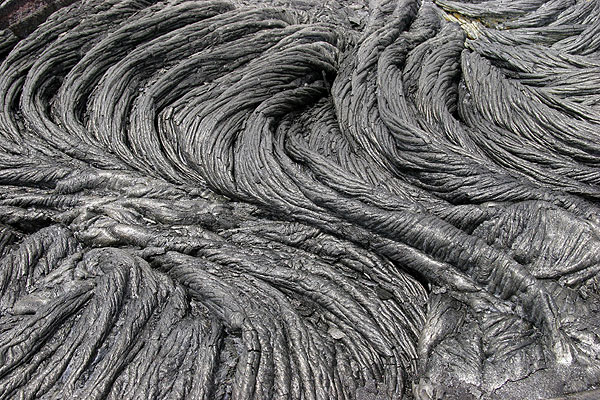
Bertrand Russell caught this vein in Conrad’s worldview, suggesting that the novelist ‘thought of civilized and morally tolerable human life as a dangerous walk on a thin crust of barely cooled lava which at any moment might break and let the unwary sink into fiery depths.’ What both Russell and Conrad were getting at was a simple fact which any historian could confirm: human civilization is an intensely fragile construction. It is built on little more than belief: belief in the rightness of its values; belief in the strength of its system of law and order; belief in its currency; above all, perhaps, belief in its future.

Once that belief begins to crumble, the collapse of a civilization may become unstoppable. That civilizations fall, sooner or later, is as much a law of history as gravity is a law of physics. What remains after the fall is a wild mixture of cultural debris, confused and angry people whose certainties have betrayed them, and those forces which were always there, deeper than the foundations of the city walls: the desire to survive and the desire for meaning.

Climate Grief

Since 2007, Elizabeth Kubler-Ross’s five stages of grief has been applied to climate change by both those who accept the science and by those who do not. Looking at climate change through the Kubler-Ross lens isn’t quite as straightforward as if you were the one receiving the terminal diagnosis or if your spouse had just passed away. She later regretted creating the impression that grief progresses in a linear way through a defined set of stages. It does not, and no more so in the case of climate grief. The stages are signposts on a circuitous journey back to wholeness, through the gradual emergence of climate data and the shifting terrain of social responses to that data.

Facing one’s own mortality or the loss of a loved one occurs against a backdrop of relative stability. It’s socially sanctioned. There are many social structures acknowledging, empathizing with and supporting a passage through such grief. All the other aspects of one’s life may remain relatively certain as one addresses and metabolizes a radically disruptive transition. But generally speaking, the infrastructure of one’s life is not threatened.

Climate change, on the other hand, threatens the foundations of civilization, the biosphere, the underpinnings of everything we know, what we in the ‘developed’ world might call modernity. There’s no such universal social support for this type of grief because, unlike guaranteed mortality, climate grief is not universally shared. It also represents an unprecedented disruptive condition, one that doesn’t arrive all at once, but one that unfolds in multiple unpredictable ways over a long period of time.

The widespread denial of climate change losses prevents our emotional pain from being socially acknowledged and validated. Those touched by this grief may be viewed as overly sensitive, as exaggerating the issue, or even as emotionally unbalanced. These responses can encourage individuals to isolate, remain silent, and become disenfranchised from their own grief process, rather than move through it with support.                                               Leslie Davenport, 2017

The diagnosis has not been terminal from the very beginning. When James Hansen testified before the US Congress in 1988 and warned of global warming, no one took that warning to be a terminal diagnosis for humanity. Its nature has unfolded slowly to the point at which it’s only now becoming clear to the majority of those paying attention: An uninhabitable earth. An entire planet not accommodating to any image of human culture as we’ve known or imagined it. Instability. Profound uncertainty and extremely daunting logistical and environmental obstacles to continued viability of civilization.

Overlaying the common 5-stage model (Denial, Anger, Bargaining, Depression, Acceptance) on these conditions is not so simple, but it does provide a way of understanding and naming key dynamics of the responses to the ever-advancing conditions we face. What a personal terminal diagnosis and climate change share in common is that resilience is possible. Even if the diagnosis is terminal, it’s still possible to recover and maintain wholeness.

The words ecology, ecocide and economics derive from the same root, the Greek word for home: oikos. This common root implies equilibrium in the biosphere and in all our relations with each other, not only through mere commerce. What we see today is a common radical disturbance of increasing severity in ecology and in economics. We have strayed far from home in both domains. We are killing ourselves and now live under a common threat of death. Whether it is understood in these terms or not, this is the root of our grief, an existential estrangement from home. To restore that equilibrium requires that we turn our efforts toward the biosphere, toward others and toward our selves to heal the economy of the whole.

The womb of grief is the seat of love, of caring. To turn away from eco-grief is to turn away from home. The feelings related to grief can be very difficult to bear. But if we remember to think of grief as a natural expression of caring, even love, we can begin to see grief as a form of compassion and strength. We can even begin to see our grief as a tool for action.                                                             Leslie Davenport

Those of us who accept the diagnosis, anthropogenic global warming, are all too familiar with the forms of denial practiced by those who do not accept it–or play with words to appear to be agnostic about it. Some deny there’s a problem altogether. They deny humans are causing the problem; they deny the magnitude of the problem; they claim mitigation measures will be too costly now and that they will be cheaper later when the impacts are more obvious. They deny the scientific consensus, attack the reliability of the data and finally, they attack the messengers, the scientists themselves, as greedy liars. And besides, what hubris it is for humans to claim God’s Plan may be flawed. The audacity!

Less obvious are the forms of denial practiced by climate advocates: We have to push harder for emission reduction. Admitting failure will only lead us to hopelessness. We can still change course (after 30 years of insufficient action). Technology will save us. We have to shield ‘others’ from hearing the truth. We practice functional denial, being well aware of our compromises, inadequacies and limited agency, but still trudge through our days as if species are not disappearing all around us. Truly, sometimes we have to give ourselves a break from the onslaught of bad news. Otherwise, we fear, we could not function. Every day is a conversation with urgency against the backdrop of our grief and periodic despair. Who could resist denying all of it from time to time?

The few, the gifted, the fearless, the ones who fully experience the deep well, the womb of grief as the seat of care are the ones who demonstrate what in our deepest heart we know is true. Those who can fully dismantle their own denial are the ones who demonstrate—even without words—the fundamental and natural connection within all of us to the full magnitude of the issue and the horror of all that is being destroyed around us. And not only by Others, but by we ourselves. Our complicity is much easier to deny than to fully accept.

The anger we feel about the denial all around us, the cynical disregard for the advancing consequences of climate displayed by politicians, the disinterest, the half-measures, the delay, the obfuscation, the lies, the aggressive ignorance, the outright hostility to the truth (as we see it) is like an unwelcome intruder, draining us of energy and focus. Anger may rise at any time, triggered by a casual remark, a headline, a social media post. It’s usually directed elsewhere, but not always. We can surely be as angry with ourselves as with someone else. But either way, it does undermine our capacity for action.

We also have our own versions of bargaining and will quickly adopt internal measures appealing to our inner panel of judges, justifying our exhaustion, assuaging guilt, promising improvement. This is the terrain of personal and collective lobbying. Pushing for someone else to do something. Ultimately, bargaining is too often an attempt to squeeze wine from a raisin. We are not getting where we need to go and finally realize we are only delaying the inevitable. This is the moment Deep Adaptation dawns upon us. We finally know we are alone and what is required. That space, a no man’s land where our agency is hopelessly lost between knowledge and action, is the crossroads of depression and acceptance.

Accompanying depression is what Kubler-Ross might have called extreme helplessness, a near-fatal despair. There is nothing to do but stare into the darkness, searching for any sign of form, of possibility, of faith. As long as any denial remains, despair will not abate. We have to acknowledge that there are others not ready to hear the truth. Perhaps we ourselves are not ready to hear the truth that we are (on our way to) losing our home, our family, our life as we knew it.

But despair is a state, not a station. It’s a passing condition. That it will change may be the only thing we can be sure of. It is telling us to change our strategies, to change the parameters of our activities, the definition of our community, the issues we tend to. It is telling us to discard what has not been working, to accept our mortality, that wholeness is not only possible for ourselves, but a gift we can offer to others.

Acceptance opens space, restoring agency and creative possibility. It opens the floodgates of feeling, connection and resilience, putting us back in the middle, holding the ambiguity of life and death, of journeying but never fully arriving. Acceptance restores meaning. This is the ethos of Deep Adaptation, remembering home from the ground up, embodying a new economy, taking care of what is within our reach and accepting limits on our capacities.


The Anthropocene: Humans Behaving Badly

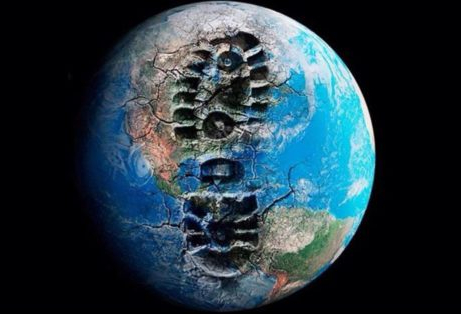
Do humans have a purpose on earth? This is slightly different from asking a more open-ended, “What is the purpose of life?” or “Why are we here?” (in this universe). The question I’m asking, and hearing others ask, is more local, more pointed: “What is the human purpose on this earth…in this epoch of time?….in the matrix of life on this planet?” This is the question of the Anthropocene, because it’s clear we’ve (the white European cohort) become especially confused lately (since the Enlightenment?) and haven’t been doing it much good.

The answer to this question will of course be different depending on whom you talk to. But it’s clear, at least from the beginning of Genesis to the end of Revelations, our destiny has been to become stewards of life on earth. And since we’re talking about who defines the parameters of the dominant narrative, the Enlightenment confirmed that, pretty much, by declaring reality (Gaia) to be dead. Now, having crossed into the unfamiliar space of being the primary drivers of an unhealthy biosphere, why is our destiny not immediately clear?

We fancy ourselves exceptional. At what point in our intellectual or technical development did the formulation of “destiny” or “purpose” even become possible and if the question is sufficiently massaged to address the local inference, why did we not recognize this capacity long ago, elevated above all other personal or collective imperatives? It seems we are only beginning to address this question as our continuing existence is increasingly threatened.

A popular theme of science fiction—and Hollywood blockbusters–is ominous speculation about robots becoming conscious—that man-made machines will become self-aware and exceed the limits of human control—not knowing their place, so to speak. The theme of humans being capable of creating monsters is not new. But now we talk of AI growing beyond our control, its human designers squirming beyond all ethical boundaries and precipitating all manner of damage upon its collective creators. Yet, as most people have noticed, humanity has already brought the rising (acidifying) waters and become the dancing brooms in Disney’s Sorcerer’s Apprentice. The Master’s messenger on earth has become the uncontrollable diabolical force of creation gone wrong with only one driving imperative—the preservation of a self-serving paradigm.

In other words, who is controlling what? Cloning vaguely falls into this category as well, creation itself falling victim to the law of unintended consequences. But we seem to have less moral ambiguity about cloning than AI. We already have the capacity to knowingly introduce bias into AI algorithms. The designation “ethical AI” itself infers the existence of “unethical” AI—which we would presumably and unequivocally reject….except “ethics” has now become a squishy concept because there’s so much money to be made. The creation of “ethical” AI now guarantees the future of the unethical variety.

I wonder if it occurs to the scientists that the train of civilization has already gone wildly off the rails?

So here’s the question that now haunts me. The sci-fi dystopian fantasies are all future oriented—as if, if we’re not careful, it can happen here. But we humans are already victims of our own development–driven by a relatively tiny cadre—a cult, if you will. We ourselves are already making the AI horror movie (and have been for a long time already), a world ruled by technology loosed upon the biosphere, wreaking havoc beyond the oversight of any cool-headed super-authority, not only being at war with the biosphere and with each other, while some of us also see what we’re doing, trying desperately to come to our senses to reverse the damage.

Not only does this view clarify the Anthropocene, humans ‘gone wrong,’ but begs the question of whether humanity—under control of the cult of growth—could ever be a neutral force. The naïve view is that somehow we have backed into a position of unprecedented influence on earth. In reality, the cult has been on a self-conscious accelerating destructive evolutionary tangent for some time; a product of natural evolution by some stretch of the imagination, perhaps, but one that now spells our own doom. Do they know what they are doing? Yes. And, as the definition of insanity so convincingly tells us, even in the face of rising danger the cult continues to believe doing more of the same will result in a different outcome. They are doubling down on the primacy of technology to manage our living relationship with nature—because money.

At what point did we stray off course? When did the progenitors of a culture of death become dominant? When did a tiny subset of humans turn to radical evil as a prime directive? When did we (they) become the proverbial robots gone rogue, incapable of thinking outside their own box? I’d say quite recently—maybe 100 years ago, accelerating in the aftermath of WWII, and the age of The Bomb.

But deeper conditions had to be present for this to be possible. As in the movies, a series of dysfunctional lines of code reinforce each other until an unpredictable tipping point is crossed and suddenly a new organism takes shape. In our case, it was a series of events over a long period. Mass production, the birth of capital finance, using money to make money (1300-1600), the creation of Limited Liability Corporations and colonialism all figure into the picture.

The Judeo-Christian fiction that humans were put here to dominate nature hasn’t helped,…and then there was that guy who said, “I think, therefore I am,” (17thC.) which segued into the ever popular, but so much more damaging, “I own, therefore I rule.” The inflection point occurring 70 years ago was an acceleration of the machinery of destruction to its current runaway status.

Along the way, while the rest of us were de-indigenizing, uprooting ourselves, enjoying newfound mobility, shifting our primary relationships away from tribe and earth to self and money, we lost contact with Home. Now, a small sliver of (distinctly white western) humanity has gained sufficient power and influence to write the rules of money and property to their own specifications, a radical evil self-interest, to rig the game in their favor. Mass psychosis has ensued. Now we have many gradations of psychosis gripping the general population, clinging to the illusions of equality of opportunity and upward mobility. Few make it, of course. The self-appointed engineers are an increasingly exclusive club.

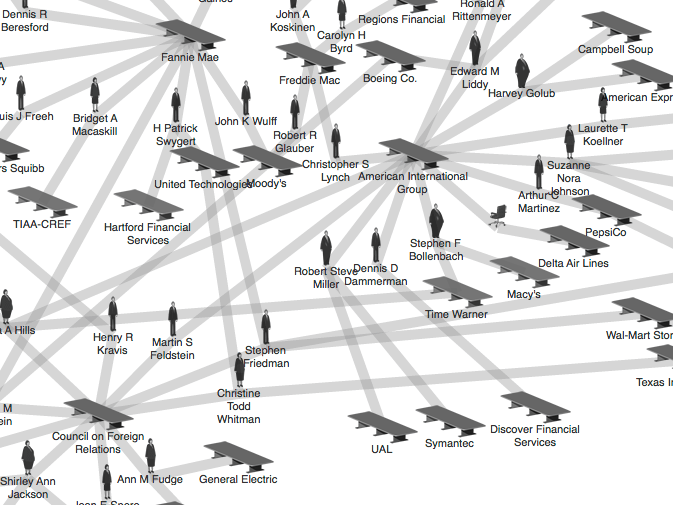
Who is this cult? It’s the Barons of Wall Street, the CEOs of the biggest mutual, hedge and pension funds, the plutocrats, Washington politicians, the intelligence community (the National Security Apparatus), the core law enforcement agencies of government, the fossil fuel sector, the military-industrial complex and certain media entities. This is an insulated, exclusive, self-perpetuating, community of moneyed and political interests who determine the rules for everyone else. Their immunity to resistance is legendary, complete and becoming ever stronger. Whether any single individual member of the cult is insane may be debatable, but the ideology is seamless, ingrained, doesn’t require specific articulation or enforcement. It has become second nature to all its members. They make the kool-aid. We’re supposed to drink it!

The next (and worst) wrinkle of ‘bots gone wrong,’ is when they decide the rest of humanity is expendable (or even must be eliminated) because they are obviously of inferior intelligence and are screwing up everything for the radically evil select few who seek perpetual control and immortality from their secure and remote compounds in the mountains of New Zealand. In other words, every wave of resistance, every opposing dialectic generated from the masses who are waking up to how far we have strayed from the original mutually beneficial relationship to all life, who wish to restore the homeostatic mechanisms (emphasis on home) conducive to life, must be crushed—or at least delayed.

Surely there’s a name for the condition of this self-selected, connected tiny sliver of humanity dragging the rest of us off the cliff, an expression worthy of this mutation of the prime directives. Some prefer the term Deep State. I like the sound of Tyrannysaurus: the tyranny of a hell-bent cult whose days are numbered. Unfortunately, I don’t think we’ll survive them. Like most mutations, the difference between the common and the rare and deranged is not radical. A few mangled lines of code are enough to set the result on a course of unchecked damage, tearing its way through the rest of the species leaving a trail of victims who will never fully recover. You know whom I mean, the uneducated, the poor, the dispossessed, the bankrupt, the disenfranchised.

The mentality of the Tyrannysaurus is separated from the rest of us only by a matter of degree. Not merely thinking for themselves, they think only of themselves. Not merely compartmentalizing the suffering of others, they are willing to directly cause that suffering by promoting a system of violence to extract every possible form of wealth from the commons. They do not merely avoid inconvenient facts, they construct alternate realities, attacking truth itself and fomenting mass delusion to support their fantasy about where responsibility lies for the ongoing wreckage. They do not merely believe humans are superior beings, but that they themselves are super-human. These aberrations of the Holocene, leading the way into the Anthropocene, believe they—and only they–are the pinnacle of evolution.

Most of all, and most damaging, they have managed to deny planetary limits to growth and the extent of our entanglement with other forms of life. Worse, they deny everyone else’s entanglement as well (because of course!), limiting our capacity to repair the damage their violence has wrought.

Long into the future, perhaps even millions of years, when the ice-bound or ashen chronicles of this age of humans is revealed and explored, the extinction story of humanity will be pieced together as an internally generated event. Unlike the first extinction of the great dinosaurs, human extinction will be a story pinned to the faulty code and resulting hubris, narcissism and unapologetic destructive force of the Tyrannysaurus forever, including the way they managed to convince so many of their contemporaries that only they had the answers to the rising danger of our uncontrolled self-destructive mass behavior and how they retreated to their secret guarded redoubts and watched billions of their cohorts, unprepared, succumb to starvation, conflict, disease and an uninhabitable climate.