The Root of Happiness

Bodhicitta is a way of connecting to other lives, of saying we are nothing without that connection and that our connection to each other is deeper than we can ever truly know.

Bodhicitta is a way of connecting to other lives, of saying we are nothing without that connection and that our connection to each other is deeper than we can ever truly know.

Four years ago, we were suddenly dropped into an alien landscape, akin to the toxic atmosphere of an alien metropolis. All plans, intentions, contemplations, associations and actions were transposed into the era of Trump.  Was this a dream, or was I waking into a nightmare?  The landscape was familiar, but somehow different, no longer safe. Everything, values, lifestyle, morality and an ever-fragile peace, balanced on a knife-edge.

I went through the motions of normalcy, repeating familiar patterns of activity. Yet nothing was familiar anymore. Everything seemed to require a little more intention, a little more clarity to become real. Insofar as I could become absorbed, focusing on something compelling or becoming temporarily lost, I was happy. But upon emergence from that condition, drifting back to the larger awareness, I was reminded in the next breath of a less stable and more threatening world, not merely in a physical sense, but in a deep moral sense. As we know, that condition has gotten much worse beyond whatever I might have imagined four years ago. Grief remains just below the surface. Happiness–true equanimity–has become much more elusive. 

There are those who would surely have said then, “Welcome to reality, dude!” As if not much had really changed. After all, we’d been on this trajectory toward dissolution for a long time, they might say. And I would have agreed. But no, with the election of Trump, dissolution went geometric. Ever since, we have amplified the suffering of the many for the sake of the happiness of a few. The great irony of that electoral decision made by so many is the belief that they would be spared the consequences of the agenda they had just endorsed with their vote.

Which brings me to ponder happiness itself. We might well ask what that was or how those who regarded Trump as a threat multiplier of unknown proportion would know it when they saw it. In truth, however, when it comes to happiness, all of us fall into the same category. Those who voted for Trump would have been mostly unhappy for a long time (never mind how they might have defined happiness), though if I ever suspected they might have seen that Trump could not (nor was he inclined to) resurrect the American Dream for them in the way they most desired or believed was possible. Or, if he had made a serious attempt, it would have come at great cost to the cohesion of the nation (as it is now), not to mention our international stature, all of which happened anyway.

More precisely, I think about how I think about happiness–because the answer to that question has a lot to do with whether I am happy or not. The intention to be happy is innate to many decisions every day; but what does happiness now mean as the era of Trump has taken so many significant and profoundly disturbing turns? We’d better know what it is, because we’re gonna have to work harder for it.

Dharma regards everyday happiness as transient since it’s entirely based on a dualistic view. Happiness is defined as the absence of suffering, but for there to be happiness at all, there must be something we call suffering. Happiness may be a benefit we wish for others by our aspiration and our action.  We may wish everyday happiness for everyone, as if the satisfaction of having “enough” is sufficient, even if it’s temporary. Beyond that, we wish for a release from the cyclic behaviors that drive us to seek happiness in ways that are not satisfying…or may even damaging to ourselves or others.

The metaphysical perch from which we view happiness is bodhicitta, a comprehensive compassionate view. We want to enjoy the relative happiness that flows from realizing the Four Noble Truths: the universality of suffering and the fact that there is a (Eightfold) path through suffering. We extend that wish to those who are experiencing the suffering of pain and the suffering of change. We extend these wishes to those closest to us and can also extend it to everyone in general.

Beyond our immediate circle, there are those to whom we do not feel close. We may feel neutral or even indifferent, but we can extend a wish for happiness to them. There are still others with whom we have a negative history and residual negative emotion. It’s more complicated to erase negative emotions completely, to extend a genuine wish of happiness to such a person because negative feelings don’t just dissolve upon request.

To transform negative emotions into unequivocal, refreshing, clear and unlimited positive regard is not trivial. Not is it an act of mere will. It is a deliberative process, sometimes a sharp reality check requiring that we go beyond what we merely wish to be true to true forgiveness and compassion– for ourselves as well as for another. At the heart of those judgments about others, I am likely to find a judgment about myself, which may itself arise from a painful incident buried in the past. It is only in looking at the origins of those judgments, at the emotional anchors and core beliefs that hold them, that they can be seen for what they so often are: self-cherishing stories, baseless assumptions, limited beliefs. 

I’ve practiced this with romantic partners, family members, a former spouse, a former supervisor, co-workers and even former friends. Admitting the deep attachment we have to our judgments about others is often slow and careful (not to mention uncomfortable) work, especially if we believe we have been personally wronged. But working through the resentment or anger to an authentic clarity is possible.

We can form honest intentions about others that we disliked at one time. Yet some measure of animus might creep back. One might manage an authentic wish for a moment but find it difficult to remain in that clarity for an extended period. It’s unsettling to realize that if I was standing in front of someone I disliked, transmitting an honest wish for their happiness, they might get the idea that I liked them.  Kinda like the way the Dalai Lama refers to the Chinese: my friend, the enemy. Could I do that face to face with a Trump supporter, a racist neo-Nazi?  They might think we could be friends, which would present even more challenging circumstances. With certain people, I’m not so sure I could tolerate that. We simply resist letting go of the hardened ways we see certain people. This gets tricky, doesn’t it? But neither does it mean I have to agree with or condone the views of any random Trump supporter.

Shantideva famously said that there is no such thing as happiness in samsara. He was referring to a previous statement he made about happiness in which he declared that the only true happiness derives from completely renouncing self-cherishing. Any wish for happiness or action toward happiness based on self-cherishing (What about ME??) would be dishonest, illusory and ultimately futile. Everyday happiness is a product of causes and conditions, meaning it is bound by time and therefore impermanent. Shantideva is saying that any such happiness is not true happiness. From the absolute perspective, anything that arises from causes and conditions has no intrinsic reality. No matter how much we avoid suffering and no matter how successful we are, the entire charade is a product of the fundamental mistake of believing in the existence of our separate identity. Removing ourselves from that view, suddenly neither happiness nor suffering have ever existed.

Of course, this is an idea that runs directly counter to our sensory experience. But again, neither our perceptions nor emotions have ever had independent (permanent) existence. Yet, neither are they non-existent! We are left with a perfectly clear choice to continue cultivating the bodhicitta of compassion that doesn’t take sides–which is to say, no matter how we voted, we are all equal in our lifelong dance with suffering and change.

If letting go of judgments seems difficult, it’s likely because those judgments reinforce our sense of a separate identity There is no need to deny the reality of our feelings and emotions so long as we don’t get hung up believing that there is any true substance to them…or, for that matter, to the feeler. By continuously reinforcing separation, every “self,” becomes a unique pattern of inattention to the larger reality in which it lives.

We can hold the great paradox of the truth of appearances while still being mindful of their ultimate non-existence. True compassion, without making any distinctions about who deserves it or not, views all emotion, happiness and suffering as equal in nature, arising from a trance-like belief in the reality of opposites. We can still be happy…realizing that suffering will inevitably be a part of that relative happiness.

Taking this view into the practice of aspiration or active bodhicitta, we can project our compassionate intentions knowing that to fully overcome self-cherishing may be out of reach–at least in this lifetime. For now, we simply do the best we can.

A supremely spacious clarity is a prerequisite for accessing the source of happiness. From that source, happiness becomes a view as vast as space, an uninterrupted flow of sensation and feeling without attachment, an expanding, unimpeded, infinitely inclusive condition of holding all that is. Everything is included: all events (including the assemblage of events that is Donald Trump), all sensation and all emotion. No need to deny anything. On the contrary, everything can be used to energize our view in every moment. If that condition of possibility can be formed, arising unimpeded according to one’s capacity, then anything can arise in that space. 

Does such a condition exist outside of ego-consciousness? What is “happiness” not arising as an object of intention? Do we call it happiness at all? If happiness can exist as something other than an object of “my” intention, then who is the “I” that is forming the wish?

Contemplating the supreme spacious quality found at the root of happiness, I do not create or wish happiness for myself. I don’t wish for the happiness of a single separate identity, “me,” to become just another passing object of attention. I seek happiness with no object, which is to say a wish of happiness for all others. Resting in the root of that happiness itself, arising spontaneously without intention from a dynamic spacious nature, being “uncreated,” as it were, it becomes entirely natural to extend it to all others.

I project a wish that others will also connect to that root. Inherent to such a wish is the knowledge that we are all connected by and as the root of happiness. We are not simply connected separately to some ineffable source of happiness. Our connection to each other is that source. The nature of happiness is identical to the true nature of everything; we can’t separate the source of happiness from the source of compassion, from the source of loving kindness or joy. They are all inseparable from each other.

Our work is more than the formation of wishes. It is the active removal of all obstacles to a connection to the source of happiness. Believing we are ever separated from the root of happiness or, for that matter, from any of the Four Immeasurables is the obstacle to overcome. In the non-dual view, since there is no such thing as happiness (or suffering), connecting to the root of happiness, already pure, goes to the heart of the Mahayana view. True happiness and compassion arise in natural abundance from the same timeless and ineffable source: the realization of emptiness.

The nature of happiness becomes known as appearance imbued with the truth of emptiness in which the very idea of happiness itself has no true existence. In every time, even as Trumpism mutates into post-Presidential threats yet unknown, that is precisely why it holds unlimited potential.


Zombie America

America is under racist assault. It has been this way for centuries—as though a cult of the undead, the empty dispossessed can only see the world in one way—Us vs Them. Purposeful demolition is the foremost objective of the undead—led by the First Family of Destruction. The zombie ideologues now get their news from the Family, its enablers, sycophants and its media amplifiers. There’s no more capacity for the undead to change than there is for a jellyfish to float against the currents. Yes, the undead are the jellyfish of the logo-sphere and they carrying a nasty sting. 

There’s no aspiration, no value, no commitment or connection to the collective, only to a their narrow view of entitlement.  There’s been no event, no sacred passage, no period of trial or transition, no foundation for their actions other than domination, jealousy, greed, anger and vengeance. There’s been no transition, no developmental progress, no entrée into a wiser way of seeing based in reality instead of wish-fulfillment.

Traditional initiation crosses a threshold to join the continuous stream of birthing and dying, with all the triumph and adversity, love and suffering in between. Emerging successfully from an initiation would mean walking with our feet on the ground and our heads in the clouds (not the reverse), holding a natural connection with our selves, others and with the land. 

Traditional cultures whose initiations were integral to the continuity of their communities prescribed these rites on the cusp of adulthood. They require a separation, a death, an awakening to essence (or soul), a time of rebirth and a return. An initiation is a second birth, having grown up dependent on family and community, the initiate is prepared to establish a separate life, to be guided by a core vision and to live out a full investment in the community according to that vision. 

Initiation is also a rooting experience, a gesture of coming home in the body-mind of the initiate. The body of the initiate is infused with the land and the spirits of the land. They become One.  This is the indigenous experience of initiation. Imagining a shred of anything similar in the American racist zombie cult is a laughable fantasy. We are diminished by all of it—for 400 years. We, as a nation, have been the undead, lost. Sadly, on the issue of race, we are as homeless as the ones sleeping in doorways.

I am of a people who, historically, had no land. The cultural lore is of temporary residence and history has tragically proven the validity of that outlook. We were not nomads, unless you count wandering in the desert for 40 years after escaping slavery in Egypt. That was the original initiation of the Jewish people. As the story goes, we received not only land after the struggle, but a rebirth in that land blessed by the God of that land. True or not, the history of the Jewish people has been one of being landless—until the establishment of the State of Israel. Overlooking the injustice of that creation for the moment (and all the suffering it has unleashed), that land remains the State of Israel in the hearts of many Jews whether they live there or not. 

Even so, tracing my own roots in the Jewish diaspora over the last 150 years, I can say I’m a citizen of America. I could even say I own land or I might trace my life in America for four generations, but I do not have a place in the same sense in which I describe it above. Rural Americans do; urban/suburban Americans don’t. As Stephen Jenkinson has said, we have learned to make do with portable gods. I personally have by conventional definition been a nomad. The deeper yearning to be of a place remains. 

My advantage, my privilege, is that I was not ripped from my ancestral home and transported against my will to this land. And beyond the mass kidnapping and enslavement, the American tradition of making others landless in the course of claiming this land continues to this day. This ideology is, under Trump particularly, delivered every day by the occupying force of police and ICE whose job it has become to enforce the message: you do not belong here. You have no claim to this place. It is ours and will never be yours. 

My personal bond connecting my history and cultural memory to Israel has been severed by the racist apartheid policies of that government. But in my adopted home, zombie white supremacy, an increasingly visible, dangerous and aggressive segment of this nation of white European immigrants, staking a claim to this land above anyone else, is now with rising brutality resuscitating and delivering a murderous message of ownership with a knee to the neck, further severing my bond to this land in the process.

Looking at the American republic, dangling as it is now between the life and death, the racist undead, led by the foremost zombie of our time, Donald Trump, remind us of an incomplete national initiation. There is nothing about Trump to suggest any history of formative, let alone transformative development, no true home, allegiance to anything or any distraction from singleminded and empty devotion to personal gain. And likewise, his most ardent followers feel entitled to demand and accept nothing less than unobstructed freedom of their personal choices without much suggestion of a commitment to anything other than that freedom–such as the common interest. 

America’s initiation on the issue of race is entering the encounter-with-death phase. Trump’s zombie cult, the uninitiated, reflect to the rest of us how severed we are from our ancestor’s bones. America is still way behind the curve of truly becoming Emma Lazarus’s home to the many. It’s primarily a home to the few whose dominance depends on successfully claiming—and selling—the idea of America as their exclusive home. The message delivered to communities of color are that they are temporary residents with shallow roots at best, at constant risk of being attacked, marginalized, incarcerated, exploited, oppressed, exported, discarded and finally, if necessary, killed. America is now being dragged into the mud of history by the undead. The world looks on in horror.

The racist undead have never been alive in the sense of recognizing interdependence as a primal reality of existence. Nor do they recognize or consider themselves beholden to any resident spirits. Even their god is homeless. Grounding to a place and to all people is not embedded in modern American culture; thus, no common vision exists of what it means to live in the full flower of diversity we represent. Our roots are too shallow; our gods are foreign. We are driven by the ideology of self-interest. And if Trump’s ascendance is any indication, the zombies are winning.

What is so disturbing and ironic in these times is that those who claim to be Most American, the ones claiming ownership and to being the ‘true’ keepers of the only legitimate version of America, the ones lugging automatic weapons into statehouses, to polling places and into the street proclaiming their ‘freedom,’ the ones acting least like they believe in the promise of this nation, have the least invested in making sure all people share and contribute to the struggle of thriving together, most likely because it is they themselves who have been hollowed out and discarded by the America they claim to love. They are our zombie chickens coming home to roost, leaning into the nihilism of the chief zombie, Donald Trump.

Solidarity, Somatics and Psychosis

The classic design of the vessels transporting the kidnapped, the brutalized and dispossessed, the colonized masses brought from Africa to the New World, endures to this day in the forms and structures of patriarchal capitalism: social stratification, marginalization, income inequality, racism, limited or blocked access to the means of acquiring wealth, property, equal justice or the general benefits of living your own dreams. White people may still enjoy the freshening breezes of the upper deck, but the metaphor still applies to nearly all of us today. It is only a matter of degree.

Yet even in the darkness, the impossibly close quarters and squalor of the lower decks, the light of freedom and joy never died. Dislocation does not extinguish the longing for home, burning to this day in the literature, art, music and poetry of the oppressed. It is in these ceremonial forms of breathing together that solidarity is affirmed. That yearning comes to life in the reverence for the journey, the longing to recover the sacred, to resolve the diaspora with the free and full habitation of a transformed body in a new land, even if that land only exists as an aspiration in the hearts of the wanderers. 

Four hundred years later, it is not only the ones who bore the lash who still cry out for home. Neoliberal economics, by commodification, relentless extraction and by the absence of any loyalty to genuine community and because it refuses to regard the earth as anything other than untapped economic potential, renders all of us landless on the new plantation just as it does in the foreign territories, occupied, re-colonized and subjugated by the weapons of finance and law. If those fail, force is applied.

These conditions, specifically the hierarchies of privilege, the tightening grip on the lash, the systemic racism and the use of money as a bludgeon, the predatory financial order and all the other inequities accompanying its regime, remind us that we can lose anything at any time. And indeed, since our relation to earth is much more than merely to a potential source of revenue, everything is being taken from us, incrementally, every day. Manifest destiny operates upon the collective body now just as it did in centuries past upon the territories of the indigenous.

Modernity is a rationalization of the wild. It is a leveling. Anyone noncompliant; anyone who dances, breaks the rules, bends time, looks beyond the borders, meets with other bodies, dwells outside the boundaries of sanctioned connection, imbibes the nectars of the sacred, seeks wisdom from forbidden sources, cries out for justice or draws outside the lines may be indulged with limited tolerance. Some will be infiltrated, criminalized, surveilled, tracked, deported, bludgeoned, jailed or killed. The rest, at least figuratively, become fugitives.

These and others like them, the restless, underserved, disenfranchised and denied, the ones living outside today’s inverted definitions of “freedom,” and “opportunity,” the ones discarded by the “free market” are the ones deserving of our solidarity. But they’re not the only ones being damaged by the paradigm of dominance and exclusion. However the systems of power continue the privatization and destruction of the commons is our disenfranchisement in real time. 

The Freudian definition of psychotherapy is that in exploring and expanding the psyche we reclaim territory. Our wounds back us into corners and make us small. Our addictions limit our capacity for outreach and connection. All the consciousness work we do is to reclaim territory, to halt the narrowing and to expand our view. Modernity rounds the edges and flattens consciousness, narrowing focus to channel and facilitate the pursuit of illusory solitary happiness. Bayo Akomolafe calls it gentrification. When we open psychic territory, we push past the limits of convention. We enter the wilds, tearing through the fences of what we know. We recover expansion and breath.

As David Abram reminds us, the original meaning of psyche was about breath, the wind or spirit of life. When we (re) occupy the wilds, we are learning to breath again, to fully inhale the spirit of life and the common territory of choice and possibility we all inhabit. Sitting and breathing is the most elementary practice of contemplative traditions. In doing so, we typically only think of ourselves, our solitary and separate bodies and the spirit, or psyche, of our existence. We inhale, filling the self, partaking of the esprit, the ruach, the motivating energy of being, momentarily narrowing our focus to this body, this consciousness, this moment, cyclically relinquishing the territory of awareness we just claimed, releasing into the non-dual self, into the unity of all consciousness, eliminating all boundaries and expanding to occupy all the territory we abandon in our pursuit of Self. We infuse ourselves with psyche

Psychosis names an abnormal state of the psyche, a condition of separation from the essence of being. We become lost to the potential of cyclical expansion and contraction of spirit embedded not only in the simple movement of air, interacting with the flow of breath essential to language. The expression of sound, the original musical intonation of nature, the stops and starts, the shapes of the throat, lips and tongue are rooted in the original sounds and symbols of our relational self. They were orienting, defined community, interspecies dynamics and expressed the ebb and flow of interdependencies upon which group survival depends. To become, over millennia, progressively separated from and to lose all sense of relationship between language and natural world, to permit indigenous languages and their ways of knowing the world to be lost is a mark of the deepening journey into mass psychosis

We lose our breath until we can’t breathe at all.

Breaking free of the mass psychosis is not simply a matter of breathing or language. It’s a much deeper process of conspiring to access and know our bodies in relation to earth in a different way. The energetics of reductionism, scientific materialism and neoclassical economics drive a widening gulf between humans and nature, from the full-bodied, erotic conversations between humans and the seasonal textures and interactive exchange of wisdom held in sacred sounds and labels of obscure and unique mind-states for which there may be no equivalent in any other language.

Recovering indigenous history is more than recovering stories. Embodiment includes discovering the architecture of authentic freedom, sharing the history of our bodies, exploring the interpenetration of culture and somatics, coming to our full stature, bringing the diaspora home to place and community, recovering belonging, power and perspective, connecting with ancestral voices bending time and preserving the libraries of wisdom contained in disappearing languages.

As Alnoor Lada declared in a recent issue of Kosmos Journal, solidarity is a direct erosion of the structures of oppression, the powers anchoring domination. Reclaiming the past informs the possibility of changing the present. Acting from a different set of values, breathing together, healing from the mass psychosis by breathing with our ancestors, redefining our identities, reconnecting to deities rendered remote and quiescent is a direct affront to the forces of economic dislocation that would erase the past and reframe history as the solitary pursuit of self-interest.

Things I Can No Longer Do #1

There is nothing further left for me in data-heavy climate tracts. I have to turn away now. I don’t want to know—at least not in the cognitive sense of knowing–because I already know.

I’ve reached the end of the line. There is nothing left for me in the latest morning-after mainstream media. I have to turn away. Yes, I’m fascinated, but I don’t really want to know—at least not in the cognitive sense of knowing–because I already know. I can’t even activate the part of my brain necessary to process an argument or anything purporting to be reasonable or logical or scientific, trying to convince…anyone… that this or that event is “directly related to climate change.” Nothing but futility and dissonance arise in the very first paragraph of such material. Where does anyone still get the idea that this does any good? Who still clings to the notion that deniers or ‘low information voters’ can be convinced otherwise? Who still imagines this particular event will constitute the critical nugget for some fence-sitter out there? Do such persons even exist? 

Popular treatment of climate issues has become performative journalism, going through the motions in service to a dying ritual of “providing a public service.” Who can stand this anymore? Numbness invariably accompanies reading such stories. They are space-fillers. As long as their vocabularies include the specialized terminologies of science, divorced from every somatic signal, gesture or sense-making faculty connecting us to the natural world, they no longer serve a purpose. There is no longer any refuge in being right. I have become a fugitive from this form of engagement. That fugitivity, as Bayo Akomolafe would say, is the definition of post-activism.

What is the root of a belief in continuing the activist debate? It’s the same dualistic ethic with centuries of baggage accompanying our estrangement from the natural world. The paradox of language is that resorting to reason as a way of propagating the conclusion that we humans have lost our way is part of the disease itself. As has become so clear in recent years, the way we react to the problem is often part of the problem. Reinforcing binaries is itself a form of distancing from our direct experience of the more-than-human world, reinforcing the dissociation at the heart of our headlong advance toward extinction.

What is more disturbing is remembering when I myself might have used words in that way, using (limited) tools of persuasion at my disposal, imperfectly, earnestly and mindlessly. But the very act of switching into that mode of communication is a betrayal. Sure, we all communicate in this way. Yes, we regularly appeal to reason and rationality, brandishing logic, evidence and data in our communications. Yet, at the end of this long trail of tears and deepening anguish, with humanity coming face to face with the self-destructive nature of our values and behavior, and mostly not comprehending, even with yet another book by the most erudite and passionate spokesperson appearing on behalf of coming to our senses, these efforts are now ringing dreadfully false and futile because, as someone living closer to my gut, the tears are already just below the surface anyway. And that feeling never goes away.  

I can view photos, arresting, disruptive, body-shaking invasions, images without any words at all, the ones that break through the most recent fragile emotional repair, images like the surgically tortured, dissected and harvested tar sands landscapes of Alberta, Chris Jordan’s photos of plastic-filled corpses of sea birds on Midway Island or the solitary orangutan fighting a bulldozer in a Sumatran rainforest or the Amazonian fires or rivers of ice-melt surging to the sea in Greenland, grayed and lifeless coral reefs or the abandoned tarpits of Ecuador. These images belong to me….and I belong to them.

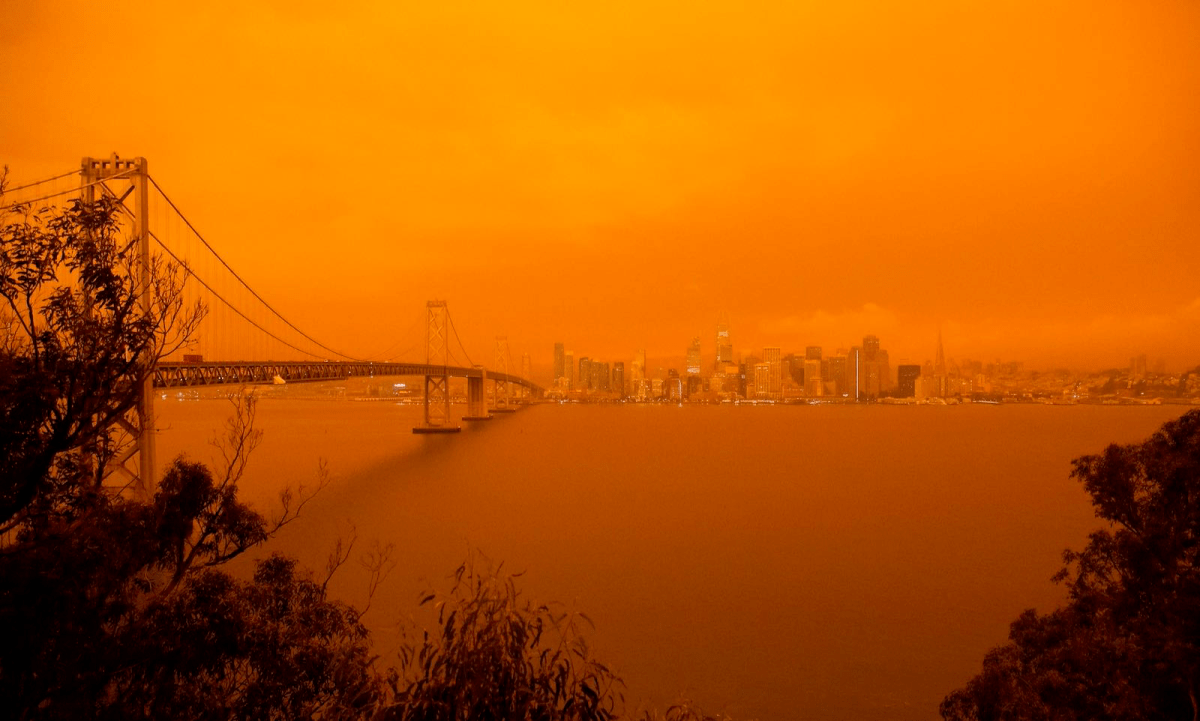
Who would dare publish nothing but photos of the most recent evidence of distorted human values and behavior? Where will we find pictures of the California firestorms with no story? The pictures of the orange sky above the Golden Gate Bridge spoke louder than any words ever could, as would typhoon devastation, denuded glacial moraines, bulldozed rainforest, dry riverbeds, open-pit lithium mines or the translucent shells of deep-sea mollusks that can no longer find sufficient accessible calcium.

Yes, I can still look at (some) graphs. But I already know what they say. Just save me from the words. That part of my brain is already exhausted. I can speak to you from my body. There I can wander with the desperate migrations of species, dream with the giants of the seas. I can listen to the land, soar with the last endangered condor searching for home. Just don’t ask me to process the words any more. It’s like eating cardboard and expecting to be nourished.

Collapse Redux

The basis of Jem Bendell’s original and revised paper on climate-induced societal collapse and Deep Adaptation was his review of current climate and public opinion research. In addressing the probability of societal collapse, his paper was and remains a contribution to popular understanding of the social implications of climate change, mainstream environmental advocacy and our current predicament. The definition of collapse he chose was an uneven ending of our normal modes of sustenance, shelter, security, pleasure, identity and meaning.  Any distinction between collapse and catastrophe was not addressed. And, by the way, what is “societal” anyway? Whose society? Perhaps this omission was intentional, but clearly, he regarded any more specific definition of collapse as a separate pursuit. 

Bendell was obviously content with allowing collapse to remain mostly a subjective frame, which would account for wide differences in definition depending on whom is talking—and where. What, after all, is the normal mode of sustenance or shelter, or even pleasure? And what is normal? If sustenance was overtaken by a revolution in food production that fed more people for less money and didn’t even require soil, would that be an ending of normal? Security is also an awfully big tent if it contains governance, rule of law, energy, health care and public health. Burning the last drop of oil would certainly be an ending, but would it be collapse? The fact that there was no serious effort to be more specific, even if it might have proven as difficult as picking up mercury with your hands, guarantees that readers remain within their subjectivity without much questioning and that the resulting variability of responses don’t represent a very reliable measure of anything. Perhaps it’s only what people believe that’s important.

Bendell also goes to great lengths to describe different psychological strategies, including denial within the environmental movement itself, for mitigating direct confrontation with advancing collapse and especially how we, particularly scientists, steer away from alarmism. Bendell has been criticized for making declarations potentially triggering despair. Different cohorts, whether scientists, laypersons, academics, different age generations or even samples from widely different cultures may have very different ideas about what collapse would look like. But in the absence of (even flawed) parameters, we are left to imagine the worst possible scenarios and a very hazy timeline in which they might unfold. Bendell may have had good reasons to avoid defining collapse any more specifically than he did, but his orientation, given the evidence he was citing, was solely to advancing climate impacts without much attention to political or economic dynamics. 

In that avoidance we lose (or overlook) a capacity to evaluate whether collapse is already progressing according to dynamics not directly linked to climate impacts per se, or whether in grappling with a definition we might inevitably expand our understanding to include dynamics that only become more visible and valid according to a systemic perspective that doesn’t arbitrarily exclude those social, political and economic dynamics. 

Collapse also deserves a closer (and wider) review because it carries implications for determining whether climate signs already exist, whether there are additional signs of collapse which may not be specifically climate-related but will augment climate impacts, and because the use of this term in this context appears to exist within a limited ethnocentric (global North) perspective. Whether collapse is already here for parts of the global south or whether it remains at a comfortable distance for the industrialized north is not even an open question. It’s difficult to tell whether Bendell was writing for a limited audience. But for the north, at least, we are already fascinated and appalled at the same time, hovering between hope and despair as events increasingly break through our dissociation. But for areas of the South, the signs are more advanced and already clear.

If we considered a single individual as a metaphor of global human systems, we could easily diagnose the patient in the grips of a profound ecological disease, even a pathology, gradually taking over. The fever is rising and the patient is in increasing distress. We see organ systems on the way to failure. From Bendell’s view, collapse represents a transition of the patient into an unmanageable condition, human systems failing to remain in any semblance of harmony with the biosphere. In other words, how can we speculate about when collapse may occur without naming the signs of illness, the social and environmental symptoms along with those strictly related to carbon emissions?

Just to be slightly more precise, although collapse may be perceived as a response to catastrophic events such as the permanent loss of polar ice, the jet stream or the Gulf Stream, it’s more likely to be a slowly unfolding emergency (uneven, as Bendell said) whose impacts aggregate over time. How long that time may be could vary from 10-50 years, or even longer. The question is, where is the inflection point between a normally functioning society and one that is coming apart—or will we only know in retrospect? There will be many signs, increasingly varied and disruptive. There will be mitigation, from mostly effective to increasingly futile. There may be rampant denial and spreading panic. How much deforestation does it take to upend normality? How much pollution? How much ocean acidification before the food chain collapses? Is fascism a sign of greater or lesser security? Is mass surveillance a sign? Is the pandemic a sign?

We are challenged to investigate relationships among an increasing variety of events and systemic adjustments to come to conclusions about what is climate related and what may not be, realizing that as time passes, the increasing number of events portending collapse will most likely be directly attributable to climate. And even if those relationships appear to be tenuous, the reality is that all events are data points illustrating the operation of a social, political and economic regime driving violent global change. 

Bendell’s references to climate research include numerous big picture metrics such as sea ice, ocean acidification, the atmospheric carbon budget and changing weather patterns. He bases his theory of inevitable collapse on these advancing measures across numerous defined ‘tipping points’ and makes a case for near-term collapse based on these and additional effects of existing carbon emissions already baked into the atmosphere. The aggregate of emissions playing out over the next 1-3 decades will, he asserts, guarantee disastrous impacts. Likewise, despite the potential for sequestration practices at significantly greater scale or for radical reduction in emissions, the fact is we are adopting neither of these measures to the degree necessary, increasing the probability of collapse.

In addition to calculations of carbon emissions and sequestration, Bendell includes further and more recent data on the measurement of methane emissions and the likely scenario for their acceleration and resulting amplified climate effects as well. This is high-level analysis permitting the most general speculation about the sustainability of human and ecological systems and the likelihood of unpredictable effects on civilization, both agrarian and ocean-based food systems, human migration, disease and the loss of biodiversity.

The greatest proportion of global carbon emissions comes from a limited number of affluent nations. There is no dispute about this. We know the effects of those emissions will fall first upon less developed economies and peoples, but their impacts will also fall on local communities. In fact, while much of the affluence of industrialized nations derives directly from resources extracted from less-industrialized nations and guarantees the true costs of fossil fuel exploration and consumption to fall on those nations, the costs of other resource extraction practices also fall upon those less-developed economies. 

In case one needs examples of these practices to fully grasp the nature of globalized exploitation and the externalization of ecological effects, we need only look at the tar-sands operations of Canada and Colombia, the destruction of the Niger Delta, toxic residues in Ecuador, the deforestation of Indonesia, the burning of the Amazon, mountaintop coal mining and the destruction of water resources in the US. In other words, the wealth and hence the carbon footprint of industrialized (white) nations derives primarily from the appetites and extractive practices of those nations in the global south. 

In the most general terms, what collapse looks like is the transition of a society from greater to lesser complexity. Outside westernized urban centers, much of the global south is already less complex than the industrialized north, with agrarian culture’s economies more localized and resilient. But since Bendell shies away from defining collapse (or catastrophe) in anything other than the most general terms, one gets the impression the destruction he speaks of will only become real when it effects industrialized societies who have benefited the most from emitting carbon—at the expense of everyone else–and that their very development and stability insulates them from initial and less dire effects of climate disruption. 

Indeed, Bendell rattles off the list of recent international institutional efforts created to mitigate the effects of climate by building resilience into developing economies. Unfortunately, these efforts aren’t much more than institutional green-washing, too little and too late. While the North refused in Paris (2015) to adequately compensate the South for climate impacts, giving themselves the freedom to define their own mitigation efforts in the absence of any enforcement mechanisms, they sloughed off their responsibilities to underfunded excuses, continuing Business As Usual and guaranteeing catastrophe far away from their own shores.

Meanwhile, contemplate just a few drivers of uneven endings:

  • The massive and unprecedented shift of wealth upward for the past four decades 
  • Unregulated capital markets and the creation of phantom economies using unregulated speculative financial instruments, shifting risk to the collective.
  • Increasing extraction from labor and destruction of intrinsic and extrinsic rewards. 
  • Intrusive and controlling policy serving narrow economic interests at the expense of health, education and the welfare of the commons.
  • Mismanagement of land and degradation of food safety: food and soil quality declining with monoculture, pesticides, additives, GMOs & preservatives.

What collapse feels like is also not a matter to ignore. What may not be at the forefront of awareness is rising anxiety and apprehension about the security of current lifestyles, a viable future and the ability (not to mention willingness) of governments to respond. Do the incremental changes in perspective, the rising apprehension and pessimism about the future (solastalgia) count as a signal of collapse? The reality of these proliferating signs of economic and psychological stress are likely more widespread than we realize. And we’re not likely to be able to calculate their true effect until it’s too late.

Meanwhile, the North continues to generate climate impacts in the South, knowing the effects and continuing practices foretelling social disruption and eventual collapse elsewhere. Climate-related signs are already present, but again, it’s only from the perspective of highly developed western economies that Bendell presents the probability of collapse, failing to account for existing signs in less developed economies. 

A few examples: 

  • Much of Bangladesh is under water. Between this year’s monsoon and a climate-amped cyclone, millions are affected by the pre-existing COVID lockdown, the closure of businesses, the loss of rural income usually provided by urban workers and the loss of arable land by erosion. 
  • Indigenous societies in Brazil are undergoing attack and destruction (ethnic cleansing?) by Bolsonaro’s aggressive agricultural development practices, directly driving climate change in the Amazon and the planet. 
  • Parts of the Pacific island nations of Fiji, Kiribati, Solomon Islands, Marshall Islands, Vanuatu and Micronesia are already disappearing. Human settlements, sanitation, agriculture and fresh water supplies are threatened due to rising sea levels.
  • Disastrous multi-year drought and total crop failure in the north of Syria caused mass migration to the cities and, along with resource mis-management, foretold the destruction of that nation. 
  • Sudan is experiencing climate driven variability and timing of extreme temperatures and rainfall, disrupting food supplies, triggering civil war, the displacement of millions and a succession of either military dictatorships or civilian incompetence. Suffering is pandemic.

We could go on. It will likely be only when there are unavoidable signs occurring at home that developed nations will take notice:

  • The rich central valley of California supplies a vast majority of all the fruits and vegetables for the entire US. Yet extended drought conditions have forced growers to tap groundwater supplies for years. Wells are now dropping 150 ft. or more into the falling aquifer. Water war is a long-standing condition between densely populated northern California urban centers and the agriculture industry. Factor in the declining snowmelt of the western Sierra and we have conditions eventually forcing choices between food and water.
  • The Southwestern US relies on water supplies from the Colorado River and Lake Mead. Water levels of both have been in steady decline for decades. It’s only as matter of time before the viability of the metropolises of Phoenix, Las Vegas and Los Angeles are threatened.
  • The UK wheat crop is the lowest in 40 years, foretelling a sharp effect on food prices. 

Climate related migration has been already underway in many locations, causing economic and political destabilization. Coastal property insurance costs are rising and coastal land values are falling. Migration from the Florida Keys, Houston, New Orleans and the Mississippi Delta is rising. Whether it’s flooding or water scarcity in India, climate migration will result in unchecked urban growth just as it did in Syria, taxing inadequate infrastructure and further causing political and social stress.

What global events have been telling us for quite awhile and which have become especially clear very recently is that virtually no aspect of human presence, other than by reductionist efforts defining linear causation, can be culled from the whole and paraded before us as irrelevant to a calculation of impending collapse. Does collapse mean preventive measures have already failed? Would the implementation of security measures or the initiation of resource conflicts themselves represent collapse? Would mass food insecurity alone or rising crime in response to food insecurity constitute collapse? Does collapse imply a breakdown of governance, lawlessness or border disputes? 

One of the most practical aphorisms of this age is to “think globally, act locally.” From this view the Deep Adaptation agenda makes sense, although it could stand some scrutiny and even radical expansion of what Reconciliation means from a global view. Personally, I see few signs of human resolve to revert to true reciprocity with the natural world in time to forestall broad collapse. Given the pace of events, the high degree of integration of global systems and realizing the entirely ethnocentric orientation of this agenda in the face of a huge disparity between the outlook and fortunes of the North and South, we might consider reversing the aphorism to “think locally, act globally,” asking what we need to do on an international scale to restore reciprocity and reverse the drastic inequities already playing out as consequences of our privileged over-consumption of carbon-based products. In doing so, we might even be saving ourselves. 

Black Soil is the Other Oil

Ukraine is known as the “breadbasket of Europe.” According to a recent report from the Oakland Institute, it has one-third of all the arable land in the EU (32 million hectares). For 19 years the nation had resisted the arm-twisting, coercions and seductions of global finance to protect its rich agricultural base and keep it in the hands of millions of peasant owner-farmers, sparing them the invasion of industrial scale use of pesticides and fertilizers. Ukraine is the 7th largest wheat producer in the world. This is some of the best land on the planet. Guess who wants it. 

Since COVID effected the Ukraine economy in the same ways it has everywhere else, the nation was cash-strapped. The IMF, the Snidely Whiplash of global predators, offered Ukraine a desperately needed bridge loan. In return, the IMF wanted to open a land market, gaining access to that black soil, over the objections of 80% of the population (who were locked down and could not publicly demonstrate), President Zelensky eventually agreed. And since then (March, 2020), those cash-poor, land-rich peasant farmers have been gradually separated from their most valuable asset because they couldn’t come up with the cash necessary to obtain a license to keep their own land.

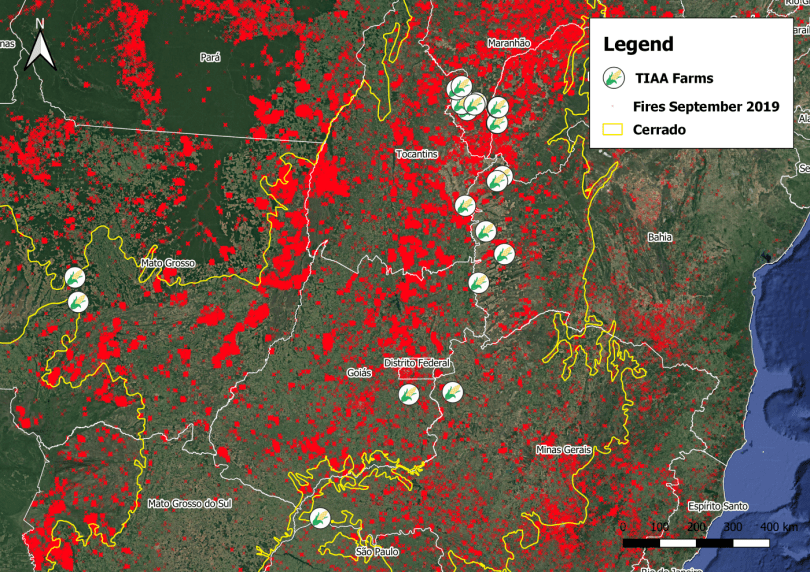
In fact, with the IMF fully engaged, private financial backing for the world’s 35 largest meat and dairy companies totaled an estimated $478bn (£380bn) between January 2015 and 30 April this year. The financing came in the form of loans, bonds and share ownership from the likes of BNP Paribas, Barclays, HSBC, Prudential UK, Standard Life Aberdeen, Legal & General. Pension funds were also singled out for criticism in the report, with Norway’s Sovereign Wealth fund listed as one of the largest shareholders in meat and dairy corporations. US participation in the agribusiness sector also comes from some of the largest pension funds such as TIAA, CalPERS, the NY State Teacher’s Fund and other state retirement funds.

TIAA-CREF Brazil properties

Who benefits? Cargill, DuPont, Bayer (which recently bought Monsanto). The land will be used for cultivation (corn and soybeans), grazing (meat and dairy) and mining. In fact, this trend of multinational agribusiness buying up rich farmland across the world has been going on for 15 years for more. Large tracts in Brazil, East Africa, Eastern Europe, Zambia, Myanmar, Poland, Chile, Australia and elsewhere have been snatched up because the return is reliable. If you’re wondering who is buying the land being cleared by fire in the Amazon, look to these companies and their partners in ‘market efficiency’, i.e. crime: private equity funds, retirement funds, endowments and most likely hedge funds. And then look at the fertilizer giants following right along such as Syngenta with its bee-killing neonicotinoids.

The ostensible reason agribusiness has been descending on vulnerable nations to sweep up large tracts for cultivation is to “feed the world” or to “reduce poverty.” But in reality, the former occupants of the land, living there for generations, often cannot produce clear title. The approach to gaining access to the land is to institute ‘reforms’ that create an ‘efficient’ market where there previously was none. So while the new ‘owners’ use deep financial resources to gain control, the previous owners are dispossessed because they can’t ‘buy’ their own property and are left with meager compensation and no transitional training. Another side of the story is that unlocking ‘dead capital’ can help the poor improve their land, gain access to credit and realize greater returns from it. However, this is World Bank, IMF and The Bill and Melinda Gates Foundation neo-colonial theory based on limited evidence . And while having little or no effect on local poverty, new owners of unused or state-owned land tracts institute cultivation practices known to be damaging to soil, water resources and finite mineral resources. 

Scientists have repeatedly expressed alarm over the environmental impact of large-scale food and dairy production and are calling for a transformation of the global food system. They say the current model is responsible for up to 30% of greenhouse gas emissions and 70% of freshwater use, with huge reductions in meat-eating essential to forestall climate crisis.

Public employees and other American investors checking out the returns from their pension and retirement accounts are, to a degree, looking at the success of these rapacious intrusions into legacy land ownership systems and flawed title systems based on community ownership. These intrusions are designed to take advantage of historically informal systems by pushing formal registries with the intent of separating peasant farmers from their land in the name of ‘productivity.’

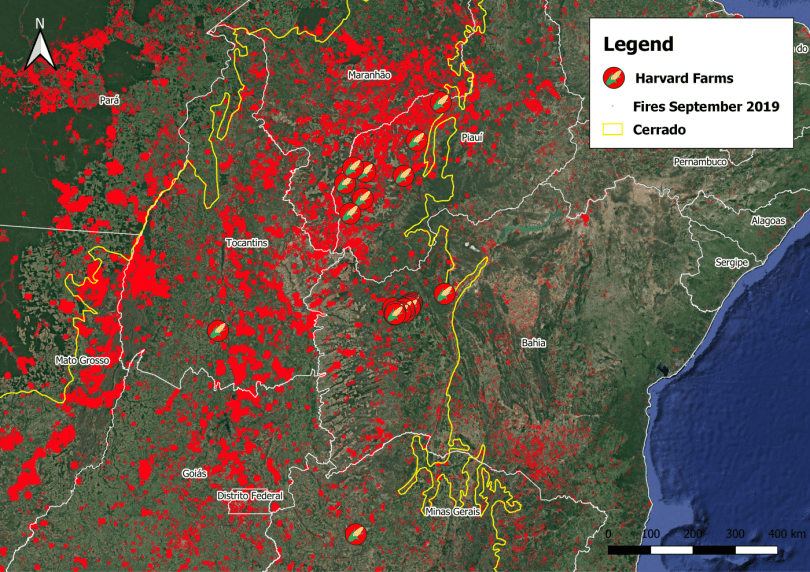
Harvard Brazil Properties

Brazil is a slightly different story. The Amazon fires have spread to the largest and most bio-diverse savannah in the world, the Cerrado. Fires have cleared 40,000 sq miles of land for international agribusiness investors including two of the largest private pension funds in the US: the Harvard Endowment (owner of over 1 million acres) and the New York-based TIAA-CREF (owner of over 830,000 acres). These practices are directly fueling land grabs, assassinations of environmental activists, displacement of indigenous populations, environmental destruction and the well-documented destructive practices of monoculture with chemical inputs.

Arable land is a limited resource. Black soil is a limited resource. Keeping that soil from becoming a source of GHGs instead of remaining a carbon sink and keeping it out of the hands of “drill and kill” developers is just as necessary as preventing the fossil fuel industry from exhausting earth’s ‘carbon budget.’

This Time

In this time of Covid, economic upheaval, the climate monster bearing down on us, unrest and uncertainty, many are suffering. And many, both citizens and entire foreign nations, are watching in horror as American democracy is dismantled by the madman, abetted by his entire party. Joanna Macy’s spiral approach to being present in this world (gratitude, honoring our pain for the world, seeing with new eyes and going forth) is not merely playing out in our imaginations or in private retreats or zoom gatherings. There’s no such abstraction here. It’s playing out in real time, every day as we struggle to grasp the pace of change, how to stay grounded and engaged and not overwhelmed by circumstances beyond our control.

The pace of change draws us more deeply into the present moment. The past evaporates like volatile liquid exposed to the atmosphere. The future is ever more uncertain. We are left awash in the feelings and sensations of the immediate moment. And that immediacy demands a response. On one hand we can dwell on loss. And there are many reasons to do so because so much is being lost—or at least suspended. Lives are being lost, biodiversity is being lost, polar ice, human trust. The rule of law and the social contract are under attack.

Rilke says it best in one of Joanna’s favorite sonnets:

Let This Darkness Be a Bell Tower

Quiet friend who has come so far,

feel how your breathing makes more space around you.
Let this darkness be a bell tower
and you the bell. As you ring,

what batters you becomes your strength.
Move back and forth into the change.
What is it like, such intensity of pain?
If the drink is bitter, turn yourself to wine.

In this uncontainable night,
be the mystery at the crossroads of your senses,
the meaning discovered there.

And if the world has ceased to hear you,
say to the silent earth: I flow.
To the rushing water, speak: I am.

Sonnets to Orpheus II, 29

We are losing our resolve to address the advancing disaster of climate change. We are seeing our political agency being undermined and incrementally destroyed. We are seeing dissent being suppressed combined with the promotion of outrageously bizarre versions of truth. All the trappings of fascism are building into a wave that threatens to sweep away all we hold dear. Every day I am drawn into that loss, perhaps only for moments; but at least daily, at

times even hourly. I descend into agony, beating back and forth from grief to passion, from annihilation to liberation, each fueling the other. Maybe it was Martin Prechtel who said, ‘grief is the womb of art,’ or maybe it was me, I’m not sure. Every day is a transition, swinging from brief regeneration in the soil of grief, being tenderized and motivated to go forth once more with new eyes, an awakened and softened heart, being able to listen and feel what is right on the surface in moments of rededicating myself to possibility.

….but when I lean over the chasm of myself,
it seems my god is dark
and like a web: a hundred roots silently drinking.

This is the ferment I grow out of.
More I don’t know because my branches

rest in deep silence,
stirred only by the wind.

–Rilke

The creative moment is right in front of me. I have left behind all urgency. I am operating in a different time where urgency no longer exists. And I have all the time I need. To make haste is to be driven by a fantasy that may never appear. The fullness of this time is what some Buddhists call the bardo of everyday life, a time of embodying life and death in equal measure, living your dying in every moment, embracing life and being open to the awakening potential of each.

Widening Circles

I live my life in widening circles
that reach out across the world.
I may not complete this last one
but I give myself to it.

I circle around God, around the primordial tower.
I’ve been circling for thousands of years
and I still don’t know: am I a falcon,
a storm, or a great song?

If I could choose, I would be that great song, written while standing in the eye of the storm we are living through right now.


The Global Violence Index

The relationship between the environmental movement and racism is clear. We’ve known this for a long time and it’s become even more important to articulate this view right now. The link between dehumanization, white supremacy, class war, religious bigotry, ethnic hatred, misogyny and climate change is straight. What’s been working in me for the last week or so is a further elaboration on this theme.

The fallacy of economic development fueled by cheap energy has always been that ecological damage is the externality not priced into the cost of that energy. It’s taken 150 years, but failing to account for that externality is what’s bringing us to the brink of extinction. Racism and slavery were (and are) the ignored human cost, the economic externality on which all of that national (and global) economic development depends. Continuing ecological externalities as well as the ongoing human costs of racism are each forms of violence. They lie at the center of the founding and building of this nation and at the center of the global phenomenon of colonialism and economic imperialism.

Colonialism and its neocolonial forms are racist and genocidal violence happening on a mass scale since the 17th century. Fortunately, the violence of slavery was overcome, but the violence of racism, ethnic hatred and continuing forms of economic slavery have held on, all of them fueling the capitalist ideology of Progress. All of them are founded on white supremacy. We may also categorize the industrial engine of capitalism as a violent machine wreaking havoc on social ecologies, biodiversity, polluting and destroying the oceans and the atmosphere.

It took us a long time to recognize and begin to throw off the violence of colonialism and racism, and even longer for us to fully grasp the economic and ecological violence of extraction, consumption and pollution. But it’s time to recognize the true and full consequences not only of continuing racial and ecological violence, but that these two, along with religious bigotry, misogyny and climate denial, driven by white supremacy and neoliberalism, are the singularity of global violence. They comprise what I am calling the Global Violence Index, measured as GHG emissions. This is the legacy of colonial and neocolonial racism.

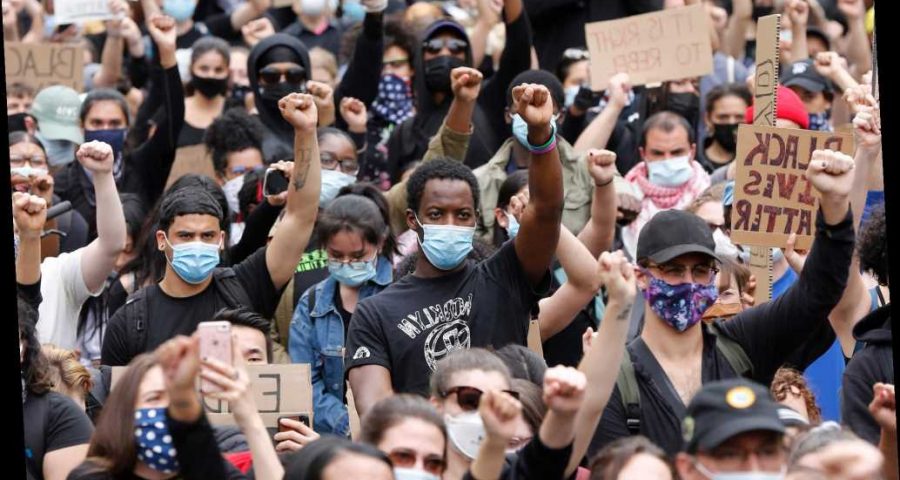
ccelebritiesgeorgefloydprotests-900x480-2

A deeply rooted vestigial tolerance of economic and human externalities is what begets sweatshops in Bangladesh, Indonesia, China, India and Thailand, a minimum wage stuck for 12 years at the same level, ten percent of the American workforce laboring for less than that, an offshore oil rig exploding in the Gulf of Mexico. They are all violence. Tar sands extraction and mountain top coal mining commit violence on the land and the waters. And let’s face it, rare earth mining for the lithium in our phones, EV batteries, military hardware and for an increasing number of appliances is also violence.

Displacement of indigenous peoples is violence, whether it’s the XL pipeline or the mega-hydropower projects of Asia, Africa or South America. Dams on the upper Mekong in China destroying downstream economies and ecologies are violence. Intellectual property laws, with complicit politicians, lawyers and trade organizations are legalized violence. Monsanto, forcing farmers worldwide to buy new seed annually, destroying native seed diversity and driving thousands of small farmers in India to suicide, is violence. Monoculture is violence. Multinationals conspiring to deprive workers of living wages, benefits and to further destroy environmental protections. All of this is violence. The gig economy is violence. Wage theft is violence. Food insecurity is violence. You get my point.

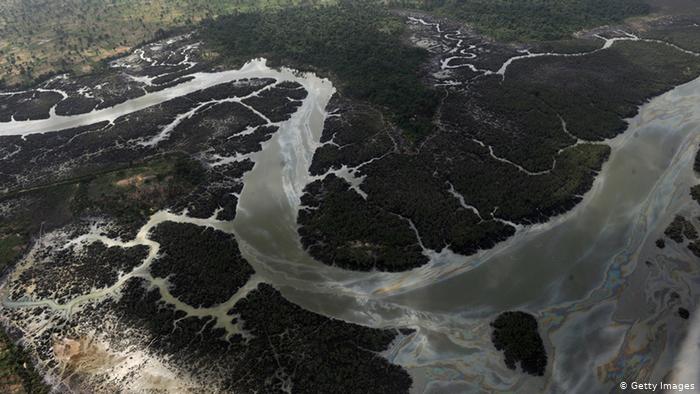
All of these practices have directly or indirectly driven the growth of greenhouse gas emissions worldwide. The neoliberal machine has subjugated governments of developing nations, sown corruption and debt peonage. It is the modern engine of global inequality, committing economic violence, depriving nations of funds for education, infrastructure, health care and the social safety net, all while displacing peoples, undermining democratic institutions and wreaking ecological destruction. The Niger Delta might be Exhibit A. Hell, the USA, with rising levels of poverty, the unraveling of the social safety net, the degradation of education, healthcare, laws and practices, legal and illegal, excluding non-white people from equal opportunity, falling life expectancy, rising infant mortality and the massive class divide is Exhibit A+.

17211913_401
Niger Delta

Domestically, the creation of sacrifice zones, placing dangerous, toxic and destructive installations in African-American, Latin and immigrant communities where people don’t have the economic and political power to resist is violence. Driving economic externalities into already externalized communities destroys their homes, their health and their safety. In a context of already denying livelihoods, wages, health benefits and decent education, communities of color also have to contend with these installations and their deadly products. Now we are gaming out the consequences of global climate change, the increasing impact of extreme climate events, the economic damage and the displacement they portend. We already know who will be most impacted.

America’s journey on the issue of race is entering a death-spiral phase, collapsing into fascism. As a nation of immigrants, having left (or been ripped from) the places where our ancestor’s bones are buried, there is an aspect to the American character that remains homeless. The economic regime’s casual destruction of Home arises from this deep spiritual emptiness. It extends to indigenous communities, such as in North Dakota or here in North Carolina with the placement of fossil fuel pipelines through sacred homelands. America is primarily a home to the few whose dominance depends on successfully selling the idea of America as white people’s exclusive home. This is the subliminal false narrative Trump sells in his deliberate and increasingly extreme efforts to retain control.

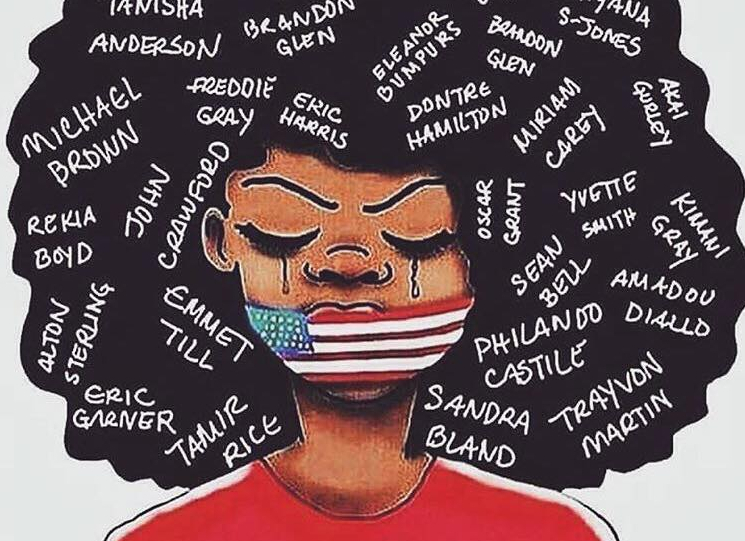
But all the colonial policies and practices here in the US, coupled with the occupying force of policing in indigenous and communities of color send a single message: this is not your home. The destructive and ultimately violent economy doesn’t respect our Home. The message of police violence in communities of color is that the social contact doesn’t matter when it comes to their lives, that they are merely temporary residents. Their right to Home and safety never existed and still doesn’t exist. Their adherence to the social contract doesn’t matter. It can be violated at will and mostly without consequence.  They can be attacked, marginalized, incarcerated, exploited, oppressed, exported, discarded and finally, if necessary, killed—mostly with impunity. And also, you can even be deprived of your vote on all of that.

gotjustice-1

Ironically, COVID-19 has put a temporary stop to the engine of violence. Even while it was devastating the elderly and communities of color in this nation, the Index of Violence crashed. Ten years of gains in global GHG emissions have disappeared. The prospect of full recovery is slim. I’m not suggesting all commerce is violence; not at all. But the interruption of global supply chains, the radical reduction in transportation all contributed to this crash. The long-term prescription for economic recovery is identical to what we already know will reduce global emissions: re-localization, economic equity, the recovery of community, the simplification of supply chains, greater resilience to the coming climate impacts, all fueled by renewables. All of it portends a reduction in violence. All of it will reduce emissions.

So when we take to the streets, we are not solely fighting for racial justice. Justice is not only One Thing— it is Everything. It is the disruption, dismantling and removal of the legitimacy of inequality and white supremacy: the establishment of economic justice, ecological justice, cognitive justice, gender and generational justice. We are fighting to unravel the engine of violence. It is one fight. We are fighting for Home, for the only home we have, for the right to safety, for the fruits of our labor, for prosperity for all. It has taken great suffering and centuries of pain to realize this. Now we know and cannot ever un-know. Success will be reflected in lowering the Global Violence Index.

The Pornography of Everyday Life

In 1964, Supreme Court Justice Potter Stewart famously noted that pornography is “hard to define, but I know it when I see it.” Therein, Stewart uttered and characterized for the rest of us, in perpetuity, the intuitive and pragmatic nature of perceiving and assessing the amorality and distorted values inherent in extreme and damaging relationships.

On the other hand, the implication of his statement is that authentic relationships represent the antithesis of the abuse that Stewart and what most of the rest of us “know” when we see it.

Today, there is much to see all around us as behaviors, attitudes, actions and inactions share the core of these common characteristics which, when examined in depth and taken together as they function in the larger social system, sure look and feel like pornography.

We understand the typical depictions of pornography as the degradation and humiliation of another, turning them into objects, images that conform to a distorted (even psychopathic) view of reality; the denial of and dissociation from another’s humanity and especially from one’s own entirely natural, creative and erotic impulses.

Pornography is the predatory exploitation of vulnerability, an indifference to suffering and/or deliberate infliction of emotional and physical violence. These are the features of the genre. In the current world, the intensity of the dialectic demanding resolution increases almost daily.

We also recognize that damage to the victim directly reflects the depravity and the denial of the perpetrator’s own humanity. Most important, we commonly understand the objects of all these twisted expressions are women. The female is the one who is almost universally degraded, exploited and turned into an object. She is the one onto whom the pornographer projects his pain, his own humiliation and denial. She is the one who is torn apart, chained, turned into a resource and a receptacle, reduced to a purely functional part. She is silenced. Her identity or nature is not of interest. She is reduced to an actress playing the part of a living person.

It’s commonly noted, whether true or not, that rape is not so much about sex as it is about power. It’s an extreme denial of another’s reality, personal safety, needs and very existence. The pornography industry has always included in its routine product the depiction of domination, humiliation and simulations of rape. In its most extreme forms, these include imprisonment, torture and even murder.

The killing of nature is also a metaphor pervading modern American culture; the killing of the natural world, our intrinsic nature; the transformation of the natural within each of us to conform to cultural imagery establishing the patriarchal authority structure, prescribes thought, behavior, preferences and which proscribes the instinctual, the relational, the authority of our individual and unique lived experience–and the erotic.

The killing of the natural world takes place daily in myriad ways and venues, all of which take their toll on the tender hearted, the naturally vulnerable aspects of our nature. Instead, we are subjected to an onslaught of messaging to hate dependence (poverty, disability) and the interdependence it implies. The deliberate cruelty on exhibit every day during the Trump presidency and particularly now in the midst of the pandemic is a further denial of interdependency and vulnerability.

Look around you. Are we not seeing the spilling of rhetorical abuse upon us every day? Are we not witnessing Trump gaslighting, defending, extolling the aggressive and predatory economy, the turning of public goods into private gain, selectively rewarding his friends with vital resources while exploiting vulnerability for political gain? Are we not seeing a vaudeville review of sadistic amorality, defensive self-orientation and denial of responsibility coming daily from the Pornographer-in-Chief in the White House briefing room?

While the most immediate effects will fall upon unnamed and yet uncounted numbers of deaths as a result of his self-serving view, the most pervasive and destructive form of this violence is to our primary (and primal) love affair with the natural world. In the current case, the reflexively embraced metaphor of war is adopted to reinforce allegiance to an authoritarian ideal by framing our relationship with the virus as a manifestation of the natural world. This is 9/11 redux. This is the extremity of the Anthropocene. No further consideration is required, or even necessary.

The objectification of nature, the ideology of dominance and control, the increasingly coercive practices adopted by those whose routine intent is invasion, colonization, extraction and profit is ultimately dehumanizing to us all. Surely you’ve noticed–or perhaps even experienced–how the Trump mafia is facilitating PPE and medical equipment manufacturers to treat their customers as resources, slipping the ‘market economy’ shiv between our ribs during a state of  emergency. This is pure exploitation of vulnerability. No wonder we so often see these acts described as rape. And if someone dies as a result, too bad for them.

The relentless expansion of such exploitive practices with minimal or no regard for the violence that occurs in their wake is of a piece with the pornographic denial of the Other. Neither love, passion nor compassion ever enters into this equation. There is nothing remotely relational, erotic, sacred or even very creative about the single-minded trading of human capital to sustain a lifestyle that systematically murders the goddess of nature within and without. We have been warned many times already. Yet even now, our panic and narrow war-like response to this virus is of a piece with continuing practices now threatening our existence.

The monetization of relationships in a world of constant and highly sophisticated media messaging manipulates, guides and entrains our appetites and emotional responses, interrupting and incrementally substituting for authentic instinctual guidance. We are increasingly remote from the knowledge of our own bodies. Meaning is strip-mined from our lives, divorcing us from the plain and simple meaning lying within the material experience of being alive. It is no wonder that so many see evidence of a pandemic spiritual crisis. The eruption of compassionate humanity we see all around us now serves as a stark contrast to the prevailing condition.

The response to COVID-19 by the pornographic White House is also of a piece with the wishful thinking of certain media propaganda outlets, who for decades now reflexively substitute facsimile for authenticity. That will take its toll. Perhaps this virus will, when it’s finished killing a few (100,000?) of us, also wake us up to the magnitude of our hubris about nature and remind us of our subservience. But even if such a message gains footing in the culture at large, it will be ignored or resisted by the pornographic GOP cult of cruelty and death.

The crisis of authenticity is most evident in the young, who for their entire lives have been subjected to simplistic and demeaning stereotypes about they way things are. Seeking false refuge in the material and the rational, certain of our superiority and goodness, kneeling to the commands of narcissism while denying the shadow parts of our selves, we day by day are losing control over our own lives: these are the dimensions of a dissociative process also capturing the young.

They are maturing into a world that deprives them of security, optimism and spirit. In a world of increasing economic coercion, especially now, the chickens of debt slavery, the transformation of America into a low-wage nation, the unraveling of the health (s)care system, the social safety net, the constant assault on the compact of community, the privatization of the commons are all coming home to roost. The message is all too clear: you are only matter; your being, your spirit does not matter; you are a resource to be exploited like a forest or a petroleum deposit. If you resist, you can be cast aside; there will be someone else to take your place, for less. Only ownership matters. That, and inherited wealth.

The arbiters of this imagery, those who craft and trade in and sculpt it in its various forms and manifestations are white men. The denial of nature, the assault on the feminine, the domination and exploitation of the earth is planned and executed by white men. In doing so, they not only deny their own nature, the risk their own future.

When we contemplate a mass killing (another form of pornography), we are grateful the  killer is not us, that we have not been subjected to a seemingly random violent act. The killer was the one disturbed. What could have gone wrong with him, we ask? Even if we have no intent to fully analyze him, the raw facts of the case are often evidence enough that he was caught in a matrix of obsession, denial, hatred, pain and rejection.

The murderer kills a rejecting parent, their own desperation, their own intense pain. They murder impotence, the loss of control they never had. They murder innocence, their own nature, their own lost inner child. They lash out at everything “out there” because they cannot live in a landscape of uncontrollable emotion, dependency and fear. We’ve known for a long time he is a symptom. What of the treatment?

We live every day now with the pornography of extreme wealth, the narcissistic entitlement of the economic elite and their secretive machinations. We live with the pornography of massive tax avoidance combined with the infection of the political process by money, the backlash of patriarchy in the form of ever more aggressive forms of misogyny. And, day by day, as if its various forms are separate from each other, the appetite for (and escape into) online pornography reaches new heights. Surely we know all of this when we see it every day.

Evangelicals and Trump: A marriage made in….USA.

What is it with evangelicals and Trump? He can do no wrong. In fact, the wrong-er he gets, the more they genuflect. Even now, as he turns every press briefing in the midst of a surging pandemic into a campaign rally. Even as he stands by while people die by the hundreds, especially in New York. Why?

Because, of course, he’s a messenger of God.

Let’s take a very cursory tour through religious history, brought to you by someone who is not at all a religious scholar. But bear with me.

Through the earliest period of Christianity, there was a debate. Did Jesus believe everyone and everything is the Light of God? Or did he believe only He is the light of God? The Gnostics believed everyone—everyone—is the Light of God, that divinity dwells within and that the Light can be directly experienced. It cannot be given nor taken away. You’re It already.

If that’s all true, then who needs a church, right?

The Patriarchal clergy, the Church, came to believe, conveniently, that only Jesus was the Light of God and the only Way to God was Through Jesus and the only Way to Jesus was Through the Church. God was objectified and the religious monopoly was born. You are a sinner and the divine Light does not live in you and only the Church can tell you how to get some.

Constantine became the first Christian Emperor, promoting the faith and merging the Roman Empire with The Church in 325 AD. The State became the Holy Roman Empire and the Church became its spiritual ally and instrument. The first fascist state: the union of corporate spirituality with the institutional power of the state. So began the Holy Reign of Terror of the Church–ruling by fear, torture, extortion, intimidation, disempowerment (and disembowelment), theft and other forms of abuse. There was, in effect, no difference between economic and spiritual subjugation.

The Evangelicals of today want a return to that world: USA = Holy Roman Empire redux.

The first thing the Church did was identify and attack heretics. Calling someone a heretic was the way to consolidate and maintain power by demonizing all opposition and recruiting the flock –energizing the base– to assist in meting out retribution for ideological impurity. Sound familiar?

The original heretics were the Gnostics–the ones who believed that everyone is the Light. They were attacked and erased because they believed the Light of God was in everyone….. or, what might be a modern equivalent, that immigrants are people.

America has always believed itself to be the holiest among nations. But now, the authoritarian structure of Evangelical Christianity has merged perfectly with the pursuit of ideological purity by the Republican Party. Amerikkka on steroids.

Together they root out and demonize heresy wherever it lies. The primary heretics today, just as in ancient times, are the ones who believe the Light of God is in everyone and everything and everyone has equal access to the divinity within.

Today’s heretics, like the Gnostics, are the absolute Devil. Egalitarianism is heresy. Multiculturalism is heresy. International cooperation is heresy. Racial equality is heresy. The USA is now a lawless nation not subject to any restriction other than its own spiritual law—a cloak  gathered upon the opportunistic shoulders of….yeah, you guessed it: Donald Trump.

And for the Evangelicals of today, just like the Holy Roman Empire and the Catholic Church of the First Millennium, money and power are the measure of your spiritual worth. For them, the nation is the body of the Church and thus only the pure, the true believers, may enter (or vote). The President is the Holy Father who is burdened by the Cross of Persecution placed on his shoulders by the devils (Deep State, media) seeking to take down the Church. The ideas of the heretics are everywhere, posing as reason, logic, evidence and the rule of law. Or democracy. Especially democracy.

The work of the Devil is everywhere, making deceit, surveillance, secrecy , cruelty, usury, conspiracy, extra-legal acts and violence legitimate tools of the Church/State. Because those are effective tools against the Devil.

In the eyes of evangelicals, Trump is the Pope of the New Church, seeking Imperial Legitimacy as the voice of God Herself. Oops. That’s another work of the Devil, imagining God as female. Trump’s (unconscious but convenient) design is to disrupt and expose heresy, i.e. the aforementioned belief in law, reason, logic and evidence. Only He, like the Pope, defines what is right for the nation. Only He stands between the nation and Chaos, even as he becomes the primary source of chaos. Only He can protect the body of the Church. Create a crisis, use it to grab more power, wash, rinse, repeat.

Purity is to be defined and established by policy, outlawing heresy in all its many forms. Heretics are hiding in plain sight. They are brown, black and yellow, foreign, non-European, poor, disempowered–and especially uppity females. They are storming the Church. They are ecumenical. They are sad and dangerous fools who think love is love. They worship false gods such as equality, self-determination, intrinsic divinity and the social good. They also believe actual humans lives are worth saving. They are to be rooted out by any means necessary.

The flock is preparing for that day.