Collapse Redux

The basis of Jem Bendell’s original and revised paper on climate-induced societal collapse and Deep Adaptation was his review of current climate and public opinion research. In addressing the probability of societal collapse, his paper was and remains a contribution to popular understanding of the social implications of climate change, mainstream environmental advocacy and our current predicament. The definition of collapse he chose was an uneven ending of our normal modes of sustenance, shelter, security, pleasure, identity and meaning.  Any distinction between collapse and catastrophe was not addressed. And, by the way, what is “societal” anyway? Whose society? Perhaps this omission was intentional, but clearly, he regarded any more specific definition of collapse as a separate pursuit. 

Bendell was obviously content with allowing collapse to remain mostly a subjective frame, which would account for wide differences in definition depending on whom is talking—and where. What, after all, is the normal mode of sustenance or shelter, or even pleasure? And what is normal? If sustenance was overtaken by a revolution in food production that fed more people for less money and didn’t even require soil, would that be an ending of normal? Security is also an awfully big tent if it contains governance, rule of law, energy, health care and public health. Burning the last drop of oil would certainly be an ending, but would it be collapse? The fact that there was no serious effort to be more specific, even if it might have proven as difficult as picking up mercury with your hands, guarantees that readers remain within their subjectivity without much questioning and that the resulting variability of responses don’t represent a very reliable measure of anything. Perhaps it’s only what people believe that’s important.

Bendell also goes to great lengths to describe different psychological strategies, including denial within the environmental movement itself, for mitigating direct confrontation with advancing collapse and especially how we, particularly scientists, steer away from alarmism. Bendell has been criticized for making declarations potentially triggering despair. Different cohorts, whether scientists, laypersons, academics, different age generations or even samples from widely different cultures may have very different ideas about what collapse would look like. But in the absence of (even flawed) parameters, we are left to imagine the worst possible scenarios and a very hazy timeline in which they might unfold. Bendell may have had good reasons to avoid defining collapse any more specifically than he did, but his orientation, given the evidence he was citing, was solely to advancing climate impacts without much attention to political or economic dynamics. 

In that avoidance we lose (or overlook) a capacity to evaluate whether collapse is already progressing according to dynamics not directly linked to climate impacts per se, or whether in grappling with a definition we might inevitably expand our understanding to include dynamics that only become more visible and valid according to a systemic perspective that doesn’t arbitrarily exclude those social, political and economic dynamics. 

Collapse also deserves a closer (and wider) review because it carries implications for determining whether climate signs already exist, whether there are additional signs of collapse which may not be specifically climate-related but will augment climate impacts, and because the use of this term in this context appears to exist within a limited ethnocentric (global North) perspective. Whether collapse is already here for parts of the global south or whether it remains at a comfortable distance for the industrialized north is not even an open question. It’s difficult to tell whether Bendell was writing for a limited audience. But for the north, at least, we are already fascinated and appalled at the same time, hovering between hope and despair as events increasingly break through our dissociation. But for areas of the South, the signs are more advanced and already clear.

If we considered a single individual as a metaphor of global human systems, we could easily diagnose the patient in the grips of a profound ecological disease, even a pathology, gradually taking over. The fever is rising and the patient is in increasing distress. We see organ systems on the way to failure. From Bendell’s view, collapse represents a transition of the patient into an unmanageable condition, human systems failing to remain in any semblance of harmony with the biosphere. In other words, how can we speculate about when collapse may occur without naming the signs of illness, the social and environmental symptoms along with those strictly related to carbon emissions?

Just to be slightly more precise, although collapse may be perceived as a response to catastrophic events such as the permanent loss of polar ice, the jet stream or the Gulf Stream, it’s more likely to be a slowly unfolding emergency (uneven, as Bendell said) whose impacts aggregate over time. How long that time may be could vary from 10-50 years, or even longer. The question is, where is the inflection point between a normally functioning society and one that is coming apart—or will we only know in retrospect? There will be many signs, increasingly varied and disruptive. There will be mitigation, from mostly effective to increasingly futile. There may be rampant denial and spreading panic. How much deforestation does it take to upend normality? How much pollution? How much ocean acidification before the food chain collapses? Is fascism a sign of greater or lesser security? Is mass surveillance a sign? Is the pandemic a sign?

We are challenged to investigate relationships among an increasing variety of events and systemic adjustments to come to conclusions about what is climate related and what may not be, realizing that as time passes, the increasing number of events portending collapse will most likely be directly attributable to climate. And even if those relationships appear to be tenuous, the reality is that all events are data points illustrating the operation of a social, political and economic regime driving violent global change. 

Bendell’s references to climate research include numerous big picture metrics such as sea ice, ocean acidification, the atmospheric carbon budget and changing weather patterns. He bases his theory of inevitable collapse on these advancing measures across numerous defined ‘tipping points’ and makes a case for near-term collapse based on these and additional effects of existing carbon emissions already baked into the atmosphere. The aggregate of emissions playing out over the next 1-3 decades will, he asserts, guarantee disastrous impacts. Likewise, despite the potential for sequestration practices at significantly greater scale or for radical reduction in emissions, the fact is we are adopting neither of these measures to the degree necessary, increasing the probability of collapse.

In addition to calculations of carbon emissions and sequestration, Bendell includes further and more recent data on the measurement of methane emissions and the likely scenario for their acceleration and resulting amplified climate effects as well. This is high-level analysis permitting the most general speculation about the sustainability of human and ecological systems and the likelihood of unpredictable effects on civilization, both agrarian and ocean-based food systems, human migration, disease and the loss of biodiversity.

The greatest proportion of global carbon emissions comes from a limited number of affluent nations. There is no dispute about this. We know the effects of those emissions will fall first upon less developed economies and peoples, but their impacts will also fall on local communities. In fact, while much of the affluence of industrialized nations derives directly from resources extracted from less-industrialized nations and guarantees the true costs of fossil fuel exploration and consumption to fall on those nations, the costs of other resource extraction practices also fall upon those less-developed economies. 

In case one needs examples of these practices to fully grasp the nature of globalized exploitation and the externalization of ecological effects, we need only look at the tar-sands operations of Canada and Colombia, the destruction of the Niger Delta, toxic residues in Ecuador, the deforestation of Indonesia, the burning of the Amazon, mountaintop coal mining and the destruction of water resources in the US. In other words, the wealth and hence the carbon footprint of industrialized (white) nations derives primarily from the appetites and extractive practices of those nations in the global south. 

In the most general terms, what collapse looks like is the transition of a society from greater to lesser complexity. Outside westernized urban centers, much of the global south is already less complex than the industrialized north, with agrarian culture’s economies more localized and resilient. But since Bendell shies away from defining collapse (or catastrophe) in anything other than the most general terms, one gets the impression the destruction he speaks of will only become real when it effects industrialized societies who have benefited the most from emitting carbon—at the expense of everyone else–and that their very development and stability insulates them from initial and less dire effects of climate disruption. 

Indeed, Bendell rattles off the list of recent international institutional efforts created to mitigate the effects of climate by building resilience into developing economies. Unfortunately, these efforts aren’t much more than institutional green-washing, too little and too late. While the North refused in Paris (2015) to adequately compensate the South for climate impacts, giving themselves the freedom to define their own mitigation efforts in the absence of any enforcement mechanisms, they sloughed off their responsibilities to underfunded excuses, continuing Business As Usual and guaranteeing catastrophe far away from their own shores.

Meanwhile, contemplate just a few drivers of uneven endings:

  • The massive and unprecedented shift of wealth upward for the past four decades 
  • Unregulated capital markets and the creation of phantom economies using unregulated speculative financial instruments, shifting risk to the collective.
  • Increasing extraction from labor and destruction of intrinsic and extrinsic rewards. 
  • Intrusive and controlling policy serving narrow economic interests at the expense of health, education and the welfare of the commons.
  • Mismanagement of land and degradation of food safety: food and soil quality declining with monoculture, pesticides, additives, GMOs & preservatives.

What collapse feels like is also not a matter to ignore. What may not be at the forefront of awareness is rising anxiety and apprehension about the security of current lifestyles, a viable future and the ability (not to mention willingness) of governments to respond. Do the incremental changes in perspective, the rising apprehension and pessimism about the future (solastalgia) count as a signal of collapse? The reality of these proliferating signs of economic and psychological stress are likely more widespread than we realize. And we’re not likely to be able to calculate their true effect until it’s too late.

Meanwhile, the North continues to generate climate impacts in the South, knowing the effects and continuing practices foretelling social disruption and eventual collapse elsewhere. Climate-related signs are already present, but again, it’s only from the perspective of highly developed western economies that Bendell presents the probability of collapse, failing to account for existing signs in less developed economies. 

A few examples: 

  • Much of Bangladesh is under water. Between this year’s monsoon and a climate-amped cyclone, millions are affected by the pre-existing COVID lockdown, the closure of businesses, the loss of rural income usually provided by urban workers and the loss of arable land by erosion. 
  • Indigenous societies in Brazil are undergoing attack and destruction (ethnic cleansing?) by Bolsonaro’s aggressive agricultural development practices, directly driving climate change in the Amazon and the planet. 
  • Parts of the Pacific island nations of Fiji, Kiribati, Solomon Islands, Marshall Islands, Vanuatu and Micronesia are already disappearing. Human settlements, sanitation, agriculture and fresh water supplies are threatened due to rising sea levels.
  • Disastrous multi-year drought and total crop failure in the north of Syria caused mass migration to the cities and, along with resource mis-management, foretold the destruction of that nation. 
  • Sudan is experiencing climate driven variability and timing of extreme temperatures and rainfall, disrupting food supplies, triggering civil war, the displacement of millions and a succession of either military dictatorships or civilian incompetence. Suffering is pandemic.

We could go on. It will likely be only when there are unavoidable signs occurring at home that developed nations will take notice:

  • The rich central valley of California supplies a vast majority of all the fruits and vegetables for the entire US. Yet extended drought conditions have forced growers to tap groundwater supplies for years. Wells are now dropping 150 ft. or more into the falling aquifer. Water war is a long-standing condition between densely populated northern California urban centers and the agriculture industry. Factor in the declining snowmelt of the western Sierra and we have conditions eventually forcing choices between food and water.
  • The Southwestern US relies on water supplies from the Colorado River and Lake Mead. Water levels of both have been in steady decline for decades. It’s only as matter of time before the viability of the metropolises of Phoenix, Las Vegas and Los Angeles are threatened.
  • The UK wheat crop is the lowest in 40 years, foretelling a sharp effect on food prices. 

Climate related migration has been already underway in many locations, causing economic and political destabilization. Coastal property insurance costs are rising and coastal land values are falling. Migration from the Florida Keys, Houston, New Orleans and the Mississippi Delta is rising. Whether it’s flooding or water scarcity in India, climate migration will result in unchecked urban growth just as it did in Syria, taxing inadequate infrastructure and further causing political and social stress.

What global events have been telling us for quite awhile and which have become especially clear very recently is that virtually no aspect of human presence, other than by reductionist efforts defining linear causation, can be culled from the whole and paraded before us as irrelevant to a calculation of impending collapse. Does collapse mean preventive measures have already failed? Would the implementation of security measures or the initiation of resource conflicts themselves represent collapse? Would mass food insecurity alone or rising crime in response to food insecurity constitute collapse? Does collapse imply a breakdown of governance, lawlessness or border disputes? 

One of the most practical aphorisms of this age is to “think globally, act locally.” From this view the Deep Adaptation agenda makes sense, although it could stand some scrutiny and even radical expansion of what Reconciliation means from a global view. Personally, I see few signs of human resolve to revert to true reciprocity with the natural world in time to forestall broad collapse. Given the pace of events, the high degree of integration of global systems and realizing the entirely ethnocentric orientation of this agenda in the face of a huge disparity between the outlook and fortunes of the North and South, we might consider reversing the aphorism to “think locally, act globally,” asking what we need to do on an international scale to restore reciprocity and reverse the drastic inequities already playing out as consequences of our privileged over-consumption of carbon-based products. In doing so, we might even be saving ourselves. 
Stray Thoughts

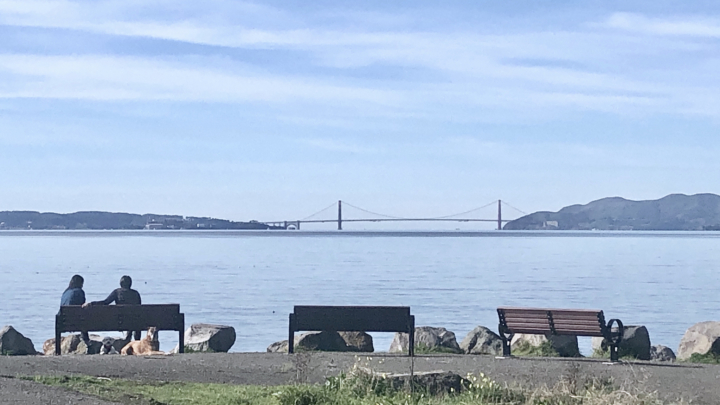
Here by the water the only constant
is the wind, the waves behave as if they
couldn’t be bothered to make themselves known

against the rock. A fellow nearby looks intently
at The Gate while his beloved sits in silence,
chin in hand, waiting for the answer that should come

to her at any moment. This bench is dedicated to the
public service of a city councilman, who from this spot
shall look upon the Bay forever, contemplating the

shifting nature of the world he left behind.
This is the day I will record the argot of the shaman
preparing his evening magic by a low fire,

a squirrel rising up from a rocky windbreak,
the clatter of small drums,
the snap of kite tails and unintelligible

harmonies celebrating sunshine. Ballooned yachts
criss-cross the horizon, white sails whipping halyards
taut — a flock of gulls straddling the updrafts–

white wings, distant whitecaps, a white cotton
candy sky, a white dog passing,
the white socks of the walkers,

the white lace gown you wore last night,
the bed a Rohrschach in white.
The Buddha never shifts his gaze.

Black Soil is the Other Oil

Ukraine is known as the “breadbasket of Europe.” According to a recent report from the Oakland Institute, it has one-third of all the arable land in the EU (32 million hectares). For 19 years the nation had resisted the arm-twisting, coercions and seductions of global finance to protect its rich agricultural base and keep it in the hands of millions of peasant owner-farmers, sparing them the invasion of industrial scale use of pesticides and fertilizers. Ukraine is the 7th largest wheat producer in the world. This is some of the best land on the planet. Guess who wants it. 

Since COVID effected the Ukraine economy in the same ways it has everywhere else, the nation was cash-strapped. The IMF, the Snidely Whiplash of global predators, offered Ukraine a desperately needed bridge loan. In return, the IMF wanted to open a land market, gaining access to that black soil, over the objections of 80% of the population (who were locked down and could not publicly demonstrate), President Zelensky eventually agreed. And since then (March, 2020), those cash-poor, land-rich peasant farmers have been gradually separated from their most valuable asset because they couldn’t come up with the cash necessary to obtain a license to keep their own land.

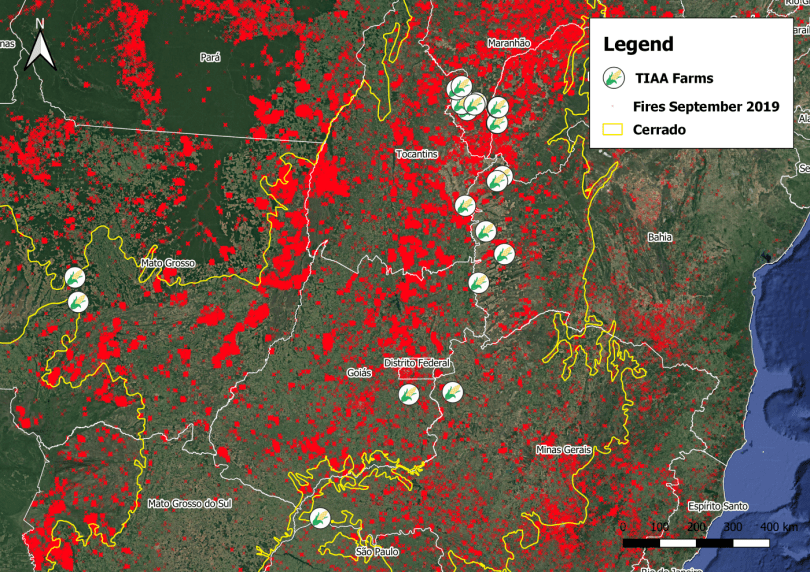
In fact, with the IMF fully engaged, private financial backing for the world’s 35 largest meat and dairy companies totaled an estimated $478bn (£380bn) between January 2015 and 30 April this year. The financing came in the form of loans, bonds and share ownership from the likes of BNP Paribas, Barclays, HSBC, Prudential UK, Standard Life Aberdeen, Legal & General. Pension funds were also singled out for criticism in the report, with Norway’s Sovereign Wealth fund listed as one of the largest shareholders in meat and dairy corporations. US participation in the agribusiness sector also comes from some of the largest pension funds such as TIAA, CalPERS, the NY State Teacher’s Fund and other state retirement funds.

TIAA-CREF Brazil properties

Who benefits? Cargill, DuPont, Bayer (which recently bought Monsanto). The land will be used for cultivation (corn and soybeans), grazing (meat and dairy) and mining. In fact, this trend of multinational agribusiness buying up rich farmland across the world has been going on for 15 years for more. Large tracts in Brazil, East Africa, Eastern Europe, Zambia, Myanmar, Poland, Chile, Australia and elsewhere have been snatched up because the return is reliable. If you’re wondering who is buying the land being cleared by fire in the Amazon, look to these companies and their partners in ‘market efficiency’, i.e. crime: private equity funds, retirement funds, endowments and most likely hedge funds. And then look at the fertilizer giants following right along such as Syngenta with its bee-killing neonicotinoids.

The ostensible reason agribusiness has been descending on vulnerable nations to sweep up large tracts for cultivation is to “feed the world” or to “reduce poverty.” But in reality, the former occupants of the land, living there for generations, often cannot produce clear title. The approach to gaining access to the land is to institute ‘reforms’ that create an ‘efficient’ market where there previously was none. So while the new ‘owners’ use deep financial resources to gain control, the previous owners are dispossessed because they can’t ‘buy’ their own property and are left with meager compensation and no transitional training. Another side of the story is that unlocking ‘dead capital’ can help the poor improve their land, gain access to credit and realize greater returns from it. However, this is World Bank, IMF and The Bill and Melinda Gates Foundation neo-colonial theory based on limited evidence . And while having little or no effect on local poverty, new owners of unused or state-owned land tracts institute cultivation practices known to be damaging to soil, water resources and finite mineral resources. 

Scientists have repeatedly expressed alarm over the environmental impact of large-scale food and dairy production and are calling for a transformation of the global food system. They say the current model is responsible for up to 30% of greenhouse gas emissions and 70% of freshwater use, with huge reductions in meat-eating essential to forestall climate crisis.

Public employees and other American investors checking out the returns from their pension and retirement accounts are, to a degree, looking at the success of these rapacious intrusions into legacy land ownership systems and flawed title systems based on community ownership. These intrusions are designed to take advantage of historically informal systems by pushing formal registries with the intent of separating peasant farmers from their land in the name of ‘productivity.’

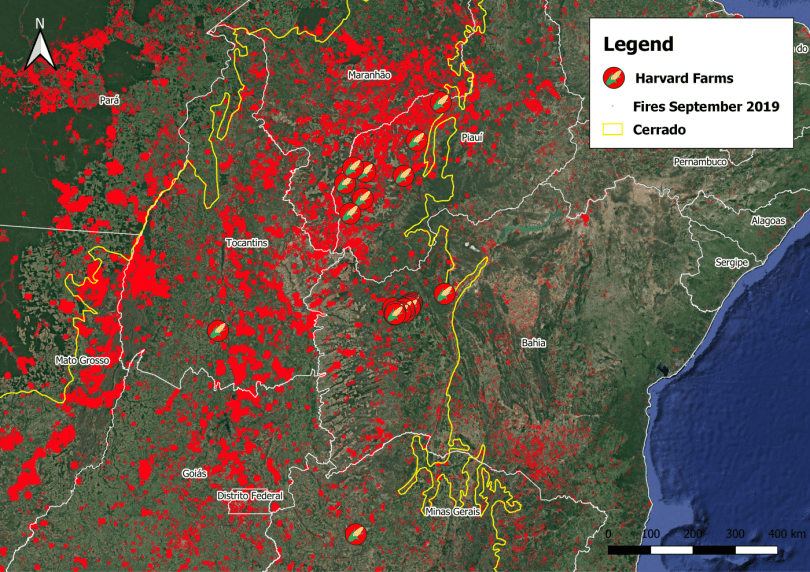
Harvard Brazil Properties

Brazil is a slightly different story. The Amazon fires have spread to the largest and most bio-diverse savannah in the world, the Cerrado. Fires have cleared 40,000 sq miles of land for international agribusiness investors including two of the largest private pension funds in the US: the Harvard Endowment (owner of over 1 million acres) and the New York-based TIAA-CREF (owner of over 830,000 acres). These practices are directly fueling land grabs, assassinations of environmental activists, displacement of indigenous populations, environmental destruction and the well-documented destructive practices of monoculture with chemical inputs.

Arable land is a limited resource. Black soil is a limited resource. Keeping that soil from becoming a source of GHGs instead of remaining a carbon sink and keeping it out of the hands of “drill and kill” developers is just as necessary as preventing the fossil fuel industry from exhausting earth’s ‘carbon budget.’

The Eye of the Storm

The state of gnosis is defined as an arrival of total awareness, a direct and often sudden experience of reality, wholeness, some spiritual truth beyond typical conceptual understanding. Gnosis is an intense and total immersion in the unity of divine nature. Few could say they’ve ever had such an experience nor anything close to such complete knowing, a burst of non-dual presence, whether lasting one hour, one minute or even one second. 

What if we’re all having that experience right now? What if this mystifying unveiling, the cataracts of modernity being stripped from our eyes, the complex system of global culture stopped in its tracks, the open wounds of racism, white supremacy, inequality and of highly discriminatory structures of social control exposed before us, not to mention the exhaustion of the idea of human supremacy over the natural world, reductive medicine, the agonies of earth, the collapse of the legacy energy system and even the specter of extinction appearing on the horizon are together generating a mass experience of wholeness? 

What if we’re all standing on the threshold of our own personal breakthrough moment, wrestling with the sensations, feelings and barely comprehensible observations, realizing the full nature and impact of interdependence beyond any theories, contrived models or imagination? What if we’re taking our first steps into a deeply uncertain future already knowing far more than we realize? 

Gnosis transports us into the heart of emergence, interdependence and universal relationship. All phenomena, including thoughts, feelings and sensations are all one and all now. We are standing against a tsunami of perpetual stillness, a continuous tidal wave of creative interdependent unfolding that has no beginning, no end, no center and no limits. Boundaries dissolve. There is no distinction between the inner and the outer universe. Ego is lost, subsumed in radical entanglement with everything. Is that not the experience of this moment? Despite our struggles to make sense, our separate identities become gauzy and indefinite. Even more importantly, much as we might wish to cling to hope as a lifeline to the future, what confidence can we muster in the face of such a muddled vision?

Spaciousness, however, abounds. Time slows down, awareness of all ‘events’ is acutely and vividly focused. We might well imagine such experiences are extremely rare. And they are. They can be unsettling. But this moment is unprecedented. Beyond the safe confines of our carefully constructed identities, unexplored capacities are emancipated. The familiar is upended. We are instantly seduced to tease, to assimilate, interpret and to act. 

Gnosis is commonly a religious or mystical experience. It’s a spontaneous encounter with truth beyond comprehension. In modern culture, it’s not acknowledged nor is gnosis well understood or even regarded as a worthy pursuit except in mystical circles, as though the rituals of inquiry, the visionary pathways have been lost in antiquity. But that’s just the way we like it, isn’t it? We don’t have to think for ourselves. In fact, instead of piercing our accumulated filters of bias, bewilderment and fear, plenty of people seek refuge in nationalism and religious dogma, believing them to be bedrock values. But we are far beyond these now. We are wandering in primal terrain where such accessible anchors can only take us deeper into delusion. We are being challenged to rewrite the source code for human presence on the planet. 

We are arrested, with no sign of easy or proximal solutions as we share this sensation of falling together. Loss and instability reign, the personal and collective parameters of normal are eroding without any replacement reality in sight. Even though corporate and political forces seek to take control in this vacuum, we have not yet stepped into the new. The point of gnosis, however, is to realize we already know. We must become our own sense makers. We cannot wait for someone else to decide for us. 

In the midst of this transition, instead of confusion, fear and reactivity, we are on a mass unwitting collective and individual journeyThere are few authentic leaders here, only pretenders. Our antipathy toward any kind of limit is on full display: a pandemic freely driven by its own intrinsic directives, climate change, economic disparity, the sophisticated wealth extraction of late-stage capitalism, a persistent and dispiriting assault on truth, the rise of theocratic fascism and environmental destruction are all stripping us to our raw essenceWe can see the macro. Now it’s time to attend to the micro. It is our responsibility to seek guidance from within, to track the subtle and nuanced flows of feeling with focus and rigor and to respond in real time to the truth of our relationships and to the destructive nature of so many granular decisions of everyday life. 

Who are we to become? We may have only a vague notion of how to process what is emerging, let alone what is beyond this moment. We do sense there’s no way to dissociate or avoid what is happening all around us and within us. All we truly know is the intensity. We have no choice but to be here and totally in it. Instead of resisting, going through familiar motions and attempting to reconstruct systemic collapse, suppose we were to let go and stand in the eye of the storm, watching all resistance dissolve as we sink deeper into the shifting currents of change?

Gnosis is an entirely different take on agency. The rules don’t conform to conventional physics. We are becoming the world as the world is becoming us—which has always been true, but only now becoming more visible. Complete interpenetration with no static outcomes is the new rule; we are enmeshed in an unpredictable eternally transformative process of inter and intra-active engagement with no logic to contemplate, no rules to apply; nowhere to go for advice. 

Gnosis sees all events from a vastly greater perspective. Linear causation is not recognized as a prime directive except from the narrow view of a very limited array of events. From the perspective of gnosis, making significant decisions on such analysis is foolish and self-destructive. To sit still with all the feeling, confusion and not knowing of this unfolding drama is the current challenge. Now everything matters; the smallest stimuli, the smallest adjustments, how we make sense of our world, all matter more than ever. This will determine who we become.

We’re waking up from a narcissistic, self-destructive dream. Waking into gnosis cuts through the illusions, the complexity, the inertia, the havoc and tenacity of modern culture. We’re in the wilderness now. We’re being given a chance, perhaps a last chance, to find our way. 

Gratitude

Gratitude, I am your listening post,
perched on the shoulders of mountains,
in the grasses, in your granite faces,
reclining in the long valleys of your body.
.
Send me your chariots, your champion angels,

warriors of the spirit, whose love rises in speech,
in gesture, in wordless looks,
bathed in sublime rose waters;
even in anguish for the suffering of others.

Send me your thoroughbreds, heavy with bridle;
I will race alongside you, breathing my thanksgiving
for the idealism of youth, for the wild and holy power
of the earnest novitiate;

for conversations between fathers, mothers,
sons and daughters, blooming in the
rising cumulus of purity and courage, in
the altitudes of high regard, the vitality of innocence,
the awakening of inquiry.

Let me travel beside you,
raining down with the pounding hooves
of your galloping love.


No Time To Lose

Reading Andrew Harvey’s 1994 book, The Way of Passion, about Rumi’s relationship with his teacher Shams i-Tabriz is a riveting and enlightening dive into the poetry Rumi produced from that time.

Reading Andrew Harvey’s 1994 book, The Way of Passion, about Rumi’s relationship with his teacher Shams i-Tabriz, is a riveting and enlightening dive into the poetry Rumi produced from that time. Why would I read this? Because devoted to my Buddhist niche as I may be, it’s dry in comparison to the ecstatic and explosively awakened passion of Sufism. Continue reading “No Time To Lose”

This Time

In this time of Covid, economic upheaval, the climate monster bearing down on us, unrest and uncertainty, many are suffering. And many, both citizens and entire foreign nations, are watching in horror as American democracy is dismantled by the madman, abetted by his entire party. Joanna Macy’s spiral approach to being present in this world (gratitude, honoring our pain for the world, seeing with new eyes and going forth) is not merely playing out in our imaginations or in private retreats or zoom gatherings. There’s no such abstraction here. It’s playing out in real time, every day as we struggle to grasp the pace of change, how to stay grounded and engaged and not overwhelmed by circumstances beyond our control.

The pace of change draws us more deeply into the present moment. The past evaporates like volatile liquid exposed to the atmosphere. The future is ever more uncertain. We are left awash in the feelings and sensations of the immediate moment. And that immediacy demands a response. On one hand we can dwell on loss. And there are many reasons to do so because so much is being lost—or at least suspended. Lives are being lost, biodiversity is being lost, polar ice, human trust. The rule of law and the social contract are under attack.

Rilke says it best in one of Joanna’s favorite sonnets:

Let This Darkness Be a Bell Tower

Quiet friend who has come so far,

feel how your breathing makes more space around you.
Let this darkness be a bell tower
and you the bell. As you ring,

what batters you becomes your strength.
Move back and forth into the change.
What is it like, such intensity of pain?
If the drink is bitter, turn yourself to wine.

In this uncontainable night,
be the mystery at the crossroads of your senses,
the meaning discovered there.

And if the world has ceased to hear you,
say to the silent earth: I flow.
To the rushing water, speak: I am.

Sonnets to Orpheus II, 29

We are losing our resolve to address the advancing disaster of climate change. We are seeing our political agency being undermined and incrementally destroyed. We are seeing dissent being suppressed combined with the promotion of outrageously bizarre versions of truth. All the trappings of fascism are building into a wave that threatens to sweep away all we hold dear. Every day I am drawn into that loss, perhaps only for moments; but at least daily, at

times even hourly. I descend into agony, beating back and forth from grief to passion, from annihilation to liberation, each fueling the other. Maybe it was Martin Prechtel who said, ‘grief is the womb of art,’ or maybe it was me, I’m not sure. Every day is a transition, swinging from brief regeneration in the soil of grief, being tenderized and motivated to go forth once more with new eyes, an awakened and softened heart, being able to listen and feel what is right on the surface in moments of rededicating myself to possibility.

….but when I lean over the chasm of myself,
it seems my god is dark
and like a web: a hundred roots silently drinking.

This is the ferment I grow out of.
More I don’t know because my branches

rest in deep silence,
stirred only by the wind.

–Rilke

The creative moment is right in front of me. I have left behind all urgency. I am operating in a different time where urgency no longer exists. And I have all the time I need. To make haste is to be driven by a fantasy that may never appear. The fullness of this time is what some Buddhists call the bardo of everyday life, a time of embodying life and death in equal measure, living your dying in every moment, embracing life and being open to the awakening potential of each.

Widening Circles

I live my life in widening circles
that reach out across the world.
I may not complete this last one
but I give myself to it.

I circle around God, around the primordial tower.
I’ve been circling for thousands of years
and I still don’t know: am I a falcon,
a storm, or a great song?

If I could choose, I would be that great song, written while standing in the eye of the storm we are living through right now.


Bumps in the Road

Things are getting better and better and worse and worse, faster and faster.                                                                                      —–Tom Atlee 

Conditions are changing so quickly at the emerging edge of climate response, culture, politics and technology that we’re perpetually building a raft as we hurtle down the rapids. What is still very much undecided is whether we’ll end up crashed and splintered against a rocky reach or spill into a vast and placid common future. Many would say there’s a far greater probability of the former than the latter, but that we’ll more likely muddle along with great uncertainty and increasing risk.

When Jem Bendell wrote his article launching Deep Adaptation, his analysis was based solely on an assessment of climate science. His conclusion was that social collapse (due to climate factors) within 10 years was a virtual certainty. The primary critique he received was from climate scientists or psychologists worried his conclusion would be too difficult to assimilate and only throw us into despair–and inaction. Those who have gravitated to Deep Adaptation, aligning with this assessment, considered themselves “collapse-aware.” There are others, outside the membership of the Deep Adaptation Forum or Facebook group, and preceding it by a significant period of time, might also consider them selves collapse-aware.

Now, two years hence, what was once lurking quietly at the periphery of movement politics, gaining traction, adding adherents, analysts, writers and organizers, and due largely to the blatant inequities revealed by COVID as well as recent and shocking displays of racist policing, is now exploding into awareness across the entire progressive spectrum as an ideological singularity; namely, that racism, climate, public health inequities, economic inequality and the entire extractive economy are a single issue. The implication being that by bending any distinct manifestation of the global operating system, whether it be economic inequality, the extractive economy or racist policing, toward justice would result in reduced overall violence and be reflected as a reduction in carbon emissions.

Simply stated, the determination that ‘climate’ refers not strictly to the state of the atmosphere or the oceans, the polar ice caps or the Siberian tundra, not solely to an unfolding extinction event, but to the ‘climate’ of the entire macro system driving us toward extinction. And as well, the micro conditions in which we find ourselves, the deeply troubling cognitive, ethical and spiritual conflicts are also part of that larger operating system. The deeper we go into the neuro-linguistic labyrinth where we address personal and collective trauma, the degree to which we have all been colonized by the macro system, the closer we get to the roots of that system, to understanding its power dynamics and the engine driving it.

From this view, we may regard emissions as a derivative marker of global violence, not as a single issue among many to be assessed and prioritized, but as a summation of the effects of economic extraction and oppression, social control, the authoritarian politics of domination and cruelty and exclusion across all domains and geographies, not to mention all the financial crimes inherent to its operations. Just look at Brazil as one example. To address emissions as the primary driver of global climate change without demanding fundamental economic and political change is to save one tree while letting the entire forest burn.

America is its own poster child for this view. The systematic (or at least attempted) deconstruction of environmental regulations, emission standards, the preservation of sacred lands, attacks on indigenous populations, reopening offshore oil exploration, combined with renewed rhetoric and secret subsidies to the fossil-fuel economy while undermining the renewable energy industry harken back to Ronald Reagan’s Interior Secretary, James G. Watt who, 40 years ago famously said, “When you’ve seen one tree, you’ve seen them all.”

From the Trumpian view, it’s clear that the response of the global operating system to the approaching dangers is to double down, to prevaricate and procrastinate, to camouflage reality in public relations double-talk, to co-opt and to funnel more money upwards toward toothless ‘remedies’: in short, to hasten the apocalypse. All of it is the definition of insanity.

To be looking at global emissions as a separate marker among many, devising policies and practices to directly limit global emissions and focusing on the renewable energy build-out as the principle remedy for avoiding climate catastrophe has for decades been the organizing principle behind the climate movement. Along with the integration of decolonization as an approach to personal and social transformation and examining how our reflexive responses to the ethical and moral issues of our time can get in our own way, we are realizing that the calculation of global emissions is a symptom, not the disease itself.

The modern extractive economy was originally (and ultimately) based on oppression, colonization, violence, slavery and even genocidal policies. The social structures maintaining racial and economic hierarchies remain deeply entrenched and largely in place. The minority view of white capitalist patriarchy is the primary obstacle to the realization of gender, racial, economic and democratic egalitarianism at the heart of the movement for social and political transformation across the world.

In this context, Deep Adaptation represents a critical shift away from direct opposition to entrenched climate policy to direct organizing of local resources to develop adaptive systems and practices in anticipation of imminent (or ongoing) collapse. Deep Adaptation is an alteration of our sense of time and a search for efficacy beyond control. How do we avoid the pitfalls of the control mindset in the presence of obstacles, ideologies, contradictory surges of events, side currents flowing into the mainstream — all of which intend to become the mainstream?

Deep Adaptation largely remains a niche phenomenon. As we discuss the Four Rs and  even as we expand them to include more R-words, how much attention is spent reinterpreting Deep Adaptation in terms of the emerging singularity at hand? Are we becoming more facile with cross-systems thinking and less wedded to linear causality? Are we escaping reductionism and understanding the exponentially disruptive nature of emerging technologies? Can we be fully aware of the forces directly opposing us even as we explore the spaciousness of Deep Time in which there is no urgency, only an expanding possibility of relationship and common purpose?

What are the prominent obstacles to the transformation we seek? There are many to choose from, but I would list three in particular: Incumbency, white nationalism and property rights.

Incumbency is one obstacle to the propagation of a different view and a different ethic because it carries the expectation that the continued exercise of economic and political power in the future will be by the same players and in the same ways as in the past—also known as insanity. Incumbency presumes legitimacy and appeals to our own natural resistance to change as much as to any intrinsic resistance by the incumbent. Incumbency relies on linear forecasts not taking the full complexity and potential near-term disruptive power of emerging forces into account. If they did, the continuity of any primacy accorded them would immediately come into question.

This goes, of course, for economic and political players, primarily central banks, investment banks and asset managers. It goes for monopolistic utilities, Big Oil, airlines and other large transportation interests, multinational corporate interests, trading interests (WTO), global supply managers and the primary resource extraction interests. This is the priesthood of ‘normalcy.’ And of course it goes for the giant global technology interests, who may well have a better view of the future, but are also no less interested in retaining economic control of it. The inertia of incumbency, as we well know, is also buttressed by the money-driven political system, populated by players whose fortunes are wedded to Business As Usual.

A second less well-known or understood obstacle is white nationalism. Given that the Trump administration is populated by numerous authoritarian white-nationalists whose primary interest is to dismantle the gains of collectivist environmentalism, one would find it odd, not to mention disconcerting, to know that there is a ‘green’ faction within the white nationalist movement labeled ‘eco-fascists.’ A very recent extensive article on this topic resides here.

Two of the most recent and devastating mass shootings (2019), in Christchurch, New Zealand and El Paso, Texas, were committed by avowed eco-fascists whose manifestos provided an open window into their ideology. A third eco-fascist actor, Anders Breivik of Norway, was responsible for the slaughter of 77 youths in 2011. He also left an extensive manifesto, providing the ideological basis for the Christchurch shooter, Brenton Tarrant.

In eco-fascism we see a convergence of white nationalism, environmentalism, anti-Semitism (attributing anthropocentrism to Judeo-Christian influence and blaming Jews for capitalism and the destruction of the natural world) and eugenics (a pre-occupation with population control). The most recent example of the potential for environmentalism to be coopted by this ideology was Michael Moore’s movie, Planet of the Humans and its director’s (Jeff Gibbs) preoccupation with population control.

In fact, Trump and the Republican Party have now positioned themselves as passive executioners of minority populations and the elderly, those most susceptible to COVID-19, whom the eco-fascists regard as the actual virus and thus expendable for the sake of reopening the economy. But being ‘environmentalists,’ eco-fascists also advocate for biodiversity and thus also support racial diversity—human biodiversity—even bioregionalism, except only under strict segregation into ethno-states. In other words, North America belongs to them. Everyone else must go.

These ideas, like high-volume tributaries entering mainstream ecological thinking, are also propagating among numerous known and obscure nodes of cyberspace, all anti-immigration and anti-egalitarian, and are–believe it or not—each gaining a foothold in the environmental movement. Though their advocates will carefully couch and dilute their ideas in acceptable language, they are as much a part of the deep cover of politically influential actors as Christian Dominionism is to the person of Mike Pence. The danger of eco-fascism is that they also recognize oncoming…and even wish for…looming social collapse. Their objective is to be provocateurs, to hasten that collapse, and to then exploit it for their own purposes.

In the words of author and activist Daniel Denvir—[white] nationalism “poses a greater threat to addressing global warming than climate denial-ism.” The environmental movement, particularly the collapse-aware cadres of DA, must recognize that the ground will continue to shift, that a threat of cooptation exists, and remain vigilant to what this threat portends for the larger crises to come.

Finally, a third obstacle to the transition we seek is the entrenched machinery of intellectual property. This could be extended to general property rights, but in this case, privatizing IP is even more threatening to a viable future because the frontiers of technology are extending into the territory of DNA manipulation (CRISPR) and Precision Fermentation. These are emerging technologies already showing signs of prominence in our future. There will be thousands of opportunities to create new biological entities that could improve human immune function. PF may have profound influence on nutrition and health, producing food at a fraction of current costs, all while improving safety and using fewer resources.

The promise of these and other technologies will propagate and be enhanced in an open-source world, whereas restricting what will likely be a mushrooming of benefits to a few companies holding the secrets of low cost, healthy nutrition not dependent on physical land will essentially privatize innovative, inexpensive and mobile production systems for food at a critical time when humanity will be needing such developments to address the consequences of widespread social collapse. Few developments could be less democratic and more damaging to a world in transition than such a scenario. Yet a tenacious and vigorous and pitched legal battle for retention of property rights over essential life support is virtually guaranteed.

All of these technologies can either become extensions of, even accelerators of the organizing system currently driving us toward catastrophe (shortening our ‘time’), or they could be turned to the dismantling of that system, transforming human culture into an open-source, transparent and egalitarian structure benefiting all (lengthening our ‘time.’)

We might even observe that there isn’t much time to deliberate. Yet to regard these matters as urgencies and to find ourselves reacting as if they are real emergencies is to regress into the capitalist definition of time and to allow ourselves to become fragmented and diverted from our primary purpose, which, among all the things Deep Adaptation may also be, is about stepping out of conventional time and not being wedded to and swept away by views misaligned with the natural pace of emergence.

“The end of the world as we know it is not the end of the world. 
The end of the world as we know it will be the end of a way of knowing the world.” 
                                                                    —Dougald Hine

My Lineage

My lineage is the vast space of Longchenpa,
the precision of Jigme Lingpa, the tickster
Patrul Rinpoche and heart of Dilgo Kyentse.

My lineage is the perpetual union of all opposites,
the devotional music wafting through the
thick silence of a Rishikesh dawn.

My lineage is Durga the Invincible,
Kali, the Dancer of Destruction,
Parvati, the messenger of Love and Devotion.

My lineage is the lost language of the Algonquin,
the Mohican and the Miwok. It is the shining eyes
of a Lisu girl, the radiant gaze of a stranger
at the Maha Bodhi temple.

My lineage is the woolen robes collapsed like
ghosts on the benches of Shugsep nunnery,
the mountain peasants standing in line to
enter Samye monastery.

My lineage is tears of surrender on the cheeks
of pilgrims, whirling prayer wheels and wooden floors
worn by the prostrations of the devoted.

My lineage is the half-blind old woman greeting
me at the doorway of Gangri Tokar,
love beyond measure emanating from
a single ancient eye

My lineage is the morning mists of Gangtok,
the sanctuaries of Bagan, the lanterns hung
by the river at Hoi An.

My lineage is the master calligraphers of ancient Islam,
the Wailing Wall, the cathedral at Reims.

My lineage is the whales singing their
song across a thousand miles of ocean,
never singing an oldie, always a new song.

My lineage is slipping into the deep chill of the Yuba River,
diving the blue-green depths of Lake Tahoe,
climbing the trails of Devil’s Postpile
and the cliffs of Kalalau.

My lineage is egrets dive-bombing for frogs in the
rice paddies of Bali, a glistening web
hanging in a redwood forest, the wetlands, the badlands,
the white birch, the alpine, the Douglas fir
and the mighty sequoia.

My lineage is Rilke’s falcon, circling in a great storm,
the heart of Joanna Macy, the ecstatic passion
of Andrew Harvey, the mythic stories of Michael Meade
and the linguistic jail-break of Bayo Akomolafe,
voices of longing, resilience, illumination,
messiness and trouble; koans of entanglement.

My lineage is the relentlessly curious, the rule-breakers,
the sense makers, the light revealers,
travelers of the transverse, sentinels of the timeless,
fugitives of rationality, non-doers in a world of doing,
outlaws, burning and bursting through
the crumbling walls of every Jericho.

At Sea

A portal appears. I am bathed in light, warm, soft, welcoming, forgiving, familiar. It fills me with a reminder of what has always been true. What I have known, what I have misunderstood, what I have dared to wish for, what I have forgotten, all emerges unexpectedly, like a musical styling never heard before, now returning.

The teachers always say to relax. But such a thing can only be achieved or expected to a limited degree. This quality of relaxation cannot be constructed. We cannot simply relax out of our human frame of reference, leaping beyond ego to see from an entirely different reference point. Attempting to do so relies on the very mental activities responsible for our blindness, the very behaviors we have used to climb the illusory ladder, the gradual path, to arrive here in the first place. To circumvent them now, not merely ignoring them, would be to see through them as if they no longer exist.

And that’s the point, is it not? To extinguish the very idea of a reference point? Perhaps trekchod (cutting through) is nothing so dramatic after all. Perhaps it’s simpler than it’s made out to be, more accessible than imagined. How does one “make space” for this? How can one make space for…something so elusive as this? That is the mystery. Perhaps I’m receiving an answer. The shift from ‘normal’ mental activity to a condition of relaxation, ‘cutting through,’ dropping through or ‘making space’ for a different way of seeing is quite subtle. But it truly is a relaxation. Not in the familiar sense in which we understand deliberate relaxation, doing so from within the fortress of ego. Such an approach is actually a mis-direction, a distraction. The nature of this relaxation is not even really a physical experience, though physical relaxation is a by-product. In this case, the activity of ‘thinking mind’ is cast in a wholly different and fresh light.

One cannot merely sweep away the activity of mind as if it’s some Herculean task, moving mountains of manure, searching or foraging into the most remote corners of consciousness with a mental broom or shovel, only to be overtaken by the relentless appearance of More. No, not at all. The task is to deconstruct the stable itself. Not relaxing the mind exactly; relaxing the thinker, the one entranced by the activity of mind.

But specifically, not in any deliberate way. As long as the mind is regarded as an object, as Other, and especially as Self, by the originator of that mind, attempting to relax thoughts will forever be an exhausting and ultimately misdirected task. ‘Relaxing the mind’ means relaxing the structure of mind, turning off the entrancement, allowing the entire architecture housing thought, the very idea of ‘my’ mind, to collapse. The dualistic view one has about mind as a phenomenon collapses into an awareness of Mind, infinite spaciousness not limited or contained in any way. Non-meditation.

It feels like stepping out; stepping out of thinking, out of identity, even the undoing of that identity, stepping away from the entire drama of being someone, a personality with a history, an agenda, a need to continue, to be perceived, to perceive oneself in a certain way. Such an experience highlights the random nature of all events, the appearance and disappearance of all things. And thus, wherever attention is drawn, beginning with inhabiting the structure of identity itself to the most minute and fleeting objects of attention, is determined by karma. Unless we become truly able to arrest that process, we cannot simply look away.

Everything before me, all thoughts, sensations, emotions, are only one thing: emanations from nothing, originating as nothing, unconditioned, becoming nothing; each a tiny wave upon a vast and gentle ocean. I am held, lifted and aroused, born by the mystery and the familiarity, the variety, simplicity and purity of everything being just as it is, unique, unchanging, and also being nothing whatsoever, appearing, disappearing and leaving no trace.

There is nothing to renounce; nothing to attain. There is only supreme relaxation, a surprisingly accessible, easy and straightforward condition, which is really no condition at all, only a subtle side step from ordinary awareness, without fanfare or drama, without a director and without consequence. No coming or going. Emptiness, dhamakaya, at the heart of all, fullness in the heart of all, without words or messages; nothing to do or be. Is this space? Is this the nature of what has no nature, the heart essence of the Beloved? Is this the time of having no time?

pebbles-in-a-pond-blog

Superimposed on this essence, this condition of being unconditioned, is the vividness of lucidity, sambhogakaya, an innate brightness without source. It is the limitless expanse defying categorization, Being enjoying itself, the frequency of vibration intrinsic to all space. And beyond lucidity is the manifest nature of becoming a ‘thing,’ an ongoing ‘event’ level of Being, nirmanakaya, the realm of unnamable presence, which has nothing but absence at its heart. This is the nature of the three kayas, distinct yet non-existent, in unity, separately. Not layers, not even organs of differing functions, they are distinguishable, yet inseparable. Things are not things independent of them. Yet also, because of them, things are not things at all.

So it’s come to this. All the searching, striving, study, assimilation, conjecture, telling myself the story I want to hear, breaking open, closing again, remembering, forgetting, a lifetime of compliance within a field of wandering, constructing my boat, testing myself, riding waves, winds according to impulse or duty, it all comes to this moment; falling open.

I consume pita chips without awareness just now because I’m hungry, yet am also consumed by an inner quiet. No outward motion or need, no compulsion or mechanical adherence to random inner commands can disturb me. These are the mechanics of life, of the body, all understood, accepted, un-judged, even humorous in their urgency. All are included, regarded equally, experienced and allowed to disappear like pebbles sinking beneath the surface of a pond, momentary disturbances of an otherwise implacable and impeccable presence. Or like bubbles, once distinct and magical, bursting on my open palm.