State of Excess: II

The extremes to which which Qatar must go to create or procure the basic requirements of life combined with the rising risks of the entire Q22 effort are reminiscent of an off-world simulation, the illusion of abundance surrounded by an unforgiving landscape.

The Beautiful Game

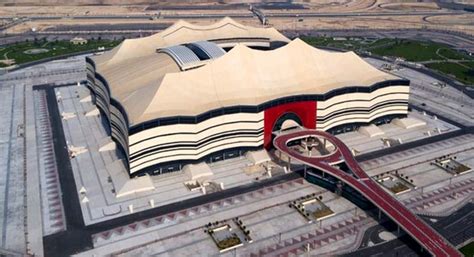
The original plan forthe 2022 World Cup (Q22) called for nine new stadia in addition to three existing stadia. Since the approval of the plan in 2010, the building agenda has been scaled down to seven new stadia of varying capacities. A new metro system with a total length of 320 km will be completed in 2021. The entire effort will be a showcase for Qatari architectural design, engineering, urban planning, sustainability, transportation systems and fiscal management.

The design of the stadia will reflect aspects of Qatari and Islamic history and tradition such as a retractable roof in the shape of a tent, another reminiscent of traditional dhows used by Qatari fishermen as well as a design in the shape of traditional (male) Qatari headwear. There will also be geometric intricacies integrated into the designs echoing traditional art from across the Islamic world. Most of the new stadia will be repurposed after the Cup, turned into educational, sporting, healthcare and commercial uses with some components donated to sporting programs across the world.

All stadia will provide optimal conditions for players, match officials, spectators and media as they are equipped with retractable roofs and ultramodern (and in some cases solar-powered) refrigeration technology permitting year-round use. Each stadium will be a cocoon of comfort, preventing hot desert winds from penetrating while maintaining temperatures of 20-23ºC on the playing pitch while outside temperatures average 37ºC.

The dark side of accomplishing this massive task is that construction companies in Qatar hired manpower recruiters in numerous counties, Nepal among them, to dangle the benefits of working in Qatar. In a multi-year frenzy of semi-legal activity, these agencies charged recruits for costs, health checks, work permits, visas and airfare, in extreme cases totaling as much as $9000 each, an enormous sum for workers from one of the poorest countries on earth. The Qatari government was actively involved in this effort as well. A Nepali government investigation revealed direct (illegal) links between Qatari diplomats and the recruiting agencies. When the workers arrived in Qatar, they were already indebted to their employers who then paid only one-third of what they promised or in some cases withheld payment entirely for extended periods.

As of May 2017, over 400,000 Nepali migrant workers, half originating from a single indigenous group, had entered Qatar. They’ve had the lowest per capita income of anyone in Qatar. The $4B in remittances sent back to Nepal each year equal 20% of the entire Nepali national GDP, roughly equivalent to sixty minutes of economic activity in the USA. As the infrastructure build-out for Q22 is completed, further employment opportunities will dry up. This will have a significant impact on the Nepali economy, especially since Qatar and other Gulf states are seeking to diversify their labor base and raise the skill level beyond the primary sources of labor they’ve employed for the past decade.

Working 10-14 hours per day in extreme conditions without proper rest, sanitation facilities and living in sub-standard housing (often without wages), workers sustained an estimated 6500 deaths (from India, Sri Lanka, Pakistan, Nepal and Bangladesh) over a decade’s time, compared to a combined death toll of less than 30 construction labourers involved in the two previous World Cups. True, many of these deaths may not have been directly related to construction work. Nevertheless, that’s five workers from these countries dying every week since 2010 when Qatar was selected for the World Cup. Qatar barely investigated many of these deaths, classifying them as due to ‘natural causes.’

Even after the disastrous 2015 earthquake in Nepal, Qatar refused to allow workers to return to attend funerals or to care for their families. For years this modern-day slavery and indentured servitude went unchecked. In Qatar and the rest of the Gulf Cooperation Council states, until 2018, according to the kafala (sponsorship) system, all of this was essentially legal. Domestic help is treated the same way, and not only in Qatar.

Despite rising global criticism, as recently as 2019, a German broadcaster revealed video evidence that few of these practices had changed. Qatar started reimbursing recruitment fees to some workers in 2018 and enlisted over 200 contractors to comply. But determining the actual fees paid and to whom they were paid was a complication guaranteeing the number of workers reimbursed fell far short of the total deserving them. Some of the restrictions on worker movement were eased in 2020. Wages were increased 30% and employers were enjoined from retaining worker passports. Kafala was being dismantled. But as recently as March 2021, the Norwegian Sovereign Wealth Fund declared they would be investigating questionable labour practices across Asia, including Qatar and those specifically related to Q22.

Meanwhile, in the boardrooms, university departments and government institutions, Qataris crow about staging a carbon-neutral world-class event. Carbon-neutrality, however, does not magically appear in a carbon-neutral way. The financing, sourcing and procurement of materials, however sustainably produced, is entirely dependent on revenues from extraction: the sale of offshore gas and the labour extracted to build the venues, the metro system, the parks, the new airport, the hotels and all the other amenities and accommodations of the event.

There are multiple initiatives such as ‘Green Hospitality,’ investments in appropriate carbon offsets and ‘sustainable operation practices’ to support the ultimate carbon-neutrality of the World Cup. But it all depends on visitors using the metro, recycling all waste and using recyclable plastic water bottles, marking a turning point in the standards of the local tourism industry. Qatar is leveraging the World Cup to push the hotels to elevate their game. Fair enough. In this respect, Qatar is indeed implementing progressive climate initiatives, but only at great cost to human and natural capital.

Qatar As Off-World

The extremes to which this nation must go to create or procure the basic requirements of life combined with the rising multiform risks associated with the Q22 effort are reminiscent of an off-world simulation, an artificial biosphere, the illusion of abundance surrounded by an unforgiving landscape, barely sustainable except by extreme measures. Surely there are few places where the interdependence between humans and the natural world is more clouded. Qatar defines the combined rituals of extraction and separation, the mechanics of it, the exploitive nature of it, the psycho-spiritual harm, the mass psychology of compartmentalization and denial to such an extreme that here, life itself is turned into a resource to be mined, leaving devastation in its wake. There is nothing new here. Instead of treating human capital as foundational to a successful society, it’s being used the same way as their offshore gas. Burned.

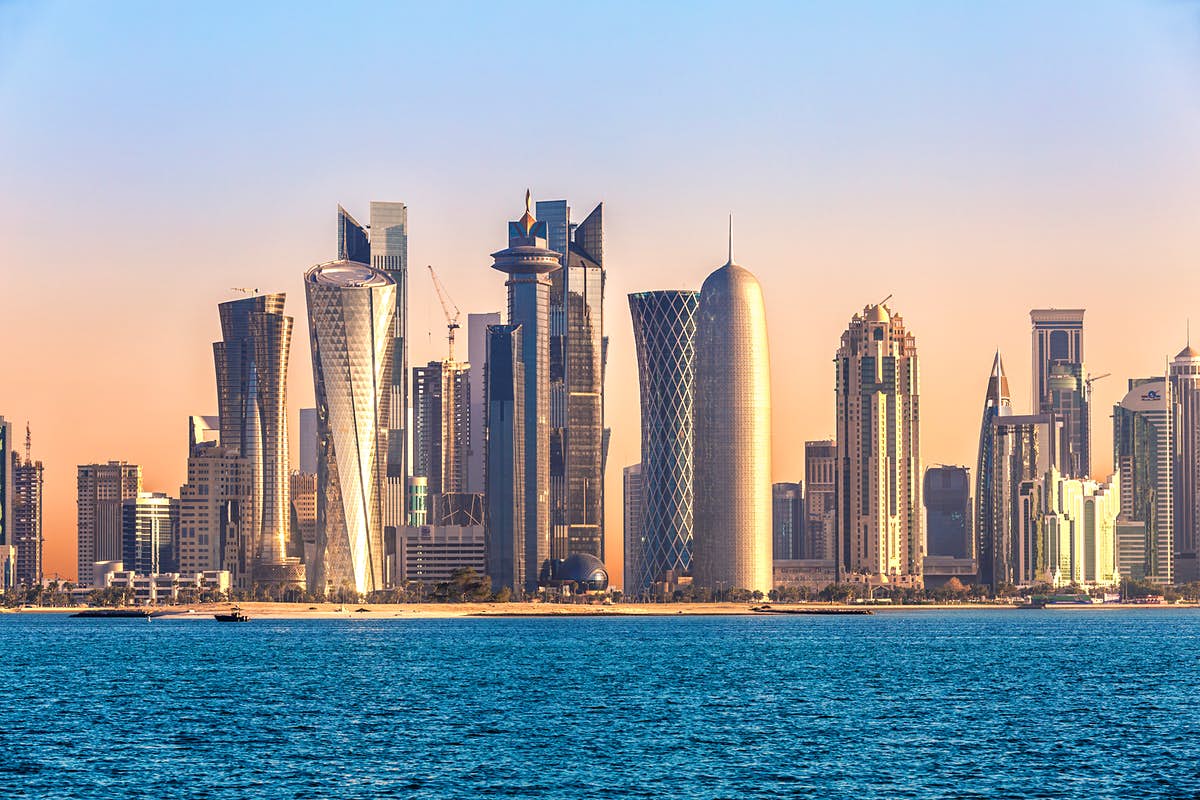
And here also is where the product of that denial emerges as multiple jaw-dropping architectural temples of sport, a gleaming futuristic skyline, steel and glass offerings to the gods of permanence, every comfort either accessible or constructed for the micro-managed spectacle of ‘earthly’ competition, sponsored by all the same ubiquitous multi-planetary corporate brands to be simulated and broadcast in endless detail back to the proletariat, attended by the international glitterati, entirely compatible with an artificial ethos of extreme resort living, creating new standards of excess, but without the inconvenience of interplanetary hyper-sleep. This is not some dystopian future. This is now.

Qatar and the other Gulf States are in a special class of nations driving the global legacy energy system, where the belief in their own illusions is reinforced at every turn while the reality of barely restrained plunder and its real-world consequences is cloaked in PR campaigns and market-speak. By the extremity of their lifestyle, they symbolize an apotheosis of Western nihilism, the radical divorce from ecological foundations and our headlong drive to collapse. There is only a contorted facsimile of belonging here.

One might argue that Qatar is doing everything right. They are conserving their natural assets, diversifying their $300B sovereign wealth fund to hedge against oil price fluctuations, investing in prime real estate in London and New York, shopping malls in Turkey, renewable energy projects in Sub-Saharan Africa, private and public companies throughout the world, venture capital and global tech. They’re catering to international tourists. They’re aggressively reducing methane leakage from their drilling platforms, redesigning their desalination plants, planning for their future and building their renewable portfolio.  But at the same time, as their national carbon footprint falls, the risks are not disappearing: inundation by a rising sea, draining what little aquifer they still have, poisoning the life of the Gulf, human rights, the rights of nature, the living nature of earth.

Bismillah-ir-rahman-ir-rahim. In the name of Allah, The Most Gracious and Compassionate, The Most Merciful…

This sacred phrase, known throughout Islam, is repeated throughout the Qur’an. It is said to contain the essence of the entire Qur’an, even the essence of all religion. With the most receptive heart, utter devotion and with the purest of intentions, practicing Muslims speak these words on a daily basis. It’s not that Qatar is pursuing selfish gains or profit for its own sake. In a devout Islamic nation such as this, largely governed by Sharia Law, leaning into the Wahhabism of Saudi Arabia and the community of its brethren nations, that would contradict religious teachings.

I began by calling Qatar an extreme example. Yet who is to say any nation cannot pursue the benefits of its wealth, share them among its citizens and showcase their skills and generosity to the world? Therein is the advancing and crushingly poignant reality: Qatar, like virtually all nations, no matter how many times the words may be repeated with utmost sincerity, is not on a trajectory to lasting peace or beauty as the Qur’an might have us believe. It cannot reconcile its extractive practices with the costs. Qatar, like the rest of the world, to a greater or lesser degree, is stuck in the same cycle of addiction and shortsightedness. Even with all its so-called wealth, it cannot save itself. This is our ultimate poverty.
State of Excess: I

If there were a single place, a petri dish of the fatally hedonistic culture of extraction, consumption, and the gaping wound of interrupted reciprocity, sustained by an illusion of abundance, it might be found among the Gulf States of the Middle East. Qatar is one of these.

The extractive economy is a daring game of chicken we’re playing with ourselves. It’s always been a necessary part of our micro-reality, but only recently have we reached a scale of malignant self-destruction doing irreversible damage to the living environment. We take it for granted as an indispensable feature of modernity. The term ‘climate’ should rightly include extraction among its many references. If applied to the whole of life, climate is not solely about atmospheric or oceanic conditions or the many thousands of other biological effects; it is also about our external and internal worlds reflecting each other. The climate of earth is collapsing. And we are collapsing with it.

If we trace the acceleration of the global warming effect, the loss of ice, acidifying oceans, the threats to food chains, the Sixth Great Extinction, wild tantrums of weather now commonplace, all are paralleled by massive concentration of wealth, the degradation of civil discourse, attacks on science, the corruption of democratic norms, the influence of dark money in politics, feudalization of the economy, spiritual malaise, the destruction of capital in all its forms and the ever-intensifying jockeying to secure vital natural resources. It is a hollowing. Earth as an object of hostile takeover. None of us can truly breathe anymore.

If there were a single place, a petri dish of the fatally hedonistic culture of extraction, consumption, disconnection and the gaping wound of interrupted reciprocity, sustained by an illusion of abundance, it might be found among the Gulf States of the Middle East. Qatar is one of these, perhaps second only to the United Arab Emirates for a standard of living supported entirely by extraction yet deeply insulated from the consequences. Qatar is a parable of earth.

The citizens of Qatar are not oblivious to the issues. Popular sentiment clearly acknowledges the primacy of global warming, the causal relations between fossil fuels, pollution and climate change. They are acutely aware of urban congestion and resource management. Even though government officials, academics and civil society share a consensus that something must be done (not only about the traffic!), personal lifestyle adjustments hold limited appeal. Qatar produces 7000 tons of trash daily. Yet no recycling program, no matter how expertly designed or promoted, can mitigate the emissions from local plants producing 20,000 tons of cement every day. Such a functional disconnect is the definition of un-sustainability. In this semi-constitutional absolute monarchy, ruled by a single family for nearly 200 years, the Emir, Abdullah bin Hamad Al Tahni, has the last word. There are no democratic mechanisms to shift policy as far or as fast as it must go.

The marvel of climate change can be reduced to numbers, but they don’t—and can’t—plumb the depths of the flawed outlook, the psychological mechanisms of denial, except perhaps by applying an analogy of autoimmunity. We are attacking ourselves. The sensual appeal of lifestyles are so comfortable that the thought of any substantive shift in priorities never reaches critical mass. In Qatar as much as anywhere, an inexorable series of self-destructive and irreversible decisions are being made. They are now accompanied by promises to change, failure to change, the cycle repeating with rising guilt followed by self-deception and dissociation. These are the behaviors of an addict. Not all of humanity is addicted, but the addicted are leading the rest of us into the abyss.

Qatar is small. Its total area is only three times greater Mumbai or half the size of Vermont; or, if you prefer, seven times the size of greater London. The amount of arable land per capita is a vanishingly small .005 hectares. The population, having grown 400% since 2000, is still less than three million, but only 12% are citizens. The remaining 88% are foreign workers, largely from South Asia, including hundreds of thousands of unskilled and skilled labourers who came to participate in the promise of Qatar’s selection as the site for the 2022 FIFA World Cup. The influx of expats is the reason 70% of the population is between the ages of 25-54 and the reason Qatar has the highest ratio of men to women in that age group in the world, 5:1. But perhaps there’s another reason. In this small group of patriarchal states, restrictions on women’s behavior and movement and the absence of laws clearly criminalizing domestic violence are driving women from these countries altogether.

Qatar is living a schizophrenic culture of extremes—at a precarious edge between the inevitable consequences of extraction and the countervailing abundance it provides.  There is world-leading prosperity, the fourth-highest per capita income behind only Macau, Luxembourg and Singapore. There is high growth, and to the degree possible with average summer temperatures exceeding 40ºC, an illusion of separation from the elements, from anything remotely related to the lived experience or diversity of a jungle, a coral reef or a wooded mountain.

It’s also a tourist destination of mega-theme parks and giant shopping malls, man-made islands and a soon-to-be opened aqua resort with underwater hotel suites. It is known for its architectural design and cultural beauty, and as the leading financial service center of the Middle East. Qatar boasts world-class universities, sports venues, a highly educated technocratic class and its own stunning collection of ancient and modern Islamic Art. The unemployment rate is a microscopic 0.08%. Even though it imports most of its food, it has reclaimed thousands of hectares of desert through irrigation schemes to produce hothouse crops.

L’Essence de Vie

The impact of less than three million people on the global condition may be miniscule, yet the impact of Qatar is far greater than its small numbers would suggest because of extreme energy inefficiency. How is that irrigation supported? Qatar has near-zero surface water and less than 100mm/y in rainfall, 80% of which runs off into the sea. Natural renewable water resources have been estimated at 71m3/per year per capita, far below the water poverty line of 1000m3/y/ca.

Ninety-nine percent of municipal water is produced by energy-intensive conventional thermal desalination. Qataris use 500 liters of water per day per capita (132 gal/d), twice the global average. The water coming out of the tap, the water for washing $2B worth of cars (more than one for every two people) every day, the water for swimming, water for the fountains, the landscaping, the reflecting pools, the water for wudu (ritual cleansing), every bit of water used in Qatar including most of what is used to grow food is also bringing the Persian Gulf closer to becoming a dead zone. And even though Qatar claims the tap water is safe for drinking, most everyone drinks only bottled water.

Sixty percent of all global capacity for extracting fresh water from the ocean is in the Gulf States. There are over 1000 desalination plants ringing the Gulf from Kuwait to Saudi Arabia, from Bahrain to the UAE and Oman. As demand continues to rise, new and larger ones are constantly being built. Together they are impacting the salinity of the Persian Gulf, releasing hyper-saline water with chlorines into an ocean that already has a 25% higher saline content than the average ocean. By 2050, the salinity of the Gulf will be more than twice that of either the Red Sea or the Mediterranean.

Desalination plants also release sulfur dioxide into the atmosphere in quantities exceeding international standards. The Persian Gulf is already a shallow sea, averaging less than 50m deep. Combined with a high evaporation rate, insufficient freshwater replenishment and multiple sources of dumping such as animal farms, sewage, oil spills, industrial outfalls and fertilizer factories, along with desalination along the entire coast, not to mention the millions of gallons of oil deliberately released by Saddam Hussein during the Gulf War, the Gulf is slowly becoming a dead sea. Algal blooms known as the Red Tide, generated by heat and an influx of nutrients from anthropogenic sources, are reducing oxygen content, killing fish and intermittently forcing temporary shutdowns of desalination in some areas.

In recognition of the precarity of water resources, Qatar is building five mega-reservoirs, intending to store emergency supplies according to estimated demand in 2036. They will likely convert the surface of these reservoirs to floating solar installations, further dropping overall carbon emissions. But alas, only a drop in that bucket.

Climate, Energy & The Environment

Qatar has the highest per capita CO2 emissions of any nation except Kuwait, again, partly because of extremely inefficient consumption. Emission levels also reflect the extremely low natural biocapacity of the nation to produce the basics of survival, yet the population is entirely divorced from the costs. Water is free. Energy is free. Education and health care are free. Only one nation, Iceland, uses more energy per capita than Qatar, though Iceland’s energy is 90% geothermal, which delivers 4-5 times the energy of fossil fuels.

Qatar’s wealth derives from the third-largest proven natural gas reserves in the world (25 trillion cubic meters), mostly offshore, providing 85% of its national revenues. It also has 15 billion barrels of proven oil reserves and is a major exporter of petrochemicals and fertilizers. Unfortunately, Qatar considers natural gas to be “clean energy.” In fact, it’s only half as dirty as coal and emits as much as 10x more carbon than some forms of biomass—of which Qatar has none.

The government, in concert with twenty-two members of the Pan-Arab League, intends to diversify its energy base. This is a progressive plan, but it’s been slow to develop. There was no renewable energy base as recently as 2015. The current goal is to reach 20% renewables by 2030. This is not solely out of environmental concern, but part of a drive to save its natural gas for export instead of domestic consumption. A huge solar installation, Siraj-1 (700MW, 10 sq. km), is slated for commissioning in August 2021 and will be used in part to power a ‘carbon neutral’ World Cup. Siraj-1 will produce the cheapest utility-scale solar energy in the world. On the other hand, dust driven by desert winds will likely make it the most difficult solar plant to keep clean and operational at peak capacity.

Qatar’s obligation to the UNFCCC and the Paris Accords was, as with all other nations, to submit Intended National Defined Contribution statements declaring a commitment to sustainable practices, education, research and implementation of improved technologies to reduce emissions. The fact that 10% of its land area is no more than one meter above sea level, that 18% is no more than five meters above sea level and that 96% of the population lives in that zone is a stark reminder of Qatar’s vulnerability to sea level rise.

Nevertheless, the music continues, and even more loudly. As with so many other signatories to the Paris Accords, specific emissions targets were never declared, and all intentions were entirely voluntary and subject to change to any time. While they are demonstrating a commitment to mitigation and adaptation, the key statements in the INDC, virtually identical to similar statements of other nations, provide loopholes to choose development over environmental concerns at any time.

The Unmasking Continues

Covid is a warning shot, a harbinger of things to come. If we imagine our response to the pandemic as a practice run for future crises, we are doing rather poorly.

Covid has been referred to as a portal, a re-boot, a mirror, a hoax, a metaphor of everything good, bad or ugly about capitalism and modernity. There’s not really much daylight between many of these interpretations. Another comprehensive and enduring metaphor is that we’re in the midst of an unmasking, which is the definition of apocalypse-a removal of the veils obscuring a clear view of the present reality. As the pretense of stability fractures, we encounter a storm of feeling and response. And as the Delta variant now sweeps through nations, ignoring borders, class and threatening to ignore vaccines, we must ask again what is being revealed.

There are those who believe we will regain momentum on some imagined trajectory to normalcy, reinstating the familiar rules and laws of commerce, that all hierarchies and differential privileges will be retained, boundaries and binaries we take for granted (or don’t even notice) will be restored, the eternal rules of economic gravity will be reinstated, upon which we can return to the serious business of inequality, denial, extraction and ecocide.

Covid is a test. The presumption that modernity can manage it all, the ideologies of sustainability, ‘freedom,’ medicine, the engines of mass communication, public relations, mainstream journalism, public health, the entire narrative of progress, the veneer of corporate social responsibility, equality, even the fantasy of mass spiritual awakening, all of these lie bleeding on the sidewalk, unmasked in a quickening drama of collapse. The airwaves and social media are filled with hollow discourses, dissociation, sophisticated ego-driven delusional schemes by which we entertain ourselves and by which huge sums and resources flow to a minuscule number of individuals, increasingly tired systems of indoctrination, dominance and control. The structures of the dominant paradigm are trembling and the costs some are willing to pay to prop up the game is bleeding into savagery. The empire has no clothes.

Covid is intensifying and accelerating the dialectic. The protestations of those who most closely believe in God’s plan are reaching the level of medieval religious hysteria. Which part of God’s plan is at work here? On the other hand, the media/corporate/public health/medical axis has been desperate to assert control of the narrative, that Covid was an accident (do we really know that?), that following a few basic guidelines will manage and contain the spread of the virus, and primarily that the virus is an enemy to be battled through vaccines, responsible behavior and will be solved by following scientifically validated protocols. Many are drawn to the hygienically rational (unbiased?) legally protected pronouncements from the inner sanctums of Big Pharma.

We are moving so far beyond all of this.

Shunyamurti, 2013:

Is it just that every narrative circles hopelessly around its own apocalyptic core, like the moth spiraling toward the flame? Is the Word no longer God? [Now words eclipse the Word], until the words all begin to implode into nonsense and face us with the falseness of their meanings, the labyrinth of delirious signifiers that have created a sound barrier between consciousness and Truth. 

Driving all of the above is the 40-year advance of the oligarchic agenda promoted by political parties, think tanks, organized religion and mass media attempting to cleanse national security, foreign policy, civil rights, law enforcement, medicine, higher education and the nation state of all but true believers. We are witnessing deepening cracks in the dominant narratives. The timid voices of integrity and credibility are now making space for bad actors to use vast political and media resources to drive sophisticated messaging to trigger fear and anger: bifurcation for its own sake, promoting versions of reality serving their personal, corporate, financial and political benefit. Collective psychosis, brought to you by the neofascist international crime syndicate

The stock market is an apropos example illustrating the increasingly threadbare fabric of economics and culture. We say the market is not the real economy, but such pronouncements don’t penetrate the bastions of the linguistic managers. The message perpetrated by central banks, five or six major investment banks and politicians of both parties is that everything is (or will be) OK. Yet the financial benefits of monetary policies meant to prop up and maintain the facade of growth and prosperity do not reach 80% of the population. It’s mostly gaslighting to protect the investor class. Mainstream economists are trying their best to convince us that risk is diminishing while the moral hazard in the largely opaque shadow markets increases month by month and the remaining measures to sustain the unsustainable shrink to a perilous few. This is a deadly game of musical chairs. The music is getting louder and the song is nearing its end.

Covid is a slowly unfolding series of shocks, revealing the trauma of conventional rationalism upon the collective consciousness. What is unmasked is the spiritual monoculture modernity has become–down to the vacuous micro-level pseudo-authoritative presentations in social media and TV, the tone of voice, the appearance, the time (or character)-limited delivery of information, the rapid segues from ‘bad’ news to ‘good’ news, the sequestration of subjects, the appeal to only a single level of comprehension. This is a continuation of progressive disembodiment that began very early in our lives. It is incremental developmental trauma.

You can avoid reality. But you can’t avoid the consequences of avoiding reality.—Ayn Rand

The combination of manufactured distrust of government combined with actual lying to the public by the government has inflicted cumulative trauma ever since at least the origins of the CIA (and likely well before). The effects of that trauma on civic trust is reaching its apotheosis in the spreading cracks in consensus reality, all of which is producing a culture in which, as James Kunstler has said, ‘anything goes and nothing matters.’

Covid is a warning. If we imagine our response to the pandemic as a practice run for future crises, we are doing rather poorly. Trump’s response to the pandemic in the US will be one huge reason for our failure. And the failure to investigate and prosecute Trump’s response will be another. We have resistance to sharing vaccine technology and we do not have mechanisms to make sure all nations, regardless of economic status, can be included in a global response. We don’t have a public conversation about the long-term trajectory for vaccine research or the implementation of practices that will reduce the likelihood of another virus emerging in the future. Capitalism is proving inadequate to deal with these long-term issues because it’s so focused on short term private profit. In fact, we might even say that capitalism has brought us the virus in the first place. How do we imagine capitalism is the solution to a problem it created?

How is that mask going to ripped off?

Burma: Women Are the Revolution

Re-blogged from Engagedharma.net : This article was originally published in TIME Magazine

Myanmar’s Women Are Fighting for a New Future After a Long History of Military Oppression

BY MIMI AYE MAY 31, 2021 11:24 PM EDTAye is the author of award-winning cookery bookMandalay: Recipes & Tales from a Burmese Kitchen. She was born and brought up in the U.K. by Burmese parents, but regularly visits friends and family back in Burma. Aye also hosts the food and culture podcastThe MSG Pod.

The world will have noted that women have been on the front lines of the revolution in Myanmar, with activists, elected officials, and journalists such as Ei Thinzar MaungThinzar Shunlei Yi, Wai Hnin Pwint Thon, Daw Myo Aye, Naw K’nyaw Paw, and Tin Htet Paing playing significant roles.

Many have assumed that this is a newfound feminist ferocity, but from ancient Queen Pwa Saw, to the first woman surgeon Daw Saw Sa, who qualified in 1911, Myanmar women have always been as strong as, if not stronger than, our men. The sad truth is our cause was set back by over 60 years of brutal and misogynistic oppression by the Burmese military.

I spent last Tuesday reviewing evidence from a Myanmar women’s group for submission to the U.K. Foreign Affairs Committee’s inquiry into the Myanmar crisis. Just reading about the atrocities committed by military forces meant I slept badly that night. Nearly 50 women have been killed in the protests so far, and around 800 women have been arrested. Sixty percent of the people involved in the Civil Disobedience Movement, a peaceful protest designed to shut down the country, are women, and they continue to face sexual violence, harassment, abuse, and threats from the junta. Many, including beloved film stars such as Paing Phyo Thu and May Toe Khine, have been charged under Section 505A of Myanmar Penal Code—a disproportionately punitive piece of legislation, and a hangover from colonial times that basically criminalizes freedom of speech. In prison, military forces have subjected women detainees to more violence, humiliation, and even torture.

A huge part of this is a horrific reflection of the misogyny—cloaked in patriarchy—that the military holds dear, having beaten it into the hearts and minds of the people of Myanmar. The military declares itself the father of the nation, but one that deems its female children as lesser human beings.

Read more: How Myanmar’s Protests Are Giving a Voice to LGBTQ+ People

Before Myanmar, then called Burma, first fell to military dictatorship in 1962, its women enjoyed an unusual measure of freedom and power. In 1919, the first women’s association Konmari Athin, was formed; in 1932, Daw Hnin Mya was elected as the country’s first woman councillor; and in 1952, Claribel Ba Maung Chain became the first woman government minister. Burmese women kept their maiden names and property, they handled financial affairs, and voting rights were granted to them in 1922, only 4 years after women in the U.K. got the vote. Melford Spiro, the famous anthropologist, wrote: “Burmese women are not only among the freest in Asia, but until the relatively recent emancipation of women in the West, they enjoyed much greater freedom and equality with men than did Western women.”

Many successful businesses were owned by women, including the Naga Cigar Company founded by my great-aunt Naga Daw Oo and the Burmese Paper Mart, founded by my grandmother Daw Tin Tin, who was also a senior member of Upper Burma’s Chamber of Commerce. Another great-aunt was the famous dissident and writer Ludu Daw Amar, who founded the newspaper Ludu Daily. Shortly after the coup in 1962, all of their businesses, along with those of countless other women, were either shut down or requisitioned by the Myanmar military who were adamant that women should no longer have such power and influence.

Angel a 19-year-old protester, also known as Kyal Sin, lies on the ground before she was shot in the head as Myanmar’s forces opened fire to disperse an anti-coup demonstration in Mandalay, Myanmar, March 3, 2021.

The women’s liberation movement in the country was far from perfect. Even some of our most progressive women, such as author Daw MiMi Khaing, still saw men as spiritually superior, thanks to outdated religious views. But the movement was on the right track until it was derailed by the dictatorship. It then entered what writer Kyaw Zwa Moe referred to as a “feminine ‘dark age’”—an era in which the military and its hardline clerical supportersreinforced dogma for their own regressive agenda.

For example, every Burmese man is deemed to have hpone or glory. An ancient fable relates that men will lose their hpone if they walk under or come into contact with women’s sarongs (known as htamein) or undergarments; according to the military, this was because women are inferior or unclean. This is, however, a subversion of the original superstition which was that women are sexual temptresses; when I had my first period, I was told that I could no longer climb pagodas in case I toppled them with the might of my vagina, and that only men could ever be innocent enough to ascend to the highest plane of nirvana. This concept was just as sexist, but it at least recognized that women were powerful rather than pathetic.

Shortly after the February coup, Myanmar women gladly took advantage of these attitudes to use htamein as barricades against the military. Even the junta knew that it was being ridiculous: If you need any further evidence that the Myanmar military does not really believe that htamein are unclean, its members have been known to wear them at special events because their astrologers once told them that only a woman would rule Myanmar.

The idea of a woman being in charge was so loathsome to the military that when it came to pass, in the person of Aung San Suu Kyi, the generals banned people from saying her name or displaying her picture. During decades of its rule, the military not only sidelined women in terms of financial, cultural, and political power, even worse, they also brutalized them in war—especially women from minority groups like the Rakhine, Shan, Rohingya and Kachinusing campaigns of rape and other forms of violence and terror. It should come as no surprise that women fight alongside men in the ethnic armed organizations, whereas the Myanmar military has no women in its combatant ranks.

But the flames of female resistance never really died down in Myanmar, despite the military’s worst efforts. In 2007, there were notable women activists in Myanmar’s Saffron Revolution, including Nilar Thein, Phyu Phyu Thin, Mie Mie, Su Su Nway and Naw Ohn Hla. At the time, the Assistance Association for Political Prisoners estimated that since the 1988 Uprising, which also saw many women take a prominent role, more than 500 Myanmar women had served prison terms because of their political activism. In 2015, Phyoe Phyoe Aung, general secretary of the All Burma Federation of Student Unions, was one of the student leaders whose protest against the National Education Bill was violently suppressed by military police in Letpadan.

Read more: The World Has Failed Myanmar, So Now It’s Youth Is Stepping Up

This time around, women activists such as Thinzar Shunlei Yi and Ester Ze Naware again at the forefront, women lawyers such as Zar Li have been working day and night to ensure the release of detainees, and women journalists such as Naw Betty Han and Nyein Lay are risking arrest and injury to report on developments in Myanmar. Even the first death of a protester was that of a 19-year-old female, named Mya Thwe Thwe Khine.

Since Feb. 1, hundreds of thousands of other women have exchanged their work tools for daily protest marches. Medical workers, teachers, and garment workers are on strike and are all from sectors dominated by women. Tin Tin Wei and Moe Sandar Myint are, respectively, an organizer and the chairwoman of Myanmar’s Federation of Garment Workers, and have spoken out against the coup so vociferously that the latter has gone into hiding for her own safety.

The most promising sign of a much-needed return to gender equality in Myanmar is that the National Unity Government, made up of ousted lawmakers in hiding, has appointed several women ministers, including human rights advocate and former political prisoner Zin Mar Aung as minister for foreign affairs and Ei Thinzar Maung as deputy minister of women, youth and children’s affairs—the latter appointment being groundbreaking in more ways than one, as she is the youngest minister ever at the age of 26.

After decades of misogynistic and violent oppression by Myanmar’s military and its cronies, it finally looks like the women of Myanmar might be taking back everything that we lost and more. The Women’s League of Burma is an umbrella organization of 13 women’s groups, such as the Shan Women’s Action Network, who are working together to enhance the role of women of all backgrounds and ethnicities at a national and international level. A global, growing feminist movement called #Sisters2Sisters has even been set up, through which more than 80 civil society organizations are demanding an end to the violence against women in Myanmar and the immediate release of women human rights defenders.

Whatever happens, we will always have hope, and long may we continue to rise.

Burma: Art & Protest

We wanted to celebrate the power of the people, and the uniqueness of this movement. It was also curated so as to be accessible to outsiders just learning about #WhatsHappeningInMyanmar

Re-blogging from Engage!

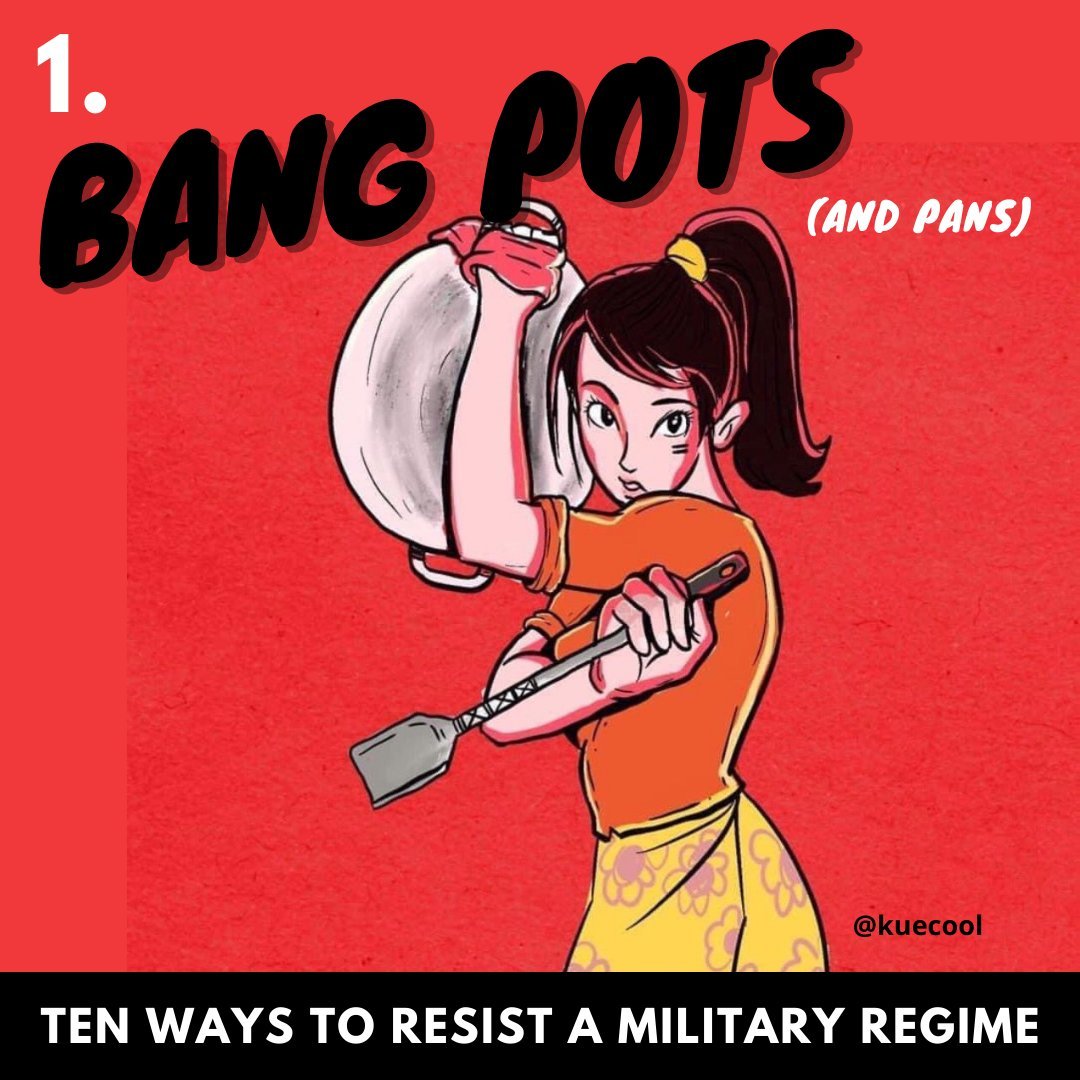
“10 Ways to Resist a Military Regime” .@ThetHtarThet1 and I collaborated on this series. We wanted to celebrate the power of the people, and the uniqueness of this movement. It was also curated so as to be accessible to outsiders just learning about #WhatsHappeningInMyanmar

Share this:

Present as Prologue

We are in the midst of an awakening, a rough transition from the dream of modernity and the emerging reality of its failing, if not wholly false, promises of universal prosperity and abundance.

When I think back over the past couple of decades and ask how was it and when my thinking shifted from imagining it was possible to find the political will to confront climate change to realizing social collapse was far more likely, I can point to a number of inflection points. It’s not quite so easy to assign specific turning points, but there are some events marking the passage toward my current position.

In 2012, Joanna Macy and Chris Johnstone published a book called Active Hope. The subtitle was ‘How to Face The Mess We Are In Without Going Crazy.’ Segueing from anti-nuclear activism that began in the 80s, Joanna has spent the past forty years helping people access deep feeling for what is being lost and then to watch a fresh and grounded conviction to act emerge. But seeing that particular book appear was a signal to me that she was acknowledging our intensifying circumstances and the increasing difficulty of not only processing all the emotions associated with the incremental decomposition of nature and culture, but also of realizing a positive outcome of The Great Turning. I wondered when active hope or, if you will, radical hope becomes desperation? If we imagined hope as a regenerative resource, is it inexhaustible? When does active hope become hopium– an intoxicating strategy of pacification, helplessness and rising delusion?

To add some context, Obama’s weak stance and the failure of negotiations at COP 15 in Copenhagen in 2009 were also part of my turning, particularly upon learning that the fossil fuel propaganda campaign was deliberately targeting that event. In 2013, I was also collaborating on a political strategy to promote a carbon tax in the USA, submitting it for critique and confronting the obstacles to that effort. Ultimately, I found that process to be deeply dispiriting.

Not too long after that episode was the Paris Agreement of 2015, when the INDCs, Individual National Declared Contributions (to global decarbonization) were declared voluntary. Of course it would be naive of anyone to imagine nations agreeing to self-generated required contributions and submitting to enforcement, whatever that could mean. But voluntary contributions were also guaranteed to expose the entire effort to be more platitude than action, particularly in the case of the biggest polluters, which of course meant the United States. And it was.

These are moments I’m calling inflection points. They all had antecedents, a series of episodes dropping like grains of sand on one side of a scale until suddenly their accumulation shifts the entire balance away from the probability of avoiding systemic collapse to one of guaranteeing it. Accompanying all of this is a process of letting go of hope, similar to the five stages of grief. But I’d be wary of trying to fit myself into boxes that might be too small. Regardless, that negotiation with all the familiar names is about the ultimate acceptance of endings, the contemplation of mysteries we enter most gingerly.

So here we are. As with grief, the entire process is not one of giving up so much as opening to something new, regardless of its mystery. When do we let go of bargaining? When do we loosen our grip on a false future of endless beginnings or, to put it another way, step outside the law and induced conventions sustaining a false future to expose ourselves to the truth (and terror) of something far less familiar, but which is becoming ever more likely? 

And anyway, was that even the future to which we were–or are–clinging? Or was it the past? A past in which the so-called promises of modernity could become ever more inclusive and the fantasy of personal and collective prosperity could continue indefinitely? In those terms, we’ve not been headed into the future at all. Our increasingly desperate grip has always been on the past–the conveniences we enjoy and particularly the ideology of endless growth. The culture war, the current battle of narratives is between those who deny it altogether, those who believe we can manage climate change without really giving up very much, that we can keep most everything we have and still call ourselves ‘sustainable’-and those who believe we must explore and design radically different lifestyles based on a new definition of abundance. What if nature has another agenda entirely?

The real future, if we can stop lying, is so overwhelming we may not fully grasp what is virtually imminent. Thus, we turn our gaze to the past, the recent past, to preserve the fantasy of human omniscience, the fantasy of our unlimited capacity to manage our way through every obstacle, every rising tide, every rapid in the downstream flow of history. Party like it’s 1999! All of this is fueled by vapid pronouncements from the technology sector, the advocates of bioengineering and the offices of politicians bought by fossil fuel interests. In fact, we have no idea precisely what will finally convince us of a collapsing biosphere. But we know the signs are all around us.

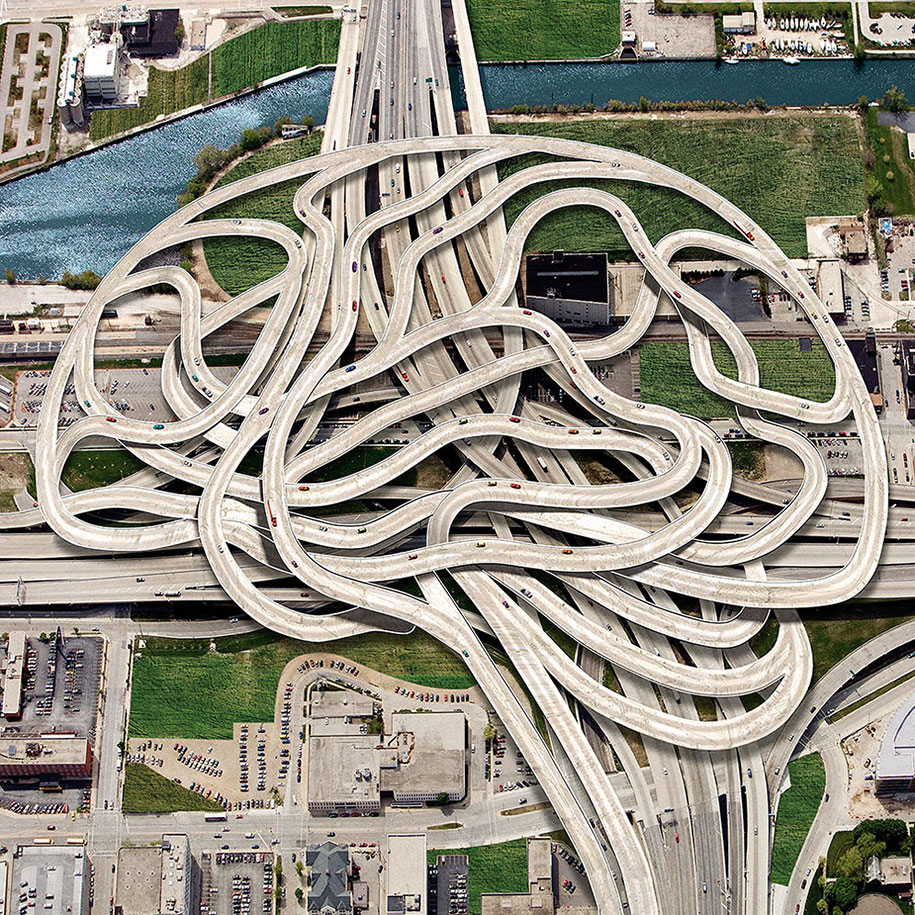
Releasing our grip on the future—telling the truth of the moment—is a landmark principle of psycho-logical health—admitting what is—allowing us to deal with ‘reality.’ At the same time, we are also trying to modulate extreme emotional responses, rising solastagia and deepening disorientation, which are negotiated in a specific system of the brain devoted to survival. While we don’t want to trigger impulsive, personally damaging or anti-social behaviors, we do want to retain enough forebrain function to generate positive corrective measures.

We–and by that I mean we in the US–may be a single extreme climate event away from triggering a mass shift in public attitudes about what is on the way (several are already underway), what mass media is still timid (or worse, negligent) about addressing. But this is where we find ourselves wading into a swamp of uncertainty, disagreement and potentially dangerous outcomes that were wholly unanticipated at the beginning. We don’t want panic to become even mildly contagious–like the pandemic. And besides, a significant segment of American culture is already being bombarded with triggering messages generating anti-social behaviors against their own interests, which are also threatening the collective well-being of the nation.

In trying to temper the information flow to avoid elevating mass anxiety, fear or contagious hopelessness, we remain deeply embedded in the territory of complacency. When Greta Thunberg addressed the annual World Economic Forum in Davos in 2019, she said, “I don’t want your hope. I don’t want you to be hopeful. I want you to panic. I want you to feel the fear I feel every day, and then I want you to act. I want you to act as you would in a crisis. I want you to act as if our house is on fire. Because it is.” 

Meanwhile, managing social behavior, refusing to form a vision of a collective response to the realities upon us or being determined to ‘both sides’ it all is robbing us of the opportunity to convey clearly how fragile our situation really is. Everything matters more than ever if we ever expect to become someone’s ancestor, because everything, the wake-up call and the suffering of the past 18 months, the dislocation, the uncertainty, the disruption of commerce, the loss of stability, the political and economic inequalities, the creative energy and social innovation, the conflicting moralities and the redefinition of community are all just a rehearsal for a rapidly advancing future.

The following is an obscure Facebook post from 2017, written by a nameless founder of the Into The Wild Festival:

And finally the great ancient god of nature, of the wild places, of the muddy-brooks and the golden hills, of the damp forests and the hidden glades, the protector of beasts, of horned and hoofed, he of the wild-lichen eye-brows, musk-eared pungent aromas swelling in through the ether, playing his deep octave of enchantment on his bone flute from beyond the veils, from under the other worlds. He curls his misty eyebrow towards humanity once again, reminding them that their tiny insignificant lives are mere dew-drops on the vast garden of existence. All their self-help seminars and self-important narcissistic endeavors are nothing but the froth of waves under the infinite sun-rays of existence. 

You can wash your hands, but you cannot wash away the wild, the mysterious, ravaging ferocious tenacity of the world. You can try to blame it on 5G or 4G or GG. You can create as many concepts as you like, but in the end, nature will rule with wild and ecstatic bloodthirsty longing to take us all home to where we began, the deep dark emptiness where everything arises and begins, time without end. Pan, the original horned god will once again step out of the shadows with his name on the tongues of all beings, pandemic, pandemonium, panic, panacea, all bursting forth like wild flowers yearning to kiss the sky.

In this realm there is no good or bad, high or low, rich or poor, just the wild abandoned expression of life and death forever dancing in the orgasmic Milky Way of existence, radiant in its potential. So, we are nature in our deepest dreaming, before we civilized ourselves into square boxes of ready meals. We are life and death. We are the earth-woven lovers of the wild. We are that radiant mysterious emptiness. We are Pan. We are all people. Listen to the call of all beings deep in the dark of night, at the cusp of dawn or dusk and you will hear your ancient voice forever singing you back home.

We are all Pan, as god, as archetype, as a voice of the irrational. Pan travels deep in our psychic underworld. Nature is Pan, both beautiful and treacherous. By exiling him from our natural terrain, by dislocating or repressing the divine Pan from the pantheon of gods, we are dishonored. We lose ourselves. Eventually we suffer the consequences of that repression in the form of emerging tortuous pathologies.

We are in the midst of an awakening, a rough transition from the dream of modernity and the emerging reality of our failing, if not wholly false, promises of universal prosperity and abundance. That was never really part of the deal and now, with all the Pan-words dancing before us, the true costs are mounting.

How will it all Pan out?

The Absolution of the Father

For two decades before his death, he became a study in deepening humility, self-deprecating humor, compassion and generosity, a slow softening process. I don’t know if it was deliberate or if some inexorable conviction took hold of him and he simply released and rode its momentum all the way into shore.

By any measure I grew up in a traditional family—one fully aligned with the context of its time. My father was the sole provider until I entered the final year of college. When it became necessary to pay two college tuitions at the same time, my mother took a US government job not far from home. (We can laugh or cry now, because that was when college was still affordable). My parents were staunch members of the local religious community and I and my siblings were brought up in its cultural practices and traditions. We were educated in its precepts and marked our maturation by the requisite ceremonies.

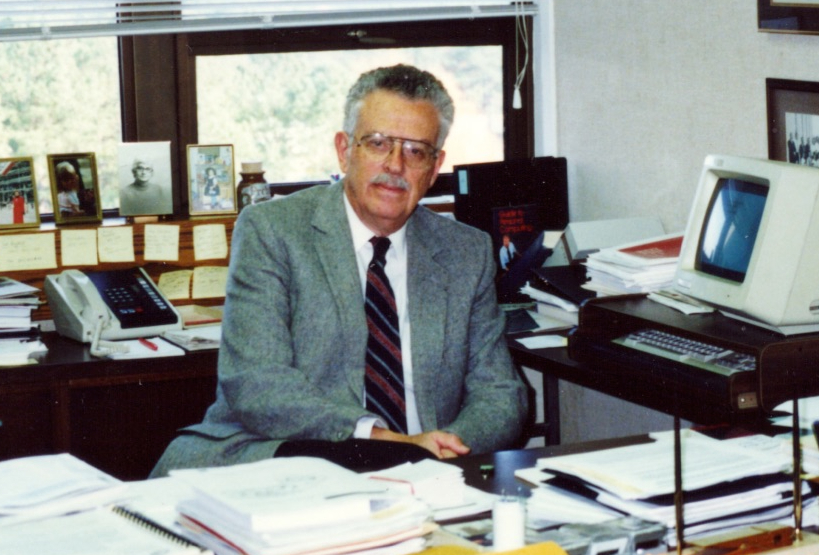
My father was an academic, a scientist, in what then was a relatively obscure field-statistics. He lived by the rules of what could be seen and proven. He could also be volatile, prone to explode at his children or my mother. He was a disciplinarian, leveling strict rules of behavior and he had no uncertainties about his ethics or what constituted integrity. He served his family, his work and his community. He was a model citizen.  

For all of my youth and well into my adulthood, my mother was a long-suffering passive voice, not totally intimidated by her husband, but not inclined to stand up for herself with any conviction—at least not in front of me. Before I went away to college and then as I disappeared to the far west, confused by slogans and reacting to my own infection of righteousness, driven by spiritual unrest and the emotional fallout and social impact of the Vietnam War, I never knew her to challenge him on principles or his style of interaction. I never saw her put her foot down or ‘win’ an argument. I never saw him back down. But at the time, I no longer cared.

I was intimidated, both silently seething, withdrawing and also identifying with the insults and crude judgments he dished out not only to me on a regular basis, but to my siblings as well. His derogatory characterizations of me echoed endlessly, foretelling my reticence, half-hearted ventures, risk-aversion, fragile self-confidence, confusion and doubt. I’m not sure even now whether I was careful not to venture into anything too challenging because I was certain I would never measure up to his standards or whether I was just determined to stay out of his way. 

Fourteen I was, 
back when time slowed down and I
began to clock the distance between
father and tomorrow.
Took my time to cover my tracks
wrote out the difference between 
school and the random anarchies
fulminating under cover of darkness.
A walking cadaver I was
toe tied to family meals
and algebra into moonrise.
In the mornings 
sliding out from my slab of sleep
the symbols melted all over again
.

From a much longer view, our relationship could be understood as a karmic encounter. I, introverted, confused and emotionally blocked, landing in—or choosing–a family that seemed always to bring me face to face with my internal dilemmas, forcing me to choose. Was I to break the spell and become an autonomous being? It took a decade after college before I found my ground enough to pursue a professional objective with confidence. It was the fruit of a long and deliberate progression into somatic therapeutics, all of which was a gradual embodiment as a sensing and whole emotional being with a full array of feelings and innate creative responses to new and uncertain conditions.

In retrospect, my values were largely rooted in my family, my religious community and my father’s view of the world, a world in which justice might have been the single most important value. Identifying that principle as a core value could lead to numerous side conversations here about ethics, hypocrisy, righteousness and equality. After all, he voted for Shirley Chisholm for president. But, never mind. The more immediate point is that while I maintained my distance into my thirties, even as I disguised my antipathy, even to myself, I overruled it for the sake of appearances and conducted my life as if I was an independent being, the certainty of that independence was not as secure as I might have wished. I knew myself as responsible for my own choices, yet I could not make those choices without adhering to some inner voice of caution, confused allegiance to or dependency on the voice of the inner critic–his voice, recapitulating the impossible standards he typically applied to himself.

As I was entering the professional world, something else began to happen. My mother found herself. She shut down the emotional abuse. She spoke up, refusing to stand for his bluster. She entered her own space. Lo and behold, my father began to soften. How these two phenomena interacted exactly I cannot say. My subsequent visits with them as they sailed into retirement began to assume a character of authentic affection and care.

Their children long since launched, they filled their empty nest years with travel, grandchildren and community service. My father received the rewards of his extended professional life. Throughout this process, he continued to soften, as if he was shedding the toughened skin of professional ambition and family responsibilities, being the sole breadwinner and a patriarch to his family and community.

I had grown out of the resistance and resentments, the judgments and recriminations of my younger years, but paradoxically, by transforming himself in the ways that he did, my father was not only coming to terms with his own issues (to the extent that he even regarded them as his issues), but was also helping me address my own issues with him. He was revealing my own work yet undone, giving me permission to re-enter the shuttered chambers of the past and to forgive at deeper and cleaner levels until we gradually settled into a greater peace. From that vantage point, it’s difficult to imagine how hard it is for so many others, growing up in significantly more abusive families, to find true forgiveness for themselves in the absence of any sign of real change by their parent(s).

The truth is, though I can regard myself as fortunate and have long since settled into a deepening field of gratitude for all of it, I can also look back and say we were both scarred by our relationship. He was pursuing his own flawed notions of parenting. As is true in so many families, children are not seen for who they are, but regarded as receptacles of ideas, values and behaviors he himself held close, holding me to the impossible standard to which he always held himself–most likely the standards and expectations of his own father. He was recapitulating his own childhood, exorcising his small-minded resentments against the world as he planted them in the heart-mind of his offspring. I was merely the next generational version of the same dynamic.

Some of this was surely the effect of growing up in the Great Depression. But as he healed his own scars, so I began to heal my own. Even now, just in recounting the tenacity of his buried pain, I could not swear those scars disappeared. And anyway, there’s no magic to be performed upon them. But neither do they remain visible forever. They did not diminish me any more than they diminished him or his fragile journey of turning them into objects of beauty for their own sake. The past can never be cosmetically hidden or fully excised. If we are fortunate, our wounds become portals, beautiful monsters. We may never appear to ourselves wholly unblemished, but we may well become whole, creating our own definition of purity by carrying the past more lightly.

Which brings me to consider the end of life. Yes, I am concerned with uncertainty and the unknown. I can also mollify that uncertainty by seeking the stabilizing effect of visionary perspectives. In this respect I include my father, who for those two decades before his death became a study in deepening humility, self-deprecating humor, compassion and generosity. The heavier his body became, the more lightly he carried it. He entered that slow softening process long before he died and I have no idea what consciousness he had of any of it. I don’t know if it was deliberate or if some inexorable conviction took hold of him and he simply released and rode its momentum all the way into shore. Regardless, even if the terms of that process were left largely unspoken, something important was imparted to me and to others around him.

His journey became a source of nourishment. It remains like a shadow next to me. My younger life with him was no soft ride. I don’t recall any softness in him then, but if I had a framework through which I might nourish myself or others, it would be to recognize that our innermost contemplations about how we lead our lives or the emerging frame of how we approach the end of life is not a property to keep to oneself, but instead a cultivation of what Stephen Jenkinson calls a “village-mindedness.”  We have an opportunity to demonstrate to those close to us a fearless and curious, generous and open-hearted contemplation of the unknown with the intention to offer the same to others as we offer to our selves. If that was to be my intention, then my father’s model is a good place to start.

Love comes in many forms, which can include deliberately or subliminally planting seeds informing others who have yet to consider their own uncertain future. While I would miss something if I neglected such a process, what they would miss becomes part of the equation as well. Those seeds come in the form of carefully chosen actions. Now, more than merely resting in the flow of time, the dream body makes a subtle change to a transitional state of becoming, from discerning what requires focused attention, articulation and expression to bringing the fruits of that attention into the world.

I assume a posture of stillness, cultivating Being like a river trout nosing into the oncoming current with minimal exertion. The trout is not striving, not forcing himself into the world, just waiting as conditions change and become clear, for the instant when a response is required, making the smallest adjustments necessary to exercise one’s agency while remaining unperturbed, steady within the passage of time.

That whole process might ultimately be named, what some might call a good death, even a fortunate death, a conscious transition which can begin at any time, the earlier the better, with neither panic nor anxiety nor fear nor even hope. Yes, there are surely further signposts coming along the way, yet more versions of reality to encounter and digest. I reach into the neglected territories of awareness to make sure all is attended. Whether I anticipate ultimate freedom in this life or in some other time, a certain portion of my attention is devoted to exploring the parameters of completion. And also on what continues beyond.

The Dark Side of Modernity

Modernity constantly encroaches upon and threatens to consume decolonial thinking, diversity, extremity, classifying certain people as outlaws, certain thoughts as unsanctioned and presuming to define normality, centrism and the norms of authentic self-expression. This is modernity cannibalizing itself to sanitize culture for the sake of preserving its own ever-narrowing definition.

For a word being thrown around so casually these days, one may wonder what exactly modernity means. It’s certainly everything we might initially assume it is. But let’s tease that apart. It’s been defined as a historical period that could have started as far back as Medieval times. Sometimes it’s regarded as the light arising from the Enlightenment, or even beginning sometime in the 19th century with the industrial revolution.

The most inclusive definition associates modernity with a number of historical developments: nations, languages, industrialization, mercantilism, capitalism, urbanization, mass literacy, mass media, representative government and mainly also a shift from traditional culture, meaning a proliferation of things we do when we’re not entirely focused on survival, and systems of knowledge, to the triumph of rationalism and scientific materialism. One may include a number of positive aspects to modernity such as secular culture, evolutionary thinking, developments in psychology, medicine, philosophy and emancipation. But especially now, we can’t avoid also associating environmental devastation with modernity, which is now undermining the very stability of culture and modernity itself.

A formal definition of modernity, according to Walter Mignolo’s substantial body of work on the subject, should begin with the Renaissance, coinciding with the intention of Western Europe to embark on the imperial project which had several faces and which was rationalized as bringing civilization to the New World, saving the world for Christianity and which then evolved into what we now call capitalism.

However we paint it, Modernity is synonymous with colonialism and thus, racism is inherent to it. Could the modern world look as it does today with the current economic regimes as if no imperial intentions had ever existed, no massive transport of black bodies from Africa to North and South America, no East India Company, no appropriation of native lands, forced and unpaid labor, the imposition of governance and financial obligations? I think not.

Thus, hidden behind the rhetoric of modernity, economic practices dispensed with human lives, and knowledge justified racism and the inferiority of human lives that were naturally considered dispensable.

—The Darker Side of Western Modenity

Dark bodies weren’t granted full humanity. And white bodies rationalized their moral responsibility as social systems, spiritual practices or bodies of knowledge were systematically destroyed. We continue to feel the effects of the colonial mentality 500 years later not only through globalization and neoliberal economics but through the definition of development itself and the division of the world into so-called developed and less developed cultures. The term ‘Third World’ was a French invention.

Colonialism did not advance solely as a mercantile or as an imperial military adventure. It was a religious and cultural force propagated through the cracking of indigenous linguistic code, the imposition of new languages, geographical mapping, religious indoctrination, economic subjugation, wiping out cultural memory, arbitrarily defining territories according to political or economic expediency, destroying centuries of cultural wealth, appropriating land and vast material wealth, creating a domestic class of proxy colonialists who benefited directly from the economic subjugation of their brethren and generating entrenched bureaucracies to sustain the inertia of political systems primarily serving colonial interests.

Colonialism emerged from and as what we know as western civilization, ultimately defining modernity in terms of politics, economics, religion and culture. The imperial project was to extend the definitions of civilization, language, philosophy, politics and economics to the colonized world. That initially included Latin America and Africa, extending into the Islamic world and South Asia. The definition of development itself was determined by the western colonial enterprise and persists to this day as defined by Wall street, the IMF & the World Bank. It’s primary purveyors are government agencies and diplomacy, clearing the way for multinational corporations backed, in case additional persuasion becomes necessary, by military might. Even as the overt manifestations of European imperialism dissolved in the mid-20th century, the American imperial project in the Western Hemisphere over the past 150 years is well known

Perhaps the greatest impact of colonialism was to control knowledge and especially the definition of knowledge. The definition of knowledge codifies the essential power relations between races, genders and cultures and became encoded in languages, beginning with Spanish, Portuguese, German and French, all rooted in Latin, extending more recently in English. Since knowledge and its definition is held primarily in western hands over the past few centuries, the way we think about problems and their solutions also arises from within that codification.

In that respect, the rhetoric of modernity is a pernicious monoculture of ideas to the extent that now modernity has become hostile to culture. Like the cannibalistic psychosis of Wetiko, it creeps into all aspects of life in the form of social media, advertising, mainstream political discourse. Modernity constantly encroaches upon and threatens to consume decolonial thinking, diversity, extremity, classifying certain people as outlaws, certain thoughts as unsanctioned and presuming to define normality, centrism and the norms of authentic self-expression. This is modernity cannibalizing itself to sanitize culture for the sake of preserving its own ever-narrowing definition.

We are also in the midst of an uprising over who gets to set the terms of discourse, who gets to define and preserve the codification of white innocence, superiority and patriarchal economic hegemony into the political and economic rhetoric set forth over the centuries of the colonial enterprise. The latest skirmish in this ongoing war is about the 1619 Project, which, by unearthing real history and bringing its unsavory truths to the forefront of modern awareness, lays bare the principle that white privilege only lives by keeping its own past buried.

White patriarchy has had the floor for 500 years and now the plantation systems are breaking down everywhere. There are popular movements with a different idea rising in virtually every culture now fighting for survival and presenting a rising threat to the owners and guards of the prison without walls and the prisons with walls. Repression and authoritarianism are the last remaining tools of control. Witness the right-wing backlash against Bolivia’s Evo Moralies, Rafael Correa in Ecuador and the rise of Bolsonaro and the jailing of Lulo De Silva in Brazil, not to mention the increasingly desperate and increasingly lawless measures by the white minority in America to retain minority rule.

What was taken centuries ago cannot be recovered. Inasmuch as we identify with and join the shifting communities of rebellion, art, theater, feminism, resurgent indigenous voices, economic cooperation, the recovery of ancient wisdom, we become fugitives from the plantation to construct a new economy. As decoloniality and the critique of modernity becomes more elaborate and encompassing, it is increasingly clear that we will no longer accept the structures of domination on any level of human activity and relationships, most particularly in regard to the natural world.

The signs of backlash are everywhere. Nikole Hannah-Jones being denied tenure by the University of North Carolina School of Journalism. Republicans voting en bloc against a Black women becoming Director of the Civil Rights Division of the Department of Justice. The refusal of Big Pharma to support generic vaccines being distributed to less affluent countries. The sudden reversal of the NFL to now regard the claims of neurological damage by black former players as equal to those of white players. How much more systemic can you get? These are actions and perspectives which all arise from and reveal the vestiges of the racist colonial mindset.

Islands in the Stream

If there is an object of practice, it is to stop trying to be something, to unwrap the most subtle layers, progressively unmasking the operation and direction of the CEO, the games, identities, directives and assumed capacities of ego, until there is nothing left but living in the stream, free of all bardos. Non-meditation.

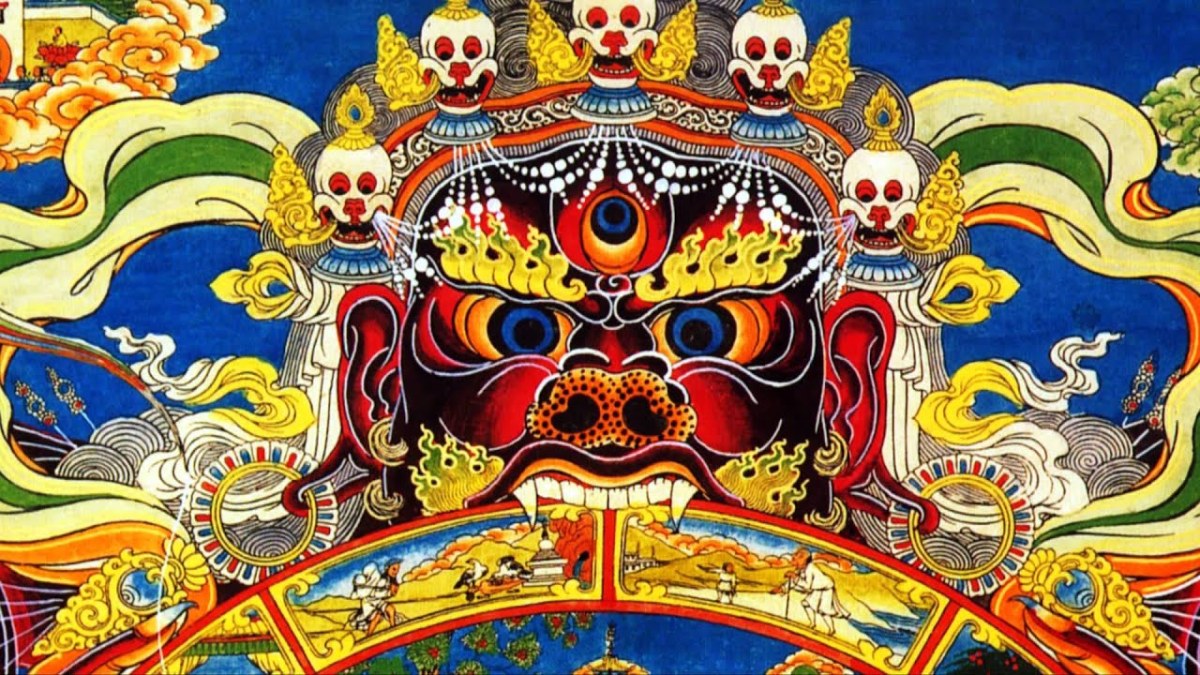
The bardo teachings of Tibetan Buddhism identify six post-death transitional states: birth, death, meditation, dreams, dharmata and becoming. Likewise, there are six realms of being (gods, jealous gods, humans, animals, hungry ghosts and hell beings) through which, according to karma, we continuously cycle during life. 

The intense experiences we have in life can be connected to one of the six realms, but surprisingly, they may also be connected to one of the six after-death states or bardos. Most accessible to us all in life, the experience of the six realms also contain bardo experiences. In other words, throughout life, we may become entranced or motivated by one of the dominant emotions of the six realms of being (anger/aggression, desire, ignorance, pride, envy or pleasure) and find ourselves encountering such circumstances which can only be considered bardos because of the imperative they present to us by their extreme nature.

The clearest way to describe this condition is to realize that each dominant emotional state of being contains the possibility of bardo experiences within it. We may cycle through realms by a lifetime or by the hour, but most likely we are in one or the other for limited periods except in the most extreme cases when we are truly stuck in a single realm to such an degree that there’s very limited possibility of ever escaping. The paranoia/envy of the jealous god realm (asuras) or the anger/aggression of the hell realm may well become prisons. But we may also be equally blinded by the pride of the human realm.

Each behavior type (realm) is like a station, a home base, a default field of awareness, our personal preoccupation with a way of comprehending our world. The experience of each station is not strictly limited to its intrinsic nature that one could never experience qualities or domains associated with other stations. Your station is determined by karma. Associated domains, the states we venture into away from our default domain, are more transient.  So while we may spend most of our time in one or another realm, we can still have affinities with others. Within our dominant realm, we can—and will–have any type of bardo experience.

The translation of the word bardo refers to being ‘in-between islands.’ These ‘islands’ (call them states of mind or emotions that drive our lives) appear as obstacles, predominant mind-states such as fear or aggression, compassion, or perhaps gross events, life-long dynamics or ‘karmic’ predispositions. Islands become obstacles when we get attached to them, set up residence and interpret the world through their narrow lens.

The steam or the river of consciousness is natural mind, a more awakened state. This is a state beyond bardos, existing in the gaps of experience. Since realization is regarded as an unchanging state of infinite space without origin or cessation, that awakened condition (of staying ‘in the stream’) implies an escape from all realms and all bardos. From that point of view, all identification with ego is an island we encounter in the stream. We are constantly running into and climbing about on these ‘islands,’ which are mere appearances in the flow of experience, sometimes for short periods and sometimes with a profoundly anchored grasping nature that makes it extremely difficult to escape…or ever return to the stream.

How we move through realms and bardo states implies we are perpetually jumping from one island to another and completely missing the stream because we are fundamentally misinterpreting our experience and perpetually grasping for antidotes to the flow of extreme emotional or psychic conditions.

If we take into consideration the Dzogchen view of a constantly refreshing arising and disappearance of phenomena, radical impermanence, then every arising of consensus reality is an island and every ‘gap’ between arisings is a ‘window of possibility,’ an opportunity to have an experience of true clarity, which would also be a bardo in that instant. The offer to awaken is always present. Entering that gap may be a momentary escape from a particular realm, but most likely, if karma has anything to say about it, any such ‘glimpse’ will stimulate an immediate descent into yet another antidote.

As markers of ego-identification, ‘islands’ are illusions. We can become entranced by the appearance of any island, such as personality, occupation, lifestyle, personal trauma, and cling to it, set up camp and live there-possibly our entire lives. We have experiences of pleasure and pain there, sometimes even misinterpreting what is pleasure and what is really pain. The way we relate to the islands is an indicator of the dominant realm we are operating in at the time, the way we are manifesting ego-based spiritual materialism. Being open to learning, such as in the human realm, distinguishes us from the animal realm, the jealous gods or the hell beings. But of course it’s all quite tricky. When pride and ego-driven indulgence and pursuit of peak experience and spiritual ‘attainment’ are the primary drivers, we, like religious fanatics, create our own brand of spiritual materialism and can easily imagine ourselves in the god realm. Another illusion.

Meanwhile, the river never stops flowing. Emptiness and impermanence are the only truths. The true nature of mind never changes, whether it is peeking through the gaps between every arising or in between our encounters with the ‘events’ of our lives, our karma or our perpetual wrestling match with ego. 

Although the bardos are primarily described as after-death experiences, the meaning of bardo impacts everyday existence. It’s may seem complicated to understand existence this way, but this view opens a window of possible understanding that was not there previously. The bardo of existence (bardo of everyday life), dreams, the stages of physical dissolution immediately following death, the bardo of dharmata (non-duality) with its many visions, benign or fearful, the transition to the bardo of becoming presaging rebirth, all of it is described as the post-death appearance of islands in the stream and identified primarily with one or another of the six realms.

Going more deeply into the meaning of bardo and in relating the bardos to the six realms is a radically different way of presenting the entire proposition. We begin to understand bardos are falsely regarded as transitions between “permanent” conditions like birth, life, death and rebirth. But no, everything we regard as solid, any demarcation we may identify in life, its beginning, middle or end and all the consciousness along the way, are no more solid than any post-death bardo we care to name. It is always a function of ego to reify any or every aspect of existence. Simply by identifying everything as bardo, it all becomes transitional. Every moment is bardo, infused with the shifting attention of ego trying to make something to latch onto where there is nothing, controlling or clinging to or reacting to the appearance of every island with its various seductive opportunities for the comfort and safety of ego indulgence. 

The Source

Out of nowhere, the mind comes forth
All is returned to you, beyond the cause
And effect: the oak tree
In the garden, chirp of crickets
Inside and out, aching knees
On a dusty mat. Without knowing it
We have wandered into a circle
Of wonder, where our confusion
Shines more
Outside the seeming errors and the search.
Wake up to your sleep
And sleep more wakefully!

—–Zachary Horvitz

From this view, the conception of the dream space of sleep is a metaphor of the waking space, a perpetual navigation of illusion in which, at least in sleep, the mind operates at subliminal levels, throwing images and stories before us and over which, if one seriously pursued dream yoga, one might eventually gain some control. The capacity to ‘awaken’ in the dream and even a capacity to write a new ‘story’ in the dream…or a new story of the dream is not only the story of dream yoga. It’s the reality of our waking condition.

The identity of the dream state, the waking meditative state, the post-meditative state and especially the immediate states upon physical death all present an identical opportunity: to cultivate a possible ‘awakening,’ a capacity to distinguish between illusion and reality, to recognize the activity of ‘mind’ for what it is and to meet every island appearing in the stream as an island without becoming transfixed. This is the context in which these interpretations of bardo imply–or verify, if you prefer– that every act, every moment in life, just as it is depicted in the after-death experience, is an opportunity to realize natural mind, a rehearsal for the post-death experience.

Those who are familiar with bardo teachings or practices or, for that matter, any meditative practice, may take a certain pride in accomplishment as we mark our progress. And we can attain a good deal of pleasure in the course of our practice. The pride of the human realm always sneaks in the side door whenever one believes one has arrived, when one imagines having achieved absorption or true equanimity, even for a moment. That is when one wishes to preserve it, to extend it, to own it or become it. But all of this is about hope and fear, and thus a form of spiritual materialism. In the extreme, this is the realm of the gods, who seek pleasures in every form, like notches on a belt. Sound familiar?

And at some point every edifice of attainment will dissolve into frustration and backsliding, becoming the opposite of pleasure and deconstruct into forms of ego-recrimination. All that attainment is impermanent! Damn! This is the bardo experience. This sort of confusion is identical to the character of post-death experience, perhaps the bardo of death, in which any hint of noticing the Nature of Mind, something that may already have arisen as part of our living practice, turns into such a striving that we instantly fall back into deeper confusion and even anger, the anger of the human realm or even something more toxic, the anger of a hell being. 

So there we are, cycling and recycling in the whirlpool of samsara, confronting our own karma, particularly acute at moments of being so neurotically lost, so swept along in one or the other realm that we become deaf and dumb–we can’t hear or obey anything except ego. Lather, rinse, repeat.

I identify my existence along an axis between the human and the hungry ghost realms. There is certainly a desire to learn, an openness to what is new and even a willingness to let go of the trappings of my ‘personal monastery of achievement.’ I am largely free of the single-minded pursuits of the god realm, the paranoia of the asuras, or the fanaticism and anger of the hell realm, but at times I sense a descent into the hungry ghost realm in which I fail to relinquish anything and nothing is ever quite enough. There is a striving for more, more of something perceived to be absent.

This a form of aggression—an act of aggression upon the self. “I am not enough. I do not have enough. I am not good enough.” Blah, blah, blah. This hungry aggression is fundamentally materialistic, also a powerful and deep and pervasive character of humanity. The evolutionary path of humanity is to realize and confront this aggression and to allow it to die. 

Aggression also operates in meditative practice. There are more different meditation practices than one may count. Many of them are beneficial in uncountable ways because they develop capacities which might otherwise never exist. But at the bottom of all practice, there must be a letting go of the striving, the need to manifest something, to fix something, to find something or even give up something. In life, you can be anything as long as you can also detach from being the one who believes in the need to be something. If there is an object of practice, it is to stop trying to be something, to unwrap the most subtle layers unmasking the operation and direction of the CEO, the games, identities, directives and assumed capacities of ego, until there is nothing left but living in the stream, free of all bardos. Non-meditation.

A Quiet Heart

A quiet heart is a still place within a storm. It is where the voices of ego, judgement, instinctive self-preservation and grasping may penetrate, but to which an aggressive response is not automatic. A quiet heart is not immune to desire or greed, not dissociated from attachment, anger or sadness, confusion or grasping.

Aggression makes itself known in many ways. We usually think of it as gross acts. We can see and name many manifestations of aggression throughout local and global society, none of which seem to change much no matter what we do. On a more personal and interpersonal level, aggression happens within and around us every day in many ways. It could be an impulsive moment of indiscretion while driving, a chance encounter with another person arousing an aggressive response, speaking to customer service. You know what I mean.

The current polarization plaguing culture is marked by a dangerous increase in obvious aggressive behavior–in all sectors and from all strata of society. When I look at my own behavior, I notice subtle forms of aggression going all the way to the root of suffering. No surprise. Delusion, greed and aggression are regarded as the three primary kleshas, or roots of suffering. Lately we even talk about micro-aggressions, subtle but harmful ways by which structures of domination are reinforced. 

Rather than talk my way through this by focusing on the mind and referring solely to mental behaviors and patterns, adding the somatic experience seems essential. The sum of all the somatic changes we know as aggression is a configuration of stress responses generally regarded as unhealthy—that is, unless they’re accompanied by complete amorality. The resolution of aggressive impulses is what I’m calling a quiet heart. A quiet and open heart is the physiological and mental product of recognizing and letting go of aggression in its many forms. A quiet heart may be another name for equanimity, a heart not so immediately clouded by arousal, confusion, striving or other behaviors generating internal and external conflict. It remains balanced in the face of the shifting weather of emotion and events. 

A quiet heart is a still place within the storm. It is where the voices of ego, judgement, instinctive self-preservation and grasping may penetrate, but to which an aggressive response is not automatic. A quiet heart is not immune to desire or greed, not dissociated from attachment, anger or sadness, confusion or grasping. It is just not reactive to or controlled by any of these.  A quiet heart is a refuge within all of it.

In fact, considering the five kleshas, or fundamental flaws of consciousness, aggression is born of desire and desire is born of attachment. So, the primary klesha is interpreted by some as attachment manifesting in a more extreme form as anger or aggression. But for me, aggression is not only noticeable in its grossest forms. It is deeply connected to many behaviors connecting multiple emotions and motivations in the most subtle ways. 

How does aggression appear in our thoughts or expressions? How can we return to a quiet heart? I’ve come to believe (which in itself might be dangerous) that disquiet, attachment and the more obvious expressions of aggression have something to do with non-existence, or emptiness. The Dzogchen view is that all things, both material things, our physical nature, and also non-material things like thoughts and feelings are both existent and simultaneously non-existent. All of it appears real, yet all of it is manufactured, illusory, non-existent.

Nothing exists independently of anything else. Nothing stands alone. As a commentary on the nature of phenomena, this view can be expressed as Nagarjuna’s (2nd century CE) four-fold negation, a tool used to deconstruct fixed views: phenomena are not solely appearance nor are they solely illusion. Nor are they both appearance and illusion. Nor are they neither appearance nor illusion.

Confused? Yes, confusing. But the point is that in everyday awareness, non-existence, emptiness, is probably the furthest thing from our mind. We either never consider it or lose track of non-existence and fall into the trap of completely believing everything appearing before and within us truly exists. And there, in that karmically-driven deluded certainty, is where aggression rises. There is where relative existence continuously arouses multiple, complex feeling states and dynamics that run from confusing to upsetting, to downright unhealthy. Most of them undermine a quiet heart. The belief in all the behaviors surrounding that certainty about the materiality of everything is how we identify and recreate ourselves. The entire apparatus and mechanics of believing what we consider to be the world out there is a product of aggression. 

Why? Because as soon as we believe all our constructions about the world out there, we are moved to manipulate it, reproduce it, improve it, eliminate it, deny it, claim it and change it in uncountable ways. This is what Lao Tzu might call habitual discrimination—which is slightly different from ordinary discernment. With this in mind, it seems clear that aggression manifests in multiple ways masked as something else.

Anxiety (a combination of fear, helplessness and hope) is a form of aggression. Impatience is aggression. Frustration and resentment are aggression. Jealousy is aggression. Even gossip is aggression because it’s usually about moral superiority. The epidemic of political gaslighting is a form of aggression. These are signs of conflict between wanting to control events and realizing we cannot control them. Enslavement to the notion that we can control events is the engine of aggression. It is anxiety about the future or recrimination of the past. Aggression is the antithesis of surrendering to spaciousness. It is the frantic self-preservation instinct of ego. It is the opposite of surrender. 

Where in this maelstrom is a quiet heart?  Chapter 29 of the Tao Te Ching seems to be about aggression:

“Do you want to improve the world?

I don’t think it can be done.

The world is sacred.

It can’t be improved.

If you tamper with it, you’ll ruin it.

If you treat it like an object, you’ll lose it.

There is a time for being ahead, a time for being behind;

a time for being in motion, a time for being at rest;

a time for being vigorous, a time for being exhausted;

a time for being safe, a time for being in danger.

The Master sees things as they are,

without trying to control them.

She lets them go their own way,

and resides at the center of the circle.”

Aggression may be an attempt to recreate a pleasurable experience; how we become motion when rest is required; how we overestimate our agency in the world. The center of the circle is where the quiet heart may be found. Where no manipulation is necessary, where action arises from non-existence, as much as from materiality, where the appropriate response is not entirely driven by ego.

Chogyam Trungpa says aggression can be very polite, such as in the way we ‘cut the truth into pieces and serve ourselves the tastiest morsal while discarding the rest.’ Much of Buddhist teaching may be about eliminating ego, or as Trungpa says, ‘cutting off its arms and legs.’ But really, if the elimination of ego is a prerequisite for what we imagine is ‘enlightenment,’ how likely is it that we will ever get there? Instead, we will be egotistic. Ego will never completely die, but we can remember it doesn’t truly exist anymore than ego-lessness truly exists. 

Being at the center of the circle means living at the balance point between existence and non-existence, like perpetually sunning ourselves at the beach, becoming lost in the rhythm of the ocean without a care in the world…except for taking care not to get burned. That is where the balance lies between not existing at all and also very much existing. Every venture away from being in the center of our circle, to preserve something, to reify something, every disconnection from earth, from ground, from other people, from the true nature of life is an act of resistance, a resistance to dropping into not-knowing, a refusal to surrender.

The Vajrayana view is that the wrathful guardians of the dharma, the dharmapalas, are always guiding us into deeper realization and away from faulty thinking and action, away from our own aggression, by visiting us with mishaps, obstacles, ruptures, loss and even trauma. If we suddenly find obstacles arising in our path, like the car breaking down on the way to a job interview, or someone you thought of as a friend suddenly turning on you, the dharmapalas are providing an opportunity to address our latest reflexive dive into aggression.

Is pursuit of a goal aggression? That depends. Is righting injustice aggression? It certainly can become so. What does healthy aggression look like? It depends on the quality of energy we put into the process. If it means climbing over someone else, violating basic ethics, operating from a zero-sum view, chances are we will soon be visited by the dharmapalas. Instead, healthy aggression might look like joyous determination, a constant dance with shifting forces in a way that feels more like swimming downstream than fighting the current. All while being mindful of non-existence playing with us as we constantly become attached to our mental constructions.

The quiet heart is a construction of that joyous determination, nurturing the discipline to remain connected at the junction of our true capacities and our true nature. Cultivating the capacity to remain in that quiet center offers a cleaner and more precise view of the many faces of aggression while relieving so much of the stress of becoming attached to the fantasies manufactured by a wild and untamed mind.