The Path To Thriving II: Possess Nothing, Own Everything

The more deeply we dive into the philosophical core of sustainability, the more we realize a critical principle determining our human aliveness is whether we can realize the trans-corporeal matrix currently being impinged by every increment of our expanding economic structure. How do we live as fully connected beings? What are we connected to and what is the currency of that connection? And, starting again at the bottom, what kind of economy grows out of embodying the true nature of our connection to each other and the earth?

Many are addressing these questions and have articulated behaviors that together unleash a living transformational process. We are on the cusp of creating an evolutionary culture in which we arrive at a new clarity about how ego—in the form of the money (and time)–based economy–feeds intra-personal dysfunction (our bottomless desire for “more”), inter-personal dysfunction (“more for you means less for me”) and social and economic dysfunction (acting out of greed, fear and scarcity to destroy the Commons).

Yet also, the term sustainable has been appropriated, co-opted, modified, turned inside-out, contorted to death by the very forces in the culture that have brought us to this precipice. At one time, Shell Oil promoted itself as a “leader in green technologies.” Need I say more?

In the midst of all this blurring of meaning, does the term thriving mean anything? Or is it a merely another artificial designation? I repeat, as Peter Block has said, “All transformation is linguistic.” What does the word thrive convey that the word sustainable does not?

I would suggest Four Principles of Thriving:

  • Thriving is the spiritual dimension of sustainability. What sustainability is—or was–to a material economy, thriving is to the spiritual economy. We intuitively know it is not enough to birth a new world that provides the necessities of life without acknowledging and attending to the spiritual implications for each person in their own lives. To the extent that sustainability is about economics, then thriving is about each of us embodying (living our true nature) that new economy: becoming that new economy expresses not only our love of each other but manifests Love as the primary principle of being alive.
  • Thriving is the fire of spirit and the air of open heart-space. Sustainability evokes the esthetics of earth and water. Thriving is about the inception and integration of a divine fire that infuses all our actions with openhearted possibility. 
  • Thriving is the precarious edge of balance. If sustainability invokes balance, thriving challenges us as chaos and complexity challenge predictability, birthing an order in which emergent complexity demands continuous innovation. Here, at an evolutionary edge, consciousness speaks nature into being, becoming the locus of adaptation and experimentation, the trial and error of organic vitality.
  • Thriving is the mythic dimension of sustainability, the meta-narrative of possibility. It is a reference to the continuous, spontaneous process of creating, modifying and re-forming the open architecture of diversity; where distributed networks of freely accessible information and self-organizing governance activate the free-flow of resources to meet real needs.

The full implication of a healthy earth is healthy beings. Maybe that includes humans, maybe not. The separate (small-s) self is bringing us to the precipice of annihilation. At the root of the consuming fire enveloping all systems of earth is this myth of separation and the acquisitive drive springing from it. The drive to accumulate and “possess” the illusory objects of imagined wealth, drawing unto ourselves all the things that reinforce our personal conception of a unique “self,” is leaving us bereft of humanity and community. Despite the ubiquity of messages reinforcing Separation, its rationale is fracturing and its flaws are becoming ever more apparent.

To the degree that we are able to relinquish the trappings of the acquisitive self and listen to a deeper voice emerging from the inmost fire, guiding us to connected action in the world, we may each discover our personal gift and appropriate occupation. And to the degree we are able to manifest that occupation in service to family, community or bioregion, the Gift of that service is rendered to the Giver, the web of life itself. All the “things” we now “own,” the “possessions” we create and temporarily hold to ourselves, have come from and will return to that web of life, including our “selves.”

The Connected Self is an individual, yet one who no longer has a need to possess an identity based on separation, competition or domination. The Connected Self is awakened to a universal force, becoming an open channel for inspired vocation, beauty and diversity in co-creative action. The Connected Self becomes a unique expression of love and justice, profoundly trusting a rightful place in the world, unflinchingly descending into the reality of and living our common material nature. For the Connected Self, the distinction between Self and Other blurs and dissolves. Every individual who lives this connection enters the heart as an expansive new home and becomes an owner, a steward of a new economy whose currency is compassion.

Our true freedom, finding our place in the connected community of life, derives from comprehending the reality of our temporary ownership of a few objects and, at the same time, our timeless ownership and responsibility to all things. The true nature of all possessions is transitory. Our freedom derives from letting go of separation and simultaneously embracing our Common Wealth with a dynamic sense of ownership and responsibility.

That ownership means we can no longer avoid addressing the depth of our complicity in the way things are, nor can we turn away from the sight of others committing acts of separation and extraction destructive to the common wealth. A new economy derives from our ability to perceive and live the whole, unimpeded by the illusion that any part truly belongs to us. Possess Nothing. Own Everything. Then we may have a chance to thrive.
The Path To Thriving I: Sustainability is Dead

For years the word sustainable held sufficient gravitas to alert us to advance a worthy objective: balance. As the increasingly terrifying news rises to and leaks over the bulwarks of denial and indifference, and despite political orchestrations and establishment media and especially the green washing of Wall Street’s “socially responsible investing”, that word has now become virtually meaningless. It is yet another casualty of the war on truth. It’s an empty slogan. What used to be there is now so muddled as to be unrecognizable.

With all the machinations of the expensive and increasingly sophisticated public relations campaigns bent on greening corporate images (see Black Rock just last week), appearances change while incremental concessions are seduced from the public. The airwaves and social media are infected by super-bugs of disinformation immune to the latest antibiotic push-back of truth. Whatever laurels ‘sustainable’ may have had to rest upon rapidly became linguistic deathbeds. Authentic dialogue must again be rescued from the merely opportunistic.

There is something missing from the conventional use of the term that no longer articulates the full flavor of what we imagine is the coming world. Maybe it’s our imagination that needs an overhaul. The world we want, slipping from our grasp, is something more like sustainability on steroids; not merely providing basic necessities or doing so without degrading life support system, but a world in which all people are living at an enhanced quality that can only emerge when we live in generous relationship and open possibility. Generosity is key. Unfortunately, the rising tide of bad news tends to corrode that option, making it even more urgent.

In the heart of spreading references to thriving is the ratcheting up of urgency that we feel in our bones and brains about the coming transition whose details are beginning to appear and the obstacles to which are emerging just as quickly. We want passion. We want to be touched by passion, moved by it. We want to feel that passion within our lives as a searing fire that will sustain us and burn through the old as we surf–and birth—a transformation into whatever is to come.

But let’s back up for a moment.

A simple operational definition of sustainability is that living systems meet all the needs of its members and don’t borrow (or steal) from the future. Without even checking any “official” definition, sustainability (simplistically) is a condition of using no more resources than can be fully regenerated in the harmonic course of natural process. But we are well past that point. The ecological account is overdrawn and collection is landing heavily at our front door.

This definition would apply regardless of the resource under consideration, from the material to the spiritual. The maintenance of a dynamic equilibrium, a systemic motility embodying a capacity to respond fully to natural forces, is to interpret inputs and modify behaviors appropriately to maintain systemic viability. Lots of attributes of sustainability have been devised and articulated. And surely it means different things to different people, depending on the scale of consideration.

There are the more popular, and also misunderstood, but easily explained practical economic attributes such as zero-growth—which is the primary reality disregarded by Wall Street, global investors, emerging economies and central banks. The dominant human social and economic paradigm of endless growth in a field of limited resources is clearly not sustainable. That’s why it must be disregarded. And, as many have adopted, we humans, having entered the Anthropocene, are on the verge of determining whether we are even capable of interpreting and responding appropriately to clear data that demands we modify our behavior to secure our own future viability. This, while losing a football field-sized chunk of pristine Brazilian Amazon rainforest every minute.

Yet the terms of that “sustainable” future are being redefined as we speak. The planetary system is adjusting according to its own laws, while the homeostasis we’ve depended upon for millennia is degrading. As we notice new and alarming components of the breakdown, such as insect loss, ocean acidification, desertification, the torrential runoff from Greenland being added to the known components such as radical weather, whatever we meant by sustainable a (lost) decade ago now has virtually no meaning at all.

To be bluntly specific, three features of the current paradigm (capitalism, patriarchy and empire) are unsustainable. The extractive industrial growth imperative regarding the earth as a limitless storehouse of resources as well as a waste dump; the dominance of the masculine principle in our social design, economic modeling, learning communities, workplaces and political discourse; and the economic and political class warfare driven by scarcity, fear, morphing into racial and ethnic conflict as we speak, have already conspired to bring many species to extinction and are now conspiring to bring humans themselves to a critical decision point.

Then there are the less widely understood social, political, and spiritual implications of sustainability. Regardless of the domain, however, at its heart, the term sustainable refers to a biological, energetic and social vitality, a structure/process that is perpetually and self-consciously adaptable enough—at sufficient speed–to recognize and address emerging needs, i.e. it is alive! It is dynamic. It changes easily and continuously. If anything is going to save us, it will be our ability to integrate, tolerate and respond to the actual pace of change.

We Are Failing

The Anthropocene is the label of choice for the success and the failure of humanity. Yet now, the signs of Nature withdrawing its endorsement of modernity are multiplying in frequency and diversity. She is fighting back against the totalitarian ideology of objectivity, which, ironically, we could say is something She created in the first place.

Linearity is disrupted. The plantation of Modernity is being liberated. We have not saved humanity from poverty or ignorance or inequality. We cannot Save the Planet from ourselves. We are not saviors at all. We are becoming fugitives, uprooted from our comfortable illusions of growth and permanence. We are now the dispossessed. We are the ones losing our home because we pursued the belief that we could have an objective home, some place that is “ours.” But no, our home is not a place. It is a state of mind. Culture is our home. Communion is our home.

Peter Block, a renowned consultant in organizational and community development, has said, “All transformation is linguistic.” The very idea that we view our selves and each other as objects, thereby separating our selves from the immediate, the entangled, the subjective, we become distinct from nature and view reality as dead. All of this renders true communion far more remote.

Making a simple linguistic shift from objects to subjects, we reimagine ourselves as perpetually evolving in imaginative and poetic ways, sharing an identical subjectivity with all others, human and non-human elements of the biosphere, which is itself a continuously emergent generative process without beginning or end. As subjects, we access an ego-less dimension of participating in the shared experience of co-creation, of the emerging meaning of our nature, bringing forth the aliveness in every moment.

“Nature” is not coming apart. We are coming apart. We are colonized by a totalitarian system of our own making, an inverted ideology in which we are conditioned to believe we are objective actors who have exercised our freedom, as it were, to act in our own interest, while our primary interest is obliterated by the colonizer. And, make no mistake, there is a colonizer. By believing in our objective status, we act against our own interest.

We are seeing the unraveling progress everywhere. The Enlightenment tells us—and we imagine—we are doing something ‘to’ nature. As is clear even to the most casual lay observer, by failing to acknowledge we are part of the very metabolism of the biosphere, in distorting and undermining our own sanctity, we are injuring our selves and the homeostasis of the whole. Thus, by failing, we arrive at a new ethic. But there is no arrival. Our failures will become seeds of something new. But we can never fully leave the failures behind and we will never fully arrive at success. We will always be in the middle.

Deep Adaptation II

Jem Bendell arrives at his assessment of existing climate conditions to conclude that near term social collapse (within 10 years) is a certainty, mid-term catastrophe is likely and species extinction is possible. That’s his core platform. He is now the principal progenitor of what is being called the Doomasphere. Yet for us to proceed as if this is the only possible scenario is silly. Each of us may come to a very different subjective assessment on the issues of collapse, catastrophe, personal impact, timeline or helplessness/hopelessness. Every person will make their own assessment, regardless of its rationale, and arrive at a personal ‘temperature’—what they expect will happen over the next 10-50 years. This will become the basis of further inquiry, examining our assumptions and refining our perspective.

Second, Bendell’s reference to collapse and catastrophe only hint at the wide range of possible differences each of us may face depending on our location, climate and social conditions. An urban dweller will face different issues from a rural farm site. I have unpacked them and created a process to look deeper at our own attitudes about these issues and to form an outlook to address these possibilities in our own communities. However, as Bendell says very clearly in his initial paper, denial gets in the way of seeing clearly and moving forward. Hence, though it’s not as simple as we might imagine, denial in its many forms must be addressed.

Third, Bendell also alludes to values several times in his video interviews. But again, he is not explicit–nor do I think he should be. We have an opportunity—perhaps an obligation—to come to consensus about what we hold most important, particularly as we might anticipate conditions that will cause conflict. This is the territory of Reconciliation, determining what principles we will hold and measures we will create to reduce conflict.

I understand Deep Adaptation to be about reducing suffering. The deeper we go into the values, intentions and objectives for developing personal and collective local responses to the advance of climate disruption, the more clear it becomes that this is the primary directive.

Finally, as Bendell also indicates in multiple communications, the possibility of extinction implies the onset of rising fatalities due to displacement, the loss of infrastructure or support systems—the possibility of mass death, being personally impacted by community or family vulnerabilities, even our own death. That possibility may be very slim for some people and quite daunting at the very least. But again, here is where denial enters the calculations.

Imagine receiving a personal diagnosis of a condition, which, if left untreated, would definitely be terminal. Beyond the initial shock and grief, what would become most immediately important to you–a commitment to the treatment, the values on which you can no longer compromise or procrastinate, defining your community, deciding how you wish to live? Humanity is being given that diagnosis. Bendell has cut though a great deal of chaff to define the territory. It is up to us to explore it. That’s what Deep Adaptation means to me—discovering how we wish to respond.

Where Did Deep Adaptation Come From

Jem Bendell is a professor of sustainability and leadership at the University of Cumbria. In July, 2018, he published a paper, Deep Adaptation: A Map for Navigating Climate Tragedy. Based on his assessment of all available climate data, he reached a conclusion that Social Collapse is “inevitable” within 10 years, that climate Catastrophe is “probable” in the mid-term and human extinction is “likely.”

His paper received a dramatic response, all the way from highly critical reviews from scientists, social psychologists and others, to viral circulation and positive responses from the general public. Since that moment 18 months ago, over 100,000 people have downloaded the paper and many around the world have quickly become involved or connected in some way to this approach.

A Deep Adaptation Forum emerged in March, 2019, providing 10 different categories of engagement including an active community forum. The principles that drive Bendell’s approach are the 4Rs: Resilience, Relinquishing, Restoration and Reconciliation. In order, he’s talking about saving what we need, restoring what has been lost, letting go of what we don’t need and what needs to be done to reduce conflict as we enter more extreme climate conditions.

The issue of Deep Adaptation has significant personal and collective implications. What needs to be done individually; what needs to be done to build trust and confidence among people who wish to become involved at this level and what needs to be done collectively to address the world that is coming? These are not simple issues to untangle. But there is a vein of rational assessment, emotional clarity, creative potential and spiritual hunger that is being galvanized by this approach. I feel it and I’m in.

What I intend to be doing on this issue is to explore many questions arising around this approach to the climate emergency, finding clarity for myself and offering the same to anyone else who cares. I will also be exploring what needs to be learned, how to craft an accessible and fulfilling approach to Deep Adaptation for those wishing to become more involved and active in their communities.

Resonance as Resilience

The principles of Presence, Resonance and Inter-Being may be well known even now. They just haven’t been applied to the Deep Adaptation context to the extent possible. Resonance, the deep state of inter-subjective communion, may be called a shared experience of emptiness. It isn’t a total leap into a mutual experience of non-dual awareness, but it is a window into ‘awareness of Awareness’, a moment in which the true nature and presence of Being intrudes into the mutual common discourse of beings. This is a glimmer of the absolute, a moment of non-duality within duality.

In entering Resonance/Inter-Being, Self and Not-self do not exist independently. They are more like the Tao, continuously folding into and out of each other as polar expressions of a single reality, instantaneously and continuously trading places at the forefront of influence and awareness. We are just as fully in our ego-selves at all times as not. We are thus not capable of entering Resonance only if we are able to dissolve ego—as if only then can we enter mutual or group Resonance.

If we examine our experience of Resonance, we would acknowledge our heightened sensitivity to its appearance and disappearance—or, perhaps more correctly—the continuously fluctuating relative dominance of Self and Not-self as a feature of the field. Thus the field is not uniform; it is constantly changing in every way. But that doesn’t make it any less real. Just the opposite. We are not failing to achieve or sustain our intention. We can still choose to direct our attention, just as we do in solitary practice.

And where shall that attention go? Personal attainment does not depend on a permanent achievement of selflessness, but rather a capacity to live in a continuous awareness of appearance and emptiness as One. Likewise, the field awareness of Resonance is not at all about Not-self, but an ability to hold both Self and Not-self as immanent, timeless and unchanging, which is to be both–and neither–in every moment.

This quality of awareness implies the larger reality, Inter-being. We enter a quality of relationship enacted by whoever is present. Thich Nhat Hanh reminded us we are connected in ways we either do not normally notice or cannot (yet) consciously access. He suggested we learn to do so because Inter-Being is always at play, always enacting itself in the forms and formlessness of our relations at every fractal of the Whole.

From this vantage point, what we do in communion with each other, whether in dyads or groups, in the suspension of timeless inter-subjectivity, is perform mutual transfusion. We reflect to each other our essence; we tune in together at a cellular level of exchange; we sustain each other on a precipice of possibility; we nourish each other in the midst of decay and collapse; we recognize and empower each other in our grief within the unending cycle of birth and death; we relinquish the illusion of personal agency, leveraging it on behalf of the collective; we hold space together for what is to come without attempting to define what is not yet here.

This quality of Resonance is a message from Inter-Being, the message of Inter-Being; it is a bridge to Inter-Being. Entering Inter-Being consciousness at any scale is poietic, a productive and juicy flow of awareness of Awareness often flooded with rich and dynamic imagery. To do so in a group is a palpable shared entrance into the timeless paradox of Self and Not-self fully and simultaneously.

By whatever method or approach, we glimpse our true body, the trans-corporeal body of Inter-being, a deeply loving and forgiving and compassionate space of relationship, the source-less source of everything: emptiness. In other words, Deep Adaptation can be an induction into Inter-Being as an embodiment practice, accessing the clarity and unlimited creative potential of our fundamental and true nature. Justice, Values and Governance informed by this view are a future worth creating.

Resonance: An Emerging Ethos

We are currently being driven deeply into every remote crevice of consciousness, to every hidden root of clinging to the past and into the disintegrating present. As we talk of changing the collective Story, we focus on an emerging ethos. A new ethic springs forth, outlining the features of justice and the governance we so dearly seek. The past cannot be changed. We can’t fully imagine a future that is not yet. What we can do is attend honestly and rigorously to the present. Rather than spinning a yarn about a possible future, I would look at some of the relational foundations of future scenarios, the principles and proficiencies necessary to build right now. We are familiar with some, but perhaps not all.

Rather than imagining Events or Things, we might start with the most basic process of relationship. Part of this journey is to re-envision wholeness. The terms taking center-stage in this drama increasingly center on Presence, Resonance and Inter-Being. We are talking our way into dialogic process accessing or generating inter-subjective field phenomena. The experience of Resonance is a foundational feature of Resilience. It may be applied to what is discovered in the inter-subjective field with intent to generate impulses arising from communion. Such field phenomena have been called collective intelligence, morphic resonance or energetic manifestations of increasingly intimacy characterized by courage, trust, compassion, fearlessness and love.

Inter-Being is an intrinsic portal to potentials evoked spontaneously or by deliberate group interaction. Whether it’s psychological or spiritual or evolutionary depends on whom you talk to. The full potential of Inter-Being remains unexplored and virtually unlimited. Diverging from formal hierarchies, we explore the potential of We-Space/Inter-Being to facilitate direct interactive non-conceptual experience, functioning as a matrix connecting diverse collective awakening practices or to highlight the limits of–if not overthrow–the paradigm of scientific materialism. But that is the grand design, is it not?

Such development is analogous to long-term solitary spiritual practices or parallel development of religious or sacred philosophies. Group practices are exploding out of a rapidly growing knowledge base resulting from deep and creative explorations with roots reaching back five decades, driven by an intuition that solitary practices may be leveraged to group process.

The intention and language of Deep Adaptation evokes emergence, coherence and authenticity and the attendant heart-opening practices permeating that world, driving our progress and building a durable foundation. We are struggling to comprehend what we are called upon to know and do in a world collapsing around us. Whatever excitement we have about our gains is tempered (and driven) by the torrent of grief underlying the urgency.

In short, we are learning about communion, to become agents of communion. In so doing, communion becomes a force driving us as its agent. We have already cultivated the passive arts of accepting, embracing and allowing. But we can be tourists no longer. We must move further into becoming and owning a process of forging the persona and systems of Deep Adaptation, even as we remain explorers. In this sense, we become professionals, increasingly attuned to impeccable relations—professionals deepening our embodiment of the emerging ethos. As professionals, we fully accept our obligation to drive further into the coda of presence, resonance and inter-subjectivity, evoking Inter-Being as it influences and shapes a possible future, deliberately framing our communications as a message to that future.

Buddhism says the union of appearance and reality is complete, permanent and unchanging. When we consider whether and how this view operates in relationship, we enter a new domain. We already know something happens when people come into a deep and trusting connection. We call it empathy, authenticity or synchronicity. An interactive quality of openness and exchange occurs, immersing us in a larger field; as if an altered state can envelope each one and the augmented communication within that envelope takes on an extraordinarily enhanced quality. In this realm, the object disappears. The sense of Other dissolves. Two subjects become One.

Another feature of Resonance is its timeless-ness; the future and the past fall away and all that exists is this moment. Surely there are biological markers of this condition such as a parasympathetic response. Consciousness of threat abates and defenses dissolve into an intrinsic state of mutual trust, safety and unbroken availability for more. Boundaries become mutable. In such a moment, karma falls away. There is opportunity here like no other. It’s a delicate restorative condition, but one that can be cultivated, particularly if we have a better understanding of its elements and principles. At the very least, we are reconciling the divisive influence of modern society.

Weathering Each Other

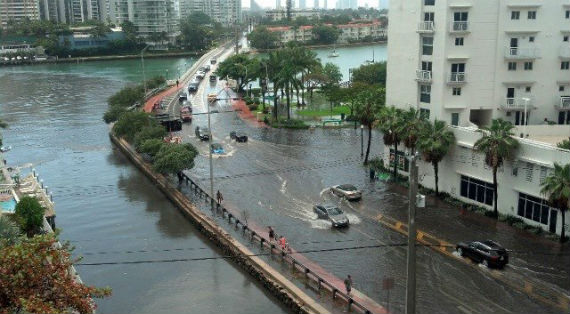
miami


 The signs are more frequent and stronger now. Climate change is accelerating. To many, the sensation of being personally effected is inching forward and becoming more immediate. Those who might have imagined themselves immune or safe are seeing the floods, feeling the lapping of rising water, the storms, the heat and the fire.

To many more beyond the view of western media, climate change is already as real as the droughts, floods or rising seas already a part of their daily existence. The pace of change is accelerating. But while the distance is narrowing between an intellectual grasp of the issue and a direct intrusion of a destabilized climate into our lives, climate disruption remains an abstraction for many. Even so, it’s becoming obvious that to remain distant from the issue of climate change is to remain utterly dis-embodied.

Our bodies, being of the natural world, are materializing just as the planet is materializing. The weather is not happening “out there.” We have always been weathering each other. Only now is it becoming clear what that means. Being fully entangled with the natural world; the inner processes of our bodies are not separate from the outer conditions in which we grow and change.

But we’re not talking solely about bodies here. Consciousness is evolving and is equally entangled with the evolution of the planet. The boundary we imagine between inside and outside, between appearance and reality has never truly existed. It is a figment of our imagination. We can say the same about climate and the natural world. Weather and climate are not phenomena in which we live at all–where climate is some natural backdrop to our separate human dramas–but are rather of us, in us and through us.

We are subject to climate change in our bodies and psyches. We are expanding our view of the perplexing complexity of our connections, becoming aware of the trans-corporeal matrix, the body that sees through its own skin, to and through other bodies, the migration patterns of fellow creatures, the crystallization of water on rock walls, the curling toes of climbing animals, the rhizomal conversations of wild plants, the stories archived in the weathered rings of trees. We are literally one with the biological. All is being processed and recorded, the entire experience of emergence, in the transient, elliptical and toroid story we create and which is creating us.

How is that so? What seems to separate us as biological creatures, our physical boundary, is far less solid and more mutable than we normally imagine. Likewise, the psychic boundary, the consciousness differentiating us is far more real. We are “viscous porosities,” neither solid nor liquid, no more than temporary aggregations of a host of life forms, structural elements (collagen), an energy interface (ATP), a replicative blueprint (DNA) and intra-communication networks, participating with the environment in the creation and exchange of sugars, temperature, moisture, evolution and extinction, even light transformed by chlorophyll.

In fact, all communication is intra-communication. There is no objective separation between any elements of the biosphere. All communication occurs within that realm. There are no side conversations. Everything is part of the whole. At the same time, we are individual contractions of climate, “intra-acting” precariously with the planetary system, each according to our geography and culture, a fractal of the macro-dynamics of planetary change, biology and the micro-relationships in which we live every day.

As trans-corporeal beings, we are making the weather and the weather, created by our human partners, is making us. The idea of ‘externalized’ costs of climate change is a construction of the capitalist economic model. It has no reality otherwise. Those ‘costs’ do not appear merely as respiratory diseases, auto-immune disorders, disease vectors, lost species or degraded atmosphere, but also as cellular deposits, tissue invasions and incipient mutations.

Weather has always been a fundamental factor of our relations, crossing all imagined boundaries between bodies and species. In industrialized societies as in much of the emerging world, we are mostly insulated from weather in our shingled, weather-resistant, secure, durable and isolated domiciles. We want to keep the weather out! Being able to retreat into our vented and layered temperature-controlled shelters provides an illusion of control.

We are distanced, psychically and emotionally, from the realities of those who live much closer to and experience more directly the subtle and constant nuances of weather such that disruptions of the larger cycles of climate are more apparent. In fact, those very temperature control mechanisms that protect us from weather contribute to the very weather we are attempting to protect ourselves from.

To remain distant from climate change is to remain distant from our own bodies and from the community of bodies and non-human species. Yet, the notion of being a weather-maker, creating enhanced cyclones, drought and flooding as well as the internal consequences for others by our daily actions throws the ethics of personal responsibility into sharp relief.

I don’t know about you, but I notice simultaneous hyper and hypo-affective responses of my own, at times feeling urgency and at other times wanting to distance myself from awareness of the impact of my decisions–like air travel, especially–that are surely making others’ weather. At times I feel acutely responsible for all life and am thus aware of the minute decisions I make throughout any given day. At others I will deny any possible personal impact because I want no part of that burden.

Whether we want to know or care makes no difference. The ways we each create weather have, at micro and macro levels, an effect on everyone else’s weather. How do we negotiate or respond to the weathering we are receiving from others? Do we just insulate the attic? Turn up the AC? When the Philippines calls out Western nations for balking at compensation for cyclone damage, when the Third world demands compensation for the weather they are receiving or when the Marshall Islands are slowly subsumed into the Pacific, Western nations treat the equation more as a legalistic abstraction than a contemplation of direct (though delayed) responsibility for their losses–or even the loss of our own coastal real estate.

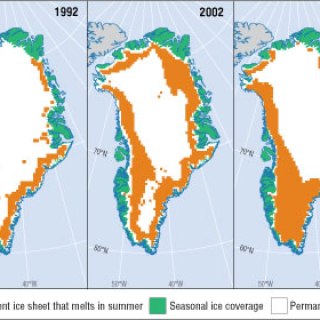
greenland

Likewise, the continuing objectification of nature permits us to release toxic chemicals in the belief that they will either be sufficiently diluted or that significant time will pass before any meaningful contact with humans will occur. Neither of these views accounts for a trans-corporeal planet. This is analogous to the way we view the linkage between environmental pollution and cancer rates. It is all couched in hyper-legalistic terms of denial that resist the quantification of linear causality or the assignment of financial culpability. The political modeling we get–influenced by energy interests, of course–is that we can continue to create your weather while forgetting that it is also our own bodies that are changed by it. The ethic of individual responsibility is overrun by entitlement.

When Hurricane Sandy hits, a drilling platform explodes in the Gulf of Mexico or parts of Bangladesh are submerged, it’s happening somewhere else to someone else. But when your house is consumed by a wildfire in California, all entitlement dissolves. It is no longer someone else’s problem. And you might become acutely aware of how your weather has been created by the collective action of your neighbors.

The line between “acts of God” and acts of men is increasingly blurred. In fact, the larger dynamic of climate change will continue to undermine and, if not substantially thwarted, will eventually render obsolete assumed or constructed political, economic and social boundaries we take for granted: such as nation-states and money. Increasing conflict will be inevitable to the extent it is believed national boundaries, national character, cultural norms, tribal roots and even language are sacred and must be preserved.

When we ask “was that (climate catastrophe) caused by climate change,” we are weighing responsibility. On our trans-corporeal planet, how do we deal with knowing that as we retreat into our self-contained shelters and isolated thoughts, we are creating distant conditions that are driving others out of their own such shelters?

We are not doing well with this.

How do we accept eating pesticides, depositing pharmaceuticals into each other’s water supplies, causing extinction among creatures that cannot adapt as fast as conditions are demanding? It’s all well and good to attribute agency to nature and to imagine the ways we are impinged. But the capacity of nature to act is constrained by time. Nature does not act as quickly as humans act.

Thus, the times are urgent. Let us slow down.

Trans-corporeality is a denial of denial-ism. Denial-ism denies human agency, non-human agency, and the collectivism at the heart of legislative remedies. Propagating the idea of human intra-action is slow. Yet it should not obstruct focused efforts to influence policy, which is to design instruments that materialize collective responsibility, broaden and hasten abatement of the uncounted damage, anticipating and adapting to the dissolution of so many boundaries along the way. Short of a universal adoption of trans-corporeality, such would be the best means of materializing an accounting that has so far been so elusive.

A generative collective response to the weather dilemma does not depend on a single social or political approach. We need multiple measures, even if they arise from within the paradigm that still objectifies nature. As our common dilemma upsets more of what we know and reveals more of what we don’t know, living and acting in both old and new paradigms simultaneously will still be an effective human way of ‘being there while getting there.’ Ultimately, what we will require is much more than policy to get ‘there.’ We will need a healing view reflecting the true nature of our entanglement with each other and the world.