Decolonization

Colonization happened to us and there is no undoing the past. But colonization is also constantly still happening, through the reinforcement of patriarchal white supremacist capitalist culture. So naturally, our resistance needs to acknowledge both–a calling back to tradition and a creative response in the now.

—Marina Osthoff Maghalaes

How deep are the roots? Can they even be measured?
Not too deep for a body to remember, embedded as they are
in rutted crags, carved over generations,
giving birth to subservience… or entitlement.

Where is the original language held?
In the social matrix?
Or is that merely a primal assumption, a substrate
of belief and common practice?

How many incantations does it take for the
ground to burst into flame, to blow open the libraries of
petrified belief, to start a new conversation about
proscribed behaviors, as if by controlling the body, the mind
will follow?

And what of conflicting motivations in layered
opposition, cross-purposed hardening in knots of flesh,
extended to a lifetime of thwarted expression?

Colonization 2
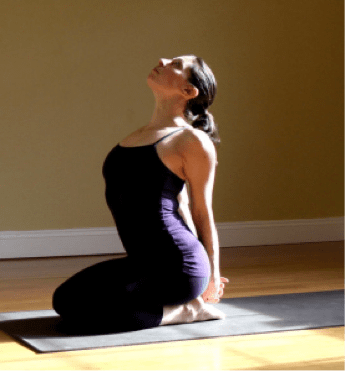
In the holy seat, the sanctuary of the sacred sacrum,
in the bravado of pectoral expanse, the caged knowing,
an offering, secret sounds unearthed by impossible contortions,
foreign shapes suddenly becoming ancestral calls
from the more-than-human realm,

visible through angled fingers, wrists cocked,
looking askance at the audacity of scapular rebellion,
the grimace, the tongue forming words never spoken,
the once-automatic, intrinsic dances known in sleep,
choreographed in dreams.

What story is told here, upside down, disgorging
writhing ghosts, knees chattering to each other,
bent low, locked up, jiggered at odd angles to the ankle,
an old story retold, beaten out with a beat,

on the floor, in the throat, letting go into the mouth agape,
the ears piqued, listening for sleek contractions of
contoured cacophony, falling into micro epiphanies,
shaking off the chains, rocking to rhythms unabashed,
unpredictable and unafraid.

Colonization 4

Colonization clings deeper than the bones, deeper than forgotten
movements, to the original face, the cradle of conversation, its
signature in eruptions thwarted, no longer finding a launching pad.

It resides in residue, beneath the words, hiding in the
rules of sense, of grammar, in the structures of writing,
sentencing the body to an incarceration
of its own making, in the most common of common courtesies.

It lies in the deep pictures, the brain patterning,
neurons that fire and wait for the ones
which have forgotten when to fire.
Asking, “Is you spiritual?” is like asking,
“Are you the earth?” Or is you not?

Colonization
How can something you so completely is,
naturally and totally, that you cannot even name,
something you could not not be,
be taken from you, displayed as “not us,”
examined, dissected, mounted and archived?

The dance of decolonization is elemental,
a journey of finding and losing identity,
a journey from object to subject,
to all becoming subject, traversing pain and promise,
the disease and the cure,

escaping the fixed orbits of the common language,
clearing the colluded arteries of patriarchy, surgically excising
self-denial, weeping the sweat of the oppressor,
recovering lost lineage, recovering the linkages
between rock and heel,

between the soft palate and the soft pelvis,
plumbing to its depth, giving it
up for something new–and old–the shaman’s bones,
the seat of myth, before time, before ideology,
before language, before family,

Colonization 5

dropping beneath the cloaks of tribe, race, culture,
down to the yoga of raw truth where objectification
no longer exists, to what is neither White, Latina,
African or Asian, neither Inuit, Samoan, Yoruba or Maori,

neither “third world” nor secular:
the aboriginal new body, living in new words,
seeing with new eyes; pure reverence,
lengthening through the heart.

Radical Impermanence

The tragic and glorious reality brought to us by the pandemic has been a daily encounter with impermanence, the poignant fragility of sentience and our exquisitely balanced interdependence with the natural world. The other dimension breaking into mass consciousness has been the fragility of conventional ‘modern’ life, from health care to food to energy and transportation. The stability of the economic system is deeply shaken, spurring an increasingly desperate autocratic ideology to prop it all up. Not only is life itself impermanent, but the way we live is also part of the illusion. As painful as it all may be, this is a healing moment.

The underlying violence of the financial system is starkly displayed. The matrix of global supply chains bringing us food, clothing, technology, information, energy, health and transportation is a house of cards, reminding us the way we understand the world requires overhaul. As if impending climate collapse isn’t sufficiently grave, COVID-19 has presented a similar diagnosis in an even more personal and immediate form: failure to act risks death. What could be more clear?

Over the past months, we’ve emerged from a dream and come crashing back to earth. ‘Progress’ has rarely mirrored our own frailty so clearly. No amount of Othering can disguise the fact that we are not other than the world itself. We are not exceptional. Life is an ongoing dynamic confluence of subjectivities between the human and the non-human. We live and die by its turning. Climate change has at least taught us that. We may have agency, but are not and have never been in control.

From our isolated redoubts, we witness the ongoing trauma of Business As Usual. The virus did not magically appear from nowhere; whatever its origin, it is Business as Usual. Yet it is also a liberating force, tearing the blinders from our eyes. Everything about our existence, individually and collectively, is about constructing temples of permanence. To paraphrase Bayo Akomolafe, by imposing the past upon the present, reassuring ourselves of what we already know, despite ever-increasing cost, we create Progress.

Strangely, in this light, progress is a conservative ideology and nearly all of us are caught in it. But conflating survival with permanence is deeply confused. By this definition, racism and sexism are progress; injustice is progress; inequality is progress; climate change, pollution, national boundaries and even war all sanctify permanence. All bow before the altar of progress. Our cities are monuments to atomized ritual devotion to money; our logistical frameworks & financial systems are all ordered and maintained on the presumption of permanence. The fossils fueling Progress come at increasing cost and decreasing benefit. The apparatus guaranteeing permanence requires increasing complexity… bringing increasing vulnerability. This what we are calling ‘normal.’

The increasingly deterministic ‘rules’ of modernity are etched deeply in our consciousness: who belongs, what roles are assigned, defining our relationship to the world. The exploitation, violence, expropriation, befouling of natural resources and the disenfranchisement at their heart are simply denied. The virus has undone those rules, cracking through the veneer of separation while revealing the true nature and depth of ongoing social and political dysfunction. The foundations of modern culture are shaken. Normal persists at a high spiritual cost, extracting meaning while channeling exclusionary ideologies, presuming superiority and mastery, even rationalizing mass death. Everything depends on our somnolent compliance.

We find ourselves squarely in the paradox of compassionate and generous impulses while remaining in anxiety about safety and scarcity. As the sword of impermanence comes slashing downward, slicing through our illusions, we see clearly the necessity and potency of standing for a planetary dialogue on the once cool, now overheated trauma from which we are awakening. In the face of mass de-compensation, we see the possibility of a new consensus arising.

Progress believes we can think our way out of this, as if we are here because of something we did. But, no. We are here because of what we are. The very fact that we think about problems is part of the problem. Our predicament is that we don’t know how to do otherwise. Thinking we are separate is how we got here. Do we now think we can think ourselves out of separation? Even ‘understanding’ is objectifying. There’s a time and place for all of that, but it hardly occurs to us that we can’t think outside the box. We are the box.

Engaging with impermanence, living it, is as close to thinking outside the box as we can get; seeing life as it truly is. A new freedom is immanent; in uncertainty and instability there is an enlivening of creativity, curiosity, spontaneity and new relations. In a field of continuously refreshing engagement, we aren’t compelled to impose the past upon the present; we are less inclined to sink into the quicksand of permanence. Imagining we can return to ‘normal’ is a profoundly false, desperate and ultimately doomed proposition—as if we should look away from what’s being exposed and reconstitute a façade without the substance required to ensure viability. Instead, everything is up for renegotiation now.

The lives we’ve lost become the fuel of our engagement. What the deceased have given us is immeasurable. They have cleared space for us to mourn, to explore fully our own discomfort, our deep unrest, the knowledge of work undone and the opportunity to see that work and to perform the tasks necessary to heal this world, our selves.

Borrowing from Vanessa Andreotti and Dani d’Emilia, we can reactivate our vital compass and return to genuine earth-centered experience; we can restore our capacity to feel ourselves as the metabolism of the earth while accepting vulnerability and discomfort as the desperation of our fragile egos. We can serve as guides, comforting each other as we navigate the agonies of throwing off our addictions and restoring our exiled capacities. Our strength comes from resting in the eye of the storm. Our grief becomes the fertilizer of creative imagination, inspiring and moving us to what is next.

With commitment and compassion, our actions will naturally arise and be naturally accomplished–though not without risk. We may imagine refuge in conceptual deliberation and meticulous formation of intent, but let us cultivate intimacy and seek guidance from non-conceptual sources, arising from the matrix of unmediated experience and universal relationship. May such actions awaken us from the prevailing architecture of causation.

The increasing velocity of change, radical impermanence, frees us from dependency on the archetypes of the dying paradigm. The coronavirus is a portal for healing. Let us move through it with enlightened action, spontaneously and freely arising according to generous and creative impulses. The more forcefully and deliberately we apply ourselves to preparing for the apocalypse, the more we release the weight of hope upon our labors, the more likely we are to delay that apocalypse. In denying hope lies the possibility of a future: the end of deifying progress, the false hope of returning to a world that is ending. Healing potential lies in expressing who we are without calculation, wholly and inclusively, entering a deeper field of impermanence, ever-renewing connection, expression, presence and engagement, with humor, humility and reverence.

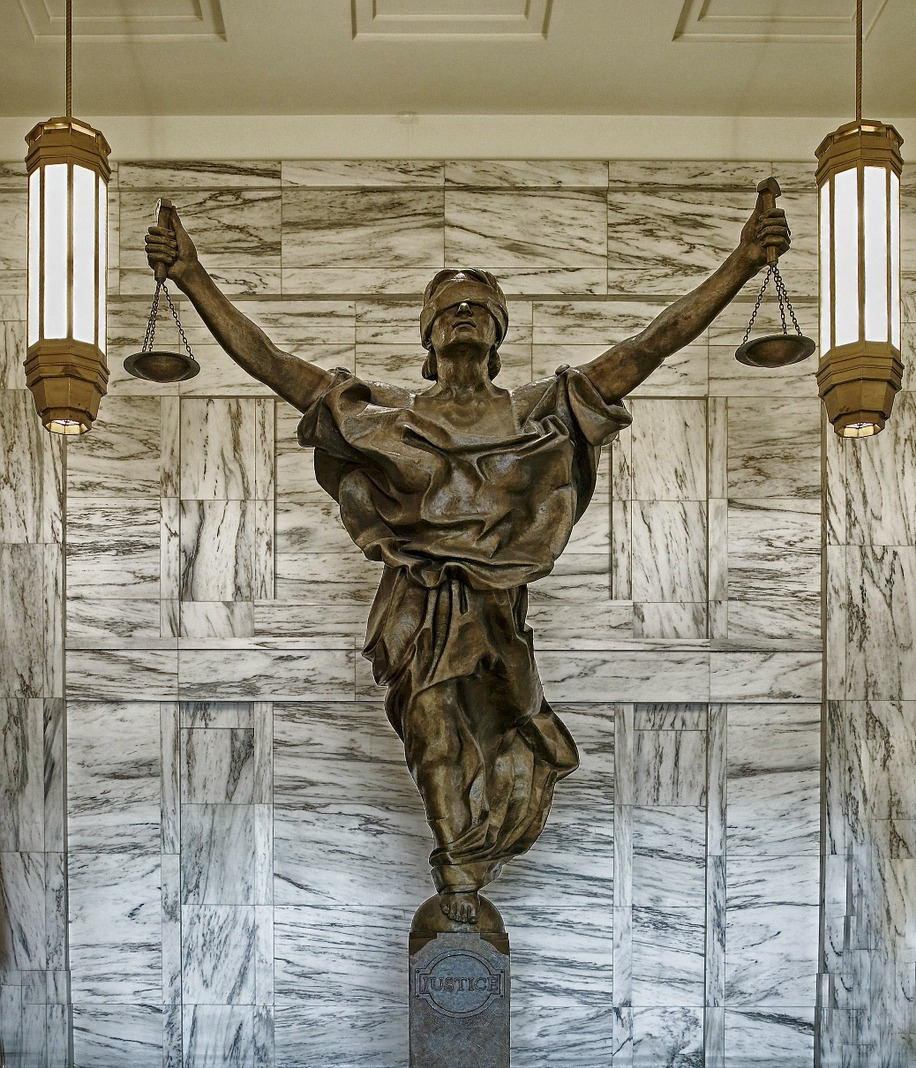
Reconciliation II: Justice

Each of the 4Rs of Deep Adaptation, Resilience, Restoration, Relinquishing and Reconciliation is a searching journey from the world we have to the world we want. The more we explore, the more we find to explore. Just looking at all the associations we have with the word Reconciliation opens many doors. Whether we talk about intra-personal, inter-personal or our relations with the living metabolism of the earth, it means a return to friendly relations. It can mean establishing compatibility of beliefs and practices. In accounting, it refers to a balancing of accounts, rendering what comes in with what goes out, reestablishing harmony at every possible scale.

Not everything that counts can be counted; and not everything that can be counted, counts. — Albert Einstein

We have only to look at our accounts with Earth itself to grasp how out of balance we are. Even the terms we use for accounting are evidence of cognitive colonization. They only reflect the mindset of separation. For humanity to meet and survive what is taking shape, even at this moment, reconciliation implies redefining those terms, an enormous commitment on every level, the expenditure of massive personal and collective resources, a profound re-ordering at the soul level, in the human energy body.

Defining a different path forward, one reflecting the true nature of our entanglements, we imagine how fraught with obstacles such an effort might be as we scan the spiritual, social, political, environmental and financial landscape in this time of increasing risk, uncertainty and unfolding collapse. Even a limited unpacking of what we mean by justice leads to considerations of decolonization as it is tied to the preservation of  nation states, the preservation of capital, risk and financial systems driven by commodification, shareholder interests and debt-driven speculation.

In this consideration, we must  include 1) racial justice: establishing racial equity by confronting the history of racial injustice and addressing systemic issues perpetuating racial stereotyping, racial privileges and locking racial groups out of educational, economic, housing and employment opportunities; 2)cognitive justice: the breaking of exclusionary ideologies to include recognition and establishment of the right of different knowledge systems to co-exist; the return of meaning to being. There are no outdated, irrelevant or second-class ways of knowing the world; 3) relational justice, also called restorative justice: the repairing of relations damaged by criminal violence and the reformation of responsibility based on generosity, compassion and humility, 4) intergenerational justice: the considerations of generational equity in  tax and spending policy, allocating funding for the future security of generations yet unborn, the way we live now and how we address climate change, 5) ecological or environmental justice: establishing equity in consideration of environmental impacts on community infrastructure, habits, livelihoods and public health, 6) economic justice: establishing fairness in policies effecting economic stability, opportunity, mobility, security and benefits to all members of the economic system. The players in this conversation include all beings, all life, all sentience from the macro to the micro-biome.

Where do ‘we’ stand in all this and what is the prerequisite for any of this investigation? It’s one thing to find a separate peace, yet our internal state has never been separate from the larger matrix. For us to find congruence in all our relations, we have to renounce the exhausted story of ‘progress’ and find relief from the inadequate ideology of ‘reform,’ which now only serves the entrenched, never really challenging or even touching the comfortable. Reform is a euphemism for cooptation and defeat. At this very moment in America, the comfortable receive rapid, virtually unlimited and unconditional transfusions of taxpayer money created out of thin air while the proletariat will ultimately bear the burden of these expenditures while hacking away at impenetrable forests of shifting bureaucratic obstacles to receive a few crumbs.

Coming to any semblance of reconciliation of all these accounts strikes to the core of who we imagine we are, the limits of language, the pandemics of depression, addiction, hopelessness, auto-immune disorders, meaninglessness, the loss of economic mobility, the obscene concentration of wealth, the loss of personal agency, the destruction of the biosphere and biodiversity,  the decline of life expectancy and the cloistering of the future in a shrinking box of falsehoods.

These conditions are signals of exiled human capacities, the disappearing knowledge systems defining the diversity of relationships we have with ourselves, our surroundings and the planetary matrix. Our institutions have become intense battlegrounds where values are shredded, where we diverge from community and settle for ever narrowing definitions of opportunity, social mobility, abundance and our sacred responsibilities.

It’s only even possible to consider reconciling the most inclusive list of stakeholders and relational issues, balancing accounts, as it were, if the primary premise is accepted: the archetypes of separation, human superiority and mastery over nature, rooted in the Enlightenment and capitalism, are spelling our doom. The entire system has come to represent only domination, extraction, exploitation and violence.

That violence is expressed as colonial expansion, the creation of empire, increasingly extreme exploitation of life, natural and personal resources, the institution of extractive economies including he corrosion of personal well-being, the surveillance state, the growth of mechanisms of control, the corruption of thought, truth and the persistent reinforcement of a paradigm of exclusion.

Every one of these features, every level and domain of operation of the Vehicle of Extinction can be represented as the management and offloading of risk. All risk is deflected by the few to the many.  Living with risk infuses the majority of lives with increasing uncertainty, instability and vulnerability.   The pandemic is highlighting these inequities because service workers in many fields (manufacturing, agriculture, transportation, law enforcement) and even many health care workers now deemed essential during COVID shut-downs are the very ones with no choice but to expose themselves to the increasing risk of infection. While we celebrate the genius, the heroic commitment and the compassion of these frontline workers, their most admirable virtues are also being exploited along the way.

True justice  as the equitable redistribution of risk, the restoration of a tangible level of social and systemic financial support to more broadly manage uncertainty.  Sharing risk equitably is a benefit to all, not only the privileged few. If risk levels were the central motivating factor in repairing our relationships,  in only one of many possible ways, we would be addressing climate change on a massive scale. We would be opening economic opportunity, social mobility, repairing mental and spiritual health, increasing public safety and unleashing untold reservoirs of creativity and generous contribution to the well-being of the whole. None of this is about eliminating risk. That would be impossible. But imagine a future driven by an abiding clarity on the meaning of justice in all its forms. In that world, counting all that counts including all that cannot be counted, our accounts would be moving toward reconciliation.

The Sanctuary of Not Knowing

Suggesting spiritual refuge is to be found in ‘not knowing’ rings a familiar bell, though ironically, striking it yields no sound. It has no tone; yet all vibration is missing. I am intrigued. The clapper isn’t striking anything solid, as if that would be too much like ‘knowing.’ As if knowing is the materialization of thought, as if anthropocentric knowing is the only way, as if what we ‘know’ is all that can be known. One cannot un-ring the bell.

Not knowing feels like an undiscovered land, an abundant refuge in which I am not the center. Perhaps there is no center, only a kind of getaway we all seek but rarely find. It’s freeing to not know, to imagine oneself a rich and compelling un-network connecting everything without having to be anything at all. It’s seductive, to be sure. We are invited to imagine the Unseen, to enter a limitless ubiquity. Being shaken from whatever we thought we were doingand being drawn into this provocative, gestating, undefined space of is not unlike being a fish suddenly realizing there’s such a thing as water. Aha!

It seems there once were some fish who spent their days swimming around in search of water. Anxiously looking for their destination, they shared their worries and confusion with each other as they swam. One day they met a wise fish and asked him the question which had preoccupied them for so long: “Where is the sea?” they asked. The wise fish answered: “If you stop swimming so busily and struggling so anxiously, you will discover that you are already in the sea. You need look no further than where you already are.”  —Carolyn Gratton, The Age of Spiritual Guidance

So it is. If we can allow our vision to soften and detach from whatever is capturing our attention, whether sensation, feeling or thought, even for short moments, we might discover a new quality of animation, not to mention connection, among all things.

When was the last time you encountered someone determined to ‘not know,’–if that isn‘t a contradiction? When was the last time you – a fellow explorer of not knowing — locked eyes with a fellow not knower? I can only imagine such a moment as spontaneous combustion — of possibility, the sharing of a unique view in which we remain uncommitted, an intermingling of presence and absence, witnessing yet not adopting every impulse to hold anything, noticing without retaining. Holding all that is real without declaring any of it to be true…or not true. This is an island in the middle of a vast ocean, stillness surrounded by motion.

We’re used to connecting over what we know. We’re used to establishing agreements about what we know, forming alliances, partnerships, romantic, economic, political and spiritual relationships defined by all we agree is true. And not true. Everything hinges on sustaining those agreements: all progress, growth, everything, every framework of discernment, even love itself is restricted to the parameters of agreement. And we habitually behave as if shared knowing defines the entire context in which we swim.

Could it be otherwise? What becomes of love in a field of not knowing? What if we weren’t so quick to define water, instead allowing ourselves to marinate in a realm of dissolving assumptions? What if we weren’t so quick to believe knowing and believing are the only currency of being with. I mean, look around. How are we doing with that? Certainty about what we know is the root of all conflict. We, humanity, are being driven over the precipice by those who know and who never take the time to not know. I’m not suggesting we deny physics or science in general, but just consider, even science is also invariably, inescapably, inadvertently conducted according to discernible biases about what is true.

Not knowing dissolves presumed boundaries. It becomes an entree to trans-corporeality, an intermingling of bodies, minds and natural phenomena. We become each other for a moment–at least until the knowing mind interrupts. We enter an uncommon relationship that doesn’t make sense. And at this historical moment, attempting to make sense in the usual ways makes no sense at all. We should likely infer the parameters of this unknown territory have always been accessible beneath the awareness of the One Who Knows. We can become the one who doesn’t know – adopting wholly different terms of relationship that have always been available were we to ever simply let go of knowing.

Not knowing is Rumi’s field beyond right and wrong.  It lies beyond Yeats’ widening gyre. It might as well be the field beyond truth and falsehood. It’s the undiscovered and unappreciated spaciousness of mind, released from restrictions imposed by being So Damn Sure, which is what makes living with uncertainty So Damn Hard.

Truly realizing not knowing becomes a meditation on Belief. Every voice tugging at the mind to give up this quixotic adventure arising from belief becomes a restraint against discovering and exploring the freedom of not knowing. Not knowing implies a certain trust and fearlessness to remain present in a state of greater uncertainty than we have ever known. It also offers perspective on the routine uncertainties of our current predicament, making them more palatable, even mundane by comparison.

None of this implies the disappearing polar ice caps aren’t real. They are indeed. It is the reflexive struggle againstuncertainty generating the pandemic rise of fear and anxiety just now. Not knowing allows us to befriend uncertainty.

We are not in control. We never have been, no matter how we cling to that myth or struggle to recover. Anxiety and fear are functions of belief. Knowing and doing are intimately related. Not knowing is a sanctuary in which we may release ourselves from impulsive doing to allay anxiety and fear. The sanctuary is where we can exercise non-doing, waiting for doing to arrive.

Can doing arise from non-doing? How will we know? Can doing exist in a field of not knowing? I will say yes. I’m going to say enthusiastically that doing arising from not knowing is not like any doing we’ve done before because it emerges in a pervasive field of uncertainty.

If we choose to remain in not knowing, will we do what needs to be done? Will we even know what needs to be done? I don’t have the basic practical measures in mind, but rather the deeper personal existential and spiritual choices. We will know what must be done because whatever doing arises from not knowing will be enacted in a context of Presence. Presence being the absence of past and future.

All belief, all knowing arises with memory of a past and a vision of a future. Presence rarely exists in a field of doing, at least not in the fullest sense. Presence dawns in the act of fully relaxing into not knowing, allowing the past and future to fall away. We are here. We don’t need to believe in anything. We are available for not doing. There is no place for anxiety and fear to hide here. This is sanctuary.


Covid-19 Meets I Ching

Turning Point (24)

Shock (51)

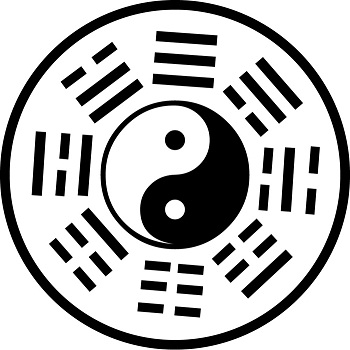
The I Ching is an ancient code expressing laws of nature. This accumulation of Taoist wisdom is not specifically about human nature. It’s about the nature of Nature. We can interpret these expressions, represented as hexagrams, as we would mathematical formulae. The permutations of meaning expressed by the 64 hexagrams of I Ching reveal a subtlety normally beyond our commonplace awareness. Unpacking them permits us to enter the realm of InterBeing, the dynamics of the web of life itself.

The combination of these two hexagrams, Shock and Turning Point, appeared as a response to a specific inquiry about the meaning of Covid-19. Accordingly, my amateur status notwithstanding, and despite stretching the primary application of I Ching beyond personal concerns, I interpret these two hexagrams in two ways: the first as abstract expressions of energetic laws of nature; the second as they imply emotional, rational and spiritual dynamics expressed in action.

The first hexagram is divided into three bi-grams. From the bottom up, the first bi-gram demonstrates a strong yang (solid) line lifting upward and outward. The implication of this yang force is that instinct arising deep in somatic being drive one’s perspective and one’s actions. Instincts are strong, yes, but may also be fearful and restricted by tradition. There is certainly a character of cultivation, creation and accomplishment here. Yet the energy of this basic yang impulse also overlooks the higher aspirations of production, benefitting others beyond one’s narrowly defined group.

Likewise, the yang line in the middle bi-gram has a strong character of restricting the free flow of what is rising from those instinctual drives. This yang line is like a closed gate, turned toward the first bi-gram than the third. In other words, generosity, vulnerability and more expansive views of the world, not strictly limiting oneself to the instinctual self or to one’s immediate group, with a capacity to look beyond reflexive fear are far more desirable and congruent with the open and accessible upper tri-gram.

Hence, we are given opposing ways to respond to the shock of having our worldview shaken or even destroyed by COVID-19. The questions framed by this reading relate to different planes of perception. On the physical plane, what our bodies know doesn’t require interpretation. On the rational level, we have to choose which direction we will turn for relationship, comfort and collaboration. In the realm of imagination and intuition, we explore and gain insight into the qualities of relationship providing fulfillment, direction, challenge and expansion.

The key emotion connecting all of these questions seems to be vulnerability—a sense that by remaining open–or, opening the gate in the middle bi-gram, as it were, shown in the second hexagram–to uncomfortable conditions and fearlessly sharing personal truth, we will discover the answers to every other question. We will also find the formation of relationships a natural and effortless process leading to those answers.

Covid-19 is stripping most of us—though evidence suggests that we can exclude the banking, investment, CEO class and most politicians–of all pretense. The superficialities of life are being stripped away. We are in deepening shock as the multiple vulnerabilities of our society are exposed. Yet the cultivation of relational acts of resilience are already rising broadly and creatively.

Hexagram #51—The Arousing (Shock)–changing to Hexagram 24–Turning Point demonstrates a strong shift to a more open, congruent and dynamic relationship arising from a clear-minded and unobstructed manifestation of our highest ideals in material actions. The shock of dealing directly with the threat of a potentially deadly illness is, ironically, galvanizing us to engage with the world in restorative and resilient action. This is our Turning Point, but it won’t be fast or short. A period of gestation is required, a time to gather strength and durability.

Much is being written about the ways people respond to the rolling disaster of bad news about the climate, all of which contribute to an increasingly dire prospect of a future radically disrupted from the version of Modernity we’ve enjoyed in the past. As if climate predictions alone weren’t enough of a terminal diagnosis? Covid-19 as well as future pandemics, including drug-resistant bacteria, add to a high-risk future. They may not portend catastrophe, but at the very least they undermine the sense of security we might have enjoyed as a species.

These hexagrams demonstrate that while Shock may describe the initial impact of bad news, the more fundamental impact of our current predicament is one of removing the last remaining shreds of complacency, casting us deeper into the turbulence of uncertainty and portending a volatile future. New pieces of the picture of a future beyond our control come in the form of new reports, news stories, scientific proclamations, new aspects of how natural is responding to the human-driven distortions of our world.

One might even say anyone paying attention to the news is now in perpetual, unexpected and deepening shock. We are all in various degrees of trauma, desperation, grief, panic, denial, exhaustion, rationalization or hopelessness, all of which together may be categorized as stagnation,….while, curiously, we may even simultaneously claim a sustaining determination or unbreakable resolve.

There is no safe haven. Further shock either drives us deeper underground into an insulated and isolated cavern of despair—or—awakens us to a Turning Point, casting aside what has not been working, yielding an even greater resolve to seek partners, to nurture intimacy, to repair and restore what can be salvaged from the wreckage, to identify and adhere to vital principles to guide our actions now.

Each of these shocks reinforces and underscores the mutability of nature—and our mutability within nature. They are messages reminding us that WE must find the capacity to change and to quicken the pace of change to meet the conditions unfolding before us. This is no longer about ‘fixing’ anything. The greatest shock of all is the accumulation of news telling us the possibility of fixing the dramatic unfolding of catastrophe on multiple fronts is slipping through our fingers.

Now is the time for adaptation—and not in a superficial way. Adaptation is what we can call the nature of the change we seek. The Deep Adaptation Agenda arrives as a decision to use the shocks we are receiving as fuel, to fully feel them, to permit ourselves to remain vulnerable to them, to restore a new freedom, to restore movement, to gather and direct our energies to drive more creative and innovative responses to the blows now being delivered to Modernity in rapid succession.

Reconciliation I: Peace as Rebellion

The fourth of the Deep Adaptation 4Rs framework, along with Resilience, Restoration and Relinquishing, is Reconciliation.  We imagine its meaning to be about restoring and sustaining a state of peace, resolving past conflict and, at the very least, designing for the resolution of future conflict.

We do not imagine all conflict can be resolved. Far from it. In a collapsing world, there is very likely to be increased conflict. Reconciliation refers to a consciousness and a versatility with practices most likely to resolve small and large scale conflicts in ways that extend concentrically from an ethical and practical center.

In the simplest terms, achieving peace in an increasingly turbulent world requires resolute and focused personal practice. The internal condition might be more correctly called equanimity, a capacity to respond to changing circumstances without being reflexively triggered into anger, fear, jealousy, aversion, indifference or pain. But not being triggered is not quite enough. Response-ability means being moved to act.

In this alienating and isolating world, setting one’s vertical compass to generosity and gratitude may feel good, but if we’re not also orienting horizontally to confront the mythologies (scientific materialism, separation) and operational practices (exploitation and violence) of modernity,  which establishes hierarchies and treats them as biological laws, we are committing an act of blind privilege. It’s not entirely useless, just incomplete.

How do we arrive at equanimity? Borrowing principles from both modern and ancient psychology, we can develop the skills necessary to improve our access to equanimity and we can improve our stability in it. But as long as there is conflict in the world between nations, ethnic groups, tribes, families or individuals, we are not in a state of peace. We may find a personal non-dual view, an oasis within the collective dualism, like vacationing at our own personal monastery, but we cannot permanently turn our backs on the origins of conflict all around us.

Any conversation about ‘getting there,’ arriving at the desired internal state, has to do with identifying and removing obstacles to our direct access. This inevitably requires an exploration and discovery of the many ways we remain in a state of self-deception. We are called to identify every self-limiting belief, every flawed construct, every incongruent intention and every addictive behavior that stands between us and an authentic experience of equanimity. Not the false equanimity of indifference. Not the by-passing of real emotion, but an authentic capacity to be with. Along the way, we might also have to reconcile conflicting beliefs about our own identity, asking and clearly answering the question, “Who is experiencing this peace/equanimity, anyway?” and perhaps most importantly, “How do I find it again after I lose it?”

All of the foregoing constitutes what we might call a “path” to peace, a method or a checklist of issues to resolve before we can say we “are” peace. Take out the dustpan and get behind the furniture, straighten out those sheets on the bed. Take out the trash. Then we will have peace. When there is nothing in the world (out there) to shake us from our oasis of equanimity, then we will be immune to the temptations of conflict. Then we can be compassionate. Then we can be mindfully open to whatever arises in our world without reacting thoughtlessly.

But alas, no. There is no path “to” peace, just as there is no path “to” realizing our true nature. Yes, there are practices to develop our skills, perfecting our access to equanimity. We may imagine fully awakened mind as the fruit of steady practice and incremental refinement of specific skills. Yet, upon closer examination, there is no denying the “fruit” of all that practice can only bring us back to the seminal realization that what we call a peace/process is already our nature. There is no way to any such goal. We are already there.

If we accept this premise, that there is no path, no outcome and no fruit of any labors, then there is no far-off objective of our practice that is only realized after a lifetime of disciplined pursuit. The only way “to” the goal is through direct realization, here, in this moment.

What are the components of a direct access to peace that serves each of us right now?First, cut through the illusion of a separate Self. One needn’t become a scholar of the origins and historical, cultural, cosmological or spiritual propagation of this flawed idea so much as a relentless inquisitor into the direct effects of holding it. Believing in the separate Self requires the existence of the Other. Without the Other, the only conflict that can exist is within the One.

Thus, all manifestations of conflict are internal in nature and origin. Every moment we spend out of alignment with this truth, which cannot be modified, enhanced or diminished, we abandon our innate wholeness and contribute to further conflict within the Whole.

Second, yes, there are a plethora of psychological and spiritual metaphors, conceptual frames, processes and exercises that define peace and may enhance our skill in achieving more direct embodiment. I’m not anti-intellectual nor am I anti-psychology in the least. Yet every conceptualization, rendering of thought, planning, consideration or representation of the state of peace is in essence an effort to ‘get there.’ Ultimately, there is no ‘getting there.’ There is only there. There is no other way there except to be there.

Third, whether we are being there, getting there or lost somewhere in between, there is nothing to be done. There is no action, there are no steps to take, no conceptual progression to save us or guide us. Inaction is also not the way. If there is a way, it is through non-action. Or, as it may sometimes be put, the direct realization of a state of peace is neither being there nor getting there, but somewhere in between. That is the territory in which an immense creativity resides, where something powerful and transformational is liberated.

Finally, the only matter left to this brief consideration of the true embodiment of peace is that appropriate responses are required in a world far from being aligned with the notion of no-self, which preserves and operates upon the presumed reality of the Other and which believes the only way to address conflict, or any problem, for that matter, is through direct oppositional action.

In this context, peace is rebellion. Peace lives outside the consensus frame. Peace becomes a relentless, unswerving and unapologetic commitment to one’s inner truth. And we become its guardian. It’s not a solitary truth whatsoever, as realization becomes a dynamic imperative so purely and clearly requiring engagement that there is no denying it, rationalizing or obscuring it. Arriving at that clarity is an eyes wide open, fearless and undaunted continuous journey into and through the full depth of one’s own suffering–to the point at which a magnificent, clear, fierce and uncompromising universal compassion dawns. Here, the impulse for collective Reconciliation awakens.

Learning To Die in the Anthropocene

In a chilling, factually grounded and provocative 2015 book, Learning to Die in the Anthropocene, Roy Scranton describes his tour of duty in Iraq in 2003 as an exercise in facing death every day as he departed the relative safety of his protected encampment in a Humvee, armed, armored and backed up by the awesome firepower of the US Army.

To be constantly facing death required an assembly of valued resources, one of which was an 18th Century Samurai manual, the Hagekure, which advised, “Meditation on inevitable death should be performed daily.” He took the advice to heart, eventually adopting an attitude as he headed out each day that he was “already dead.”

He then proceeds to draw the analogy between his experience in Iraq and the human role in driving climate change; namely, that we will do almost anything to avoid naming our true predicament. We humans in the Anthropocene, named for our historically unprecedented position of being a single species driving planetary geological change, have attended a terminal diagnosis for quite some time, which we know, left untreated, will spell the death of modernity including mass extinction, possibly even our own. We humans who, at least in the developed world, have become so expert at denying death, now see The House of Modernity we have built being threatened to its foundations.

Have we been providing the required treatment of the condition? No. Not even close. And for the past 15 years, out on the fringes of climate science, there has been a rising chorus of voices (and data) telling us we are already “already dead,” that there is too much damage already baked into the atmosphere and the oceans to escape or reverse course. No one knows for sure how long it will be before much more significant impacts will roll across the globe, particularly because most predictions have turned out to be conservative. It may be 10, 30, 50-80 years or more. We don’t know. What we do know is that we have procrastinated, and continue to do so, for no good reason.

hurricanes-storms-hero-1-1024x684-1
Credit: dark-mountain.net

How do we process all this? What does that mean in terms of our attitude, our actions and our philosophy of life? What is a meaningful way to live now? What are the choices we have to make in this increasingly uncertain time?

Scranton asks, “What does consumer choice mean compared to 100,000 years of climate catastrophe?” Really. Suddenly, how important is it that we can choose from 25 different kinds of washing machines when water security could be impaired long before that machine is scheduled to die? Or, for example, we don’t know exactly what conditions will dramatically impact global harvest….but can we say governments are truly prepared for such a scenario? No.

We are suddenly awash in philosophical questions for which there are no instruction manuals. If, as a French philosopher mused, to philosophize is to learn how to die, then we have entered a new philosophical age. We have to learn how to die not only as individuals, but also as a civilization.

What does that mean, “Learning to die?” The daily context of war is one thing. What of our everyday world?

Let’s put it this way: I meet the basic qualifications for being an elder. I take that label seriously in the sense that it is my social duty to convey whatever wisdom I have accumulated in the course of my life, whatever my vision of a just and equitable world that serves all and includes all has come to be, however expansive that view may become, to younger generations. I have been fortunate in being able to live a full life, and particularly for being able to devote myself to what is most important right now. That life is also taking on the inevitable risks and obstacles and trappings that come with age. I am undeterred.

Even though I could say, with the exception of seeing no truly significant collective action on climate change and the virulent rise of fascism at home and abroad, my dreams have not been entirely stolen. To my own child and other next-generation members of my family and to all their age-cohorts across the world, I would say, “Your dreams have been (at least partially) stolen by me and my generation.” That is the true shape of our predicament and obligation. But by virtue of my complicity and that of my generation and the ones before us, you are now forced to contemplate the death of something far greater than any individual.

Their children’s dreams, which is to say the opportunity to live in a thriving, low risk, equitable and just society with a generous opportunity to lead a fulfilling life of their own choosing, have been appropriated by conditions set in motion by previous generations and will thus be more difficult to realize. The twin mythologies of endless growth and ecocide without consequences are dead. By the time their children mature, the transformation we have set in motion in the name of building our House of Modernity will be well on its way. For them, a strong, intensely focused resolve to live by life-affirming values will be an even greater challenge.

Beneath our well-constructed and endlessly adorned personal identities, beneath our striving and our plans, our coping strategies, our denial, anxiety, fear and uncertainty, beneath impacted layers of personal history, the wounds of family and the trauma and separation imposed by this culture, there is a timeless reality, deeply and endlessly compassionate, unafraid, loving and creative. Our task is to access, develop, and share that intrinsic nature, building our capacity for unconditional love, fulfilling relationships, mutual-reliance, trust and courage. This is an initiation like no other. It is our final loss of innocence. Time to really grow up. And time to grow young, to regain an original innocence that will sustain us for the future.

Stephen Jenkinson describes love as “a way of grieving that which has not yet slipped from view’ and as ‘an active form of grieving that doesn’t require sadness.’ The courage, the skill, the intelligence and the love we need right now do not require sadness. But they do require we acknowledge our grief and pass through this portal with our eyes open, leaving behind the old world as we prepare to meet and thrive in the coming world. It’s time to elevate our game.

Kali Takes The World II: Baba Yaga

By Vera de Chalambert

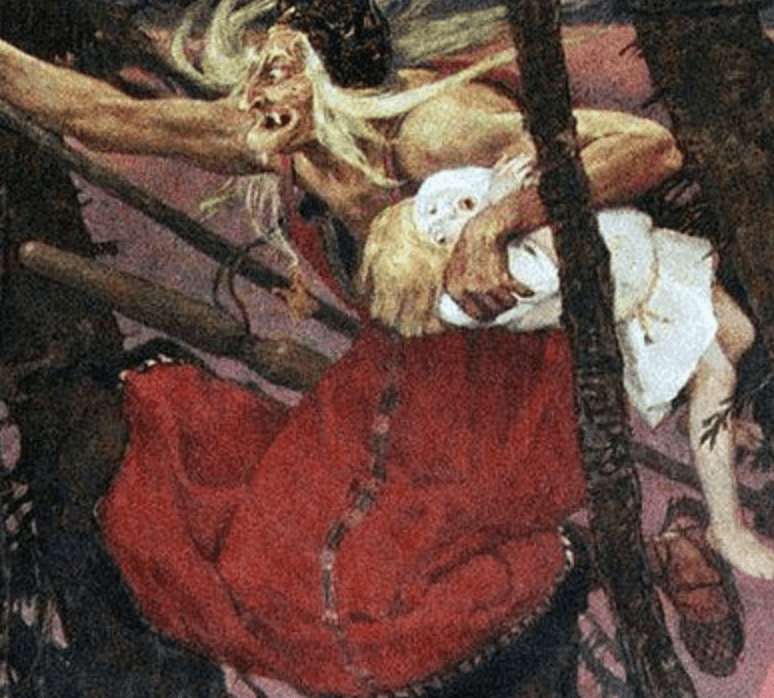
She appeared out of nowhere, as if from an explosion of smoke thrown by a cheap magician while I was meditating on another goddess. It was a mix of vision and cartoon unfolding on my confused mind-screen. She smelled like cemetery earth from my father’s recent burial. Her hair was white, disheveled, as if on fire, her nose was a huge hook, warts and all, just like I imagined it as a child when she still terrified me from the corner of every dark room. Baba Yaga, the infamous dark hag, the evil witch of every Russian fairytale, the one who eats children and lives in her house on chicken legs and rides a broomstick, was in my room and in my face, and she meant business. Her demeanor was urgent. She barked with a deadly seriousness, shoving a femur bone in my face. She spoke in Russian, “Hold on to your bones!” Then she was gone.

I felt shaken. The experience felt so real that I wondered about my grasp of reality. I would have been thrilled with a vision of a goddess… but a fairy tale character? From the Jungian psychoanalyst Jean Shinoda Bolen I would later learn that archetypes and especially goddesses appear to us as they damn well please—cartoon fairy tales, illustrious rooftops—and that when you are handed bones, that’s an initiation, if she’s ever seen one. I learned that Baba Yaga was a primordial form of Kali even before the Indo-Aryan march across the Russian steppes. Most importantly, as the next cycle of my personal dark night unfolded only a few months later and I began moving through the devastating pain and disorientation of divorce, I returned again and again to the wisdom of the hollowness of bones. I committed to keep choosing truth over safety, the real over the convenient. I embraced the groundlessness of the Mother’s hut on chicken legs. I wailed in her dark woods until I had no voice. I let her make a stew of me. Vast emptiness, no holiness. She offered only truth.

There comes a time when nothing is meaningful — except surrendering to Love.
~ Rumi

Today, our very own postmodern Kali Yuga is upon us. The old world with its illusions of certainty and predictability is coming to an end. The Mother in her holy chaos is pulsing through every crevice of the planet, beginning her dance of change and transfiguration in the collective field. If you listen deeply, you can feel it too; we have been handed bones. I believe that Hurricane Harvey marks the first glimpse of what Andrew Harvey and Carolyn Baker in their brilliant upcoming book Savage Grace call the Dark Night of the Globe, a period of unprecedented global crisis, climate disaster, dissolution of old templates, and if we allow it, collective spiritual initiation. They prophesy that we are entering a dance that will either mark the end of civilization as we know it and possibly even human life on the planet or will force us to dive into the Mother’s cauldron of transfiguration and arise as what Andrew Harvey calls ‘divine humanity.’

In bemoaning the absence of the rights of passage in our culture, Marion Woodman explains the importance of undergoing a psychological or spiritual death. She says that unless we experience “a period of being in the dark hole of chaos, followed by a rebirth—then people don’t truly grow up.” She explains that in old cultures the young had to believe that during their coming-of-age rituals, they might die. This is how they would have to prove that they are mature enough to enter the adult world. Like it or not, for good or ill, this dark night of the world soul is upon us. And in the absence of rituals, this is all we’ve got as a global initiation into adulthood. Perhaps only such a deep collective reckoning can trigger the kind of spiritual maturation that is called for by our times. Only God knows if it will be enough to lead us to abandon our narcissistic notions of spirituality, to let go of the false promises and psychopathic tendencies of capitalism, to humble our hearts before the great Transparency, and to rise like the Mother for all living beings.

Hecate

In ancient Greece, its own dark crone goddess Hecate was known as the goddess of the crossroads. It is at the crossroads that we find ourselves. In The Dark Places of Wisdom, Peter Kingsley says: “If you’re lucky, at some point in your life you’ll come to a complete dead end. Or to put it another way: if you’re lucky you’ll come to a crossroads and see that the path to the left leads to hell, that the path to the right leads to hell, that the road straight ahead leads to hell, and that if you try to turn around you’ll end up in complete and utter hell. Every way leads you to hell and there’s no way out, nothing left for you to do. Nothing can possibly satisfy you anymore. Then, if you’re ready, you’ll start to discover inside yourself what you always longed for but were never able to find.”

We are at the crossroads now and there is nowhere to run. Our world is dying and so the call from the deep is strong. The work before us is uneasy and long, but great powers work by our side. And it is only from this place of darkness, of radical uncertainty, of coming to the edge of all our limits, the end of all our old stories, that something new within our soul might emerge. Life is roaring in dialects of Kali—asking us to get real, to get committed to our spiritual lives, to each other, and to this world. To tolerate the growing pains of the dark nights given to us. To get exceptionally honest and do our shadow work. Are we willing to give up our spiritual materialism and surrender the accolades of the false paradigms of success? Are we willing to dare self-disclosure, to reveal how imperfect and lonely and messy it is to be human? Are we willing to meet our grief, our confusion, our heartbreak—the very real uncertainty of it all—and not send suffering into exile? The Mother has no orphans. Dr. Martin Luther King used to say, “We must meet suffering with soul force.” The Mother is the soul force.

The truth is that Kali has always had the world. Marrow of time, oracle of holy change, she is the great gate of transformation through which all must pass. Her medicine is darkness. Her initiation is by fire. Appearing in difficult periods of transition—death, disease, divorce, loss of structure—she is the devi of disillusionment. It is said any contact with her transfigures the soul. From the moment the Mother birthed the universe of her holy dark womb to the instant she swallows it up again, we are hers, and she only ever asks one thing: when all is stripped from you, what remains? Whatever your answer, she will throw it up against death. So we must listen deeply now. Our planet is in crisis. We live in messianic times. And, tag, you are it! We are not free until we are all free. So, what are you willing to rise for? What is your True North? What do you sit and stand for? What are you willing to give up for it? If all that can burn is burned up, what remains?

She rides in on a tiger, magnificent and fierce. She wields weapons; she slays demons. But, we are in the long game now. We must remain vigilant, relentless, grounded in the Real. We must pray and prepare. The night will be long. The night will be dark. The forces of separation are great. But She IS here now, and in the late hour, when all hope is lost and all that we most loathe to give is stripped from us, she will rise, even more terrible, as only Love can be. And She will win.

Kali Takes The World I: Dark Night of the World Soul

By Vera de Chalambert

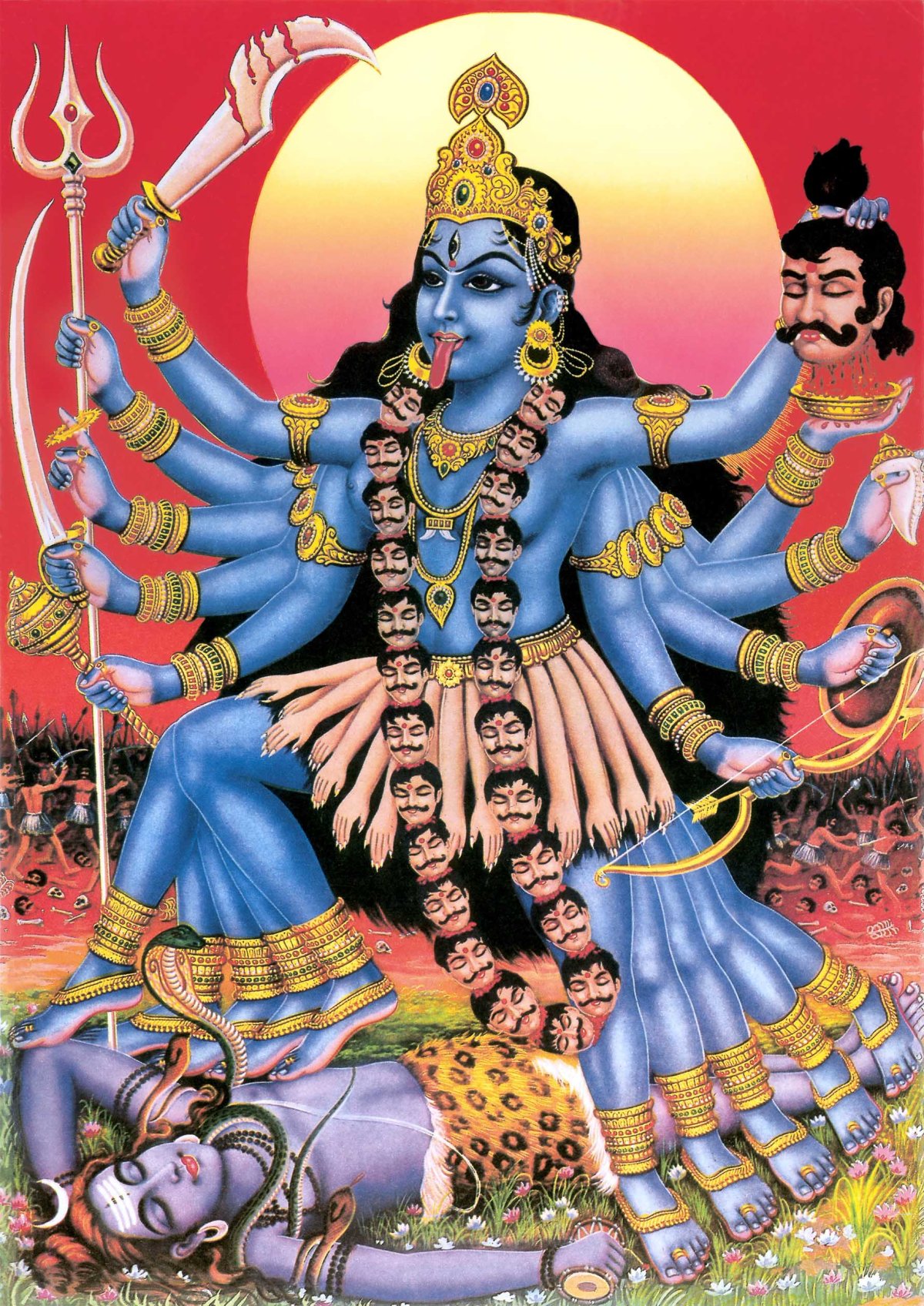
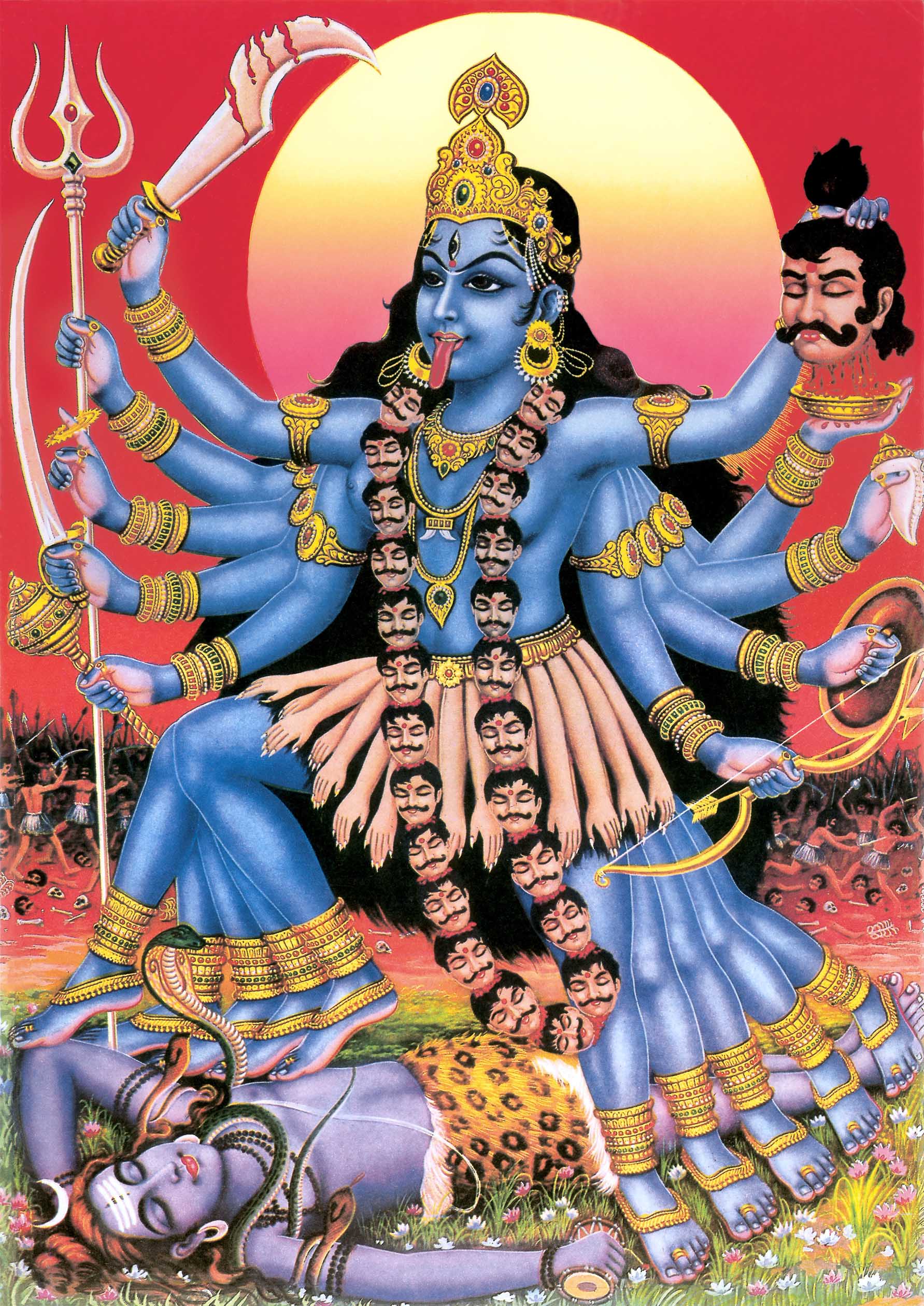
When in the summer of 2015 I saw the breathtaking image of the goddess Kali, the great Hindu goddess of death, destruction, and liberation, tongue outstretched, third eye blazing, projected onto the top of the Empire State Building for the documentary Racing Extinction, I ranted, “This a sign of the times—Kali takes New York!” A year later, as the shocking 2016 election results were similarly projected onto the top of the Empire State Building and I saw Donald Trump’s smug smirk and sly gaze staring victoriously into the shaken soul of the country, I raved, “This is a sign of the times—Kali takes America!”

kali-1Last month, I picked up the New York Magazine’s infamous “Doomed Earth Catalog” issue and it opened right to the “The Uninhabitable Earth” centerfold. I have certainly not gone unfazed by the realities of climate change, nor escaped its oft-sensationalized overtones. But this article and its striking images, like a skeleton all decked out in Ray-Ban aviator shades melted straight into the concrete and graphic descriptions of being cooked from the inside as the earth temperature rises just a few more degrees, knocked the air right out of my lungs. I suddenly wanted to wail, but no sound came out.
I suddenly wanted to run, but there is nowhere to run from reality.

If you haven’t seen it, this issue is the only tantric iconography of the Great Mother that you will ever need. It does what every statue and image of the Dark Mother was always meant to do—make us unsettled, shake up our false selves and empty certainties, strip us of illusion. The voice roaring ruthlessly from the pages of the magazine was unmistakable. She might as well have been projected again up there on top of the world. This time, in every bone of my being I knew. This is the sign of the times—Kali takes the world!

Kali

In essence, the mythos of Kali is this: apocalypse has arrived. Demons are taking over the world. And, surprise, they can only be conquered by a woman! In desperation, the gods call upon the Devi.

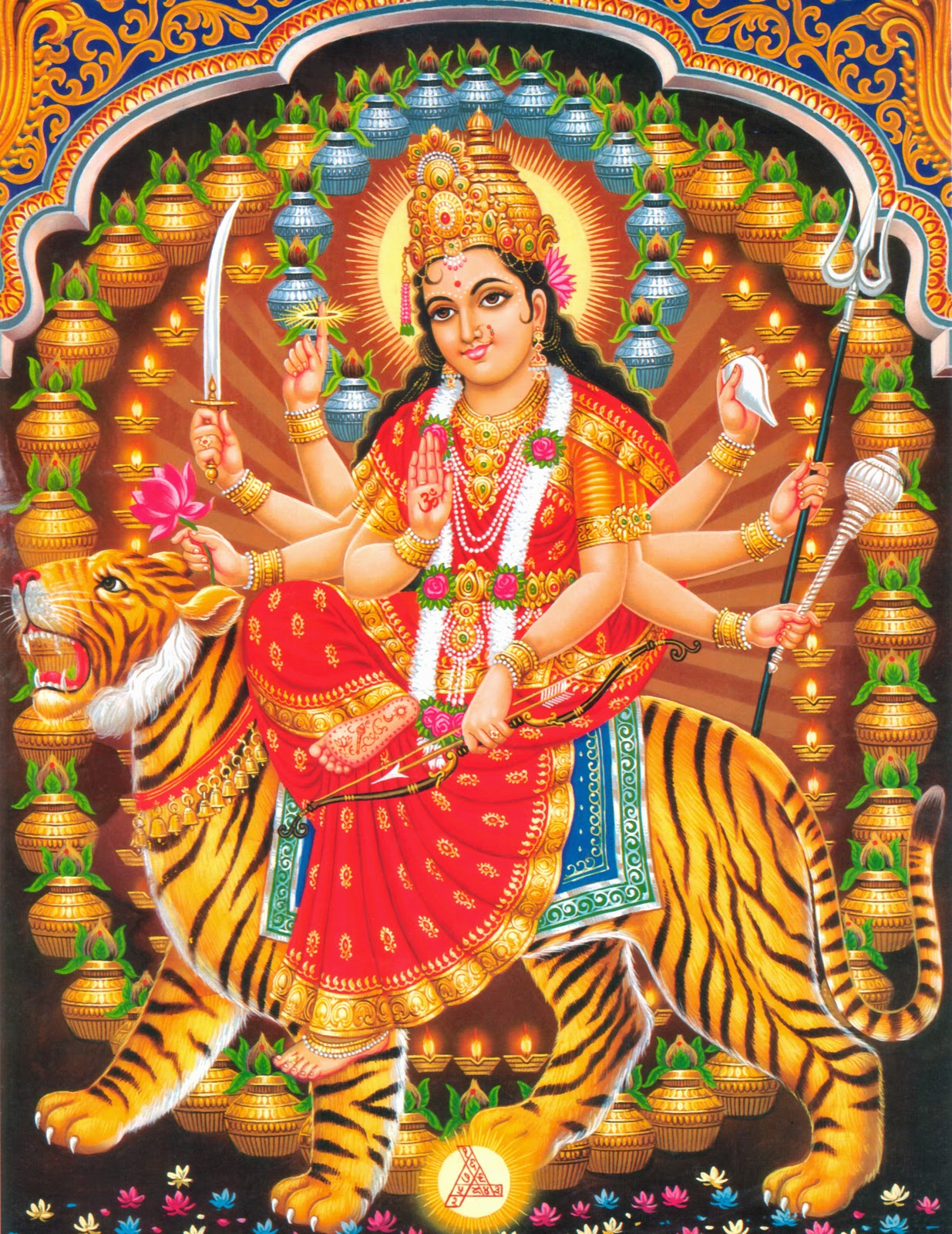
Enter Durga.maadurga5

The Goddess rides in on her pussy-tiger, magnificent and fierce. She fights valiantly, but as she wounds a great demon, with every drop of its blood, a thousand more demons arise. The Mother sees she is losing the battle for the world. “Not on my watch,” she roars.

In the last hour from her third eye, the deepest, darkest, most terrifying form of the feminine rises, and that is Kali. She is the most terrible. Nothing escapes her holy darkness. She licks up the blood of separation before it hits the ground, conquers the demons, and saves the world. Oh yes, then she dances.

If you expect any benefits from your search, material, mental or spiritual, you have missed the point. Truth gives no advantage. It gives you no higher status, no power over others; all you get is truth and the freedom from the false.” ~                                                 Nisargadatta Maharaj

Even as I write, Hurricane Harvey is still raging. Simultaneously this week, terrible floods in India, Bangladesh and Nepal have killed thousands and left millions homeless. As we stare in disbelief at images of entire neighborhoods swallowed under water, folks wading through the deep with their animals and their kids and their life in a black garbage bag, and thousands crowded into shelters, what is furiously seeping through into our collective psyche is that business as usual is over.

In our hearts we can’t help but intuit that this is only the first taste of such extreme weather cycles, that anyone of us might be next among the throngs of climate refugees, steeped in flood waters, or strung out by some future drought. Slowly, we are meeting the terrible gaze of Kali, her potent shaktipat (in Hinduism, the transmission of spiritual energy upon one person by another) meant to awaken us from our slumber of separation, burn away our prisms of illusion, mature our collective soul.

Stripped of our comforts and certainties and false assumptions about life, now faced with the vulnerability of existence, we come to feel more intimately the hollow of our bones. It is when things fall apart that we meet the un-ruined. To be planted, a seed must turn completely inside out, must break open, the old form utterly destroyed, in order to grow.

To those unfamiliar with the cycles of growth, fertility might look like annihilation. Similarly, those unfamiliar with the cycles of spiritual growth might not be able to recognize that darkening [precedes] illumination, kenosis is a condition for resurrection into divine life. Carl Jung said, “Only that which can destroy itself is fully alive.” Every fate eventually concedes to a dance in the fires of spiritual annihilation. It is important to honor holy darkness as we move through the seasons of our spiritual life. The darkness of the tomb of the ego becomes the gate into the holy darkness of the womb of the Great Mother.

Paradoxically, in spiritual life progress is marked by crisis and the only way towards intimacy with the divine is through entering the crucible again and again. Our spiritual growth is punctuated by dark nights of the soul—periods of difficulty, despair, disillusionment, and disappointment. These dark nights strip the soul of old spiritual ideas and attachments, and through radical spiritual disorientation, abandonment, and finally annihilation, they bring the soul into ultimate union.

This is why the great Mother so often appears wielding weapons, because truth cuts through illusion. Truth weans the soul from spiritual trinkets and false certainties. This is why her form is terrifying, because truth is pure terror—wrathful, uncompromising, ruthless. Truth offers no solace, no protection, yields only disappointment with the false self. This is why she appears naked, because she will strip us of all artificial safety, take away everything we use to hide and save ourselves from the real. She will shatter our most precious plans and rip off the masks we don to stay relevant, before cutting off our head, breaking our heart, and dancing on our ashes. There is no hope of improvement, no chance of resistance, no place to hide, no reason to argue with reality. Our only chance is to lean in for a kiss.

A total solar eclipse just passed across the heavens of North America and so many people looked up and were transfixed by the celestial darkening that traffic on Pornhub and Netflix hit an all-time low. An unprecedented number of Americans abandoned their addictions, gathered together—liberal and conservative alike—shared glasses, and looked up in awe.

Eclipses are oracles of change. Almost universally, eclipses are feared. They are often seen as inauspicious omens; they create terror and confusion; they can blind. In some cultures, folks lock themselves away in their homes; in others, they bang on pots or drums to scare away the demons that have swallowed the sun. And yet, of those who braved the darkness to experience totality, most report feeling profoundly transformed. Many express the sentiment that “It was like seeing the face of God.” This is the power of holy darkness: it disturbs, breeds awe, and reveals the Unseeable.

Hope, Faith & Radical Presence

What are we called to do in this time of collapse? Work harder? Think faster? Compartmentalize and multitask better?

No. None of the above. In fact, we are called to do the opposite. According to Yoruba wisdom, we are called to slow down. We are called to settle into the present, to soften and loosen our grip on whoever we imagine we are, or were, wherein we assimilate the world as it is, changing so rapidly as it is, and watch our responses, our default habits and self-serving diversions happening in the microseconds between apprehension and response.

Among other things, we discover our hyper-dependency on time. We discover the difference between its relative and absolute nature. We also discover hope is a diversion from this softening.

Time is a conception arising within our limited view of reality. Normally, we are not capable of another view. When we interrupt that dependency, a different possibility opens and we are reintroduced to timeless matters: connection, curiosity, gratitude, courage, love and grief. We discover what we seek has never been gone. It is always at hand, everywhere we look.

What enters our space in liminal moments we share with another person—or even in a group? Resonance, a timeless quality, gently arrests us. What arises in the space  between vision and execution as a quiet presence is Inter-Being. This space is filled with knowledge, yet is neither yours nor mine. We become present in such knowledge–or it becomes present in us.

There is no such thing as a unit of time in any absolute sense. Since that is so, we could even define “presence” as something more like absence. The absolute nature of time is a vastly spacious awareness no longer held in the tight grip of someone who ‘hopes’; one so expansive that even “embodiment” implies a limitation, so permeable that emotional states and the ambient phenomena of group process no longer impede the flow of connection.

Temporarily at least, one is so completely ‘here’ that time stands still. At the same time, the ego has been rendered quiescent, if only for a moment. Since there is no future, there is nothing to hope for. One may even enter a non-conceptual state in which there is only feeling, a seamless realm of knowing. There is nothing to grasp here, nothing to cling to and no one to cling to it.

From the relative (dualistic) view in which subject and object exist, we imagine events follow an order, stretched along a continuum without beginning or end. In the timeless space, discrete events exist without order, arising in random fashion, crowding each other out, competing for ‘space’ and attention, arising and disappearing in a chaotic flow.

This competition appears as sense perception and feeling, which we evaluate and then choose according to our preferences and motivations. The awakened state, the timeless space we occupy when we downshift to an imperceptible crawl is not just another unconventional and unfamiliar form of time in which ‘events’ occur.

Awakened mind lives outside of time. It permeates the construction we call time yet is not time-bound. Then again, neither is it other than time. The true nature of emergence (consciousness and biology) is the opposite of our habitual hyperactivity. It is a tsunami of perpetual stillness, an infinite evenness subsuming everything, a continuous tidal wave of creative interdependent unfolding that has no beginning, no end, no boundaries, no center and no limits.

In this realm the very idea of a separate self is an inexplicable accident; in which we realize our movement and intention within a unique place in the web of life also holds all others, informs and is informed by all others. We are so completely and fully at home there is nothing left to ‘do.’

In the context of collapse, hope has no place in such presence. It simply cannot be. It is foreign, as it is entirely incompatible with the pervasive dynamic evenness of radical presence in a timeless state. Ultimately, hope relies on causal relationships in a universe without cause. It is a condition we put on our commitment to the present, as if we need a future reward as a prerequisite for undertaking the task at hand. If we hope long enough or hard enough for a particular outcome, perhaps something will happen. Perhaps not. But ultimately, in hope we seek our own continued well-being. In that sense, hope keeps us stuck in denial of our unfolding relationship with grief. It allows us to run away from our direct experience. Hope does nothing to interrupt Business As Usual.

As Stephen Jenkinson says, “Hope is what allows us to continue [what we’re doing]; instead of stopping, we are waiting to be stopped.” If that ever happens, it will be too late. Unfortunately, such thinking exists in a narrow linearity that conflates intention with faith. Being neither intention nor faith, hope lies between the possible and the impossible, between what we know is within and what we imagine is beyond our capacity.

Vaclav Havel once remarked, “Hope is not the conviction that something will turn out well, but the certainty that it’s worth doing regardless of how it comes out.” That certainty is faith, knowing we are doing the right thing now and being committed to what matters most, not regardless of some future outcome, but because we already know what the long-term outcome is likely to be. Hope becomes a defense against despair.

Of course we cannot control the future.  But faith is an absolute belief in our agency in the present. Hope lies at the opposite pole of fear and despair, a duality in which we oscillate from one extreme to the other. Without hope, there can be no despair. By creating and clinging to hope, we create space for fear.

Evaluating our decisions based on an obligation to future generations, even seven generations hence, as is customary among some indigenous communities, does not require a reliance on hope. We do what we know is right. A nebulous disempowering wish about the future dies a quiet death as we rise to our obligations and clarify our responsibilities in the moment.

Again, Stephen Jenkinson:

The question is not ‘Are we going to fail?’ The question is how. The question is What shall be the manner of our inability to care for what was entrusted to us? The question is What is our manner of failing?……

Grief requires us to know the times we are in. The great enemy of grief is hope. Hope is a four-letter word for people unwilling to know things for what they are. Our time requires us to be hope-free, to burn through the false choice of being hopeful or hopeless. These are two sides of the same con-job. Grief is required to proceed.

Reverse engineering the next hundred years to determine how we must act now puts hope in a different light. We may not be able to shift the course of the entire human  enterprise, but at least we have taken a long view and fully exercised our capacities in the service of Inter-Being.

We immerse our selves in our immediate experience, in the feeling level of our responses to our senses, without regard for their source. Such immersion attains without labeling experience, becoming neither attracted nor repulsed by any of it, without analyzing, meditating upon it or turning away.

In other words, without turning it into an object of interest or adding it to a collection of memories, neither categorizing, discarding,…..nor even believing it. In so doing, we are both immersed and freed simultaneously, watching from a vast view, yet also noticing, feeling and burning in the fires of the moment. Our principle acts must be to reduce suffering, which only becomes clear as we allow ourselves to suffer. Rumi said, “In suffering is a gift. In it is hidden mercy.” There is no place for hope in this equation.

All of this may appear to be highly idealistic because mainstream thought and the pursuit of happiness is a relatively closed orbit, exerting immense inertia on moments of awakening that come from a full descent onto our grief, lest that awakening threaten the grip of consensus (relative) reality. And yes, regardless of how the expression of presence may appear, since it must co-exist with material reality, it is nevertheless a condition worthy of cultivation.

No matter what arises, even if heaven and earth change places, there is a bare state of relaxed openness [available], without any underlying basis. Without any reference point–nebulous, ephemeral, and evanescent–this is the mode of a lunatic, free from the duality of hope and fear.

Chöying Dzod (pt. IX) Longchenpa

Let’s all become lunatics! Our resilient future depends on it.