
Repose (as in…final)

It seems perfectly logical to say we will all be confronted with a series of moments tightening the grip of death in which we will have to decide what we believe and what our conscious role shall be in attending and adapting to a process that is both in and out of our hands, that is entirely real and entirely illusory.

If one were willing to confront the full impact of all the signs pointing to the future of life on this planet, a confrontation with the prospect of mass death is unavoidable. That prospect is inextricably entwined with the manner in which we hold the prospect of death right now–not in some nebulous future. A culture and economic model of infinite growth, illusions of permanence and control must include a denial of death, distorting the entire idea of what life is and what constitutes living. On the far side of these ramblings about mass death is the scenario of our own personal death.

Such a process might be marked by an inexorable advance into an increasingly evident material dying process, a relentless progression of conditions—or failed interventions into an increasingly complex collection of conditions—that might not rob us of cognitive faculties, but which would nevertheless be an increasingly evident reduction in the physical capacity to sustain life. Meanwhile, mind will observe from a greater distance. I might slowly leave my body as its control, to whatever degree I once had it, is wrestled from my grasp, leaving only Mind—if I’m lucky.

This progression will then likely be complicated by the presence of multiple conditions, each presenting complications for treating the others. The options narrow, for example, to a carefully tailored regime of drugs or perhaps outlandishly risky surgeries. The sense of gradual entrapment by inexorably limiting conditions rises, and the prematurity of it all begins to gain weight. But is it premature? We might reflexively consider every death to be premature, including our own, of course, but what does that really mean? The question is if these conditions ultimately describe the process of my own death, will my own death be premature?

Yes, there may be moments of fear along an uneven path of tests and treatments, appointments, the carefully modulated conversations. I listen as my body drops into a minor key, openly gazing inward and outward at whoever delivers the news and feeling that news reverberating—reconciling all the other factors impinging on life along the way. All of this depends on whether some other conditions come galloping along to raise my level of risk even further, limiting my capacities, adding variety and velocity to the drama, chasing a runaway herd of questions requiring answers with further complications. 

One’s sense of time contracts. That is the inescapable message. I become the primary character in a movie depicting this inexorable process. I am driving a car downhill on a winding mountain road, on one side is a vast and unobstructed cloud-free view, with the mountain rising sharply on the other. In the gathering darkness, suddenly there is something amiss with the vehicle. It’s becoming difficult to control, swerving momentarily toward the precipice until I regain control in the nick of time. Then, further down the mountain, the brakes unexpectedly disappear; and then further on, the windshield is suddenly covered with dust. Now, the lights don’t come on. I am blind and helpless. Either I am engulfed in terror–or something else happens.

What is that exactly? What happens next? I cannot stop. I cannot depart the vehicle. What else is there? I let go. I no longer attempt to control anything. I am no longer driving. I don’t even see the road anymore. What is taking me down? Where is the bottom? Does it even matter?

It is in that moment when the most important decisions are made. I transition from realizing my time is shortening to a practice of collapsing into the timeless present–simply allowing this body to dissolve into the soil of countless other bodies nourishing and sustaining all else as we careen down the mountain together. One makes a conscious transition from abstract knowing one is going to die to comprehending being on a direct course of dying now. Prematurity no longer exists. I am on a course less and less under my control. Its conclusions are not up to me. We are capable of understanding we will die at any time. But that very understanding is itself an objectification–as if something will happen in the future, but perhaps not to me. And anyway, we don’t want to think about it. In the meantime, we will exercise whatever agency we can muster to forestall the inevitable. 

It seems perfectly logical to say we will all be confronted with a series of moments tightening the grip of death in which we will have to decide what we believe and what our conscious role shall be in attending and adapting to a process that is both in and out of our hands, that is entirely real and entirely illusory. As we are living and dying in every moment, we are both separate from and in union with everything and everyone. Each one of these moments will be an increasingly intimate encounter, but at some point one will surely enter a dying process–one by which, if we are fortunate, we will recall that union.

The dying process may be described in detail by the medical professions, but for most of us, I suspect the process begins well before the rapid decline of cognitive function. As such, it is really an awakening process. We will discover whether animal survival mechanisms will leap over all the fences of containment and rationalization by higher brain functions and run wild, derailing us from refuge practices we’ve spent decades refining to restore and sustain equanimity, let alone what one could call resting in the vast and empty nature of mind. Or, perhaps we will comprehend the true nature of our relationship with existence in ways we never imagined possible.

Fear and anxiety may be expected, but not guaranteed, just as pain can be guaranteed, while suffering remains optional. I am steeped in a finely cultivated and detailed view of reality, life, suffering and death, developing confidence in the capacity to meet whatever arises. I’ve received the gift of gnosis, looking directly into the heart of existence, a view of emptiness, openness, inclusion and unity. The question becoming more present is whether I will continue to rely on these practices when they count the most, whether I’m going to plant my flag in that mountain of belief no matter what comes.

On the other hand, a significant part of these practices and preparations both implicit and explicit in the range and flow of Buddhist teachings; indeed, the orientation of all organized religious belief is to the existence of a soul or not, to an afterlife or not, interpreting death and preparing the believer for what is beyond life. Whether some part of us endures beyond this life, whether it’s eternal life inseparable from the divine, eternal damnation, rebirth or none of the above, true believers prepare (or hope) for whatever they long to encounter. What is sold as insurance guaranteeing the desired outcome is an unshakeable belief in what happens after death.

We stake our lives and our deaths on those beliefs. In whatever way we approach dying, particularly when we’re aware of what’s happening, no matter how much we might deny it, we cling to a belief in what happens next and mentally prepare for something like everlasting glory, perpetual luminosity or perhaps one of several intermediate states preceding rebirth into an endless repeating cycle. Such beliefs suggest there is consciousness beyond life and that steps can be taken here in the bardo of everyday life that will have a bearing on the condition of one’s rebirth. 

It’s amazing to imagine navigating bardo states in the first place. Am I going to stake whatever remaining time I have on the details of how I might respond to a nebulous and fleeting dream state? Or will I focus on the dream state of this minute? Even considering sustained moments of absolute clarity about the true nature of mind, do I imagine those are a ticket to the bardo of becoming preceding rebirth? What if I decided to be satisfied with the effort I’ve already expended? What if every moment of this life is a rehearsal for and an investment in what happens after this life? What if that is precisely and only what this life is?

That could easily sound very Christian, but it’s also an unavoidable interpretation of Tibetan Buddhist bardo teachings. A preoccupation with whatever happens after death can become what Stephen Jenkinson calls an addiction to competence, getting it right. It’s really just another way of clinging to life, to the identity we’ve spent our entire lives crafting and convincing ourselves truly exists. It’s an artifact of hope, which in the final stages of life becomes another way of not being present for what is. Chögyam Trungpa would surely call that spiritual materialism. 

Realizing I may come to a state of terminal disease or to an increasingly fragile condition sooner than I might have expected, I have to wonder if reifying such imaginings, diverting my attention to teasing apart nuanced states of post-death possibilities, imagining the exercise of intention even after the final breath has been taken, learning to recognize the signs described by centuries of teachers, exploring the likelihood of a continuation of consciousness after that final breath is the best use of my time. Staking my present life on what happens after death and exercising rituals of preparation is a preoccupation with the future, not an engagement with the unfolding present. I have to ask, holding back the guffaws, what I would think if I discovered I’d been misled?

This is a process of exploring and enacting personal justice, reconciling myself, balancing the scales, as it were, between what I wish to invest in the future when there is such abundance right here in the present. Whatever I have been taught, whatever I have sampled or believed in, the time I’ve spent assimilating it, exploring all the views and prescriptions about preparing for one’s own death have been an indescribable blessing. But there is really only one choice in this moment: to be present for whatever is here and not to worry about what comes later. This is always the Dzogchen teaching anyway. The Great Perfection is the recognition that we already exist as the seamless nature of reality. There is no creating that reality. It is already created…and in perpetual creation. There is no waiting for it, no hope of attaining it. It is always already here. We can’t ignore it or get more of it or find it or lose it.

And yet, I make no claim to any truth. I make no claim on the future. I plant no flag of belief. I anticipate nothing. I reject nothing. I renounce nothing. I simply put it all away and remain as open as possible. There is no other place or way to be. This was the primary prescription all along. There is no bridge to suchness.  Whatever rituals we repeat, whatever antidotes to samsaric mentality we adopt, we are already there.

I am already enough now. I have always been enough. Whatever comes, I will be enough. All the self-examination, evaluation, climbing some stairway to heaven or belief in anything beyond this life falls away. If there is anything that does more to make peace with all circumstances we encounter, it is simply to be with what is, to walk and talk the knowing that we are already there. It is to be giving thanks in every moment for what we are given, to live within an aura of gratitude for every breath, every encounter, every emotion, every difficulty, every teaching, every suffering and every moment of celebration. Whether this is the only life we will ever have or whether it’s just one of an uncounted number of flashes in an endless unfolding of numberless kalpas, nothing can take its place.  To live in this way is to balance the scales for whatever remaining life we are given.
Reciprocity

True reciprocity, or what we could call emergence, is an omni-variant, non-linear dynamic beyond our feeble attempts to determine chronology, origins, directions or destinations.

Reciprocity is a word we could use for the rhizomatic nature of life, or perhaps paradoxically, the social mechanics of earth. We are undeniably entangled in perpetual subliminal conversations and exchange with each other and the natural world. Reciprocity expresses our interdependence, whether conscious or not. The limits of that reciprocal relationship likely extend beyond any rational definition we might rely on. We can see ourselves in a new light, not as a single central species mastering life, but as just one species (the youngest species) sharing a vast web of life. We are learning this the hard way. 

Reciprocity, or what might well be called emergence, is an omni-variant, non-linear dynamic beyond our feeble attempts to determine chronology, origins or destinations. Much as we might wish to, or to be tied to the habit of gazing into a rainforest noticing only the layered canopy, the explosion of color, the cacophony of voices or the humidity, we cannot see the whole unless we also notice what is underfoot, buried in the rotting vegetation, the decomposing bodies, the leaf molds, the micro-organisms, the mycelium, the death amidst all that life. In fact, the death is giving rise to life. Without these, there is no rainforest, no reciprocity. Some relationships are visible, some invisible. Everything we are and all we do is part of that entanglement. 

In a culture that teaches and so efficiently reinforces separation for so long, we as individuals are reduced to atomized centers of resources to be mined and harvested. We have reached a point at which even our autonomy of thought and action are under threat. It is critical to disengage from the machine of Progress to discover and enact a new way of living closer to the reality of our place in the web of life. We are being called upon by unparalleled change to engage all our faculties, our vision and intuition, the ears and eyes, the sensations we have forgotten to notice and the capacities we use to listen for foreign and fugitive guidance to recover or discover for the first time the basis of our relations with each other and the more-then-human world.

We have to search our histories, poking around in the ashes, into the sources of imagery, before memory, before place, before blood, before nations, to the tribal, to the bones of our original values, to the individual cells of community where life is incubated and regenerated, where our relationships were not things to cultivate, where we watched each other grow and participated in the lives and transitions of everyone we knew. Somewhere in our past, even if only in our genetic memory, we have all known deprivation, displacement and domination. All is embedded in the epigenetics of the human story. More recently we have come to know the soulless commodification of fellow human beings. We have moved beyond some or all of these to be where we are and to carry that knowing with us. That is the common legacy of our time. 

The lifestyle I enjoy was built on the contributions of a billion partners, both human and non-human. For 200 years, capitalism has depended on the establishment of unequal relationships, hierarchies of privilege among all those partners. The unraveling we see around us is the legacy of that inequality, including the racism perpetuating them. We have all become complicit along the way, with colonialism and slavery, with those hierarchies of privilege, with entitlement and subjugation. We are the benefactors of exploitation and violence and we live in a nation built upon that violence and which continues to thrive on the suffering of others every day. 

The bill is coming due. I have a deep grief, emptiness and sickening feeling as I ponder all of this. But feeling guilty is also a perversion, an inversion of victimhood. It can be immobilizing, but it’s time to put it away and name and claim a different way. 

Revelation & Recovery

The appeal of post-activism–a walk into the desert beyond the last swimming pool, is an escape from human centrality, an intention to tend the wounds we have inflicted on our world, on ourselves, by presuming humans alone are the drivers of social change.

Deep Adaptation was a welcome revelation. I was suddenly relieved of pushing the rock uphill. I was diverted to more productive activity: facing unmediated and unfiltered reality and acting accordingly. These urgent times require that we slow down. I could put my full attention on the inner work of resilience and restoration, taking a slower and deeper journey into its meaning, simplifying and carefully extending myself to live a version of small-scale sustainability. Under current circumstances, as I’ve said, this seemed to be imperative.

Deep Adaptation has been criticized as a regression into despair, doom and disengagement. But I’ve never seen it as refuge of defeatism, more like a dispassionate assessment of reality. Parallel to this shift in attention, is the appeal of post-activism— a walk into the desert beyond the last swimming pool. It’s a cognitive jailbreak from a belief in objective reality. It’s an escape from human centrality, an intention to tend the wounds we have inflicted on our world, on ourselves, by presuming humans alone are the drivers of social change. It’s a turn toward recovering and redefining community away from the parameters of Progress. Conventional activism is an attempt to escape the prison (a diffractive prism?) of prevailing conditions. How is it that despite all our efforts, we largely remain in that prison, redefining ourselves over and over according to terms we can barely grasp. We are like fish trying to find water, immersed in it so deeply, so completely that we can only speculate about its nature. Post-activism is somewhere beyond all of that.

At the same time, as my health drives my attention inward, my sense of conventional (inner or outer) agency ebbs. To a degree, my definition of agency still resides in the conventional realm. If I tried to unravel this mystery, I could easily turn to despair and fatalism. As my world shrinks, I recall the vast spaciousness of mind, allow the boundaries of ego to expand and loosen, reconsidering influences steering life far beyond any imagined boundaries I might normally contemplate. I puzzle over whether and how the entire course of life has prepared me for its closing chapters. Or whether, more likely, there is no such thing as preparation, only incrementally deepening encounters with the reality of our material limitations. Clearly, there are still revelations to be had. That, revelation, if I could name a clear intention governing all of it, is what it shall be for me.

Upon arriving in Durham in October 2019, I was pressed to make my housing choices quickly, taking my health into consideration. I chose easy, low maintenance, self-contained and accessible. Any possibility of participating in building much resilience into my community or immediate surroundings was marginalized. Taking a wider view, making a commitment to a slower, smaller lifestyle requires opening to revelation from sources not previously considered. I have found these in familiar sources as well as in new voices now propagating via online communities connecting in ways we might not have explored if Covid had not come along. 

We are entering territory never previously occupied by humans—of multiple catastrophic events (Covid, climate change and Trump) arresting, rupturing and reversing the entire course of human progress, stopping us in our tracks—like a massive volcano erupting and darkening the global sky, like Nuclear Winter. This is the precipice of Peak Humanity. In some ways we’re already on the downside, heading south. The possibility of arresting the inertia of the Industrial Growth Machine is a small sliver of light barely escaping the massive black hole of Business-As-Usual.

There’s further revelation—and recovery—in realizing the depth and nature of our entanglements with the natural world and each other. We are arrested by boundaries suddenly becoming much softer than we normally realize. They are mutable and transient, more like filters, permeable and highly specific, both protective and yet facilitating communication. Less foreboding. COVID is a messenger of our porosity, a call to examine our intimate relations with the micro-biome, with ecologies interrupted, sundered and thrown into chaos. 

In this respect, COVID is also more of a revelation than any previous fugitive organism leaping across the boundaries of its normal habitat because of its deadly nature and global impact. It’s bringing us crashing back to earth from our drunken binge of extraction, acquisition and destruction. Investors and futurists may call it a Black Swan, but it’s more than that. It’s the latest event piercing the myth of separation. A more significant event propagating greater collapse-awareness could not have been engineered by any deliberate effort. We are now glimpsing a version of the future and being clearly shown what measures will be necessary to respond to similar events in addition to whatever the climate has in store for us.

To enter any recovery, all of these revelations must be digested. Also revealed are our capacities of trust, compassion, courage and a new purpose.  It’s time to recover, dust off and refurbish these exiled capacities to embody our reliance on each other, to remember we do not exist outside of relationship. Nothing is itself, by itself. As Zach Bush mentioned in a recent interview, COVID has awakened and spurred us to move from an adrenaline society to an oxytocin society, restoring the inner landscape, awakening to reciprocity. This is what we are finding in the streets, online, in wider collaborative initiatives. Every awakening is a recovery, stimulating a desire for more.

Rage & Resignation

I’ve been in a rage since before the financial collapse of 2008. Well, actually, a good deal longer than that. Perhaps since Bush v Gore. OK, let’s say I was tuned into the truth about Bill Clinton before it became patently obvious: a neoliberal excuse-maker, prevaricator, manipulator, triangulator, blah, blah, blah. There was a reason he was called “slick Willie.” I’m not even mentioning Vietnam, Nixon, Kissinger, and the thieves and sociopaths of the GOP operating ever since the early 80s, 9/11, the Patriot Act, the Iraq War. 

Plenty of reasons to be in a rage. But never mind. If I just picked 2008 as a base, it was the bailout and Obama’s (or should I say Eric Holder’s) failure to stand up for the rule of law by never prosecuting or even stepping on the toes of the financial elites. Not one. That was when “too big to fail,” was unveiled. An amazing piece of PR. Now we’re pondering whether humanity is too big to fail. Spoiler alert: nope.

Over the past 10 years, this rage alternately morphed into despair, denial, resignation and dropout about the climate issue as we’ve witnessed one failure after another, one milquetoast policy after another and terminal prevarication. I even had some words for Obama (2012) about his pursuit of America’s endless foreign wars:

your words fall
like an avalanche of dry bones
once resounding against the sky
now empty echoing in our foundations
once the sinuous awakening curvatures 
of smothered and gasping values
now falling into an abyss 
of conflict and easy temptation
stunted flowers becoming bitter fruit 
they fall away from your stunned mouth
knitting together only shame and excuses
for all the death they foretell

I couldn’t have said so at the time, but about 2014, I reached the end of my rope when I went to congress to lobby for a carbon tax. If that’s not enough to pull the rug out from under any remaining spark of inspiration one might have, nothing is. It is and always was Kabuki, steeped in an august veneer of propriety, sanctimonious deliberation, the worship of barnacle-encrusted tradition, self-serving appropriation of mythology and rhetorical sleight of tongue. Dishonesty, thy name is Congress.

For a good while now we’ve been able to name the entire criminal gang, the ones most responsible for our predicament. We know what they knew and when they knew it. We know their tactics. We know who sold out humanity for profit, who has lied, deliberately and expertly clouded the issue and mounted massive misinformation campaigns. We know their henchmen and how they obstructed popular sentiment, cherry-picked and distorted climate data, attacked experts, threw faux experts into our path, sentenced billions of earth’s most vulnerable beings to deluge, displacement, deprivation and death. All expendable. The greatest crimes against humanity, bar none. The Holocaust times 10,000. Species-suicide promulgated by sociopaths. Not one of them has been seen or is ever likely to be seen in the familiar orange jumpsuit. 

But then, parallel to the rage, coexisting in strange symbiotic temperance, is my denial, my rage about having to be angry about any of this in the first place and my cynical desire to run in the opposite direction and live a life of careless oblivion—which at times gets the better of me. Resignation. And why shouldn’t it? I’m entitled to do that simply based on the fact that I’ve already lived most of my life, a simple life as it is now. I’m not wealthy enough to afford a real high emission lifestyle. Well, except air travel. There’s that. At the same time, living that smaller footprint life, I remain complicit. 

Even though my personal mitigating measures are so miniscule as to not even register on a lifetime scorecard, I fall back into my cultural upbringing commanding me to repair the world (tikkun olam), even though not making any mitigating gestures makes about as much negative difference as any positive difference I could measure by making such gestures. Perhaps these are the terms of a new post-activism. But post-activism cannot make promises. It can only expand to define the problem. And even that is a risky proposition. The dilemma lingers—believing we can individually make a difference, which allows us to feel good–without really making any real difference whatsoever?

Which brings me closer to the present moment. Having realized some years ago we are heading toward, or have already passed, critical tipping points guaranteeing the worst climate impacts and having exhausted my taste for barking up the same old trees and being painfully aware, despite all the promise of zero-emission technology (which was not catching up to fossil fuels fast enough until the appearance of COVID), of the nature and power of the fossil fuel lobby and the sociopaths of Wall Street driving the economic machine inexorably killing us, I stumbled upon Deep Adaptation, which doesn’t quibble about our remaining chances to throw any serious wrenches into the gears of Business As Usual or place false hope in persuasion by rational argument. 

Instead, Deep Adaptation names the Anthropocene as already an era of failure, a colossal crashing to earth. It could also be named the era of The Planet Striking Back. Unfortunately, our dithering miscalculations now threaten human viability. On some world which remains foreign to me, it may suffice to burrow deeper into Buddhist practice to discover non-confrontational or non-aggressive ways to address these issues, and they may well exist, but most of the time I lean more toward channeling rage into creative pursuits–and this is not a time to drop out. Fortunately, a significant cadre separating itself from the homo sapiens death cult realizes the only sensible response to climate impacts we’ve been failing to forestall for 40 years is by utterly re-shaping the ethos of human presence. 

Not that Deep Adaptation is a pioneering idea in this respect. There are collapse-aware people all over the world, still massively outnumbered by the oblivious, but nevertheless creating new institutions, small and large-scale adaptive and resilient communities everywhere and propagating new thought. Technology provides the means to accelerate these ideas as never before. Unfortunately, it also provides the same benefit to counter-narratives. But while those local actions and personal transformative ideologies are taking hold, the mass resistance and uprising necessary to slow down the carbon emission juggernaut had never fully made itself known until the twin conditions of the pandemic and mass resistance to systemic racism became the means to realize in a new way how one condition is all conditions and that justice for some cannot be separated from justice for all. 

Rather than an invading alien, Covid-19 has proved to be the monster under the bed, a goblin from our past and a message from the future, humanity’s zombie rejected Other. We are impossibly entangled with the biological world, having corrupted ecological codes to such a degree the system is coming back upon us. Covid has put us on pause, mirroring our failure, hubris, ignorance, arrogance and the inequality on which they all depend. And how do we respond? Reflexively, automatically, identically to the medical approach, pitting humans against all invasive organisms, the easy way, the only way we know: War! Demanding a reinforcement of human centrality and control.

‘All we know’ is a perfect example of how our responses to problems perpetuate the problem: War against the virus (social distancing and other measures) followed by a popular uprising against the measures taken to defeat the virus. To view the virus in this way is bring us even closer to the next pandemic…or at least a perpetuation of this one. We have no idea how to do with-nessing, stepping all the way back from our imagined control and being with, quietly enough, even if only for a moment, to realize we are the source of our deepening agonies and that the conventional model of responding is only making things worse. These are moments when resignation overtakes me.

Personal Justice

I could be pushing myself into ‘activism,’ reaching out to interact in a larger process or to articulate a view of what is important, communicating with others and formulating strategies, a timeline of objectives. But all of that is falling away.

My focus has turned away from external engagements and activities to a more internal process directed to the remainder of life. Entering into a new intimacy with approaching mortality has been partly imposed by COVID which took precedence over collapse, catastrophe and all things future. But the underlying condition remains. As such, I have an uncertain future—or at least, I don’t know which future I may hang my hat on. I have a past, but I’m accelerating away from it and I certainly can’t live in it. I have this moment and I’m not entertaining life much beyond this moment. As Lama Keith Dowman said in an online meditation session, “Time has nothing to offer us” except as a reason to continue grasping for the trappings of achievement. The only refuge is the timeless present.

Here the framework of Deep Adaptation facilitates the more immediate issues of my personal situation. I didn’t have to do that a year ago when I was entering the field of Deep Adaptation because I thought I was recovering. Now, I hang in a limbo whose next move is shrouded in mystery; the illness is becoming more complex and limiting my activity. I’m not cowering in fear, but I’m noticing what I’ll call my constellation of avoidance behaviors. I am noticing all of them almost immediately and deciding to let them dissolve into a background of expanding patience.

I could be pushing myself into ‘activism,’ associating with others who hold a longer timeline and objectives for the collective, reaching out to interact in a larger process or to articulate a view of what is important, communicating with others and formulating strategies, a timeline of objectives. But all of that is falling away. Instead, I’m reaching inward in a different form of activism, retreating into a space between collapse and recovery. 

Every outward extension of interest, all associations and intellectual activity, every step backward into a rational or linear frame of mind feels not only like an overextension of my limited resources, but a misdirection, an exhaustion of formerly predominant and unquestioned ideologies of modernity and the typical responses to the collapse happening all around us. I am reverting to holding myself in my own lap as I would a newborn and feeling slightly helpless in that way as if I have to be exceedingly careful about everything I do—not too fast, not too hard, not focusing on a distant future. Just staying here, listening intently, taking refuge in the expanse, resting slightly beyond discursive mind in a space not defined by any boundary whatsoever. The bardo of ever moment. Therein lies its appeal.

I do not regard or accept any of this as denial. What I’m doing now is an imperative. No other choice seems possible, or for that matter, healthy. My intention is to live at the marrow level and follow its dictates. Unfortunately, at least at the biological level, not much is happening there. For all practical purposes, it’s dead space. At the same time, the framework of Deep Adaptation and particularly the list of the associated R-words (Restoration, Relinquishing, Resilience, Reconciliation) combined with a few I’ve added (Revelation, Rage, Recovery), do offer a way into this territory to explore how I can Reconcile myself to the many issues and questions arising at this crossroads. 

Justice stands blindfolded, implying a balance. It’s a slippery deal, begging the question, “Whose justice?” It’s uncertain, but the elusive definitions of justice don’t stop us from pursuing its appeal. How I (or any of us) navigate and comprehend the imperatives of the moment, happiness, fulfillment, relationship, intimacy, community, death and especially the accumulation or discard of beliefs are all in the balance now. How I interpret and meet (or not) the imperatives of the world around me, reconciling them with the world within, defining the lodge pole supporting my abode while attending to what is emerging, making decisions among the many competing realities demanding bandwidth is the topic here.

Things I Can No Longer Do #1

There is nothing further left for me in data-heavy climate tracts. I have to turn away now. I don’t want to know—at least not in the cognitive sense of knowing–because I already know.

I’ve reached the end of the line. There is nothing left for me in the latest morning-after mainstream media. I have to turn away. Yes, I’m fascinated, but I don’t really want to know—at least not in the cognitive sense of knowing–because I already know. I can’t even activate the part of my brain necessary to process an argument or anything purporting to be reasonable or logical or scientific, trying to convince…anyone… that this or that event is “directly related to climate change.” Nothing but futility and dissonance arise in the very first paragraph of such material. Where does anyone still get the idea that this does any good? Who still clings to the notion that deniers or ‘low information voters’ can be convinced otherwise? Who still imagines this particular event will constitute the critical nugget for some fence-sitter out there? Do such persons even exist? 

Popular treatment of climate issues has become performative journalism, going through the motions in service to a dying ritual of “providing a public service.” Who can stand this anymore? Numbness invariably accompanies reading such stories. They are space-fillers. As long as their vocabularies include the specialized terminologies of science, divorced from every somatic signal, gesture or sense-making faculty connecting us to the natural world, they no longer serve a purpose. There is no longer any refuge in being right. I have become a fugitive from this form of engagement. That fugitivity, as Bayo Akomolafe would say, is the definition of post-activism.

What is the root of a belief in continuing the activist debate? It’s the same dualistic ethic with centuries of baggage accompanying our estrangement from the natural world. The paradox of language is that resorting to reason as a way of propagating the conclusion that we humans have lost our way is part of the disease itself. As has become so clear in recent years, the way we react to the problem is often part of the problem. Reinforcing binaries is itself a form of distancing from our direct experience of the more-than-human world, reinforcing the dissociation at the heart of our headlong advance toward extinction.

What is more disturbing is remembering when I myself might have used words in that way, using (limited) tools of persuasion at my disposal, imperfectly, earnestly and mindlessly. But the very act of switching into that mode of communication is a betrayal. Sure, we all communicate in this way. Yes, we regularly appeal to reason and rationality, brandishing logic, evidence and data in our communications. Yet, at the end of this long trail of tears and deepening anguish, with humanity coming face to face with the self-destructive nature of our values and behavior, and mostly not comprehending, even with yet another book by the most erudite and passionate spokesperson appearing on behalf of coming to our senses, these efforts are now ringing dreadfully false and futile because, as someone living closer to my gut, the tears are already just below the surface anyway. And that feeling never goes away.  

I can view photos, arresting, disruptive, body-shaking invasions, images without any words at all, the ones that break through the most recent fragile emotional repair, images like the surgically tortured, dissected and harvested tar sands landscapes of Alberta, Chris Jordan’s photos of plastic-filled corpses of sea birds on Midway Island or the solitary orangutan fighting a bulldozer in a Sumatran rainforest or the Amazonian fires or rivers of ice-melt surging to the sea in Greenland, grayed and lifeless coral reefs or the abandoned tarpits of Ecuador. These images belong to me….and I belong to them.

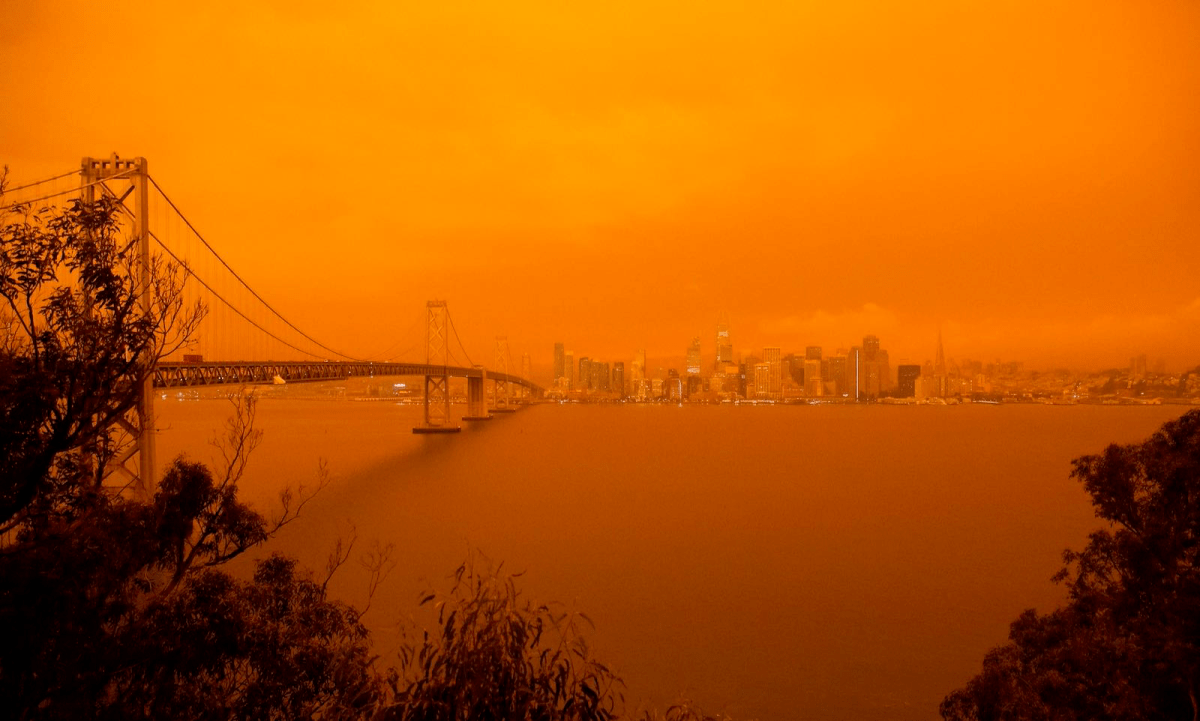
Who would dare publish nothing but photos of the most recent evidence of distorted human values and behavior? Where will we find pictures of the California firestorms with no story? The pictures of the orange sky above the Golden Gate Bridge spoke louder than any words ever could, as would typhoon devastation, denuded glacial moraines, bulldozed rainforest, dry riverbeds, open-pit lithium mines or the translucent shells of deep-sea mollusks that can no longer find sufficient accessible calcium.

Yes, I can still look at (some) graphs. But I already know what they say. Just save me from the words. That part of my brain is already exhausted. I can speak to you from my body. There I can wander with the desperate migrations of species, dream with the giants of the seas. I can listen to the land, soar with the last endangered condor searching for home. Just don’t ask me to process the words any more. It’s like eating cardboard and expecting to be nourished.

Collapse Redux

The basis of Jem Bendell’s original and revised paper on climate-induced societal collapse and Deep Adaptation was his review of current climate and public opinion research. In addressing the probability of societal collapse, his paper was and remains a contribution to popular understanding of the social implications of climate change, mainstream environmental advocacy and our current predicament. The definition of collapse he chose was an uneven ending of our normal modes of sustenance, shelter, security, pleasure, identity and meaning.  Any distinction between collapse and catastrophe was not addressed. And, by the way, what is “societal” anyway? Whose society? Perhaps this omission was intentional, but clearly, he regarded any more specific definition of collapse as a separate pursuit. 

Bendell was obviously content with allowing collapse to remain mostly a subjective frame, which would account for wide differences in definition depending on whom is talking—and where. What, after all, is the normal mode of sustenance or shelter, or even pleasure? And what is normal? If sustenance was overtaken by a revolution in food production that fed more people for less money and didn’t even require soil, would that be an ending of normal? Security is also an awfully big tent if it contains governance, rule of law, energy, health care and public health. Burning the last drop of oil would certainly be an ending, but would it be collapse? The fact that there was no serious effort to be more specific, even if it might have proven as difficult as picking up mercury with your hands, guarantees that readers remain within their subjectivity without much questioning and that the resulting variability of responses don’t represent a very reliable measure of anything. Perhaps it’s only what people believe that’s important.

Bendell also goes to great lengths to describe different psychological strategies, including denial within the environmental movement itself, for mitigating direct confrontation with advancing collapse and especially how we, particularly scientists, steer away from alarmism. Bendell has been criticized for making declarations potentially triggering despair. Different cohorts, whether scientists, laypersons, academics, different age generations or even samples from widely different cultures may have very different ideas about what collapse would look like. But in the absence of (even flawed) parameters, we are left to imagine the worst possible scenarios and a very hazy timeline in which they might unfold. Bendell may have had good reasons to avoid defining collapse any more specifically than he did, but his orientation, given the evidence he was citing, was solely to advancing climate impacts without much attention to political or economic dynamics. 

In that avoidance we lose (or overlook) a capacity to evaluate whether collapse is already progressing according to dynamics not directly linked to climate impacts per se, or whether in grappling with a definition we might inevitably expand our understanding to include dynamics that only become more visible and valid according to a systemic perspective that doesn’t arbitrarily exclude those social, political and economic dynamics. 

Collapse also deserves a closer (and wider) review because it carries implications for determining whether climate signs already exist, whether there are additional signs of collapse which may not be specifically climate-related but will augment climate impacts, and because the use of this term in this context appears to exist within a limited ethnocentric (global North) perspective. Whether collapse is already here for parts of the global south or whether it remains at a comfortable distance for the industrialized north is not even an open question. It’s difficult to tell whether Bendell was writing for a limited audience. But for the north, at least, we are already fascinated and appalled at the same time, hovering between hope and despair as events increasingly break through our dissociation. But for areas of the South, the signs are more advanced and already clear.

If we considered a single individual as a metaphor of global human systems, we could easily diagnose the patient in the grips of a profound ecological disease, even a pathology, gradually taking over. The fever is rising and the patient is in increasing distress. We see organ systems on the way to failure. From Bendell’s view, collapse represents a transition of the patient into an unmanageable condition, human systems failing to remain in any semblance of harmony with the biosphere. In other words, how can we speculate about when collapse may occur without naming the signs of illness, the social and environmental symptoms along with those strictly related to carbon emissions?

Just to be slightly more precise, although collapse may be perceived as a response to catastrophic events such as the permanent loss of polar ice, the jet stream or the Gulf Stream, it’s more likely to be a slowly unfolding emergency (uneven, as Bendell said) whose impacts aggregate over time. How long that time may be could vary from 10-50 years, or even longer. The question is, where is the inflection point between a normally functioning society and one that is coming apart—or will we only know in retrospect? There will be many signs, increasingly varied and disruptive. There will be mitigation, from mostly effective to increasingly futile. There may be rampant denial and spreading panic. How much deforestation does it take to upend normality? How much pollution? How much ocean acidification before the food chain collapses? Is fascism a sign of greater or lesser security? Is mass surveillance a sign? Is the pandemic a sign?

We are challenged to investigate relationships among an increasing variety of events and systemic adjustments to come to conclusions about what is climate related and what may not be, realizing that as time passes, the increasing number of events portending collapse will most likely be directly attributable to climate. And even if those relationships appear to be tenuous, the reality is that all events are data points illustrating the operation of a social, political and economic regime driving violent global change. 

Bendell’s references to climate research include numerous big picture metrics such as sea ice, ocean acidification, the atmospheric carbon budget and changing weather patterns. He bases his theory of inevitable collapse on these advancing measures across numerous defined ‘tipping points’ and makes a case for near-term collapse based on these and additional effects of existing carbon emissions already baked into the atmosphere. The aggregate of emissions playing out over the next 1-3 decades will, he asserts, guarantee disastrous impacts. Likewise, despite the potential for sequestration practices at significantly greater scale or for radical reduction in emissions, the fact is we are adopting neither of these measures to the degree necessary, increasing the probability of collapse.

In addition to calculations of carbon emissions and sequestration, Bendell includes further and more recent data on the measurement of methane emissions and the likely scenario for their acceleration and resulting amplified climate effects as well. This is high-level analysis permitting the most general speculation about the sustainability of human and ecological systems and the likelihood of unpredictable effects on civilization, both agrarian and ocean-based food systems, human migration, disease and the loss of biodiversity.

The greatest proportion of global carbon emissions comes from a limited number of affluent nations. There is no dispute about this. We know the effects of those emissions will fall first upon less developed economies and peoples, but their impacts will also fall on local communities. In fact, while much of the affluence of industrialized nations derives directly from resources extracted from less-industrialized nations and guarantees the true costs of fossil fuel exploration and consumption to fall on those nations, the costs of other resource extraction practices also fall upon those less-developed economies. 

In case one needs examples of these practices to fully grasp the nature of globalized exploitation and the externalization of ecological effects, we need only look at the tar-sands operations of Canada and Colombia, the destruction of the Niger Delta, toxic residues in Ecuador, the deforestation of Indonesia, the burning of the Amazon, mountaintop coal mining and the destruction of water resources in the US. In other words, the wealth and hence the carbon footprint of industrialized (white) nations derives primarily from the appetites and extractive practices of those nations in the global south. 

In the most general terms, what collapse looks like is the transition of a society from greater to lesser complexity. Outside westernized urban centers, much of the global south is already less complex than the industrialized north, with agrarian culture’s economies more localized and resilient. But since Bendell shies away from defining collapse (or catastrophe) in anything other than the most general terms, one gets the impression the destruction he speaks of will only become real when it effects industrialized societies who have benefited the most from emitting carbon—at the expense of everyone else–and that their very development and stability insulates them from initial and less dire effects of climate disruption. 

Indeed, Bendell rattles off the list of recent international institutional efforts created to mitigate the effects of climate by building resilience into developing economies. Unfortunately, these efforts aren’t much more than institutional green-washing, too little and too late. While the North refused in Paris (2015) to adequately compensate the South for climate impacts, giving themselves the freedom to define their own mitigation efforts in the absence of any enforcement mechanisms, they sloughed off their responsibilities to underfunded excuses, continuing Business As Usual and guaranteeing catastrophe far away from their own shores.

Meanwhile, contemplate just a few drivers of uneven endings:

  • The massive and unprecedented shift of wealth upward for the past four decades 
  • Unregulated capital markets and the creation of phantom economies using unregulated speculative financial instruments, shifting risk to the collective.
  • Increasing extraction from labor and destruction of intrinsic and extrinsic rewards. 
  • Intrusive and controlling policy serving narrow economic interests at the expense of health, education and the welfare of the commons.
  • Mismanagement of land and degradation of food safety: food and soil quality declining with monoculture, pesticides, additives, GMOs & preservatives.

What collapse feels like is also not a matter to ignore. What may not be at the forefront of awareness is rising anxiety and apprehension about the security of current lifestyles, a viable future and the ability (not to mention willingness) of governments to respond. Do the incremental changes in perspective, the rising apprehension and pessimism about the future (solastalgia) count as a signal of collapse? The reality of these proliferating signs of economic and psychological stress are likely more widespread than we realize. And we’re not likely to be able to calculate their true effect until it’s too late.

Meanwhile, the North continues to generate climate impacts in the South, knowing the effects and continuing practices foretelling social disruption and eventual collapse elsewhere. Climate-related signs are already present, but again, it’s only from the perspective of highly developed western economies that Bendell presents the probability of collapse, failing to account for existing signs in less developed economies. 

A few examples: 

  • Much of Bangladesh is under water. Between this year’s monsoon and a climate-amped cyclone, millions are affected by the pre-existing COVID lockdown, the closure of businesses, the loss of rural income usually provided by urban workers and the loss of arable land by erosion. 
  • Indigenous societies in Brazil are undergoing attack and destruction (ethnic cleansing?) by Bolsonaro’s aggressive agricultural development practices, directly driving climate change in the Amazon and the planet. 
  • Parts of the Pacific island nations of Fiji, Kiribati, Solomon Islands, Marshall Islands, Vanuatu and Micronesia are already disappearing. Human settlements, sanitation, agriculture and fresh water supplies are threatened due to rising sea levels.
  • Disastrous multi-year drought and total crop failure in the north of Syria caused mass migration to the cities and, along with resource mis-management, foretold the destruction of that nation. 
  • Sudan is experiencing climate driven variability and timing of extreme temperatures and rainfall, disrupting food supplies, triggering civil war, the displacement of millions and a succession of either military dictatorships or civilian incompetence. Suffering is pandemic.

We could go on. It will likely be only when there are unavoidable signs occurring at home that developed nations will take notice:

  • The rich central valley of California supplies a vast majority of all the fruits and vegetables for the entire US. Yet extended drought conditions have forced growers to tap groundwater supplies for years. Wells are now dropping 150 ft. or more into the falling aquifer. Water war is a long-standing condition between densely populated northern California urban centers and the agriculture industry. Factor in the declining snowmelt of the western Sierra and we have conditions eventually forcing choices between food and water.
  • The Southwestern US relies on water supplies from the Colorado River and Lake Mead. Water levels of both have been in steady decline for decades. It’s only as matter of time before the viability of the metropolises of Phoenix, Las Vegas and Los Angeles are threatened.
  • The UK wheat crop is the lowest in 40 years, foretelling a sharp effect on food prices. 

Climate related migration has been already underway in many locations, causing economic and political destabilization. Coastal property insurance costs are rising and coastal land values are falling. Migration from the Florida Keys, Houston, New Orleans and the Mississippi Delta is rising. Whether it’s flooding or water scarcity in India, climate migration will result in unchecked urban growth just as it did in Syria, taxing inadequate infrastructure and further causing political and social stress.

What global events have been telling us for quite awhile and which have become especially clear very recently is that virtually no aspect of human presence, other than by reductionist efforts defining linear causation, can be culled from the whole and paraded before us as irrelevant to a calculation of impending collapse. Does collapse mean preventive measures have already failed? Would the implementation of security measures or the initiation of resource conflicts themselves represent collapse? Would mass food insecurity alone or rising crime in response to food insecurity constitute collapse? Does collapse imply a breakdown of governance, lawlessness or border disputes? 

One of the most practical aphorisms of this age is to “think globally, act locally.” From this view the Deep Adaptation agenda makes sense, although it could stand some scrutiny and even radical expansion of what Reconciliation means from a global view. Personally, I see few signs of human resolve to revert to true reciprocity with the natural world in time to forestall broad collapse. Given the pace of events, the high degree of integration of global systems and realizing the entirely ethnocentric orientation of this agenda in the face of a huge disparity between the outlook and fortunes of the North and South, we might consider reversing the aphorism to “think locally, act globally,” asking what we need to do on an international scale to restore reciprocity and reverse the drastic inequities already playing out as consequences of our privileged over-consumption of carbon-based products. In doing so, we might even be saving ourselves. 

The Eye of the Storm

The state of gnosis is defined as an arrival of total awareness, a direct and often sudden experience of reality, wholeness, some spiritual truth beyond typical conceptual understanding. Gnosis is an intense and total immersion in the unity of divine nature. Few could say they’ve ever had such an experience nor anything close to such complete knowing, a burst of non-dual presence, whether lasting one hour, one minute or even one second. 

What if we’re all having that experience right now? What if this mystifying unveiling, the cataracts of modernity being stripped from our eyes, the complex system of global culture stopped in its tracks, the open wounds of racism, white supremacy, inequality and of highly discriminatory structures of social control exposed before us, not to mention the exhaustion of the idea of human supremacy over the natural world, reductive medicine, the agonies of earth, the collapse of the legacy energy system and even the specter of extinction appearing on the horizon are together generating a mass experience of wholeness? 

What if we’re all standing on the threshold of our own personal breakthrough moment, wrestling with the sensations, feelings and barely comprehensible observations, realizing the full nature and impact of interdependence beyond any theories, contrived models or imagination? What if we’re taking our first steps into a deeply uncertain future already knowing far more than we realize? 

Gnosis transports us into the heart of emergence, interdependence and universal relationship. All phenomena, including thoughts, feelings and sensations are all one and all now. We are standing against a tsunami of perpetual stillness, a continuous tidal wave of creative interdependent unfolding that has no beginning, no end, no center and no limits. Boundaries dissolve. There is no distinction between the inner and the outer universe. Ego is lost, subsumed in radical entanglement with everything. Is that not the experience of this moment? Despite our struggles to make sense, our separate identities become gauzy and indefinite. Even more importantly, much as we might wish to cling to hope as a lifeline to the future, what confidence can we muster in the face of such a muddled vision?

Spaciousness, however, abounds. Time slows down, awareness of all ‘events’ is acutely and vividly focused. We might well imagine such experiences are extremely rare. And they are. They can be unsettling. But this moment is unprecedented. Beyond the safe confines of our carefully constructed identities, unexplored capacities are emancipated. The familiar is upended. We are instantly seduced to tease, to assimilate, interpret and to act. 

Gnosis is commonly a religious or mystical experience. It’s a spontaneous encounter with truth beyond comprehension. In modern culture, it’s not acknowledged nor is gnosis well understood or even regarded as a worthy pursuit except in mystical circles, as though the rituals of inquiry, the visionary pathways have been lost in antiquity. But that’s just the way we like it, isn’t it? We don’t have to think for ourselves. In fact, instead of piercing our accumulated filters of bias, bewilderment and fear, plenty of people seek refuge in nationalism and religious dogma, believing them to be bedrock values. But we are far beyond these now. We are wandering in primal terrain where such accessible anchors can only take us deeper into delusion. We are being challenged to rewrite the source code for human presence on the planet. 

We are arrested, with no sign of easy or proximal solutions as we share this sensation of falling together. Loss and instability reign, the personal and collective parameters of normal are eroding without any replacement reality in sight. Even though corporate and political forces seek to take control in this vacuum, we have not yet stepped into the new. The point of gnosis, however, is to realize we already know. We must become our own sense makers. We cannot wait for someone else to decide for us. 

In the midst of this transition, instead of confusion, fear and reactivity, we are on a mass unwitting collective and individual journeyThere are few authentic leaders here, only pretenders. Our antipathy toward any kind of limit is on full display: a pandemic freely driven by its own intrinsic directives, climate change, economic disparity, the sophisticated wealth extraction of late-stage capitalism, a persistent and dispiriting assault on truth, the rise of theocratic fascism and environmental destruction are all stripping us to our raw essenceWe can see the macro. Now it’s time to attend to the micro. It is our responsibility to seek guidance from within, to track the subtle and nuanced flows of feeling with focus and rigor and to respond in real time to the truth of our relationships and to the destructive nature of so many granular decisions of everyday life. 

Who are we to become? We may have only a vague notion of how to process what is emerging, let alone what is beyond this moment. We do sense there’s no way to dissociate or avoid what is happening all around us and within us. All we truly know is the intensity. We have no choice but to be here and totally in it. Instead of resisting, going through familiar motions and attempting to reconstruct systemic collapse, suppose we were to let go and stand in the eye of the storm, watching all resistance dissolve as we sink deeper into the shifting currents of change?

Gnosis is an entirely different take on agency. The rules don’t conform to conventional physics. We are becoming the world as the world is becoming us—which has always been true, but only now becoming more visible. Complete interpenetration with no static outcomes is the new rule; we are enmeshed in an unpredictable eternally transformative process of inter and intra-active engagement with no logic to contemplate, no rules to apply; nowhere to go for advice. 

Gnosis sees all events from a vastly greater perspective. Linear causation is not recognized as a prime directive except from the narrow view of a very limited array of events. From the perspective of gnosis, making significant decisions on such analysis is foolish and self-destructive. To sit still with all the feeling, confusion and not knowing of this unfolding drama is the current challenge. Now everything matters; the smallest stimuli, the smallest adjustments, how we make sense of our world, all matter more than ever. This will determine who we become.

We’re waking up from a narcissistic, self-destructive dream. Waking into gnosis cuts through the illusions, the complexity, the inertia, the havoc and tenacity of modern culture. We’re in the wilderness now. We’re being given a chance, perhaps a last chance, to find our way. 

Bumps in the Road

Things are getting better and better and worse and worse, faster and faster.                                                                                      —–Tom Atlee 

Conditions are changing so quickly at the emerging edge of climate response, culture, politics and technology that we’re perpetually building a raft as we hurtle down the rapids. What is still very much undecided is whether we’ll end up crashed and splintered against a rocky reach or spill into a vast and placid common future. Many would say there’s a far greater probability of the former than the latter, but that we’ll more likely muddle along with great uncertainty and increasing risk.

When Jem Bendell wrote his article launching Deep Adaptation, his analysis was based solely on an assessment of climate science. His conclusion was that social collapse (due to climate factors) within 10 years was a virtual certainty. The primary critique he received was from climate scientists or psychologists worried his conclusion would be too difficult to assimilate and only throw us into despair–and inaction. Those who have gravitated to Deep Adaptation, aligning with this assessment, considered themselves “collapse-aware.” There are others, outside the membership of the Deep Adaptation Forum or Facebook group, and preceding it by a significant period of time, might also consider them selves collapse-aware.

Now, two years hence, what was once lurking quietly at the periphery of movement politics, gaining traction, adding adherents, analysts, writers and organizers, and due largely to the blatant inequities revealed by COVID as well as recent and shocking displays of racist policing, is now exploding into awareness across the entire progressive spectrum as an ideological singularity; namely, that racism, climate, public health inequities, economic inequality and the entire extractive economy are a single issue. The implication being that by bending any distinct manifestation of the global operating system, whether it be economic inequality, the extractive economy or racist policing, toward justice would result in reduced overall violence and be reflected as a reduction in carbon emissions.

Simply stated, the determination that ‘climate’ refers not strictly to the state of the atmosphere or the oceans, the polar ice caps or the Siberian tundra, not solely to an unfolding extinction event, but to the ‘climate’ of the entire macro system driving us toward extinction. And as well, the micro conditions in which we find ourselves, the deeply troubling cognitive, ethical and spiritual conflicts are also part of that larger operating system. The deeper we go into the neuro-linguistic labyrinth where we address personal and collective trauma, the degree to which we have all been colonized by the macro system, the closer we get to the roots of that system, to understanding its power dynamics and the engine driving it.

From this view, we may regard emissions as a derivative marker of global violence, not as a single issue among many to be assessed and prioritized, but as a summation of the effects of economic extraction and oppression, social control, the authoritarian politics of domination and cruelty and exclusion across all domains and geographies, not to mention all the financial crimes inherent to its operations. Just look at Brazil as one example. To address emissions as the primary driver of global climate change without demanding fundamental economic and political change is to save one tree while letting the entire forest burn.

America is its own poster child for this view. The systematic (or at least attempted) deconstruction of environmental regulations, emission standards, the preservation of sacred lands, attacks on indigenous populations, reopening offshore oil exploration, combined with renewed rhetoric and secret subsidies to the fossil-fuel economy while undermining the renewable energy industry harken back to Ronald Reagan’s Interior Secretary, James G. Watt who, 40 years ago famously said, “When you’ve seen one tree, you’ve seen them all.”

From the Trumpian view, it’s clear that the response of the global operating system to the approaching dangers is to double down, to prevaricate and procrastinate, to camouflage reality in public relations double-talk, to co-opt and to funnel more money upwards toward toothless ‘remedies’: in short, to hasten the apocalypse. All of it is the definition of insanity.

To be looking at global emissions as a separate marker among many, devising policies and practices to directly limit global emissions and focusing on the renewable energy build-out as the principle remedy for avoiding climate catastrophe has for decades been the organizing principle behind the climate movement. Along with the integration of decolonization as an approach to personal and social transformation and examining how our reflexive responses to the ethical and moral issues of our time can get in our own way, we are realizing that the calculation of global emissions is a symptom, not the disease itself.

The modern extractive economy was originally (and ultimately) based on oppression, colonization, violence, slavery and even genocidal policies. The social structures maintaining racial and economic hierarchies remain deeply entrenched and largely in place. The minority view of white capitalist patriarchy is the primary obstacle to the realization of gender, racial, economic and democratic egalitarianism at the heart of the movement for social and political transformation across the world.

In this context, Deep Adaptation represents a critical shift away from direct opposition to entrenched climate policy to direct organizing of local resources to develop adaptive systems and practices in anticipation of imminent (or ongoing) collapse. Deep Adaptation is an alteration of our sense of time and a search for efficacy beyond control. How do we avoid the pitfalls of the control mindset in the presence of obstacles, ideologies, contradictory surges of events, side currents flowing into the mainstream — all of which intend to become the mainstream?

Deep Adaptation largely remains a niche phenomenon. As we discuss the Four Rs and  even as we expand them to include more R-words, how much attention is spent reinterpreting Deep Adaptation in terms of the emerging singularity at hand? Are we becoming more facile with cross-systems thinking and less wedded to linear causality? Are we escaping reductionism and understanding the exponentially disruptive nature of emerging technologies? Can we be fully aware of the forces directly opposing us even as we explore the spaciousness of Deep Time in which there is no urgency, only an expanding possibility of relationship and common purpose?

What are the prominent obstacles to the transformation we seek? There are many to choose from, but I would list three in particular: Incumbency, white nationalism and property rights.

Incumbency is one obstacle to the propagation of a different view and a different ethic because it carries the expectation that the continued exercise of economic and political power in the future will be by the same players and in the same ways as in the past—also known as insanity. Incumbency presumes legitimacy and appeals to our own natural resistance to change as much as to any intrinsic resistance by the incumbent. Incumbency relies on linear forecasts not taking the full complexity and potential near-term disruptive power of emerging forces into account. If they did, the continuity of any primacy accorded them would immediately come into question.

This goes, of course, for economic and political players, primarily central banks, investment banks and asset managers. It goes for monopolistic utilities, Big Oil, airlines and other large transportation interests, multinational corporate interests, trading interests (WTO), global supply managers and the primary resource extraction interests. This is the priesthood of ‘normalcy.’ And of course it goes for the giant global technology interests, who may well have a better view of the future, but are also no less interested in retaining economic control of it. The inertia of incumbency, as we well know, is also buttressed by the money-driven political system, populated by players whose fortunes are wedded to Business As Usual.

A second less well-known or understood obstacle is white nationalism. Given that the Trump administration is populated by numerous authoritarian white-nationalists whose primary interest is to dismantle the gains of collectivist environmentalism, one would find it odd, not to mention disconcerting, to know that there is a ‘green’ faction within the white nationalist movement labeled ‘eco-fascists.’ A very recent extensive article on this topic resides here.

Two of the most recent and devastating mass shootings (2019), in Christchurch, New Zealand and El Paso, Texas, were committed by avowed eco-fascists whose manifestos provided an open window into their ideology. A third eco-fascist actor, Anders Breivik of Norway, was responsible for the slaughter of 77 youths in 2011. He also left an extensive manifesto, providing the ideological basis for the Christchurch shooter, Brenton Tarrant.

In eco-fascism we see a convergence of white nationalism, environmentalism, anti-Semitism (attributing anthropocentrism to Judeo-Christian influence and blaming Jews for capitalism and the destruction of the natural world) and eugenics (a pre-occupation with population control). The most recent example of the potential for environmentalism to be coopted by this ideology was Michael Moore’s movie, Planet of the Humans and its director’s (Jeff Gibbs) preoccupation with population control.

In fact, Trump and the Republican Party have now positioned themselves as passive executioners of minority populations and the elderly, those most susceptible to COVID-19, whom the eco-fascists regard as the actual virus and thus expendable for the sake of reopening the economy. But being ‘environmentalists,’ eco-fascists also advocate for biodiversity and thus also support racial diversity—human biodiversity—even bioregionalism, except only under strict segregation into ethno-states. In other words, North America belongs to them. Everyone else must go.

These ideas, like high-volume tributaries entering mainstream ecological thinking, are also propagating among numerous known and obscure nodes of cyberspace, all anti-immigration and anti-egalitarian, and are–believe it or not—each gaining a foothold in the environmental movement. Though their advocates will carefully couch and dilute their ideas in acceptable language, they are as much a part of the deep cover of politically influential actors as Christian Dominionism is to the person of Mike Pence. The danger of eco-fascism is that they also recognize oncoming…and even wish for…looming social collapse. Their objective is to be provocateurs, to hasten that collapse, and to then exploit it for their own purposes.

In the words of author and activist Daniel Denvir—[white] nationalism “poses a greater threat to addressing global warming than climate denial-ism.” The environmental movement, particularly the collapse-aware cadres of DA, must recognize that the ground will continue to shift, that a threat of cooptation exists, and remain vigilant to what this threat portends for the larger crises to come.

Finally, a third obstacle to the transition we seek is the entrenched machinery of intellectual property. This could be extended to general property rights, but in this case, privatizing IP is even more threatening to a viable future because the frontiers of technology are extending into the territory of DNA manipulation (CRISPR) and Precision Fermentation. These are emerging technologies already showing signs of prominence in our future. There will be thousands of opportunities to create new biological entities that could improve human immune function. PF may have profound influence on nutrition and health, producing food at a fraction of current costs, all while improving safety and using fewer resources.

The promise of these and other technologies will propagate and be enhanced in an open-source world, whereas restricting what will likely be a mushrooming of benefits to a few companies holding the secrets of low cost, healthy nutrition not dependent on physical land will essentially privatize innovative, inexpensive and mobile production systems for food at a critical time when humanity will be needing such developments to address the consequences of widespread social collapse. Few developments could be less democratic and more damaging to a world in transition than such a scenario. Yet a tenacious and vigorous and pitched legal battle for retention of property rights over essential life support is virtually guaranteed.

All of these technologies can either become extensions of, even accelerators of the organizing system currently driving us toward catastrophe (shortening our ‘time’), or they could be turned to the dismantling of that system, transforming human culture into an open-source, transparent and egalitarian structure benefiting all (lengthening our ‘time.’)

We might even observe that there isn’t much time to deliberate. Yet to regard these matters as urgencies and to find ourselves reacting as if they are real emergencies is to regress into the capitalist definition of time and to allow ourselves to become fragmented and diverted from our primary purpose, which, among all the things Deep Adaptation may also be, is about stepping out of conventional time and not being wedded to and swept away by views misaligned with the natural pace of emergence.

“The end of the world as we know it is not the end of the world. 
The end of the world as we know it will be the end of a way of knowing the world.” 
                                                                    —Dougald Hine

Emergence

Whatever else it might mean, emergence implies the most intimate character of life, a constant unfolding of arising and disappearing, creation and destruction, beyond rationality, transcending origins, judgment, intent or outcome. Tuning our view and receptive experience to this level of phenomena requires us to slow down, measuring and matching its pace, to align more intimately with an effervescent ebb and flow, to the way things really are, adjusting consciousness to the most elemental nature of nature.

That true nature, if we were to look more closely into it, is an ongoing process of life and death, each releasing into its opposite, arising and ceasing, appearing and disappearing. Nothing is fixed. Everything is less encumbered, simultaneously more connected and never still.

Emergence, at the innermost sanctuary of biological essence, lies at the neurochemical ground of being, in the transition of form to formlessness and vice versa, the nexus of conception and realization. It is the most delicate and easily injured wrapping of our existence, the pia mater, the ‘tender mother’ holding everything. It is the truest and deepest home of connection, compassion and forgiveness, where we are always alone, never lonely and in full communion with all life. In the most subtle recess where true belonging resides, the absolute belonging of no body and no-self, we give ourselves up to Inter-Being with no agenda, no grasping, no past and no future.

Unceasing change is the driving and dominant principle of emergence. Radical Impermanence is the Law. This is also a core principle of Dzogchen Buddhism. There is no true substance to anything, nor, ultimately, is there anything other than materiality. At this level, there are no values to be assigned to phenomena. Everything is simultaneously real and also apparition, including, of course, you and me in every moment.

Beneath the continuous and tenuous dynamic of birth and death is a deeper reality of unceasing stillness in which nothing is gained or lost. Everything is apparent and also continuously shifting. Any possible source or cause is beyond definition, beyond being teased out for identification or examination. There is no linearity, no progression nor any apparent reason, only an equality of opposites bound together in unceasing change. Only a self-propelled consciousness exists, a spontaneous internal intelligence based on impossibly complex systems processing information directly and immediately derived from ongoing performance, having no goal, no direction and no imperative other than to continue.

Right and wrong are less certain in this realm as the unceasing momentum of emergence cannot be definitively assigned to any single event. In fact, in absolute terms, all phenomena exist beyond any meaningful polarity and are regarded as equal. This is very difficult to grasp rationally, but every value we place on thought and action, all form, is entirely projection.  Hovering at this nexus of appearance and apparition gives rise to a quality of freedom, which can only be defined as compassionate intent, the ethical and moral engine for all action. To withdraw from the imperative of compassionate intent is to violate the mandate of life and to descend into meaninglessness, nihilism.

In the realm of emergence, nothing is containable, especially imagining a  fixed presence, such as a Self, expressing a principle of radical impermanence. Paradoxically, emergence becomes a sanctuary of birth and decay, of rapid and unending change, where safety is upended, where all reification goes to die.

At the emergent level of life, we belong to ourselves, to each other and to something vastly greater, beyond imagination. We do not belong to each other as mere ripples on the surface of life. That is the extent of the limited realm of psychology. The reason we can do to the earth and to each other what we do on a routine basis is because we do not fully belong to ourselves, and are not sufficiently mindful of how we belong to each other. What the totality of earth systems are doing now, because they cannot do otherwise, is reflect back to us what we have lost.

We are made and remade in realms of spirit and myth. In emergence, we realize our mutual dependence. In healing the rifts that separate us, we become more available to a greater sphere of belonging. If we dwelt only on the surface, we would miss the vast ocean sustaining all and to which all belongs. The internal healing process overcoming fragmentation, the dominance of subjectivity to the exclusion of full communion, is crucial to our maturation into eco-beings, cosmic citizens.

As for somatic experience itself, we are more than feelings and sensations. We are earth bodies, even though we may default to conceptual reflection–because that’s what (western) humans do. That’s what distinguishes humans from the rest of the non-human world. But this comes at great cost. The transition under way is not strictly about feelings or heart opening. It is about erotic embodiment, re-inhabiting our earth bodies, recovering the vocabulary for different ways of knowing, communicating, assessing and restoring the languages for relationship and community.

The somatic experience of emergence is happening so fast now we can’t process all of it in our bodies. Trauma, at its heart, is elementally expressed as opposing muscular action within the human system, the repression of expression contained by opposing neuromuscular conditions, the conflicting influence of opposing hormones, neurotransmitters at the fundamental level of physical mediation of incoming stimuli: the autonomic nervous system, the lizard brain. Over time, unaddressed, the sensitivity of the system increases, rendering us increasingly reactive to triggering stimuli, with all the attending memory and feelings. In emergent mind, the material of conflict becomes more accessible; the resolution of this conflict is a return to a lower baseline of sensitivity.

We can all sense the acceleration of change, making the processing of deliverance from social and historical and environmental trauma fast upon us more difficult. The depth of multiple traumas such as racism, privilege, complicity and the extractive economy are opening into full awareness. The violence at the center of the Growth Imperative, the colonization of peoples and our very capacity for critical thought are ever more apparent. The tools and pathways redefining our relationships, many though there are, are still under construction.

The vestiges of feeling ourselves as solitary are tenacious. Isolation and alienation are routine features of post-modern life. In our narrow self-oriented explorations, most of us carry memories of exclusion or marginalization. These are primal wounds of feeling excluded and separate, striking deeply into the psyche, particularly in these unsteady times.

Beneath that we cling to our identities, as if such a thing as a separate self exists in any ultimate sense. We each have varying skillsets for seeking and creating connection, the fields of intimacy meeting our needs. But due to our continued immaturity in relation to the world, many do not routinely experience union at all. Our attachment to a separate self is a fundamental source of suffering. Loneliness, the deepest wound of all, is dependent on this very principle.

One could spend all day detailing the minutiae of the typical persistently depressive longing for belonging, the pandemic of modern alienation, dislocation and dissociation from the natural world, the creeping and equally persistent solastalgia arising with the daily degradation of our common home. The effect is deep, subtle, pervasive and increasingly corrosive. All of which makes it increasingly important to decelerate and find refuge in the pace of emergence.

But when one drops beneath the conventional, asking again what we belong to or how we experience belonging, the easy definitions dissolve. The boundaries disappear and the reality of belonging simultaneously on multiple levels takes shape. While belonging may imply gaining something, part of the greater process requires we continuously acknowledge loss. It has been said that if we do not grieve properly, then that which we have lost was never truly alive. So we grieve. We grieve for what was alive in us, with us and for us. If we grieve properly, then we must also praise what is alive right now.

Resolving trauma, integrating feeling and restoring fully expressive neuromuscular function restores our pure creative impulse: eros. Emergence is the raw, un-nameable realm in which we contact this primal principle, where possibility expands beyond measure, where we meet the timeless wisdom of compassionate intent.