Enjoyment

Awareness of awareness is a blank canvas. It has no qualities. It neither facilitates nor impedes the activity of discursive mind: thinking, feeling or sensation. It does not catalogue; it has no preconceptions, agenda or even capacity to invent anything. It simply is.

There have been periods in which meditation has felt stale, unfocused, lifeless, and boring. As if I’d lost my way. My motivation lags. I devise complex equivocations to delay, shorten or skip my sessions. If meditation is part of your life, perhaps this story is familiar.

I recently discovered something lurking at the edges of awareness. In fact, I don’t recall ever previously recognizing this presence. I realized it was enjoyment. I could not remember the last time I had simply enjoyed my practice or felt joy at completion. I’ve felt many other things including satisfaction, a sense of accomplishment and release. I realize the trap that having an objective can easily become. I am practiced in not having an objective at all. But reason creeps into what is essentially an escape from reason. At the same time, the urge to compose and enact an agenda arises repeatedly by stealth and becomes increasingly vexing until it is recognized and dissolved. Yet however many times that cycle is repeated, I don’t recall ever connecting throwing away the agenda with making room for enjoyment. 

When enjoyment suddenly became accessible, I wondered how I had managed without noticing that enjoyment had been absent. Grounding, revelation, equanimity, peace—many things arrive, but pure enjoyment wasn’t one of them.  There have even been luminous periods of discovery and moments of (seemingly) profound awakening which quickly drew me back to the bench with anticipation and wonder. But even in those times, I barely landed on the unique character of enjoyment. It was always refreshing, awakening, discovering, calming, clarifying, releasing, and maybe a healing leap into wholeness, or even emptiness. 

That was—and remains–the object of meditation, to explore emptiness. And don’t get me wrong, there’s nothing dry about emptiness. It truly is a journey into a brilliant realm of compassion, unity and spontaneity. It’s indelible. Whatever you know of that realm can never be erased. But what is the fruit of practice other than the non-dual view or even an open heart if not also enjoyment?

And it turns out enjoyment is a mere whisper at the edge between being and non-being, appearance and emptiness. Enjoyment has its own distinct qualities, enough to generate an authentic excitement about returning to the bench. But upon noticing all this, the enjoyment I felt was not always tied to the experience itself, but to an observation of the experience by the ego witnessing it. It was tied to an ego judging the quality of the time I spent in contemplation. That is different from discovering a pure enjoyment intrinsic to that state instead of a derivative of it, the identity of me being pleased with myself, congratulating myself for a job well-done.

Having a pleasant experience is certainly OK as long as we recognize the determination of ‘pleasant’ is an ego-state, following directly on the heels of our intention to take a vacation from ego. Indulging in a moment of ego determining whether the time we spend in contemplation is positive or negative seems counterproductive. Someone like Pema Chodron would be the first to say such an indulgence is directly contrary to the cultivation of equanimity, which is knowing that regardless of whether a particular session has pleasant or unpleasant feelings associated with it, that such feelings do not determine the value of that time. To give them any weight is a distraction from our original motivation.

Then what is the quality of enjoyment which is not an ego expression? How is it cultivated, or how do we return to it, even in the darkest of moments? The practice of Vipashyana is where enjoyment lurks, although to go looking directly for it like some hidden treasure is a fool’s errand. The objective of Vipashyana, pervasive or extraordinary seeing, is to establish a non-discriminating, pristine, unself-conscious seeing, learning to look directly at the root of mind itself without any evaluation or analysis. In this case, it is not merely to observe the source of mind, but also to become it. The extinction of the observer would be a great (and unlikely) leap, but it is still possible to observe the activity of discursive mind without being drawn into the drama.

Awareness of awareness is a blank canvas. It has no qualities. It neither facilitates nor impedes the activity of discursive mind: thinking, feeling or sensation. It does not catalogue; it has no preconceptions, agenda or even capacity to invent anything. It simply is. Even without doing anything to sustain this condition, one cannot help but relish it. This is no contrivance, no garden-variety psychological enjoyment; this enjoyment does not derive from ego. In fact, by this view we observe with exquisite bemusement the shifting games by which ego entertains itself, moving through the many games and dance moves attending its survival. 

This is enjoyment which does not dispel or hide or overcome emotion. But it can accompany us into any condition, meeting whatever arises, even what we normally consider to be negative emotions, all obstacles, all circumstances of opposition, even the terror of loss. None of these conditions go away just because we are looking from a different vantage point. We are not indifferent to them whatsoever, because, after all, they are us. But neither do they become paralyzing. The very fact that we can experience and know the possibility of having enjoyment in our pocket, regardless of our passing condition, tickling the edges of awareness, is a kind of refuge in itself, essential to our equanimity. 

Trying

When the boundaries of this individual separate body begin to soften and space becomes continuous such that retaining an identity as a separate body becomes an afterthought, what opens is the ubiquity and uniformity of space, even merging with space, accompanied by a profound sense of unity with all phenomena and an undeniable sense of the body as an incidental event.

Meditation, or at least the intention of doing so, can be fraught with seeming contradictions and cognitive quandaries. Without intention one might never enter its labyrinth of mysteries. But at the same time, intention is also the first thing that reifies identity, removing us one step from the discovery of its benefits. By forming intention, we know ourselves. We become ourselves. By means of meditation, we embark on a journey into our true depth. Upon forming an intention, the next step is action. A set of actions might include recalling sensations, mental constructions and physical actions all designed to induce a desired condition, however we might conceptualize it. We become well-practiced in the art of self-induction: setting up a space, adding objects of meaning, determining the conditions of sound and temperature and physical support, and letting distractions fall away. Or so we tell ourselves.

Only then can we sit. And what is next? One of the first things to happen is we become more acutely aware of inner space and outward appearance. My habit is to find a position of comfort for my body, check my breathing, check my body parts, my alignment, my level of relaxation and to settle further into the ground. Many people, myself included, have been trained and inducted into preliminary rituals, recitation, mantra, all of which speak of refuge or supplication on my personal behalf, promises make to myself of what will accomplish in this session or in this lifetime. It’s not a leap to suggest that these very prayers, spoken immediately before entering a space in which we remind ourselves that me our mine have no true existence, impose a structure on the process which is curious at the very least, if not even counter-productive.

Then we get down to the business of meditation which, in the case of Dzogchen, is ultimately devoted to not trying, not constructing, not waiting for something, surely noticing the comings and goings of mental activity, but not stirring the pot. Shamatha, the practice of calm abiding, is often described as watching the arising and disappearing of ripples on the surface of the mind, as if on a mirror. Shamatha segues into Vipashyana, also described as a deeper practice of noticing the movement of thoughts like fish beneath the surface of that pond. Together, these two considerations merge into what Dzogchen literature refers to as contemplation—becoming the mirrorIt is from this contemplative state that a full transition into an experience of immediate intrinsic Awareness becomes accessible.

As we all know, the way to contemplation is littered with antidotes, deliberate acts of correction, more closely associated with the sutra system, a conceptual process of which I daresay I am a master. For a long time, I acted as if the point of meditation was to discover the perfect antidote. They come in clusters from disparate sources, or they arrive singularly with a great and deep ‘aha!’ New ones arrive all the time. Old ones are retired or forgotten. I don‘t even remember most of them now. At times the effect of employing antidotes felt like cutting a diamond, as if one day there I would discover the perfect antidote and thereafter the light would shine effortlessly through me. A different perspective might be that I was gradually wrapping myself in increasingly restrictive garments—collectively becoming a straight-jacket of admonitions—until I was immobilized and nearly void of the most precious resource for continuing–ease. Meditation under these circumstances is neither fun nor effective. 

The irony of this entire process is that only by first identifying oneself as a separate entity in the larger field of phenomena, repeatedly following a specific series of practices and instructions from a teacher, does one even begin to have a chance of entering a state of subjectivity in which the boundaries of self may begin to dissolve and an authentic non-conceptual condition of becoming one with external (objective) phenomena may arise. More than experiencing that Oneness, what previously would be regarded as separate and external phenomena are now perceived as being of our own creation—and, also of being equally created by what the dualistic mind would name as something out there.  

We can only regard this progression of practices as a series of imputed causes and conditions determined to become the foundation of realizing an unconditioned state, that which is uncreated. Much of what we adopt in preliminary meditative practices is the layering of antidotes—progressively conditioning our experience to achieve what we identify as objectives, only much later comprehending the intelligence of eliminating all antidotes, deliberately undressing the layers of mental constructs which obstruct our access to the direct experience of unconditioned reality: emptiness.

Admittedly, the balance between using or discarding antidotes is a delicate and increasingly subtle process. And the very trap intrinsic to that enterprise is to regard it as a process, when in fact, as the truth of unconditioned reality emerges, it’s not subtle. It can be dramatic. And realizing the truth of the unconditioned state, the state in which the very idea of an antidote becomes entirely foreign, is so different, so far removed from anything having to do with antidotes that we might well wonder what we were wasting our time doing for so long when it becomes obvious that what we imagined was so far away, beyond our grasp, is actually right here all the time.

When intimations of dissolution arrive, when the boundaries of this individual separate body begin to soften and space becomes continuous such that retaining an identity as a separate body becomes an afterthought, what opens is the ubiquity and uniformity of space, even merging with space, accompanied by a profound sense of unity with all phenomena and an undeniable sense of the body as an incidental event. Not a random event, nor even co-incidental, but merely a construct associated with this particular consciousness. I am adopting this impermanent form, flawed and wondrous in all its many ways, as a means of transportation, a vehicle of experience, exploration and restoration.  It is my teacher. It is my co-creator. I am its student.

This is surely a transitional state to a global experience of immediate intrinsic Awareness, the Primordial State, a softening into a realm no longer solely nirmanakaya, the form body, also not entirely sambhogakaya, the energetic body, with the full dimension of dharmakaya, the complete dissolution of any boundary between inner and outer awareness, only a breath away. The intimations are of a deeper awakening in which all three kayas are fully distinct even in their inseparability. Not only present, but fully apparent, neither being nor not being. 

Their manifestation is not a matter of doing anything other than relaxing deeper, again and again, at every indication of interruption and intrusion of conceptual process. There is no trying here. In fact, the primary condition is two-fold: relief and confidence. Confidence in the gnosis to which one is introduced, confidence in one’s capacity to recapitulate these conditions, and profound relief in the knowledge that trying no longer serves any purpose. There is only un-trying. There are no longer any antidotes in the gallery of choices. There is no longer a gallery. There is only the panorama of endless, bottom-less and uncreated seamless unity. The inevitable realization appears: with all the trying of the past, what was I ever thinking? 

Offering Mandala

Isn’t that the whole point of the mandala offering–to give up everything for the sake of realizing we never had anything in the first place?

The Middle Way pursues the embodiment of wisdom and compassion. The Great Vehicle of these attainments is parsed as a progression toward the fruition of altruistic intent and the transformation of all sentient beings such that consensus reality ultimately dissolves into unwavering non-conceptual blissful awareness: Dzogchen. The Great Perfection.

A tall order, indeed.

Wisdom is a reference to emptiness. To perceive the true nature of phenomena is called pure perception. A Buddha field is a pure realm manifested as a product of pure perception. Such a field would include everything we see, think or know, everything that happens ‘to’ us, everything we ‘have’ or “do.”

From the Vajrayana perspective…the understanding of Buddha fields is a deeper one. The root of the Vajrayana is “pure vision,” or the perception of the perfect purity of all phenomena. To enact this purity of perception, we do not perceive the place where we are now as just an ordinary place; we imagine it to be a celestial Buddha field.”     — Dilgo Kyentse Rinpoche

By offering everything we have to the spiritual home of Buddha, we are affirming it is all Maya, an illusory projection dissolving under the scrutiny of pure vision.

In other words, in Vajrayana, the celestial Buddha field is here & now in this moment. It encompasses everything in every instant. It is our everyday experience illuminated by the Dzogchen vision. The deliberate creation of detailed visualizations to further transformative experience is called Guru Yoga, a cornerstone of Vajrayana practice. Silly rhetorical questions like “where is a Buddha field to be found?” or “how would we know?” carry little weight against the benefits of engaging directly in a personal practice of developing pure vision, creating your own Buddha field, also realizing that the essence nature of everyday experience is already pure and exists whether we deliberately create it or not. 

The offering of mandala is a related practice dating back to the origins of Buddhism whose rituals, detailed in the Kalachakra Tantra, are intended to accumulate personal merit and thus ultimately escape cyclic existence and gain entry into the pure vision of a Buddha realm. The outer form of this practice employs a physical representation of the universe, all its worlds and continents. The universe we know as well as incalculable other universes we don’t know are considered pure lands to be offered.

A more internal intent of the mandala-offering practice is to self-purify by offering all possessions, all property, including one’s pleasant and unpleasant experience, one’s very body, to the pure realm of the Buddha field with a clear altruistic intent.

By the virtue of offering to you… visualized before me,
This mandala…resplendent with flowers,
– my body, wealth and enjoyments–
Adorned with Mount Meru and the four continents,
As well as the sun and the moon,
Without any sense of loss, I offer this collection.
May all sentient beings enjoy this perfect realm….

This shift in perception to recognizing our entire existence is suspended within an omnipresent projection of Buddha-mind, pure and transparent in quality and depth, momentarily breaks the grasp and completely overthrows our limited habitual view. We come into an immediate personal encounter with its illusory nature, which is telling us we don’t truly “have” anything at all.

Isn’t that the whole point of the mandala offering–to give up everything for the sake of realizing we never had anything in the first place?

Seeing everything arising as a Buddha realm renders “being” and “doing” as flawed constructions, relying as they do upon a dualistic view imputing actions and possessions with intrinsic substance. Being, since it implies the existence of non-being, is already an objectification. Doing implies the existence of a doer. The very nature of these references to something that cannot be rationalized or categorized holds us in the sway of illusion. Maya creates the language and language reinforces the illusion that there is any material reality whatsoever to objects, possessions or thought, including every conception about thought, including the very notion of Maya itself!

And yet, at the same time, we live in a world of consciousness and intent. The Two Truths are said to be completely interdependent, inseparable, and timeless, yet even these categorizations are also illusory. The Two Truths, we should recall, convenient though they may be, are neither Two nor “True.” We might even call them the Two Lies, or better yet, The One Lie.

Things, material realities, states of consciousness, arise and cease in every instant. Phenomena are both material and non-material in nature in each moment, like water at precisely 32F—neither solid nor liquid. Arising from a constant and changeless ground, they simultaneously exist and do not exist. They do not conform to any intellectual description. Nor can they be reified as constant states such as is light when we are (or are not) looking. The essence of phenomena is beyond conception, always empty. Materiality exists as an energetic manifestation of emptiness simultaneously and constantly, timelessly, without beginning or end.

Rendering everything–and it must be everything–to a Buddha realm potentially opens the pure vision of a Bodhisattva, the fruition of the Middle Way, the non-binary view in poetic dance, always becoming its opposite, destroying, and reinventing itself continuously in every moment, cause melting into effect and effect into cause.

The one in whom this altruistic intent becomes stabilized is no longer lost in the material view of contaminated Maya, resting instead in a radical openness and supreme unity, yet also finding a bottomless well of compassion for those who do.

Islands in the Stream

If there is an object of practice, it is to stop trying to be something, to unwrap the most subtle layers, progressively unmasking the operation and direction of the CEO, the games, identities, directives and assumed capacities of ego, until there is nothing left but living in the stream, free of all bardos. Non-meditation.


The bardo teachings of Tibetan Buddhism identify six post-death transitional states: birth, death, meditation, dreams, dharmata and becoming. Likewise, there are six realms of being (gods, jealous gods, humans, animals, hungry ghosts and hell beings) through which, according to karma, we continuously cycle during life. 

The intense experiences we have in life can be connected to one of the six realms, but surprisingly, they may also be connected to one of the six after-death states or bardos. Most accessible to us all in life, the experience of the six realms also contain bardo experiences. In other words, throughout life, we may become entranced or motivated by one of the dominant emotions of the six realms of being (anger/aggression, desire, ignorance, pride, envy or pleasure) and find ourselves encountering such circumstances which can only be considered bardos because of the imperative they present to us by their extreme nature.

The clearest way to describe this condition is to realize that each dominant emotional state of being contains the possibility of bardo experiences within it. We may cycle through realms by a lifetime or by the hour, but most likely we are in one or the other for limited periods except in the most extreme cases when we are truly stuck in a single realm to such an degree that there’s very limited possibility of ever escaping. The paranoia/envy of the jealous god realm (asuras) or the anger/aggression of the hell realm may well become prisons. But we may also be equally blinded by the pride of the human realm.

Each behavior type (realm) is like a station, a home base, a default field of awareness, our personal preoccupation with a way of comprehending our world. The experience of each station is not strictly limited to its intrinsic nature that one could never experience qualities or domains associated with other stations. Your station is determined by karma. Associated domains, the states we venture into away from our default domain, are more transient.  So while we may spend most of our time in one or another realm, we can still have affinities with others. Within our dominant realm, we can—and will–have any type of bardo experience.

The translation of the word bardo refers to being ‘in-between islands.’ These ‘islands’ (call them states of mind or emotions that drive our lives) appear as obstacles, predominant mind-states such as fear or aggression, compassion, or perhaps gross events, life-long dynamics or ‘karmic’ predispositions. Islands become obstacles when we get attached to them, set up residence and interpret the world through their narrow lens.

The steam or the river of consciousness is natural mind, a more awakened state. This is a state beyond bardos, existing in the gaps of experience. Since realization is regarded as an unchanging state of infinite space without origin or cessation, that awakened condition (of staying ‘in the stream’) implies an escape from all realms and all bardos. From that point of view, all identification with ego is an island we encounter in the stream. We are constantly running into and climbing about on these ‘islands,’ which are mere appearances in the flow of experience, sometimes for short periods and sometimes with a profoundly anchored grasping nature that makes it extremely difficult to escape…or ever return to the stream.

How we move through realms and bardo states implies we are perpetually jumping from one island to another and completely missing the stream because we are fundamentally misinterpreting our experience and perpetually grasping for antidotes to the flow of extreme emotional or psychic conditions.

If we take into consideration the Dzogchen view of a constantly refreshing arising and disappearance of phenomena, radical impermanence, then every arising of consensus reality is an island and every ‘gap’ between arisings is a ‘window of possibility,’ an opportunity to have an experience of true clarity, which would also be a bardo in that instant. The offer to awaken is always present. Entering that gap may be a momentary escape from a particular realm, but most likely, if karma has anything to say about it, any such ‘glimpse’ will stimulate an immediate descent into yet another antidote.

As markers of ego-identification, ‘islands’ are illusions. We can become entranced by the appearance of any island, such as personality, occupation, lifestyle, personal trauma, and cling to it, set up camp and live there-possibly our entire lives. We have experiences of pleasure and pain there, sometimes even misinterpreting what is pleasure and what is really pain. The way we relate to the islands is an indicator of the dominant realm we are operating in at the time, the way we are manifesting ego-based spiritual materialism. Being open to learning, such as in the human realm, distinguishes us from the animal realm, the jealous gods or the hell beings. But of course it’s all quite tricky. When pride and ego-driven indulgence and pursuit of peak experience and spiritual ‘attainment’ are the primary drivers, we, like religious fanatics, create our own brand of spiritual materialism and can easily imagine ourselves in the god realm. Another illusion.

Meanwhile, the river never stops flowing. Emptiness and impermanence are the only truths. The true nature of mind never changes, whether it is peeking through the gaps between every arising or in between our encounters with the ‘events’ of our lives, our karma or our perpetual wrestling match with ego. 

Although the bardos are primarily described as after-death experiences, the meaning of bardo impacts everyday existence. It’s may seem complicated to understand existence this way, but this view opens a window of possible understanding that was not there previously. The bardo of existence (bardo of everyday life), dreams, the stages of physical dissolution immediately following death, the bardo of dharmata (non-duality) with its many visions, benign or fearful, the transition to the bardo of becoming presaging rebirth, all of it is described as the post-death appearance of islands in the stream and identified primarily with one or another of the six realms.

Going more deeply into the meaning of bardo and in relating the bardos to the six realms is a radically different way of presenting the entire proposition. We begin to understand bardos are falsely regarded as transitions between “permanent” conditions like birth, life, death and rebirth. But no, everything we regard as solid, any demarcation we may identify in life, its beginning, middle or end and all the consciousness along the way, are no more solid than any post-death bardo we care to name. It is always a function of ego to reify any or every aspect of existence. Simply by identifying everything as bardo, it all becomes transitional. Every moment is bardo, infused with the shifting attention of ego trying to make something to latch onto where there is nothing, controlling or clinging to or reacting to the appearance of every island with its various seductive opportunities for the comfort and safety of ego indulgence. 

The Source

Out of nowhere, the mind comes forth
All is returned to you, beyond the cause
And effect: the oak tree
In the garden, chirp of crickets
Inside and out, aching knees
On a dusty mat. Without knowing it
We have wandered into a circle
Of wonder, where our confusion
Shines more
Outside the seeming errors and the search.
Wake up to your sleep
And sleep more wakefully!

—–Zachary Horvitz

From this view, the conception of the dream space of sleep is a metaphor of the waking space, a perpetual navigation of illusion in which, at least in sleep, the mind operates at subliminal levels, throwing images and stories before us and over which, if one seriously pursued dream yoga, one might eventually gain some control. The capacity to ‘awaken’ in the dream and even a capacity to write a new ‘story’ in the dream…or a new story of the dream is not only the story of dream yoga. It’s the reality of our waking condition.

The identity of the dream state, the waking meditative state, the post-meditative state and especially the immediate states upon physical death all present an identical opportunity: to cultivate a possible ‘awakening,’ a capacity to distinguish between illusion and reality, to recognize the activity of ‘mind’ for what it is and to meet every island appearing in the stream as an island without becoming transfixed. This is the context in which these interpretations of bardo imply–or verify, if you prefer– that every act, every moment in life, just as it is depicted in the after-death experience, is an opportunity to realize natural mind, a rehearsal for the post-death experience.

Those who are familiar with bardo teachings or practices or, for that matter, any meditative practice, may take a certain pride in accomplishment as we mark our progress. And we can attain a good deal of pleasure in the course of our practice. The pride of the human realm always sneaks in the side door whenever one believes one has arrived, when one imagines having achieved absorption or true equanimity, even for a moment. That is when one wishes to preserve it, to extend it, to own it or become it. But all of this is about hope and fear, and thus a form of spiritual materialism. In the extreme, this is the realm of the gods, who seek pleasures in every form, like notches on a belt. Sound familiar?

And at some point every edifice of attainment will dissolve into frustration and backsliding, becoming the opposite of pleasure and deconstruct into forms of ego-recrimination. All that attainment is impermanent! Damn! This is the bardo experience. This sort of confusion is identical to the character of post-death experience, perhaps the bardo of death, in which any hint of noticing the Nature of Mind, something that may already have arisen as part of our living practice, turns into such a striving that we instantly fall back into deeper confusion and even anger, the anger of the human realm or even something more toxic, the anger of a hell being. 

So there we are, cycling and recycling in the whirlpool of samsara, confronting our own karma, particularly acute at moments of being so neurotically lost, so swept along in one or the other realm that we become deaf and dumb–we can’t hear or obey anything except ego. Lather, rinse, repeat.

I identify my existence along an axis between the human and the hungry ghost realms. There is certainly a desire to learn, an openness to what is new and even a willingness to let go of the trappings of my ‘personal monastery of achievement.’ I am largely free of the single-minded pursuits of the god realm, the paranoia of the asuras, or the fanaticism and anger of the hell realm, but at times I sense a descent into the hungry ghost realm in which I fail to relinquish anything and nothing is ever quite enough. There is a striving for more, more of something perceived to be absent.

This a form of aggression—an act of aggression upon the self. “I am not enough. I do not have enough. I am not good enough.” Blah, blah, blah. This hungry aggression is fundamentally materialistic, also a powerful and deep and pervasive character of humanity. The evolutionary path of humanity is to realize and confront this aggression and to allow it to die. 

Aggression also operates in meditative practice. There are more different meditation practices than one may count. Many of them are beneficial in uncountable ways because they develop capacities which might otherwise never exist. But at the bottom of all practice, there must be a letting go of the striving, the need to manifest something, to fix something, to find something or even give up something. In life, you can be anything as long as you can also detach from being the one who believes in the need to be something. If there is an object of practice, it is to stop trying to be something, to unwrap the most subtle layers unmasking the operation and direction of the CEO, the games, identities, directives and assumed capacities of ego, until there is nothing left but living in the stream, free of all bardos. Non-meditation.
A Quiet Heart

A quiet heart is a still place within a storm. It is where the voices of ego, judgement, instinctive self-preservation and grasping may penetrate, but to which an aggressive response is not automatic. A quiet heart is not immune to desire or greed, not dissociated from attachment, anger or sadness, confusion or grasping.

Aggression makes itself known in many ways. We usually think of it as gross acts. We can see and name many manifestations of aggression throughout local and global society, none of which seem to change much no matter what we do. On a more personal and interpersonal level, aggression happens within and around us every day in many ways. It could be an impulsive moment of indiscretion while driving, a chance encounter with another person arousing an aggressive response, speaking to customer service. You know what I mean.

The current polarization plaguing culture is marked by a dangerous increase in obvious aggressive behavior–in all sectors and from all strata of society. When I look at my own behavior, I notice subtle forms of aggression going all the way to the root of suffering. No surprise. Delusion, greed and aggression are regarded as the three primary kleshas, or roots of suffering. Lately we even talk about micro-aggressions, subtle but harmful ways by which structures of domination are reinforced. 

Rather than talk my way through this by focusing on the mind and referring solely to mental behaviors and patterns, adding the somatic experience seems essential. The sum of all the somatic changes we know as aggression is a configuration of stress responses generally regarded as unhealthy—that is, unless they’re accompanied by complete amorality. The resolution of aggressive impulses is what I’m calling a quiet heart. A quiet and open heart is the physiological and mental product of recognizing and letting go of aggression in its many forms. A quiet heart may be another name for equanimity, a heart not so immediately clouded by arousal, confusion, striving or other behaviors generating internal and external conflict. It remains balanced in the face of the shifting weather of emotion and events. 

A quiet heart is a still place within the storm. It is where the voices of ego, judgement, instinctive self-preservation and grasping may penetrate, but to which an aggressive response is not automatic. A quiet heart is not immune to desire or greed, not dissociated from attachment, anger or sadness, confusion or grasping. It is just not reactive to or controlled by any of these.  A quiet heart is a refuge within all of it.

In fact, considering the five kleshas, or fundamental flaws of consciousness, aggression is born of desire and desire is born of attachment. So, the primary klesha is interpreted by some as attachment manifesting in a more extreme form as anger or aggression. But for me, aggression is not only noticeable in its grossest forms. It is deeply connected to many behaviors connecting multiple emotions and motivations in the most subtle ways. 

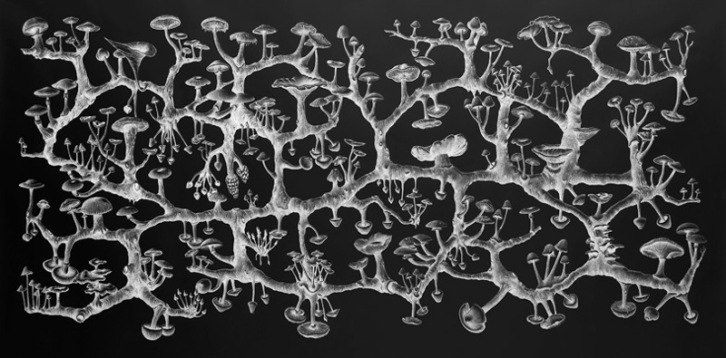
How does aggression appear in our thoughts or expressions? How can we return to a quiet heart? I’ve come to believe (which in itself might be dangerous) that disquiet, attachment and the more obvious expressions of aggression have something to do with non-existence, or emptiness. The Dzogchen view is that all things, both material things, our physical nature, and also non-material things like thoughts and feelings are both existent and simultaneously non-existent. All of it appears real, yet all of it is manufactured, illusory, non-existent.

Nothing exists independently of anything else. Nothing stands alone. As a commentary on the nature of phenomena, this view can be expressed as Nagarjuna’s (2nd century CE) four-fold negation, a tool used to deconstruct fixed views: phenomena are not solely appearance nor are they solely illusion. Nor are they both appearance and illusion. Nor are they neither appearance nor illusion.

Confused? Yes, confusing. But the point is that in everyday awareness, non-existence, emptiness, is probably the furthest thing from our mind. We either never consider it or lose track of non-existence and fall into the trap of completely believing everything appearing before and within us truly exists. And there, in that karmically-driven deluded certainty, is where aggression rises. There is where relative existence continuously arouses multiple, complex feeling states and dynamics that run from confusing to upsetting, to downright unhealthy. Most of them undermine a quiet heart. The belief in all the behaviors surrounding that certainty about the materiality of everything is how we identify and recreate ourselves. The entire apparatus and mechanics of believing what we consider to be the world out there is a product of aggression. 

Why? Because as soon as we believe all our constructions about the world out there, we are moved to manipulate it, reproduce it, improve it, eliminate it, deny it, claim it and change it in uncountable ways. This is what Lao Tzu might call habitual discrimination—which is slightly different from ordinary discernment. With this in mind, it seems clear that aggression manifests in multiple ways masked as something else.

Anxiety (a combination of fear, helplessness and hope) is a form of aggression. Impatience is aggression. Frustration and resentment are aggression. Jealousy is aggression. Even gossip is aggression because it’s usually about moral superiority. The epidemic of political gaslighting is a form of aggression. These are signs of conflict between wanting to control events and realizing we cannot control them. Enslavement to the notion that we can control events is the engine of aggression. It is anxiety about the future or recrimination of the past. Aggression is the antithesis of surrendering to spaciousness. It is the frantic self-preservation instinct of ego. It is the opposite of surrender. 

Where in this maelstrom is a quiet heart?  Chapter 29 of the Tao Te Ching seems to be about aggression:

“Do you want to improve the world?

I don’t think it can be done.

The world is sacred.

It can’t be improved.

If you tamper with it, you’ll ruin it.

If you treat it like an object, you’ll lose it.

There is a time for being ahead, a time for being behind;

a time for being in motion, a time for being at rest;

a time for being vigorous, a time for being exhausted;

a time for being safe, a time for being in danger.

The Master sees things as they are,

without trying to control them.

She lets them go their own way,

and resides at the center of the circle.”

Aggression may be an attempt to recreate a pleasurable experience; how we become motion when rest is required; how we overestimate our agency in the world. The center of the circle is where the quiet heart may be found. Where no manipulation is necessary, where action arises from non-existence, as much as from materiality, where the appropriate response is not entirely driven by ego.

Chogyam Trungpa says aggression can be very polite, such as in the way we ‘cut the truth into pieces and serve ourselves the tastiest morsal while discarding the rest.’ Much of Buddhist teaching may be about eliminating ego, or as Trungpa says, ‘cutting off its arms and legs.’ But really, if the elimination of ego is a prerequisite for what we imagine is ‘enlightenment,’ how likely is it that we will ever get there? Instead, we will be egotistic. Ego will never completely die, but we can remember it doesn’t truly exist anymore than ego-lessness truly exists. 

Being at the center of the circle means living at the balance point between existence and non-existence, like perpetually sunning ourselves at the beach, becoming lost in the rhythm of the ocean without a care in the world…except for taking care not to get burned. That is where the balance lies between not existing at all and also very much existing. Every venture away from being in the center of our circle, to preserve something, to reify something, every disconnection from earth, from ground, from other people, from the true nature of life is an act of resistance, a resistance to dropping into not-knowing, a refusal to surrender.

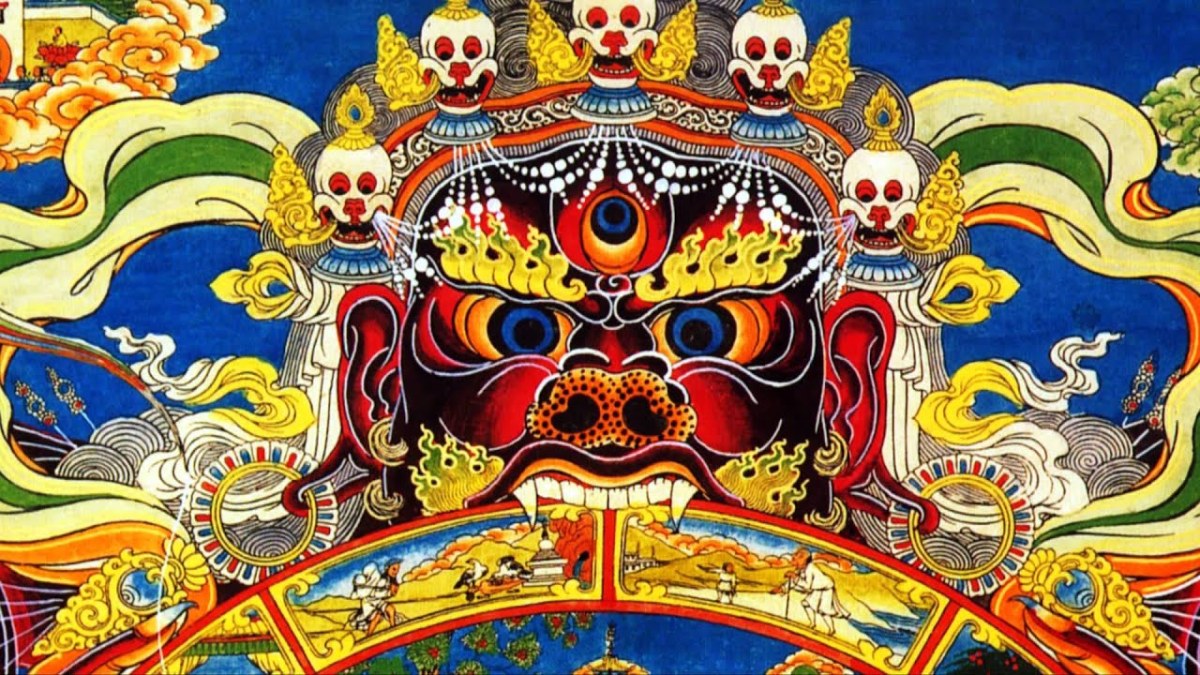
The Vajrayana view is that the wrathful guardians of the dharma, the dharmapalas, are always guiding us into deeper realization and away from faulty thinking and action, away from our own aggression, by visiting us with mishaps, obstacles, ruptures, loss and even trauma. If we suddenly find obstacles arising in our path, like the car breaking down on the way to a job interview, or someone you thought of as a friend suddenly turning on you, the dharmapalas are providing an opportunity to address our latest reflexive dive into aggression.

Is pursuit of a goal aggression? That depends. Is righting injustice aggression? It certainly can become so. What does healthy aggression look like? It depends on the quality of energy we put into the process. If it means climbing over someone else, violating basic ethics, operating from a zero-sum view, chances are we will soon be visited by the dharmapalas. Instead, healthy aggression might look like joyous determination, a constant dance with shifting forces in a way that feels more like swimming downstream than fighting the current. All while being mindful of non-existence playing with us as we constantly become attached to our mental constructions.

The quiet heart is a construction of that joyous determination, nurturing the discipline to remain connected at the junction of our true capacities and our true nature. Cultivating the capacity to remain in that quiet center offers a cleaner and more precise view of the many faces of aggression while relieving so much of the stress of becoming attached to the fantasies manufactured by a wild and untamed mind. 

Repose (as in…final)

It seems perfectly logical to say we will all be confronted with a series of moments tightening the grip of death in which we will have to decide what we believe and what our conscious role shall be in attending and adapting to a process that is both in and out of our hands, that is entirely real and entirely illusory.

If one were willing to confront the full impact of all the signs pointing to the future of life on this planet, a confrontation with the prospect of mass death is unavoidable. That prospect is inextricably entwined with the manner in which we hold the prospect of death right now–not in some nebulous future. A culture and economic model of infinite growth, illusions of permanence and control must include a denial of death, distorting the entire idea of what life is and what constitutes living. On the far side of these ramblings about mass death is the scenario of our own personal death.

Such a process might be marked by an inexorable advance into an increasingly evident material dying process, a relentless progression of conditions—or failed interventions into an increasingly complex collection of conditions—that might not rob us of cognitive faculties, but which would nevertheless be an increasingly evident reduction in the physical capacity to sustain life. Meanwhile, mind will observe from a greater distance. I might slowly leave my body as its control, to whatever degree I once had it, is wrestled from my grasp, leaving only Mind—if I’m lucky.

This progression will then likely be complicated by the presence of multiple conditions, each presenting complications for treating the others. The options narrow, for example, to a carefully tailored regime of drugs or perhaps outlandishly risky surgeries. The sense of gradual entrapment by inexorably limiting conditions rises, and the prematurity of it all begins to gain weight. But is it premature? We might reflexively consider every death to be premature, including our own, of course, but what does that really mean? The question is if these conditions ultimately describe the process of my own death, will my own death be premature?

Yes, there may be moments of fear along an uneven path of tests and treatments, appointments, the carefully modulated conversations. I listen as my body drops into a minor key, openly gazing inward and outward at whoever delivers the news and feeling that news reverberating—reconciling all the other factors impinging on life along the way. All of this depends on whether some other conditions come galloping along to raise my level of risk even further, limiting my capacities, adding variety and velocity to the drama, chasing a runaway herd of questions requiring answers with further complications. 

One’s sense of time contracts. That is the inescapable message. I become the primary character in a movie depicting this inexorable process. I am driving a car downhill on a winding mountain road, on one side is a vast and unobstructed cloud-free view, with the mountain rising sharply on the other. In the gathering darkness, suddenly there is something amiss with the vehicle. It’s becoming difficult to control, swerving momentarily toward the precipice until I regain control in the nick of time. Then, further down the mountain, the brakes unexpectedly disappear; and then further on, the windshield is suddenly covered with dust. Now, the lights don’t come on. I am blind and helpless. Either I am engulfed in terror–or something else happens.

What is that exactly? What happens next? I cannot stop. I cannot depart the vehicle. What else is there? I let go. I no longer attempt to control anything. I am no longer driving. I don’t even see the road anymore. What is taking me down? Where is the bottom? Does it even matter?

It is in that moment when the most important decisions are made. I transition from realizing my time is shortening to a practice of collapsing into the timeless present–simply allowing this body to dissolve into the soil of countless other bodies nourishing and sustaining all else as we careen down the mountain together. One makes a conscious transition from abstract knowing one is going to die to comprehending being on a direct course of dying now. Prematurity no longer exists. I am on a course less and less under my control. Its conclusions are not up to me. We are capable of understanding we will die at any time. But that very understanding is itself an objectification–as if something will happen in the future, but perhaps not to me. And anyway, we don’t want to think about it. In the meantime, we will exercise whatever agency we can muster to forestall the inevitable. 

It seems perfectly logical to say we will all be confronted with a series of moments tightening the grip of death in which we will have to decide what we believe and what our conscious role shall be in attending and adapting to a process that is both in and out of our hands, that is entirely real and entirely illusory. As we are living and dying in every moment, we are both separate from and in union with everything and everyone. Each one of these moments will be an increasingly intimate encounter, but at some point one will surely enter a dying process–one by which, if we are fortunate, we will recall that union.

The dying process may be described in detail by the medical professions, but for most of us, I suspect the process begins well before the rapid decline of cognitive function. As such, it is really an awakening process. We will discover whether animal survival mechanisms will leap over all the fences of containment and rationalization by higher brain functions and run wild, derailing us from refuge practices we’ve spent decades refining to restore and sustain equanimity, let alone what one could call resting in the vast and empty nature of mind. Or, perhaps we will comprehend the true nature of our relationship with existence in ways we never imagined possible.

Fear and anxiety may be expected, but not guaranteed, just as pain can be guaranteed, while suffering remains optional. I am steeped in a finely cultivated and detailed view of reality, life, suffering and death, developing confidence in the capacity to meet whatever arises. I’ve received the gift of gnosis, looking directly into the heart of existence, a view of emptiness, openness, inclusion and unity. The question becoming more present is whether I will continue to rely on these practices when they count the most, whether I’m going to plant my flag in that mountain of belief no matter what comes.

On the other hand, a significant part of these practices and preparations both implicit and explicit in the range and flow of Buddhist teachings; indeed, the orientation of all organized religious belief is to the existence of a soul or not, to an afterlife or not, interpreting death and preparing the believer for what is beyond life. Whether some part of us endures beyond this life, whether it’s eternal life inseparable from the divine, eternal damnation, rebirth or none of the above, true believers prepare (or hope) for whatever they long to encounter. What is sold as insurance guaranteeing the desired outcome is an unshakeable belief in what happens after death.

We stake our lives and our deaths on those beliefs. In whatever way we approach dying, particularly when we’re aware of what’s happening, no matter how much we might deny it, we cling to a belief in what happens next and mentally prepare for something like everlasting glory, perpetual luminosity or perhaps one of several intermediate states preceding rebirth into an endless repeating cycle. Such beliefs suggest there is consciousness beyond life and that steps can be taken here in the bardo of everyday life that will have a bearing on the condition of one’s rebirth. 

It’s amazing to imagine navigating bardo states in the first place. Am I going to stake whatever remaining time I have on the details of how I might respond to a nebulous and fleeting dream state? Or will I focus on the dream state of this minute? Even considering sustained moments of absolute clarity about the true nature of mind, do I imagine those are a ticket to the bardo of becoming preceding rebirth? What if I decided to be satisfied with the effort I’ve already expended? What if every moment of this life is a rehearsal for and an investment in what happens after this life? What if that is precisely and only what this life is?

That could easily sound very Christian, but it’s also an unavoidable interpretation of Tibetan Buddhist bardo teachings. A preoccupation with whatever happens after death can become what Stephen Jenkinson calls an addiction to competence, getting it right. It’s really just another way of clinging to life, to the identity we’ve spent our entire lives crafting and convincing ourselves truly exists. It’s an artifact of hope, which in the final stages of life becomes another way of not being present for what is. Chögyam Trungpa would surely call that spiritual materialism. 

Realizing I may come to a state of terminal disease or to an increasingly fragile condition sooner than I might have expected, I have to wonder if reifying such imaginings, diverting my attention to teasing apart nuanced states of post-death possibilities, imagining the exercise of intention even after the final breath has been taken, learning to recognize the signs described by centuries of teachers, exploring the likelihood of a continuation of consciousness after that final breath is the best use of my time. Staking my present life on what happens after death and exercising rituals of preparation is a preoccupation with the future, not an engagement with the unfolding present. I have to ask, holding back the guffaws, what I would think if I discovered I’d been misled?

This is a process of exploring and enacting personal justice, reconciling myself, balancing the scales, as it were, between what I wish to invest in the future when there is such abundance right here in the present. Whatever I have been taught, whatever I have sampled or believed in, the time I’ve spent assimilating it, exploring all the views and prescriptions about preparing for one’s own death have been an indescribable blessing. But there is really only one choice in this moment: to be present for whatever is here and not to worry about what comes later. This is always the Dzogchen teaching anyway. The Great Perfection is the recognition that we already exist as the seamless nature of reality. There is no creating that reality. It is already created…and in perpetual creation. There is no waiting for it, no hope of attaining it. It is always already here. We can’t ignore it or get more of it or find it or lose it.

And yet, I make no claim to any truth. I make no claim on the future. I plant no flag of belief. I anticipate nothing. I reject nothing. I renounce nothing. I simply put it all away and remain as open as possible. There is no other place or way to be. This was the primary prescription all along. There is no bridge to suchness.  Whatever rituals we repeat, whatever antidotes to samsaric mentality we adopt, we are already there.

I am already enough now. I have always been enough. Whatever comes, I will be enough. All the self-examination, evaluation, climbing some stairway to heaven or belief in anything beyond this life falls away. If there is anything that does more to make peace with all circumstances we encounter, it is simply to be with what is, to walk and talk the knowing that we are already there. It is to be giving thanks in every moment for what we are given, to live within an aura of gratitude for every breath, every encounter, every emotion, every difficulty, every teaching, every suffering and every moment of celebration. Whether this is the only life we will ever have or whether it’s just one of an uncounted number of flashes in an endless unfolding of numberless kalpas, nothing can take its place.  To live in this way is to balance the scales for whatever remaining life we are given.

Transcending Madness at the End of the American Dream

There can be no real distinction between the geological phenomenon we’re promulgating and the broad socio-political drama unfolding daily. We have become the monster under our own bed.

I am compelled to mention the Anthropocene in the very first sentence of this little essay. It may not generate the most inspiring response, but it does crystallize the zeitgeist. This so-called era of peak hubris, of humans becoming a geological force, could perhaps be more accurately understood as earth giving birth to its own destroyer. There can be no real distinction between the geological phenomenon we’re promulgating and the broad socio-political drama unfolding daily. We have become the monster under our own bed. 

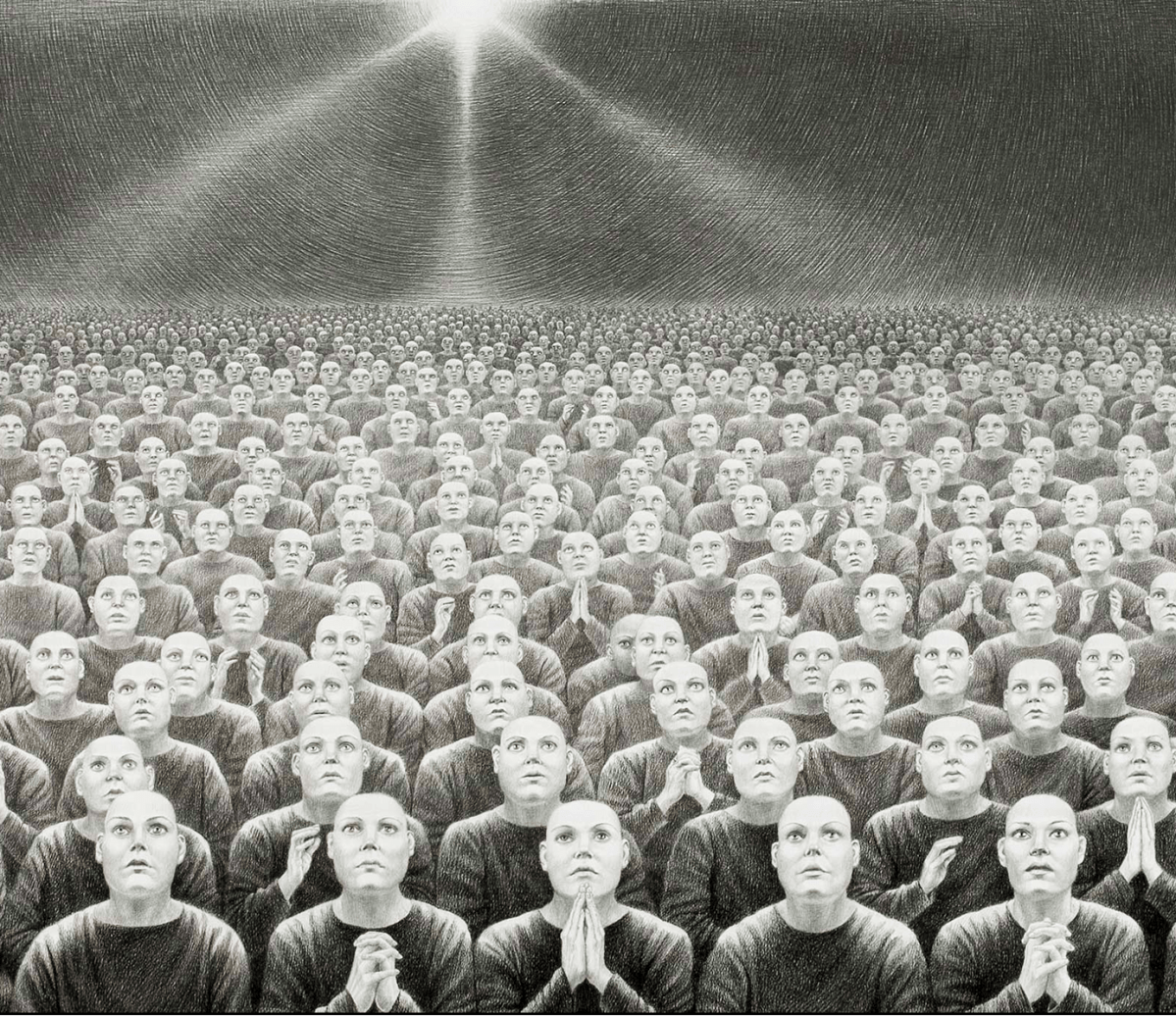
In a certain sector of Buddhist philosophy, there are six realms (or dominant states) of being. The most extreme is a destructive and insular consciousness called hell beings. Even more than the animal realm or the hungry ghosts, their actions are crude, tribal, instinctual and entitled, in extreme cases arising from a profound emotional poverty and driven by an unrelenting anger and perpetual thirst for validation and satisfaction. No effort—or capacity—exists to navigate a world full of threatening uncertainties and unknowns. 

Hell beings are most likely to be reactive and aggressive, most likely to resort to lies and violence if they cannot get their way. They will be offended and belligerent in the presence of symbols reminding them of what they most despise: generosity, patience, tolerance, mutual dependency and respect, any act of consideration for others except their own tribe. In the current case, they comfort themselves with a self-serving mix of spiritual materialism, ego, righteousness and religious dogma.

What we witnessed in Washington, DC on January 6 were hell beings driven not only by the drumbeat of the President’s lies, but also, let’s be honest, by a decades-long counterinsurgency against the New Deal, the middle class, organized labor, the flattening of the income curve and a tax system that rewarded labor instead of wealth. The counterinsurgency started with Reagan and has since driven a gradual starvation of government services, wage-stagnation, a massive upward transfer of wealth, the cynical global ‘race to the bottom,’ hollowing out the domestic industrial base, attacks on voting rights, regressive taxation, undermining the social safety net, attacks on labor unions, pensions and other benefits, the gig economy, attacks on public education and much more. Basically, the shredding of the American Dream: the neoliberal ‘austerity’ economy.

Before you assume I’m just finger-pointing and complaining about them from my lofty perch of meditative equipoise, let me say that those of us on this side of the issue ought to take a serious look in the mirror before we settle back into our cozy intellectual caves, because every realm of being in the Mahayana is equally delusional, just not all in the same way. It will take all of us to craft a viable future out of this fragile moment. No complacency allowed. No one can claim immunity to this cannibalistic virus. 

Those of us to the left of hell beings embody the sin of pride and a presumed higher (dismissive) calling. We are driven by our own sophisticated brand of confusion, a hunger for achievement and peak experience. Most of us have the good fortune of education, material security, employment and the prospect of a personally satisfying future, even within the general unraveling underway. But we are also blinded by our own narrow views, our own brand of madness: we may have escaped the forces eroding the living standard of the many, but we are directly culpable for taking advantage of it. We enjoy comforts derived from ecological devastation and economic oppression. Most of us are self-satisfied and just as prone to self-righteousness as the Christian soldiers marching off to war. 

So, let’s be clear. Despite the blanket of opportunistic lies exploiting and driving hell beings, those of us in the ‘reality-based’ community are driven by our own particular forms of short-sighted delusion which include blindness to our common condition with the hell beings. 

The counterinsurgency, recruiting from legions of disillusioned and dispossessed, is now inching toward its fascist apotheosis. While exploiting and unleashing America’s deep current of virulent racism, the oldest play in the fascist playbook, a post-truth politics has cleaved the nation. The most ardent followers live in a universe more of wishful thinking than fact. For them, values are whatever Trump/Mercer/Sinclair/Newsmax/Fox says they are. Permanent war is coming home. And for the plutocrats, race war is immensely preferable to class war.

For decades, we’ve been moving ever deeper into a polarized wasteland of conflicting values…or no values at all.  Covid-19 has been highlighting some of these issues, but in the US, the primary battleground pits federal aimlessness, incompetence and outright cruelty, driven by an ethical monoculture worshipping personal sovereignty without responsibility, willing to sacrifice the benefit of the many for the one, against an emerging ethical permaculture in which our relations derive from diverse ecologies, co-exist in nourishing mutuality, individual and social permeability and a deconstruction of divisive binaries. 

We are testing the proposition that authentic human development must include a commitment beyond the personal. And vice versa, government is the reciprocation of a collective commitment to unlocking and benefiting the potential of the one. By this measure, social, spiritual and economic development in America is stunted, even regressing. Inter-being and inter-beauty are our most worthy objectives. But for now, waking up from our own version of a destructive and self-defeating virus, we find ourselves locked in combat with those whose sole objective is to protect and enhance enclaves of personal and group sovereignty at the expense of the many…and the one. 

We’ve been flirting quite seriously for the past four years with the manufacture of consent for a domestic war. If we don’t confront and upset that narrative, redefine subjective and objective responsibility (restoring the rule of law) and demonstrate how personal and collective sovereignty can enhance each other, and quickly, not by rhetoric but by creative policy and organic initiatives at every scale, we most certainly will fall into a new and predictable barbarism. 

Delusion

It is so painful that now, given the helplessness of it all, whatever humor there may once have been in the infinite variety of human foibles is subsumed by the poignancy and terror, the desperation and bewildered hatred at the heart of mass delusion.

One of the things meditation can be is a discovery of what about us doesn’t change and releasing identification with everything else, freeing oneself of all obstacles to becoming anything other than vast space.  This means dis-identifying with form: sensation, feeling, structure, any imperatives including body, time, desires, mental journeys, memory, gender…even meditation itself. For me, that especially includes impatience. To whatever degree I may approach such a condition, the practice becomes non-meditation.  Non-meditation is the essence of Dzogchen. 

Gazing is an auxiliary practice of expansion, the elimination of distraction and finding what I have come to call integrity. Exploring what integrity means is to approach wholeness not only mentally, but also to explore its physical components. Coming into full stature in the practice of gazing is to embody a physical architecture of integrity, which is not separate from the integrity of mind. Opening to compassion is the point. Approaching integrity of the body is to create space for breath, rising into a connecting and expansive heart-space, expanding into fullness. 

Premature dis-identification with feeling or ignoring the presence of unresolved conflict (by-passing) will always get in the way of the integrity we seek. The presence of strong feelings will hinder the longer-term clarification process. There are plenty of ways to work with feeling, but however one addresses that process during or in post-meditation, it will benefit quality of life and practice. Ignoring incomplete emotional clearing will obstruct the benefits of time spent in practice. Not that practice must be interrupted or delayed, just that a short and long-term emotional clearing process belongs as a part of practice. Either succumbing to by-passing or imagining the emotional work ceases at some point is a form of delusion and will undermine our capacity to inhabit our full stature and reap the benefits of sustained and careful attention to the full expression of integrity.

Assuming the emotional and physical architecture of integrity becomes a natural platform and a capacity to cultivate compassion, from which we may even sense the massive field of human karma, from those closest to us to the most remote strangers. Becoming permeable to and connecting with karma that is not our own, to witness and hold it without being affected or thrown off balance, remaining on one’s perch, as it were, is only sustainable if it’s  based on authentic compassion, which is itself an intrinsic quality of integrity. This is the achitecture of freedom.

From this stance, Bodhicitta and Compassion become identical. They can only come from full integrity anyway. Not immobile or rigid, merely steadfast. From this platform of integrity, compassion and bodhicitta become one as they are expressions of the same thing: the mind of enlightenment. 

Gazing into the ocean of human karma, the delusions overtaking a large portion of humanity become manifestly clear. In the grip of delusion, so many are stuck, trapped in an uninterrupted and tortuous cycle of wandering, being whiplashed back and forth between the first two Noble Truths, the truth of suffering and the root of suffering. It is so painful that now, given the helplessness of it all, whatever humor there may once have been in the infinite variety of human foibles is subsumed by the poignancy and terror, the desperation and bewildering hatred at the heart of mass delusion. 

Take Trump himself for a moment. His delusion has always been apparent. And if one could momentarily set aside the wreckage left by his personal delusion, the naked and lost nature of this profoundly damaged being, he could even become an object of pity. But at some point, not only have his delusional transgressions become criminal as the relative legal world would define them, but he has dragged many millions into his orbit of self-serving chaos. How is this possible?

I think of Trump followers as those whose lives were already being lived at the edge of delusion. Inside their anxiety, resentment, victimhood and self-pity was a simmering anger with no socially sanctioned outlet. For Trump himself, seeing none of the familiar limits that most others see, the outlet has always been to push the envelope of propriety with a combination of entitlement and victimhood perpetually skirting the edges of lawlessness. Why, after all, shouldn’t he have whatever he wants? And anyway, who’s going to stop him? Who has the nerve to stand up against his audacity?

The American Dream has not been working for his people. For them, it crashed long ago. It was being systematically undermined by the plutocrats, bankers, politicians on the take, CEOs and various other capitalists (AKA sociopaths) in positions of authority. Those whom I regard as deeply lost in this cycle of hunger, resentment and rage were ready for the plucking. Yes, they’ve been exploited and played by the relentless and sophisticated divisive messaging and legislative agenda of the Republican Party for decades while simultaneously being misunderstood and abandoned by the Democrats. All it took was certainty, a certain braggadocio, someone who not only gave voice to their seething anger but who resonated with and could embody their own simplistic, zero-sum view. 

From a distance, it’s all profoundly painful. That doesn’t mean I forgive or appease them or don’t resist them, because what they’re doing is trying to draw everyone else into their world while also destroying any alternative to their view, while Trump plants his delusions deeper into their receptive brains, by any means necessary. They cannot be permitted to succeed. But at the same time, the rest of us have to create a world that demonstrates the misguided futility of their quest.

The Leftist reality is more nuanced, less black and white. Of course, it is. And that’s why it’s been under attack for so long. The world view of the Left could never appeal to or alter the mass delusion of Trump world. It’s not selfish enough. There’s even speculation now that direct economic benefits will not break through the Trumpian hive-mind. It’s not a zero-sum vision. What passes for the inner sanctums of the Democratic Party in America may be equally deluded with some of its own toxic certainties, confusion about whiteness, their corporate view. And also similar to the right-wing is their steadfast belief that they are absolutely not deluded. Their submission to neocolonial capitalism is more subtle. The forms of grasping and exploitation are less overt, remaining in constant tension with forces of generosity and mutual dependence. In Trump world, no such tensions exist.

Referring back to personal practice, just because of what it already is, I’m being as deliberate as possible about dissolving every boundary between self and not-self, between external and internal. For brief moments I may skirt the edges of non-duality. In other words, leaping over physicality or presence into what is nothing but space, softening materiality, feels like a recapitulation of the dissolution of death itself. In fact, every instruction, every sitting, every incremental step toward realizing self-knowing Awareness is a practice for the end of life. Every sitting is an encounter with my own death as if my sole concern is noticing the Nature of Mind, noticing all phenomena as the natural emanations of Mind, empty in nature. 

This is precisely a rehearsal for the bardo experience. This is the space of death, the journey through the bardos, of being finely tuned to the signs and signals of that journey, not skipping over or impulsively mis-interpreting anything, not being distracted, frightened, grasping, descending into desire, mentally chasing after every shiny object nor being afraid of any appearance that may arise. This is also a metaphor of this American moment. We are traversing the bardos, facing the conditions of our death and next life, defining the terms of a national rebirth.

The act of accessing the three kayas of Vajrayana, empty essence, lucidity and compassionate energy, realizing their inseparability, is also the personal journey into the three bardos happening every time your ass hits the cushion. Well, America’s ass is on the cushion. Our national karma and transition are playing out daily before our eyes. We’re being bombarded by demons, black arts, wrathful deities, apparitions, deniers and false prophets, the viral hallucinations of Trumpism dressed up as public discourse. But let us not be fooled. Let us remain focused and steadfast in our integrity, determined to remain in our dignity and full stature.

One important question continues to poke its nose into my space. We live within the machine, the zombie machine defined by and driven by late-stage capitalism, fundamentalism and whiteness determined to emerge triumphant and unscarred from the death throes of the Enlightenment. The machine has always offered the illusion of control. We may be able to personally or even in ephemeral enclaves or in our brief sitting time reject the machine, believing we can temporarily overcome its influence or live (or imagine we are living) outside its control and we may thoroughly reject the illusion of control. But if we are not also dismantling the machine, pointing out delusion, naming its impotence and offering an alternative, what are we doing? Practicing for our death while watching America meet its demons in this transitional time while standing for the terms of our rebirth is the only game in town.

The Awakened Embodied Self

This is the imperative of evolving spirituality, realizing Sufism’s unity of fanaa and baqaa & of Buddhism’s Two Truths, to be here and everywhere at all times, to simultaneously be emptiness and embodiment.

Anyone inquiring into the meaning and process of spiritual awakening undoubtedly encounters conflicting ideas about consciousness. Where does “I” come from and where does “I” reside? Western psychology and religion are deeply concerned with defining and preserving the Self as a separate and fixed entity with (or in) an eternal soul, while eastern religions deny any absolute reality of a separate identity. What’s a seeker to do?

When sitting to meditate, one of the first instructions we receive is to become aware of the living process. In some traditions, we are guided to bring attention to the breath and gradually to the physical sensations that come and go from moment to moment. We can dwell on these sensations for extended periods, but an essential practice of meditation is to focus on one thing while developing the capacity to notice everything else that arises in the background. 

A second level of this process is to notice how—and how easily–our attention is distracted from the singular focus we started with. This noticing and the repeated return to the original point of attention is the development of presence. A third iteration of attention is to notice the different feelings that arise in the course of being distracted and returning to our original intention. Do we have judgments about ourselves for leaving? Do we have expectations about how we return and how long we ‘should’ be able to maintain the original state? Are we trying to achieve something?

A fourth iteration might be to ask who (or what) is the one meditating and who is the one presumably not meditating while being distracted. In asking these questions, one enters the territory of distinguishing between Self and Not-self, the psychological (ego) self and the (super-ego) witness. From here it’s a short linguistic shift in attention to a witness that is itself a non-entity. In fact, unwinding this thread of consciousness to its logical conclusion would require we investigate who is witnessing the witness, realizing that a further iteration of witness arises as soon as we establish an awareness of the immediate one. Tracing the witness all the way back to its origins is what, according to Robert Thurman, Buddha himself did on the way to his own awakening.

What is found when we go ever deeper into the layered constructs of cognitive awareness? Nothing? No self? In Buddhism, what is found at the root of the ever-elusive identification of the witness, is emptiness. Emptiness completely undermines any notion that there’s objective existence of anything. The appearance of everything is dependent on something else, a precedent. When investigating the existence of the precedent, one inevitably realizes there is no single independent source of anything.

We also create otherness internally in relation to “self” when we identify with unworthiness. We are also confused about who or what is the Self—is it a container of all the internal voices we may hear at any given moment? Is it a core truth, an identity around which all these voices orbit incessantly? If the former, then who is the witness, the part to whom critics address their assessment, their directives and imperatives?  If the latter, then what is their true role and value?

God is an infinite sphere whose center is everywhere and whose circumference is nowhere.  

 —The Book of the Twenty-four Philosophers (12thC)

Reducing the complexity of the human psyche to a bit of spiritual geometry casts some light on the concept of Self, defined by behavioral therapy, which, unlike an entity with no fixed center and no boundary, implies a more actively engaged and focused energy. Self has been described as the equivalent of ‘flow,’ a ‘sense of deep concentration without distracting thought, a lack of concern with reward; confidence, mastery and well-being.’ Sounds just like being embodied in the moment.

The term “self-leadership,” carries connotations of action, forethought and calculation. But wait. Wasn’t self just described as being completely in the moment, merging with phenomena without analytical preconception–or planning? What does the term “leadership” mean? Is the self still? Is it in motion? Is it an expansive boundary-less playful state of mindfulness? Or is it a kind of executive identifying and bringing various voices and intentions to heel, establishing and re-drawing its boundaries to expand its domain of influence, micro-surgically distinguishing itself from the masks of persistent sub-personalities?

What is the source of its energies? Is it a still point distinct from the surrounding disharmony? Or is it a primary organizing principle–a magnetic north, for a being negotiating its way through Being?  Is it even distinct from “I” at all? These questions are addressed by suggesting it is not a matter of determining whether self is an active center or an expansive, more passive presence. Like light, self is neither wave nor particle, but both, or either one, like the famous double-slit experiment of 1801, depending on who is looking and when, constantly transmuting from one to the other depending on the conditions of the moment. 

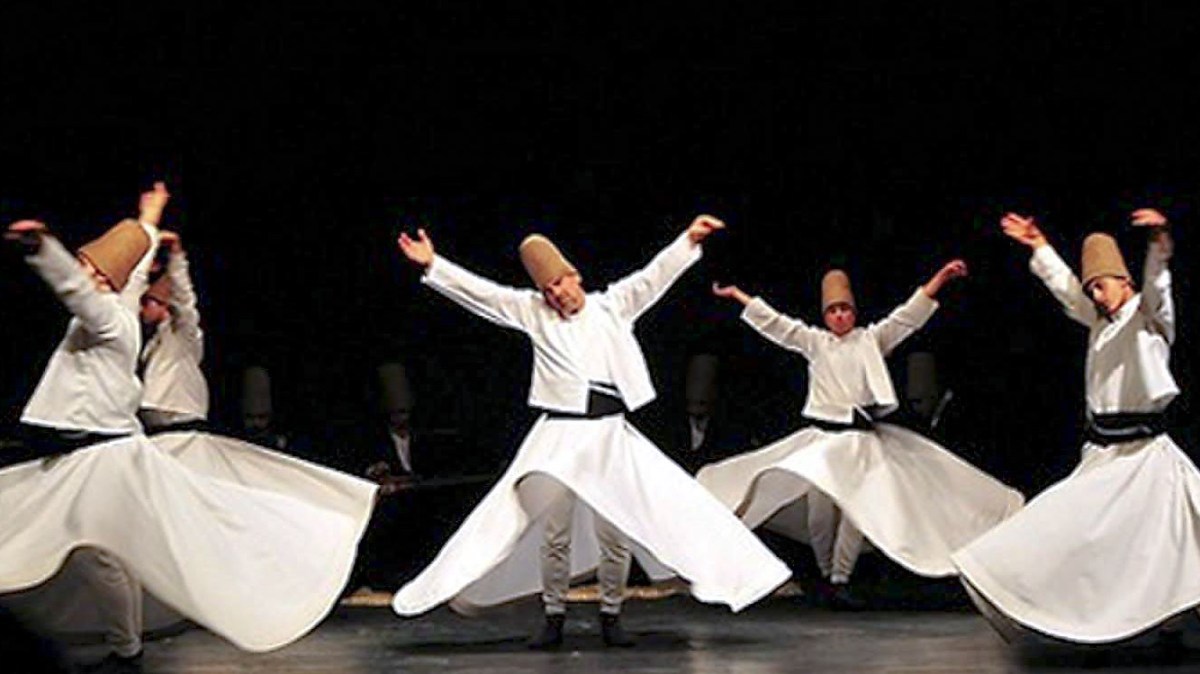
According to Coleman Barks, the Arabic words fanaa and baqaa are used by Sufis to describe the intersection of the human with the divine, a ‘constant and profound interplay full of paradox and movement, breathing in and out of every soul.’ These are seemingly opposing forces; or perhaps more accurately, the yin and yang of consciousness, the particle and wave of light; forces influencing our sense of connection to ourselves, to each other and all that is. 

Fanaa is the impulse to surrender, allowing oneself to become ‘annihilated, as if disintegrating into a vast magnificent sky, dying in order to become one with the infinite.’ Not unlike non-dual presence, the extinction of self, fanaa is the ultimate expansion, the dissolution of every boundary, every circumference. Mind-lessness. Paradoxically, this is also the highest form of concentration at the pinnacle of Buddhist ati-yoga, The Great Perfection itself. This is the ultimate devotion, realizing the truth of emptiness.

Baqaa, on the other hand, literally means permanency or embodiment. Perhaps the word discipline more precisely approaches its practical expression; the intention to be here, as opposed to being everywhere else but here. Not dissolving or shrinking from the mundane, but exploring its deepest nature, focusing one’s energies completely in the service of being exactly what we are. ‘Baqaa is the relative truth of appearance, the undeniable materiality of existence. Instead of melting into that whole sky, one aspires to nothing more than becoming one of the stars in it, experiencing the nature of one’s unique place in the sky’ or one’s place here on earth. 

True baqaa is also the fruit of a lifetime of devotion. This is where the attributes of self fully rise in dignity and durability. This is the self of Richard Schwartz’s familiar C-words of Internal Family Systems (confidence, creativity, calm, curiosity, compassion, clarity, confidence, courage) the self that becomes a mirror of clarity and purpose in every act, connected to and relating from its own ever evolving essence. Baqaa is the realization and containment of a refined skill. The pinnacle of progress on the incremental spiritual path.

The more discipline we exercise in discovering self and the more time we spend there, the closer we come to the invitations of fanaa, the ability to rest in our own essence, and increasingly to connect to the essence in others as well. And even beyond that, to the essence of all that is. Full realization.

We become, as Barks says, “the dreamer streaming into the loving nowhere of night.” This Self, the one that can live simultaneously in both fanaa and baqaa, is the self that is both particle and wave, both completely here and simultaneously nowhere, constantly transmuting appearance and emptiness into a continuously shifting torus of space. At the pinnacle of Tibetan ati-yoga practice, this is The Great Perfection, living beyond both samsara and nirvana, dissolving the Two Truths into One. This is not a Self that cannot be found, merely one which is not fixed, which cannot be pinned to either the relative or absolute. More by choice than by accident, one flows back and forth, as Barks puts it, between “visionary radiance” and the “level calm of ordinary sight.” 

These are the terms of awakening arising from the Sufi mystical tradition of Islam. This is the imperative of evolving spirituality, to realize the unity of Buddhism’s Two Truths, to be here and everywhere at all times, to simultaneously be emptiness and embodiment, to live in single-pointed awareness/aliveness within vast and timeless space, or at least available to transmute one’s capacities to the requirements of the moment, to seek both refuge in the specific and in the general, to slip the bondage, delusion and suffering of dualistic mind…and to live from a bottomless and source-less joy at any moment.

The Root of Happiness

Bodhicitta is a way of connecting to other lives, of saying we are nothing without that connection and that our connection to each other is deeper than we can ever truly know.

Bodhicitta is a way of connecting to other lives, of saying we are nothing without that connection and that our connection to each other is deeper than we can ever truly know.

Four years ago, we were suddenly dropped into an alien landscape, akin to the toxic atmosphere of an alien metropolis. All plans, intentions, contemplations, associations and actions were transposed into the era of Trump.  Was this a dream, or was I waking into a nightmare?  The landscape was familiar, but somehow different, no longer safe. Everything, values, lifestyle, morality and an ever-fragile peace, balanced on a knife-edge.

I went through the motions of normalcy, repeating familiar patterns of activity. Yet nothing was familiar anymore. Everything seemed to require a little more intention, a little more clarity to become real. Insofar as I could become absorbed, focusing on something compelling or becoming temporarily lost, I was happy. But upon emergence from that condition, drifting back to the larger awareness, I was reminded in the next breath of a less stable and more threatening world, not merely in a physical sense, but in a deep moral sense. As we know, that condition has gotten much worse beyond whatever I might have imagined four years ago. Grief remains just below the surface. Happiness–true equanimity–has become much more elusive. 

There are those who would surely have said then, “Welcome to reality, dude!” As if not much had really changed. After all, we’d been on this trajectory toward dissolution for a long time, they might say. And I would have agreed. But no, with the election of Trump, dissolution went geometric. Ever since, we have amplified the suffering of the many for the sake of the happiness of a few. The great irony of that electoral decision made by so many is the belief that they would be spared the consequences of the agenda they had just endorsed with their vote.

Which brings me to ponder happiness itself. We might well ask what that was or how those who regarded Trump as a threat multiplier of unknown proportion would know it when they saw it. In truth, however, when it comes to happiness, all of us fall into the same category. Those who voted for Trump would have been mostly unhappy for a long time (never mind how they might have defined happiness), though if I ever suspected they might have seen that Trump could not (nor was he inclined to) resurrect the American Dream for them in the way they most desired or believed was possible. Or, if he had made a serious attempt, it would have come at great cost to the cohesion of the nation (as it is now), not to mention our international stature, all of which happened anyway.

More precisely, I think about how I think about happiness–because the answer to that question has a lot to do with whether I am happy or not. The intention to be happy is innate to many decisions every day; but what does happiness now mean as the era of Trump has taken so many significant and profoundly disturbing turns? We’d better know what it is, because we’re gonna have to work harder for it.

Dharma regards everyday happiness as transient since it’s entirely based on a dualistic view. Happiness is defined as the absence of suffering, but for there to be happiness at all, there must be something we call suffering. Happiness may be a benefit we wish for others by our aspiration and our action.  We may wish everyday happiness for everyone, as if the satisfaction of having “enough” is sufficient, even if it’s temporary. Beyond that, we wish for a release from the cyclic behaviors that drive us to seek happiness in ways that are not satisfying…or may even damaging to ourselves or others.

The metaphysical perch from which we view happiness is bodhicitta, a comprehensive compassionate view. We want to enjoy the relative happiness that flows from realizing the Four Noble Truths: the universality of suffering and the fact that there is a (Eightfold) path through suffering. We extend that wish to those who are experiencing the suffering of pain and the suffering of change. We extend these wishes to those closest to us and can also extend it to everyone in general.

Beyond our immediate circle, there are those to whom we do not feel close. We may feel neutral or even indifferent, but we can extend a wish for happiness to them. There are still others with whom we have a negative history and residual negative emotion. It’s more complicated to erase negative emotions completely, to extend a genuine wish of happiness to such a person because negative feelings don’t just dissolve upon request.

To transform negative emotions into unequivocal, refreshing, clear and unlimited positive regard is not trivial. Not is it an act of mere will. It is a deliberative process, sometimes a sharp reality check requiring that we go beyond what we merely wish to be true to true forgiveness and compassion– for ourselves as well as for another. At the heart of those judgments about others, I am likely to find a judgment about myself, which may itself arise from a painful incident buried in the past. It is only in looking at the origins of those judgments, at the emotional anchors and core beliefs that hold them, that they can be seen for what they so often are: self-cherishing stories, baseless assumptions, limited beliefs. 

I’ve practiced this with romantic partners, family members, a former spouse, a former supervisor, co-workers and even former friends. Admitting the deep attachment we have to our judgments about others is often slow and careful (not to mention uncomfortable) work, especially if we believe we have been personally wronged. But working through the resentment or anger to an authentic clarity is possible.

We can form honest intentions about others that we disliked at one time. Yet some measure of animus might creep back. One might manage an authentic wish for a moment but find it difficult to remain in that clarity for an extended period. It’s unsettling to realize that if I was standing in front of someone I disliked, transmitting an honest wish for their happiness, they might get the idea that I liked them.  Kinda like the way the Dalai Lama refers to the Chinese: my friend, the enemy. Could I do that face to face with a Trump supporter, a racist neo-Nazi?  They might think we could be friends, which would present even more challenging circumstances. With certain people, I’m not so sure I could tolerate that. We simply resist letting go of the hardened ways we see certain people. This gets tricky, doesn’t it? But neither does it mean I have to agree with or condone the views of any random Trump supporter.

Shantideva famously said that there is no such thing as happiness in samsara. He was referring to a previous statement he made about happiness in which he declared that the only true happiness derives from completely renouncing self-cherishing. Any wish for happiness or action toward happiness based on self-cherishing (What about ME??) would be dishonest, illusory and ultimately futile. Everyday happiness is a product of causes and conditions, meaning it is bound by time and therefore impermanent. Shantideva is saying that any such happiness is not true happiness. From the absolute perspective, anything that arises from causes and conditions has no intrinsic reality. No matter how much we avoid suffering and no matter how successful we are, the entire charade is a product of the fundamental mistake of believing in the existence of our separate identity. Removing ourselves from that view, suddenly neither happiness nor suffering have ever existed.

Of course, this is an idea that runs directly counter to our sensory experience. But again, neither our perceptions nor emotions have ever had independent (permanent) existence. Yet, neither are they non-existent! We are left with a perfectly clear choice to continue cultivating the bodhicitta of compassion that doesn’t take sides–which is to say, no matter how we voted, we are all equal in our lifelong dance with suffering and change.

If letting go of judgments seems difficult, it’s likely because those judgments reinforce our sense of a separate identity There is no need to deny the reality of our feelings and emotions so long as we don’t get hung up believing that there is any true substance to them…or, for that matter, to the feeler. By continuously reinforcing separation, every “self,” becomes a unique pattern of inattention to the larger reality in which it lives.

We can hold the great paradox of the truth of appearances while still being mindful of their ultimate non-existence. True compassion, without making any distinctions about who deserves it or not, views all emotion, happiness and suffering as equal in nature, arising from a trance-like belief in the reality of opposites. We can still be happy…realizing that suffering will inevitably be a part of that relative happiness.

Taking this view into the practice of aspiration or active bodhicitta, we can project our compassionate intentions knowing that to fully overcome self-cherishing may be out of reach–at least in this lifetime. For now, we simply do the best we can.

A supremely spacious clarity is a prerequisite for accessing the source of happiness. From that source, happiness becomes a view as vast as space, an uninterrupted flow of sensation and feeling without attachment, an expanding, unimpeded, infinitely inclusive condition of holding all that is. Everything is included: all events (including the assemblage of events that is Donald Trump), all sensation and all emotion. No need to deny anything. On the contrary, everything can be used to energize our view in every moment. If that condition of possibility can be formed, arising unimpeded according to one’s capacity, then anything can arise in that space. 

Does such a condition exist outside of ego-consciousness? What is “happiness” not arising as an object of intention? Do we call it happiness at all? If happiness can exist as something other than an object of “my” intention, then who is the “I” that is forming the wish?

Contemplating the supreme spacious quality found at the root of happiness, I do not create or wish happiness for myself. I don’t wish for the happiness of a single separate identity, “me,” to become just another passing object of attention. I seek happiness with no object, which is to say a wish of happiness for all others. Resting in the root of that happiness itself, arising spontaneously without intention from a dynamic spacious nature, being “uncreated,” as it were, it becomes entirely natural to extend it to all others.

I project a wish that others will also connect to that root. Inherent to such a wish is the knowledge that we are all connected by and as the root of happiness. We are not simply connected separately to some ineffable source of happiness. Our connection to each other is that source. The nature of happiness is identical to the true nature of everything; we can’t separate the source of happiness from the source of compassion, from the source of loving kindness or joy. They are all inseparable from each other.

Our work is more than the formation of wishes. It is the active removal of all obstacles to a connection to the source of happiness. Believing we are ever separated from the root of happiness or, for that matter, from any of the Four Immeasurables is the obstacle to overcome. In the non-dual view, since there is no such thing as happiness (or suffering), connecting to the root of happiness, already pure, goes to the heart of the Mahayana view. True happiness and compassion arise in natural abundance from the same timeless and ineffable source: the realization of emptiness.

The nature of happiness becomes known as appearance imbued with the truth of emptiness in which the very idea of happiness itself has no true existence. In every time, even as Trumpism mutates into post-Presidential threats yet unknown, that is precisely why it holds unlimited potential.