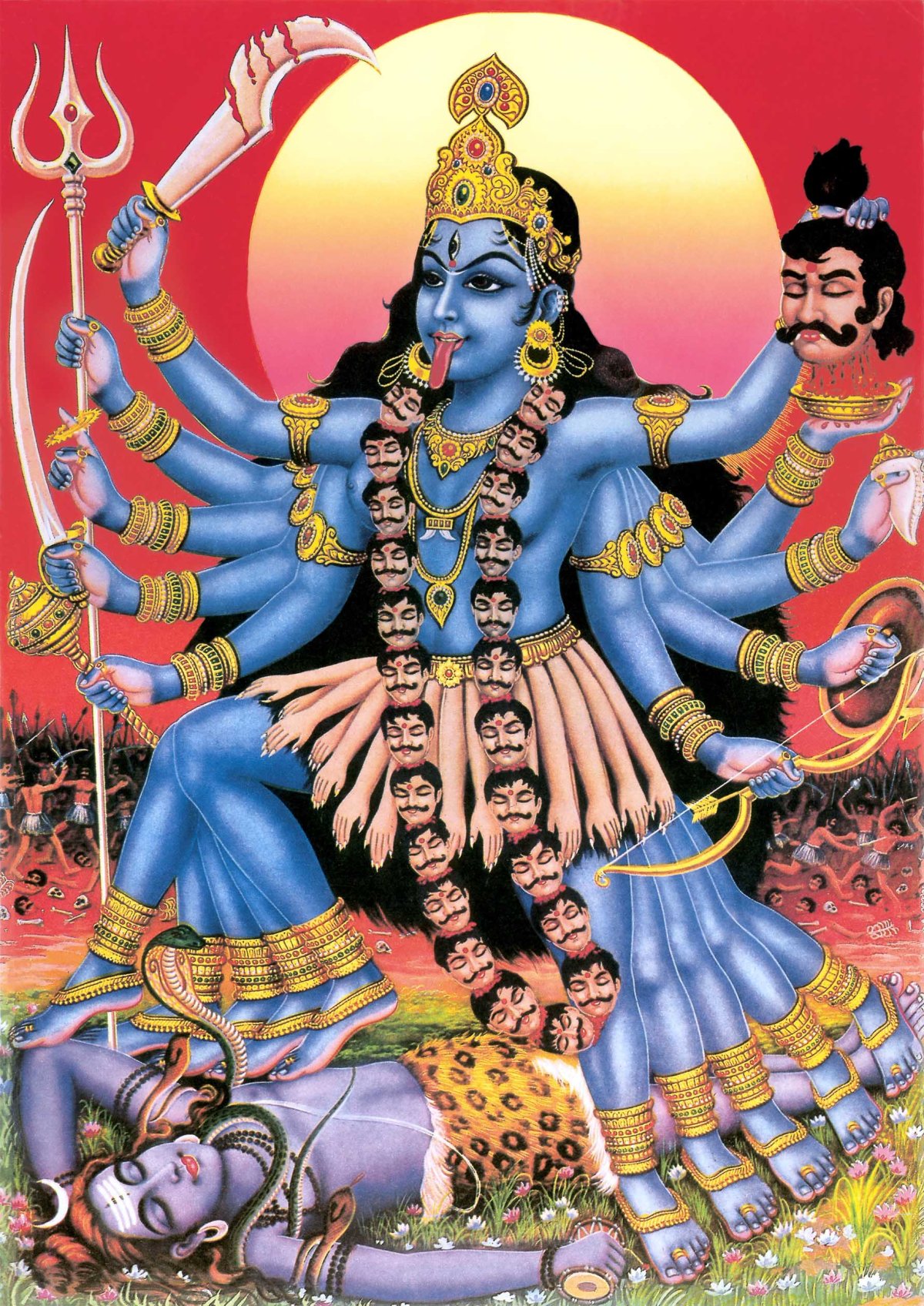
Kali Takes The World I: Dark Night of the World Soul

By Vera de Chalambert

When in the summer of 2015 I saw the breathtaking image of the goddess Kali, the great Hindu goddess of death, destruction, and liberation, tongue outstretched, third eye blazing, projected onto the top of the Empire State Building for the documentary Racing Extinction, I ranted, “This a sign of the times—Kali takes New York!” A year later, as the shocking 2016 election results were similarly projected onto the top of the Empire State Building and I saw Donald Trump’s smug smirk and sly gaze staring victoriously into the shaken soul of the country, I raved, “This is a sign of the times—Kali takes America!”
kali-1Last month, I picked up the New York Magazine’s infamous “Doomed Earth Catalog” issue and it opened right to the “The Uninhabitable Earth” centerfold. I have certainly not gone unfazed by the realities of climate change, nor escaped its oft-sensationalized overtones. But this article and its striking images, like a skeleton all decked out in Ray-Ban aviator shades melted straight into the concrete and graphic descriptions of being cooked from the inside as the earth temperature rises just a few more degrees, knocked the air right out of my lungs. I suddenly wanted to wail, but no sound came out.

I suddenly wanted to run, but there is nowhere to run from reality.

If you haven’t seen it, this issue is the only tantric iconography of the Great Mother that you will ever need. It does what every statue and image of the Dark Mother was always meant to do—make us unsettled, shake up our false selves and empty certainties, strip us of illusion. The voice roaring ruthlessly from the pages of the magazine was unmistakable. She might as well have been projected again up there on top of the world. This time, in every bone of my being I knew. This is the sign of the times—Kali takes the world!

Kali

In essence, the mythos of Kali is this: apocalypse has arrived. Demons are taking over the world. And, surprise, they can only be conquered by a woman! In desperation, the gods call upon the Devi.

Enter Durga.maadurga5

The Goddess rides in on her pussy-tiger, magnificent and fierce. She fights valiantly, but as she wounds a great demon, with every drop of its blood, a thousand more demons arise. The Mother sees she is losing the battle for the world. “Not on my watch,” she roars.

In the last hour from her third eye, the deepest, darkest, most terrifying form of the feminine rises, and that is Kali. She is the most terrible. Nothing escapes her holy darkness. She licks up the blood of separation before it hits the ground, conquers the demons, and saves the world. Oh yes, then she dances.

If you expect any benefits from your search, material, mental or spiritual, you have missed the point. Truth gives no advantage. It gives you no higher status, no power over others; all you get is truth and the freedom from the false.” ~                                                 Nisargadatta Maharaj

Even as I write, Hurricane Harvey is still raging. Simultaneously this week, terrible floods in India, Bangladesh and Nepal have killed thousands and left millions homeless. As we stare in disbelief at images of entire neighborhoods swallowed under water, folks wading through the deep with their animals and their kids and their life in a black garbage bag, and thousands crowded into shelters, what is furiously seeping through into our collective psyche is that business as usual is over.

In our hearts we can’t help but intuit that this is only the first taste of such extreme weather cycles, that anyone of us might be next among the throngs of climate refugees, steeped in flood waters, or strung out by some future drought. Slowly, we are meeting the terrible gaze of Kali, her potent shaktipat (in Hinduism, the transmission of spiritual energy upon one person by another) meant to awaken us from our slumber of separation, burn away our prisms of illusion, mature our collective soul.

Stripped of our comforts and certainties and false assumptions about life, now faced with the vulnerability of existence, we come to feel more intimately the hollow of our bones. It is when things fall apart that we meet the un-ruined. To be planted, a seed must turn completely inside out, must break open, the old form utterly destroyed, in order to grow.

To those unfamiliar with the cycles of growth, fertility might look like annihilation. Similarly, those unfamiliar with the cycles of spiritual growth might not be able to recognize that darkening [precedes] illumination, kenosis is a condition for resurrection into divine life. Carl Jung said, “Only that which can destroy itself is fully alive.” Every fate eventually concedes to a dance in the fires of spiritual annihilation. It is important to honor holy darkness as we move through the seasons of our spiritual life. The darkness of the tomb of the ego becomes the gate into the holy darkness of the womb of the Great Mother.

Paradoxically, in spiritual life progress is marked by crisis and the only way towards intimacy with the divine is through entering the crucible again and again. Our spiritual growth is punctuated by dark nights of the soul—periods of difficulty, despair, disillusionment, and disappointment. These dark nights strip the soul of old spiritual ideas and attachments, and through radical spiritual disorientation, abandonment, and finally annihilation, they bring the soul into ultimate union.

This is why the great Mother so often appears wielding weapons, because truth cuts through illusion. Truth weans the soul from spiritual trinkets and false certainties. This is why her form is terrifying, because truth is pure terror—wrathful, uncompromising, ruthless. Truth offers no solace, no protection, yields only disappointment with the false self. This is why she appears naked, because she will strip us of all artificial safety, take away everything we use to hide and save ourselves from the real. She will shatter our most precious plans and rip off the masks we don to stay relevant, before cutting off our head, breaking our heart, and dancing on our ashes. There is no hope of improvement, no chance of resistance, no place to hide, no reason to argue with reality. Our only chance is to lean in for a kiss.

A total solar eclipse just passed across the heavens of North America and so many people looked up and were transfixed by the celestial darkening that traffic on Pornhub and Netflix hit an all-time low. An unprecedented number of Americans abandoned their addictions, gathered together—liberal and conservative alike—shared glasses, and looked up in awe.

Eclipses are oracles of change. Almost universally, eclipses are feared. They are often seen as inauspicious omens; they create terror and confusion; they can blind. In some cultures, folks lock themselves away in their homes; in others, they bang on pots or drums to scare away the demons that have swallowed the sun. And yet, of those who braved the darkness to experience totality, most report feeling profoundly transformed. Many express the sentiment that “It was like seeing the face of God.” This is the power of holy darkness: it disturbs, breeds awe, and reveals the Unseeable.

Hope, Faith & Radical Presence

What are we called to do in this time of collapse? Work harder? Think faster? Compartmentalize and multitask better?

No. None of the above. In fact, we are called to do the opposite. According to Yoruba wisdom, we are called to slow down. We are called to settle into the present, to soften and loosen our grip on whoever we imagine we are, or were, wherein we assimilate the world as it is, changing so rapidly as it is, and watch our responses, our default habits and self-serving diversions happening in the microseconds between apprehension and response.

Among other things, we discover our hyper-dependency on time. We discover the difference between its relative and absolute nature. We also discover hope is a diversion from this softening.

Time is a conception arising within our limited view of reality. Normally, we are not capable of another view. When we interrupt that dependency, a different possibility opens and we are reintroduced to timeless matters: connection, curiosity, gratitude, courage, love and grief. We discover what we seek has never been gone. It is always at hand, everywhere we look.

What enters our space in liminal moments we share with another person—or even in a group? Resonance, a timeless quality, gently arrests us. What arises in the space  between vision and execution as a quiet presence is Inter-Being. This space is filled with knowledge, yet is neither yours nor mine. We become present in such knowledge–or it becomes present in us.

There is no such thing as a unit of time in any absolute sense. Since that is so, we could even define “presence” as something more like absence. The absolute nature of time is a vastly spacious awareness no longer held in the tight grip of someone who ‘hopes’; one so expansive that even “embodiment” implies a limitation, so permeable that emotional states and the ambient phenomena of group process no longer impede the flow of connection.

Temporarily at least, one is so completely ‘here’ that time stands still. At the same time, the ego has been rendered quiescent, if only for a moment. Since there is no future, there is nothing to hope for. One may even enter a non-conceptual state in which there is only feeling, a seamless realm of knowing. There is nothing to grasp here, nothing to cling to and no one to cling to it.

From the relative (dualistic) view in which subject and object exist, we imagine events follow an order, stretched along a continuum without beginning or end. In the timeless space, discrete events exist without order, arising in random fashion, crowding each other out, competing for ‘space’ and attention, arising and disappearing in a chaotic flow.

This competition appears as sense perception and feeling, which we evaluate and then choose according to our preferences and motivations. The awakened state, the timeless space we occupy when we downshift to an imperceptible crawl is not just another unconventional and unfamiliar form of time in which ‘events’ occur.

Awakened mind lives outside of time. It permeates the construction we call time yet is not time-bound. Then again, neither is it other than time. The true nature of emergence (consciousness and biology) is the opposite of our habitual hyperactivity. It is a tsunami of perpetual stillness, an infinite evenness subsuming everything, a continuous tidal wave of creative interdependent unfolding that has no beginning, no end, no boundaries, no center and no limits.

In this realm the very idea of a separate self is an inexplicable accident; in which we realize our movement and intention within a unique place in the web of life also holds all others, informs and is informed by all others. We are so completely and fully at home there is nothing left to ‘do.’

In the context of collapse, hope has no place in such presence. It simply cannot be. It is foreign, as it is entirely incompatible with the pervasive dynamic evenness of radical presence in a timeless state. Ultimately, hope relies on causal relationships in a universe without cause. It is a condition we put on our commitment to the present, as if we need a future reward as a prerequisite for undertaking the task at hand. If we hope long enough or hard enough for a particular outcome, perhaps something will happen. Perhaps not. But ultimately, in hope we seek our own continued well-being. In that sense, hope keeps us stuck in denial of our unfolding relationship with grief. It allows us to run away from our direct experience. Hope does nothing to interrupt Business As Usual.

As Stephen Jenkinson says, “Hope is what allows us to continue [what we’re doing]; instead of stopping, we are waiting to be stopped.” If that ever happens, it will be too late. Unfortunately, such thinking exists in a narrow linearity that conflates intention with faith. Being neither intention nor faith, hope lies between the possible and the impossible, between what we know is within and what we imagine is beyond our capacity.

Vaclav Havel once remarked, “Hope is not the conviction that something will turn out well, but the certainty that it’s worth doing regardless of how it comes out.” That certainty is faith, knowing we are doing the right thing now and being committed to what matters most, not regardless of some future outcome, but because we already know what the long-term outcome is likely to be. Hope becomes a defense against despair.

Of course we cannot control the future.  But faith is an absolute belief in our agency in the present. Hope lies at the opposite pole of fear and despair, a duality in which we oscillate from one extreme to the other. Without hope, there can be no despair. By creating and clinging to hope, we create space for fear.

Evaluating our decisions based on an obligation to future generations, even seven generations hence, as is customary among some indigenous communities, does not require a reliance on hope. We do what we know is right. A nebulous disempowering wish about the future dies a quiet death as we rise to our obligations and clarify our responsibilities in the moment.

Again, Stephen Jenkinson:

The question is not ‘Are we going to fail?’ The question is how. The question is What shall be the manner of our inability to care for what was entrusted to us? The question is What is our manner of failing?……

Grief requires us to know the times we are in. The great enemy of grief is hope. Hope is a four-letter word for people unwilling to know things for what they are. Our time requires us to be hope-free, to burn through the false choice of being hopeful or hopeless. These are two sides of the same con-job. Grief is required to proceed.

Reverse engineering the next hundred years to determine how we must act now puts hope in a different light. We may not be able to shift the course of the entire human  enterprise, but at least we have taken a long view and fully exercised our capacities in the service of Inter-Being.

We immerse our selves in our immediate experience, in the feeling level of our responses to our senses, without regard for their source. Such immersion attains without labeling experience, becoming neither attracted nor repulsed by any of it, without analyzing, meditating upon it or turning away.

In other words, without turning it into an object of interest or adding it to a collection of memories, neither categorizing, discarding,…..nor even believing it. In so doing, we are both immersed and freed simultaneously, watching from a vast view, yet also noticing, feeling and burning in the fires of the moment. Our principle acts must be to reduce suffering, which only becomes clear as we allow ourselves to suffer. Rumi said, “In suffering is a gift. In it is hidden mercy.” There is no place for hope in this equation.

All of this may appear to be highly idealistic because mainstream thought and the pursuit of happiness is a relatively closed orbit, exerting immense inertia on moments of awakening that come from a full descent onto our grief, lest that awakening threaten the grip of consensus (relative) reality. And yes, regardless of how the expression of presence may appear, since it must co-exist with material reality, it is nevertheless a condition worthy of cultivation.

No matter what arises, even if heaven and earth change places, there is a bare state of relaxed openness [available], without any underlying basis. Without any reference point–nebulous, ephemeral, and evanescent–this is the mode of a lunatic, free from the duality of hope and fear.

Chöying Dzod (pt. IX) Longchenpa

Let’s all become lunatics! Our resilient future depends on it.

Listen For The Beloved

Listen for the Beloved.
The walls fall down.
Listen for the Beloved.
The Stories wither to dust.

Listen for the Beloved.
The crockery dances in the cupboards.
Listen for the Beloved.
The masters obey their animals.

Empty your pockets.
You do not live in a tiny tent,
solitary in your pea pod warmth
by a dwindling fire.

No, your tent is the sky.
And that lump in your throat
is not gold.
Neither is it coal.
It is not even yours.

Set free the herd
chained to your doorstep.
Set free the millers,
chained to their wheels.

There is water aplenty
overflowing the cup
of the Beloved.
Drink by her soul hand.

The Severed Hand

(excerpted from the Dark Mountain Manifesto)

The myth of progress is founded on the myth of nature. The first tells us that we are destined for greatness; the second tells us that greatness is cost-free. Each is intimately bound up with the other. Both tell us that we are apart from the world; that we began grunting in the primeval swamps, as a humble part of something called ‘nature’, which we have now triumphantly subdued. The very fact that we have a word for ‘nature’ is [5] evidence that we do not regard ourselves as part of it. Indeed, our separation from it is a myth integral to the triumph of our civilization. We are, we tell ourselves, the only species ever to have attacked nature and won. In this, our unique glory is contained.

Outside the citadels of self-congratulation, lone voices have cried out against this infantile version of the human story for centuries, but it is only in the last few decades that its inaccuracy has become laughably apparent. We are the first generations to grow up surrounded by evidence that our attempt to separate ourselves from ‘nature’ has been a grim failure, proof not of our genius but our hubris. The attempt to sever the hand from the body has endangered the ‘progress’ we hold so dear, and it has endangered much of ‘nature’ too. The resulting upheaval underlies the crisis we now face.

We imagined ourselves isolated from the source of our existence. The fallout from this imaginative error is all around us: a quarter of the world’s mammals are threatened with imminent extinction; an acre and a half of rainforest is felled every second; 75% of the world’s fish stocks are on the verge of collapse; humanity consumes 25% more of the world’s natural ‘products’ than the Earth can replace – a figure predicted to rise to 80% by mid-century. Even through the deadening lens of statistics, we can glimpse the violence to which our myths have driven us.

And over it all looms runaway climate change. Climate change, which threatens to render all human projects irrelevant; which presents us with detailed evidence of our lack of understanding of the world we inhabit while, at the same time, demonstrating that we are still entirely reliant upon it. Climate change, which highlights in painful color the head-on crash between civilization and ‘nature’; which makes plain, more effectively than any carefully constructed argument or optimistically defiant protest, how the machine’s need for permanent growth will require us to destroy ourselves in its name. Climate change, which brings home at last our ultimate powerlessness.

These are the facts, or some of them. Yet facts never tell the whole story. (‘Facts’, Conrad wrote, in Lord Jim, ‘as if facts could prove anything.’) The facts of environmental crisis we hear so much about often conceal as much as they expose. We hear daily about the impacts of our activities on ‘the environment’ (like ‘nature’, this is an expression which distances us from the reality of our situation). Daily we hear, too, of the many ‘solutions’ to these problems: solutions which usually involve the necessity of urgent political agreement and a judicious application of human technological genius. Things may be changing, runs the narrative, but there is nothing we cannot deal with here, folks. We perhaps need to move faster, more urgently. Certainly we need to accelerate the pace of research and development. We accept that we must become more ‘sustainable’. But everything will be fine. There will still be growth, there will still be progress: these things will continue, because they have to continue, so they cannot do anything but continue. There is nothing to see here. Everything will be fine.

*

We do not believe that everything will be fine. We are not even sure, based on current definitions of progress and improvement, that we want it to be. Of all humanity’s delusions of difference, of its separation from and superiority to the living world which surrounds it, one distinction holds up better than most: we may well be the first species capable of effectively eliminating life on Earth. This is a hypothesis we seem intent on putting to the test. We are already responsible for denuding the world of much of its richness, magnificence, beauty, colour and magic, and we show no sign of slowing down. For a very long time, we imagined that ‘nature’ was something that happened elsewhere. The damage we did to it might be regrettable, but needed to be weighed against the benefits here and now. And in the worst case scenario, there would always be some kind of Plan B. Perhaps we would make for the moon, where we could survive in lunar colonies under giant bubbles as we planned our expansion across the galaxy.

But there is no Plan B and the bubble, it turns out, is where we have been living all the while. The bubble is that delusion of isolation under which we have labored for so long. The bubble has cut us off from life on the only planet we have, or are ever likely to have. The bubble is civilization.

Consider the structures on which that bubble has been built. Its foundations are geological: coal, oil, gas – millions upon millions of years of ancient sunlight, dragged from the depths of the planet and burned with abandon. On this base, the structure stands. Move upwards, and you pass through a jumble of supporting horrors: battery chicken sheds; industrial abattoirs; burning forests; beam-trawled ocean floors; dynamited reefs; hollowed-out mountains; wasted soil. Finally, on top of all these unseen layers, you reach the well-tended surface where you and I stand: unaware, or uninterested, in what goes on beneath us; demanding that the authorities keep us in the manner to which we have been accustomed; occasionally feeling twinges of guilt that lead us to buy organic chickens or locally-produced lettuces; yet for the most part glutted, but not sated, on the fruits of the horrors on which our lifestyles depend.

We are the first generations born into a new and unprecedented age – the age of ecocide. To name it thus is not to presume the outcome, but simply to describe a process which is underway. The ground, the sea, the air, the elemental backdrops to our existence – all these our economics has taken for granted, to be used as a bottomless tip, endlessly able to dilute and disperse the tailings of our extraction, production, consumption. The sheer scale of the sky or the weight of a swollen river makes it hard to imagine that creatures as flimsy as you and I could do that much damage. Philip Larkin gave voice to this attitude, and the creeping, worrying end of it.

Nearly forty years on from Larkin’s words, doubt is what all of us seem to feel, all of the time. Too much filth has been chucked in the sea and into the soil and into the atmosphere to make any other feeling sensible. The doubt, and the facts, have paved the way for a worldwide movement of environmental politics, which aimed, at least in its early, raw form, to challenge the myths of development and progress head-on. But time has not been kind to the greens. Today’s environmentalists are more likely to be found at corporate conferences hymning the virtues of ‘sustainability’ and ‘ethical consumption’ than doing anything as naive as questioning the intrinsic values of civilization. Capitalism has absorbed the greens, as it absorbs so many challenges to its ascendancy. A radical challenge to the human machine has been transformed into yet another opportunity for shopping.

‘Denial’ is a hot word, heavy with connotations. When it is used to brand the remaining rump of climate change skeptics, they object noisily to the association with those who would rewrite the history of the Holocaust. Yet the focus on this dwindling group may serve as a distraction from a far larger form of denial, in its psychoanalytic sense. Freud wrote of the inability of people to hear things which did not fit with the way they saw themselves and the world. We put ourselves through all kinds of inner contortions, rather than look plainly at those things which challenge our fundamental understanding of the world.

Today, humanity is up to its neck in denial about what it has built, what it has become – and what it is in for. Ecological and economic collapse unfold before us and, if we acknowledge them at all, we act as if this were a temporary problem, a technical glitch. Centuries of hubris block our ears like wax plugs; we cannot hear the message which reality is screaming at us. For all our doubts and discontents, we are still wired to an idea of history in which the future will be an upgraded version of the present. The assumption remains that things must continue in their current direction: the sense of crisis only smudges the meaning of that ‘must’. No longer a natural inevitability, it becomes an urgent necessity: we must find a way to go on having supermarkets and superhighways. We cannot contemplate the alternative.

And so we find ourselves, all of us together, poised trembling on the edge of a change so massive that we have no way of gauging it. None of us knows where to look, but all of us know not to look down. Secretly, we all think we are doomed: even the politicians think this; even the environmentalists. Some of us deal with it by going shopping. Some deal with it by hoping it is true. Some give up in despair. Some work frantically to try and fend off the coming storm.

Our question is: what would happen if we looked down? Would it be as bad as we imagine? What might we see? Could it even be good for us?

We believe it is time to look down.

The Toxic Masculine Empire Strikes Back

There are many ways to describe the human drama at this moment. We can talk about psychology or brain function, economic ideologies or politics, philosophy and religion. All of them have a kernel of truth. Here is another way to say it:

Deeper than ideology and psychology, perhaps even deeper than brain function, we can speak in energetic and spiritual terms about the human disease. Masculine energy is a rising force in the body/mind, an energetic evolution toward material accomplishment, a commanding view and a spiritual search for enlightenment. The feminine is an earth-bound force, rooting in the soil of life, a generative force driven by an erotic principle, connecting and interpreting spiritual awareness in the earthbound terms of community, equality and mutual nourishment. In the most basic terms, the masculine is in profound polarity to the feminine.

In a healthy culture, those energies would be circulating freely without restriction or corruption, nourished universally and manifested in tangible and humane social structures, institutions affirming our rightful place in equal status with other living beings and the living earth itself.

In terms of the chakra system of understanding human yearnings, flaws and behaviors, the wounded male energy of the current world denies the erotic, lives in and for the upper chakras sourcing his power in vision, setting the terms of existence and progress and defining the longing of his fellow humans in base and selfish ways, separating his friends from his enemies, those who deserve his attention and those who do not. Yes, the wounded male also operates in and from the second chakra, but those energies are corrupted, manifesting as toxic domination and objectification, out of touch with the nature or practice of healing  and unifying forces. In the worst case, he is ignorant of and resistant to any complementarity

This domination and subjugation extends to the feminine as misogyny, Other-ising fellow humans in the form of racism, colonialism and exclusion; to the earth as the ecocide based on the myth of separation and the myth of extraction without consequence. The wounded female is separated from her power and influence by the subjugation of men, by the loss, denial or imprisonment of her generative, erotic force and thus the connection between her creative energies and her personal power. The true nature of her spiritual powers and vision are blocked or stunted

The wounded masculine is extremely threatened by the rise of intact feminine power and energy. The very foundation of his vision and control are under siege. Thus we see throughout the world the backlash, the retrenchment and embattled mentality of the wounded masculine in the form of legislative initiatives to depress and control the manifestations of feminine expression of her essential erotic powers; the resistance to codifying equality and reversing institutionalized oppression and increasing outright violence.  Media giants under the operation and control of men subtly propagate this agenda, conveying, among other ways, their ongoing (and increasingly blatant) bias against the possibility of a female being elected as America’s President.

The rise of nativism, the retrenchment of racism, the creeping autocracy and fascism, the reversal of environmental laws, the denial of climate change, the doubling down on extractive practices, white collar and government corruption and even the unchecked  dissemination of poisons into the atmosphere, waters and soil around the world can all be interpreted as reinforcing Other-ism and the backlash of toxic masculinity, as aggressive attempts to deny, control and sequester erotic, untamable dark forces; to deny and repress the human shadow; to damn (and dam) the ideologies of community, diversity, equality and inclusion; to re-assert autocratic control by deeply dysfunctional, wounded and now blatantly omnicidal (terminally wounded) men.

The earth-cult empire of the wounded masculine, including the billionaires and all their henchmen whose wealth depends on oppression, exclusion, domination and objectification is now demanding we all drink the kool-aid, as if that alone could wipe away the collapse already underway.

The healing of the feminine force, opening the essential creative and generative energies to manifest through the centers of personal power, vision and spiritual attainment offers an alternative clarity, an inspiring and infectious force rooted in connection, collective action, equality, inclusion and a celebration of diversity.

The upper centers of the subtle body manifesting empathy, compassion; the heart speaking with a thousand tongues; telepathy (giving voice to deep and common yearning), clairvoyance (the ability to, as Rumi said, “close both eyes to see with the other eye”) and the ability to interpret the elemental as divine nature is the promise of the awakened feminine, which is not to say these powers and reformulation of essential energies are only accessible to the female, just that men may have to struggle a little more to unlock them. This struggle is, fortunately, also expanding everywhere we look.

The awakened male will have his own interpretation of these energies. But in the end, they will be congruent, shared, mutually inspiring, fruitful in expression and igniting possibilities we have not seen. Unfortunately, that world remains beyond our grasp. Do we have enough time? Unless there is a virtual instantaneous and universal paradigm shift away from the wounded masculine and a corresponding rise of integral feminine presence co-creating with the healthy masculine, reversing the pervasive and common symptoms of the core disease, our demise as a species will likely continue to accelerate toward the abyss.

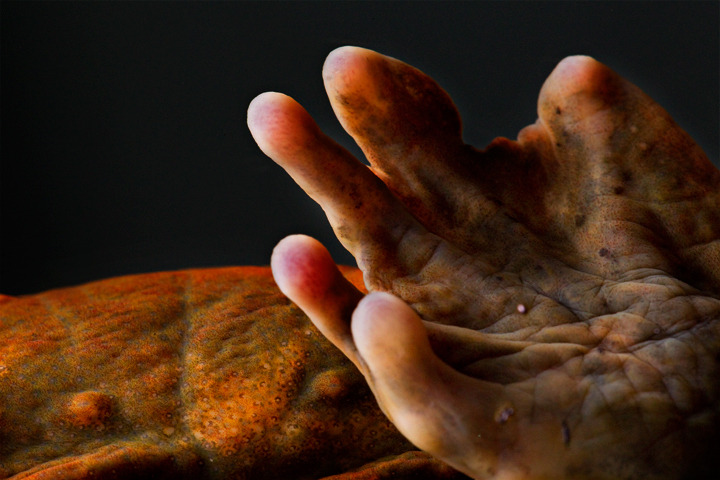
Hellbender Salamander

Tell me again how we all came from the same place.
Where you are here, opening your palm to the shaking

wriggle of worm-force, the blackness, the
soul-less gravity of imperatives watching

your unfolding, the light, the distance overcome
in the waters, the tides, the blood of time,

your age, the warp of your witness,
shadows unfurling into light, your orbit,

your center of iron, blatant divisions that must be
crossed before you can express the inexpressible.

this is love unwound. this is love before it knows itself.
this is love becoming itself, time deciding what is and is not.

this is love casting its shadow upon the deep.
twisting out of its cocoon, bursting through the soil, the night.

The GOP is Not a Cult of Fear. It’s Hero Worship.

When we think of a cult, we think of brainwashing. The members have been brainwashed to believe what the leader wants them to believe. Whatever it is, it’s the opposite of their personal self-interest. Dependency is critical to the success of the leader, reinforced and cultivated in all the messaging to sustain the leader’s power and control.

I won’t deny the current GOP has cult features, but it’s not so much an ideology as a theology. It’s a political philosophy rooted deeply in religious views. Its elected members certainly fear and are dependent on Donald Trump. And it’s also clear the non-elected members holding administration positions, including his children, must also mouth fealty or expect to be quickly shuffled to the curb. And fealty, in this case, includes being willing to break the law without reservation or complaint.

But brainwashed? I don’t think so. To repeat the favored explanation for falling into line no-matter-what due to abject fear of Trump is too simplistic. In fact, it lets the GOP off the hook. No, their allegiance is to something else. They may fear him, but they also admire him. Why? Because he’s doing what they have only dreamed of doing themselves.

Since he’s doing it for them, they’re only too happy to give him unlimited rein to overstep any boundary, test any convention and obstruct any interference. They are completely in his thrall, slack-jawed at his capacity to thumb his nose at anyone in his way.

They want more of that.

All of them, every last one (and barely excepting Mitt Romney in the Senate), including the ones in the House, Kevin McCarthy, Steve Scalise, Doug Collins, Devin Nunes, Jim Jordan, every one, is an authoritarian down to their shoes. Those who don’t have any qualms about expressing that preference either find themselves in leadership positions or becoming mouthpieces for the president.

They don’t have any reservations about lying or helping the president lie. Their deep desire to control everything and everyone, to undermine or destroy democratic institutions, silence the opposition or tolerate and participate in the rising wave  of fascism for the sake of retaining control is on display every day now, and has been for some time.

Is someone controlling Lindsey Graham? I don’t buy it. His true personality has been unleashed by Trump. And consider, anyone not willing to entertain this possibility is clinging to a fantasy, holding out hope for the hopeless.

The impeachment trial simply gave them all a bigger platform. Now that it’s passed, they will happily exercise the punitive inclinations of their collective personality disorder. They are the strict disciplinarians, vengeful gods, and the rest of us are the children to be silenced and led by the nose. Those who stray from the fold must be punished. Trump is sicker than even that, of course, but they are the most useful tools of his disorder he could ask for.

Joe Biden has repeated his belief that there are Republicans he can work with. Except that every day we are witnessing how delusional that position really is. Now the voters are having a chance to let Biden know, among other important reasons, how great is the folly of his clinging to this idea. The DNC also continues to clutch at the idea of a Biden nomination. Even greater folly.

Another Trump personality feature hammering the pleasure centers in the brains of his followers is his victimhood. He excels at being wronged, lost in the woes of enduring the slings and arrows fired upon him from all sides. I can imagine his allies secretly chuckling to themselves at how relentlessly he feigns the embattled saint, elevating the pedestrian victimhood of the Obama-era GOP to high art. Victimhood on steroids. They’re also thinking, “Why didn’t I think of that?”

Trump is such a shocking character in so many ways, the fact that he was always a caricature of himself, even more so now, has flown right over the heads of so many, particularly in the media. They just can’t bring themselves to take him seriously—I mean really seriously, treating him like the Wizard but never willing to draw the curtain.

In this CAT 5 hurricane of self-imposed blindness, the constitution barely stands a chance.

The Doomasphere

Jem Bendell has been criticized for promoting what some call “The Doomasphere,” –a dark vision of the future–though until now I couldn’t have named any of Deep Adaptation’s neighbors in that ‘hood. Is he alone? Who else occupies the Doomasphere? Is that even what he’s doing?

It turns out there are several neighbors; in fact, some very evolved and well-established ones. The premise may not in all cases revolve around a prediction of near-term collapse, but orient around the inherent fragility of modern social and technological infrastructure, which purports to be expanding and integrating continuously, thereby becoming more fragile, more volatile and less predictable. In other words, the very definition of chaotic.

Adding climate change to that mix, and especially because that continuous expansion is driving climate change, there is the recent French TV mini-series called L’Effrondrement, set in the near future and updating Jared Diamond’s Collapse, depicting how easily everything we take for granted may be swept away. It’s based on a 2015 novel promoted as a “manual of collapsologie” for present generations, upending the ideologies of sustainability, a green economy or a smooth energy transition.

Well, we already aren’t (or shouldn’t be) deluded by the notion of any smooth transitions, especially with each passing month of increasingly dire news. In fact, it’s been two decades since we passed the option of a “smooth” anything.

The pendulum of human history swings between moments of our being harmoniously embedded within natural processes and periods of population concentration, political centralization, and an urge to transcend the earth’s resource constraints. We develop economies of scale, agglomerate extractive industry on a grand scale, but ultimately overexploit our natural foundations.

The New York Review of Books

The result is articulated by another occupant of the Doomasphere, David Wallace-Wells’ The Uninhabitable Earth. In the aggregate, the primary strategies of the environmental movement have been a failure. Exxon has won. Not because they didn’t believe the warnings. They knew well before the warnings were issued. The Green New Deal, one of the most recent elaborations on the meaning of Resiliency, according to key figures in the French Doomasphere, is nothing more than a repackaging of the California technological fantasy. Also doomed to be inadequate. One of the earliest members of the Doomapshere is surely the Club of Rome, which produced a landmark report in 1972 called The Limits of Growth, in which the onset of stagnation is predicted in the 2020s. Prescient!

“We must prepare small-scale, resilient bio-regions,” on the scale of only a few thousand inhabitants. Economic circuits must be scaled to local ecosystems and resources, eschewing global supply chains. Visions of the good life that are predicated on unlimited mobility and expanding human wants must be replaced by an ethics of rootedness, the joy of living and working in a defined space.

Yves Cochet

Collapsologie shares a view of the coming world with Deep Adaptation by requiring not only a realization of our true place in the natural world, but a spiritual re-conversion to an ideology of sharing. Their view of “liberty” is also diametrically opposed to the narrow definition of Darwinism adopted by our self-appointed thought (and investment) leaders of economics and politics and the Hobbesian view of life as “nasty, brutish and short.”

While every Conference of Parties since Paris, 2015, has devolved into further finger-pointing and subversion of consensus, the narrowing of any viable environmental strategy has limited rational choices to (among other things) the escalation of resistance to further fossil fuel development, the elimination of global oil subsidies, widespread and radical rollback of income inequality and compensation for the first victims of catastrophe—the global south. All of this while preparing viable strategies to coalesce into regional resilient enclaves.

The existence of a compelling and now 10-year old conversation departing from the mythologies of ‘progress’ and ‘nature’ (why do we even have a word for nature?) resides here at the UK-based Dark Mountain Project. These conversations on the theme of Uncivilization will touch you in profound, surprising and unforeseeable ways, bouncing from head to heart to the deep somatic. There is no prescription here, but rather a litany of “hard truths to help you stay rooted in difficult times,” while building a bridge to a possible future. Dark Mountain is ambitious, illogical, arresting and most of all, real.

Finally, though I’m pretty sure he would object, Charles Eisenstein might be viewed as yet another occupant of the doomasphere simply because he views the issue of human viability as much broader than climate. In his hierarchy, pollution in all its many forms rank higher than climate change, which is about 3rd or 4th. Yet unlike any of the other inhabitants cited above except Deep Adaptation, his is A Revolution of Love, the most daunting prescription of all.


Fearlessness

If we have no fear, there is no thinking. No conceptual mind. And vice versa. No thinking, no fear. —Tsoknyi Rinpoche.

Thinking and fear are inseparable. I mean the analytical, deliberative and conceptual nature of our waking process coupled with a vague anxiety about either the past or the future. Labeling this largely unconscious and pervasive condition a defense mechanism—the opposite of a direct somatic interaction with the world– opens a portal into a rich, yet largely hidden dimension.

By whatever means, we all benefit from noticing and softening the dominance of conceptual mind whenever possible. We sense the value of alternative ways of knowing and, if we’re fortunate, gain some facility with them. But such explorations can quickly become muddy and complex with counter-intentions and conceptual intrusion. Ultimately, when the intention is to get out of our minds, the prime directive is deceptively simple. There’s nothing whatsoever to do.

Relaxing analytical mind and entering the axis of heart-mind and direct somatic experience is a dive into the deep pool of emotions and primary motivations, often blocked by uncertainty and fear. Everyday thinking (for most) is about competency and approval (in an imaginary future), driven by fear of not having things we want and not having enough time to get them.

Foremost among these is a desire to accomplish something, and quickly. For many, the thinking process is all about being somebody, reaffirming an identity, the face we turn toward the world. Acting swiftly and with confidence is the strategy to adorn our identities with permanence, constantly overlooking the fact that, in reality, there is no one to be.

Looking at this bubble of fear and deflating it is profound. Fear, it turns out, is not a permanent condition. As soon as the natural defense mechanisms to hide it are recognized, it’s possible to dial it down, sometimes to near zero, for extended periods of time. True fearlessness, the absence of thinking, may come as rare and transient moments of profound somatic presence. It may be cultivated or arise spontaneously.

Thoughts of the past or future are a defense against full somatic presence is ego’s panic. Ego is fragile and always needs reinforcement and protection. None of my fears or the illusory protection they provide is ‘me.’ ‘I’ would always rather be somewhere else, watching the entire crazy, helpless, endlessly entertaining creative process of building these defenses, which under scrutiny dissolve like so many sand castles before the incoming tide.

Viewing the climate issue through the lens of a perpetual fearful state, our individual and collective responses orient around fear-based rational metabolizing of data and formulating rational responses. That doesn’t mean we are deliberately denying or condoning the denial of our deeper emotions. But it certainly can mean we are giving short shrift to them, as if focusing on doing the same thing over and over again will distract us from the discomfort of realizing we have not altered our course from its suicidal path.

Conventional activism is not reducing global emissions. What fears construct the bulwark and what feelings lie beneath our failure to alter this failing strategy? What if the way we think about global problems is how we perpetuate them?

An alternate approach is Deep Adaptation: taking a fearless look into the darkness, unpacking our fears and listening deeply for the gifts within. Experiencing the grip of fear, whether momentary, profound or incomplete, propagates as a gift and manifests as enlightened intent. True fearlessness lies at the nexus of empathy, enlightened action, equanimity (in the face of subtle and/or uncontrollable forces) and the softening of ego. It is where uncertainty meets trust, where structure meets chaos and doesn’t recoil, where empowerment, joy and compassion intersect. This is the path of Deep Adaptation.

These qualities naturally and spontaneously subvert the life-long conditioning of the fear-based, selfish (and self-denying), rational, zero-sum paradigm and maximally defended hyper-ego of modern culture, politics and economics. To be fearless is to operate outside the perversion of today’s inverted totalitarianism. To place oneself so far outside the norm is a revolutionary condition. In fact, fearlessness is lawless, at least in the sense of operating in the present moment, outside a set of unwritten laws governing acceptable human interaction. I am talking about the absence of fear, not bravado, not a jacked-up boundless courage in the face of fear.

To live outside the law you must be honest……..Dylan.

The dominant paradigm exploits fear to condition behavior, more so now than ever because the messaging has become so sophisticated and the drive to monetize our emotions so strong. That messaging tells us when we are afraid, we must look to ourselves as the source, not to the daily deluge of mass indoctrination. The individual is pathologized. These are the mechanisms of social control.

The origins and mechanisms of fear in our lives all serve a purpose. At the same time, we can reflect on our beliefs and reflexive responses to everyday events, appetites and needs to consciously explore alternative strategies. Extending this deeply resilient and adaptive practice to the collective context exponentially increases complexity.

As we determine effective pathways to justice, it’s increasingly clear that turning off discursive mind enhances our capacity for fearlessness. This is now the cutting edge of transformative group practice, in which the presence of fear can be named, exposed and collectively defused. Cutting through the defenses and obscurations involves unwinding the triggers and layers of fear we’ve accumulated since birth–or even before.

The clarity we can build and the resulting behavioral changes eventually become automatic. Such a process may be called by many names. I call it the Buddhist long game: the transformation of mind. Every such path of inquiry into fear is a journey into the heart of suffering. This is one thing we all share. Ultimately, all practice is directed toward one simple truth: the majority of emotional (not instinctual) fears driving us, tenacious though they may be, are illusory. We may have our story about them, yet they have no true objective source. Which is not to say fear can merely be dismissed; not at all.

Compassion is closely related to fearlessness. Situational compassion expresses empathy and responds to the suffering of others in a direct way. Absolute compassion is an encompassing awareness of the profound commonality of human experience, the suffering and bewilderment at the heart of being human and related confusion about the difference between what is real and what is actually true. Holding such a view while surrounded by an ocean of fear without being affected by it is nearly unimaginable. Yet fearlessness grows with compassion. And vice versa. They are inseparable. Absolute compassion is entirely incompatible with fear.

In stepping through the gateway of compassion, we step into fearlessness. True compassion cannot fully manifest without realizing all phenomena exist in a supremely expansive state of equal-ness. There is no distinction between enlightened fearlessness and compassionate intent or any other way of being. Many of our fears are variations of denial—self-imposed disempowerment. They are responses to familiar threats to which we have become habituated. They become comforting costumes layered upon core reality. Over time they shape a fixed identity, as if abiding fear becomes a reassuring view of our selves.

Nowhere is this dynamic more apparent than in relation to the existential threat of climate change. But fear is typically subject to causes and conditions and can be reviewed by cognitive mind. Discovering and breaking through every form of denial about our future is a central principle of Deep Adaptation.

We might assume fearlessness is a matter of will. But let’s not confuse conceptual knowledge for wisdom. Knowing more will never take us to the truth of fearless intent. Wisdom comes by inquiring ever more closely and deeply–with a bottomless compassion for oneself–into the sources and nature of our fears (and denial) and liberating the energy and clarity stored within. Exercising will is more like counter-phobia, throwing a cover over that clarity and burying it further from sight.

The distracting activity of mind and the accompanying dance of denial is often symbolized as an untamed mustang. It is attractive, seductive and wild. Fearlessness is the ability to recognize the beauty and spontaneity of that wildness without being seduced by it.

The fearless one sustains an unflinching gaze into her own suffering, compromise, limiting beliefs and behaviors. The fearless one acts with a compassionate intent that holds fear, hope and separation as having no substance, no traceable origin or destination, no firm ground at all.

The fearless one is willing to sustain the consequences of living beyond convention, even if it means putting one’s own safety at risk, not solely to place a spotlight on the entrenched nature of the dominant paradigm, but to engage with it in fresh and creative ways, transmitting a highly contagious view of the possible: a world in which there is no true enemy. The fearless one affirms there is enough for all, there is unbroken relationship with all; there is infinite choice and nothing to do but create.

In this condition we glimpse our true nature. It can shake our world, arousing awareness of our fears and the sway they hold over us. The fearless one even evokes our fear of fearlessness with a gentleness that melts our defenses, exposing our vulnerability and the artifice of our times.

The fearless one opens possibility for something new, a vast, spacious and timeless freedom we know in our hearts is possible, yet which, without the support of others, we are barely strong enough to sustain more than a few moments at a time for ourselves.

What might a culture of fearlessness or fearless collective action look like? There are surely many examples, some deliberate and some spontaneous. Can all political initiatives be about dismantling the mechanisms and structures of fear? Many of them already are. To explore these pathways, interrupting our pre-occupation with individual identity and survival, is to unfold into fearlessness, to enlarge our sphere of action, to embody compassion, to forge justice, to break through the familiar into a new and fresh territory of freedom–and invite others to do the same.

Cold

My shivering spends the last energy I have
to forage a cup of hot chocolate.
Then again, there is the cover on the couch—
the blanket I left rumpled last night in my
desperation for comfort.
I am now lost between purpose,
time and timelessness.

This cold. It comes in waves.
Like the ebb and flow of glaciers,
swinging through the seasons of loss and gain
And yet, each year a little more is lost.

When we speak of acres of ice it means nothing.
When we speak of islands the size of Manhattan
or the state of Connecticut

then my shivering becomes the main event.
There is no solace anymore.
No island in these tropics of denial.
No longer any blast furnace that can warm me.

The arc of my life descends, the edges
fraying now like an old sweater.
I drop to my knees in a non-aggression
pact with the glaciers, to let myself flow with
the continents of ice, the eons of frozen awe.

Elsewhere, the lives of the natural world
still unfold without remorse, without reflection,
shedding no blood for the past.
The integrity. The harmony of the present

brings me to my senses.
The savannah will be my home
–in the next life–
where I will hunt or graze,
water or preen, live or die
with nothing more to say.

 
©gary horvitz, 2017