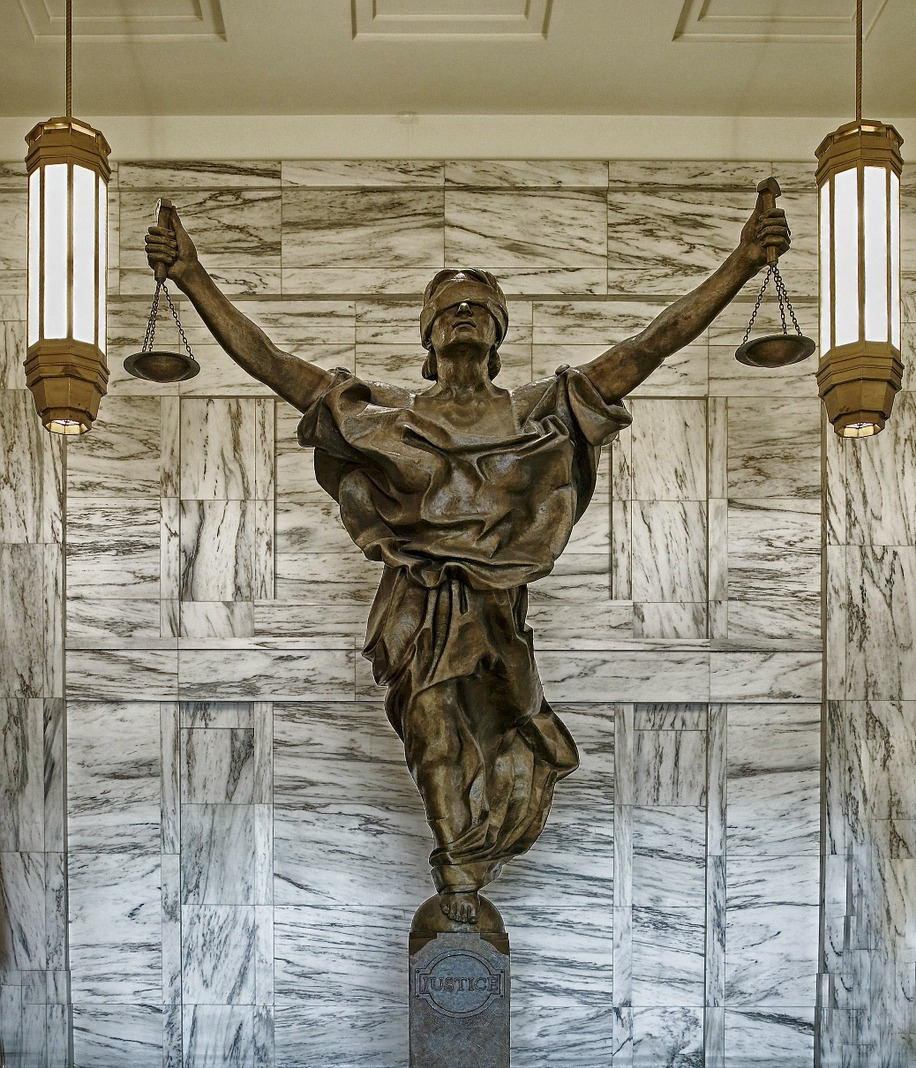
Reconciliation II: Justice

Each of the 4Rs of Deep Adaptation, Resilience, Restoration, Relinquishing and Reconciliation is a searching journey from the world we have to the world we want. The more we explore, the more we find to explore. Just looking at all the associations we have with the word Reconciliation opens many doors. Whether we talk about intra-personal, inter-personal or our relations with the living metabolism of the earth, it means a return to friendly relations. It can mean establishing compatibility of beliefs and practices. In accounting, it refers to a balancing of accounts, rendering what comes in with what goes out, reestablishing harmony at every possible scale.

Not everything that counts can be counted; and not everything that can be counted, counts. — Albert Einstein

We have only to look at our accounts with Earth itself to grasp how out of balance we are. Even the terms we use for accounting are evidence of cognitive colonization. They only reflect the mindset of separation. For humanity to meet and survive what is taking shape, even at this moment, reconciliation implies redefining those terms, an enormous commitment on every level, the expenditure of massive personal and collective resources, a profound re-ordering at the soul level, in the human energy body.

Defining a different path forward, one reflecting the true nature of our entanglements, we imagine how fraught with obstacles such an effort might be as we scan the spiritual, social, political, environmental and financial landscape in this time of increasing risk, uncertainty and unfolding collapse. Even a limited unpacking of what we mean by justice leads to considerations of decolonization as it is tied to the preservation of  nation states, the preservation of capital, risk and financial systems driven by commodification, shareholder interests and debt-driven speculation.

In this consideration, we must  include 1) racial justice: establishing racial equity by confronting the history of racial injustice and addressing systemic issues perpetuating racial stereotyping, racial privileges and locking racial groups out of educational, economic, housing and employment opportunities; 2)cognitive justice: the breaking of exclusionary ideologies to include recognition and establishment of the right of different knowledge systems to co-exist; the return of meaning to being. There are no outdated, irrelevant or second-class ways of knowing the world; 3) relational justice, also called restorative justice: the repairing of relations damaged by criminal violence and the reformation of responsibility based on generosity, compassion and humility, 4) intergenerational justice: the considerations of generational equity in  tax and spending policy, allocating funding for the future security of generations yet unborn, the way we live now and how we address climate change, 5) ecological or environmental justice: establishing equity in consideration of environmental impacts on community infrastructure, habits, livelihoods and public health, 6) economic justice: establishing fairness in policies effecting economic stability, opportunity, mobility, security and benefits to all members of the economic system. The players in this conversation include all beings, all life, all sentience from the macro to the micro-biome.

Where do ‘we’ stand in all this and what is the prerequisite for any of this investigation? It’s one thing to find a separate peace, yet our internal state has never been separate from the larger matrix. For us to find congruence in all our relations, we have to renounce the exhausted story of ‘progress’ and find relief from the inadequate ideology of ‘reform,’ which now only serves the entrenched, never really challenging or even touching the comfortable. Reform is a euphemism for cooptation and defeat. At this very moment in America, the comfortable receive rapid, virtually unlimited and unconditional transfusions of taxpayer money created out of thin air while the proletariat will ultimately bear the burden of these expenditures while hacking away at impenetrable forests of shifting bureaucratic obstacles to receive a few crumbs.

Coming to any semblance of reconciliation of all these accounts strikes to the core of who we imagine we are, the limits of language, the pandemics of depression, addiction, hopelessness, auto-immune disorders, meaninglessness, the loss of economic mobility, the obscene concentration of wealth, the loss of personal agency, the destruction of the biosphere and biodiversity,  the decline of life expectancy and the cloistering of the future in a shrinking box of falsehoods.

These conditions are signals of exiled human capacities, the disappearing knowledge systems defining the diversity of relationships we have with ourselves, our surroundings and the planetary matrix. Our institutions have become intense battlegrounds where values are shredded, where we diverge from community and settle for ever narrowing definitions of opportunity, social mobility, abundance and our sacred responsibilities.

It’s only even possible to consider reconciling the most inclusive list of stakeholders and relational issues, balancing accounts, as it were, if the primary premise is accepted: the archetypes of separation, human superiority and mastery over nature, rooted in the Enlightenment and capitalism, are spelling our doom. The entire system has come to represent only domination, extraction, exploitation and violence.

That violence is expressed as colonial expansion, the creation of empire, increasingly extreme exploitation of life, natural and personal resources, the institution of extractive economies including he corrosion of personal well-being, the surveillance state, the growth of mechanisms of control, the corruption of thought, truth and the persistent reinforcement of a paradigm of exclusion.

Every one of these features, every level and domain of operation of the Vehicle of Extinction can be represented as the management and offloading of risk. All risk is deflected by the few to the many.  Living with risk infuses the majority of lives with increasing uncertainty, instability and vulnerability.   The pandemic is highlighting these inequities because service workers in many fields (manufacturing, agriculture, transportation, law enforcement) and even many health care workers now deemed essential during COVID shut-downs are the very ones with no choice but to expose themselves to the increasing risk of infection. While we celebrate the genius, the heroic commitment and the compassion of these frontline workers, their most admirable virtues are also being exploited along the way.

True justice  as the equitable redistribution of risk, the restoration of a tangible level of social and systemic financial support to more broadly manage uncertainty.  Sharing risk equitably is a benefit to all, not only the privileged few. If risk levels were the central motivating factor in repairing our relationships,  in only one of many possible ways, we would be addressing climate change on a massive scale. We would be opening economic opportunity, social mobility, repairing mental and spiritual health, increasing public safety and unleashing untold reservoirs of creativity and generous contribution to the well-being of the whole. None of this is about eliminating risk. That would be impossible. But imagine a future driven by an abiding clarity on the meaning of justice in all its forms. In that world, counting all that counts including all that cannot be counted, our accounts would be moving toward reconciliation.
The Sanctuary of Not Knowing

Suggesting spiritual refuge is to be found in ‘not knowing’ rings a familiar bell, though ironically, striking it yields no sound. It has no tone; yet all vibration is missing. I am intrigued. The clapper isn’t striking anything solid, as if that would be too much like ‘knowing.’ As if knowing is the materialization of thought, as if anthropocentric knowing is the only way, as if what we ‘know’ is all that can be known. One cannot un-ring the bell.

Not knowing feels like an undiscovered land, an abundant refuge in which I am not the center. Perhaps there is no center, only a kind of getaway we all seek but rarely find. It’s freeing to not know, to imagine oneself a rich and compelling un-network connecting everything without having to be anything at all. It’s seductive, to be sure. We are invited to imagine the Unseen, to enter a limitless ubiquity. Being shaken from whatever we thought we were doingand being drawn into this provocative, gestating, undefined space of is not unlike being a fish suddenly realizing there’s such a thing as water. Aha!

It seems there once were some fish who spent their days swimming around in search of water. Anxiously looking for their destination, they shared their worries and confusion with each other as they swam. One day they met a wise fish and asked him the question which had preoccupied them for so long: “Where is the sea?” they asked. The wise fish answered: “If you stop swimming so busily and struggling so anxiously, you will discover that you are already in the sea. You need look no further than where you already are.”  —Carolyn Gratton, The Age of Spiritual Guidance

So it is. If we can allow our vision to soften and detach from whatever is capturing our attention, whether sensation, feeling or thought, even for short moments, we might discover a new quality of animation, not to mention connection, among all things.

When was the last time you encountered someone determined to ‘not know,’–if that isn‘t a contradiction? When was the last time you – a fellow explorer of not knowing — locked eyes with a fellow not knower? I can only imagine such a moment as spontaneous combustion — of possibility, the sharing of a unique view in which we remain uncommitted, an intermingling of presence and absence, witnessing yet not adopting every impulse to hold anything, noticing without retaining. Holding all that is real without declaring any of it to be true…or not true. This is an island in the middle of a vast ocean, stillness surrounded by motion.

We’re used to connecting over what we know. We’re used to establishing agreements about what we know, forming alliances, partnerships, romantic, economic, political and spiritual relationships defined by all we agree is true. And not true. Everything hinges on sustaining those agreements: all progress, growth, everything, every framework of discernment, even love itself is restricted to the parameters of agreement. And we habitually behave as if shared knowing defines the entire context in which we swim.

Could it be otherwise? What becomes of love in a field of not knowing? What if we weren’t so quick to define water, instead allowing ourselves to marinate in a realm of dissolving assumptions? What if we weren’t so quick to believe knowing and believing are the only currency of being with. I mean, look around. How are we doing with that? Certainty about what we know is the root of all conflict. We, humanity, are being driven over the precipice by those who know and who never take the time to not know. I’m not suggesting we deny physics or science in general, but just consider, even science is also invariably, inescapably, inadvertently conducted according to discernible biases about what is true.

Not knowing dissolves presumed boundaries. It becomes an entree to trans-corporeality, an intermingling of bodies, minds and natural phenomena. We become each other for a moment–at least until the knowing mind interrupts. We enter an uncommon relationship that doesn’t make sense. And at this historical moment, attempting to make sense in the usual ways makes no sense at all. We should likely infer the parameters of this unknown territory have always been accessible beneath the awareness of the One Who Knows. We can become the one who doesn’t know – adopting wholly different terms of relationship that have always been available were we to ever simply let go of knowing.

Not knowing is Rumi’s field beyond right and wrong.  It lies beyond Yeats’ widening gyre. It might as well be the field beyond truth and falsehood. It’s the undiscovered and unappreciated spaciousness of mind, released from restrictions imposed by being So Damn Sure, which is what makes living with uncertainty So Damn Hard.

Truly realizing not knowing becomes a meditation on Belief. Every voice tugging at the mind to give up this quixotic adventure arising from belief becomes a restraint against discovering and exploring the freedom of not knowing. Not knowing implies a certain trust and fearlessness to remain present in a state of greater uncertainty than we have ever known. It also offers perspective on the routine uncertainties of our current predicament, making them more palatable, even mundane by comparison.

None of this implies the disappearing polar ice caps aren’t real. They are indeed. It is the reflexive struggle againstuncertainty generating the pandemic rise of fear and anxiety just now. Not knowing allows us to befriend uncertainty.

We are not in control. We never have been, no matter how we cling to that myth or struggle to recover. Anxiety and fear are functions of belief. Knowing and doing are intimately related. Not knowing is a sanctuary in which we may release ourselves from impulsive doing to allay anxiety and fear. The sanctuary is where we can exercise non-doing, waiting for doing to arrive.

Can doing arise from non-doing? How will we know? Can doing exist in a field of not knowing? I will say yes. I’m going to say enthusiastically that doing arising from not knowing is not like any doing we’ve done before because it emerges in a pervasive field of uncertainty.

If we choose to remain in not knowing, will we do what needs to be done? Will we even know what needs to be done? I don’t have the basic practical measures in mind, but rather the deeper personal existential and spiritual choices. We will know what must be done because whatever doing arises from not knowing will be enacted in a context of Presence. Presence being the absence of past and future.

All belief, all knowing arises with memory of a past and a vision of a future. Presence rarely exists in a field of doing, at least not in the fullest sense. Presence dawns in the act of fully relaxing into not knowing, allowing the past and future to fall away. We are here. We don’t need to believe in anything. We are available for not doing. There is no place for anxiety and fear to hide here. This is sanctuary.


The Pornography of Everyday Life

In 1964, Supreme Court Justice Potter Stewart famously noted that pornography is “hard to define, but I know it when I see it.” Therein, Stewart uttered and characterized for the rest of us, in perpetuity, the intuitive and pragmatic nature of perceiving and assessing the amorality and distorted values inherent in extreme and damaging relationships.

On the other hand, the implication of his statement is that authentic relationships represent the antithesis of the abuse that Stewart and what most of the rest of us “know” when we see it.

Today, there is much to see all around us as behaviors, attitudes, actions and inactions share the core of these common characteristics which, when examined in depth and taken together as they function in the larger social system, sure look and feel like pornography.

We understand the typical depictions of pornography as the degradation and humiliation of another, turning them into objects, images that conform to a distorted (even psychopathic) view of reality; the denial of and dissociation from another’s humanity and especially from one’s own entirely natural, creative and erotic impulses.

Pornography is the predatory exploitation of vulnerability, an indifference to suffering and/or deliberate infliction of emotional and physical violence. These are the features of the genre. In the current world, the intensity of the dialectic demanding resolution increases almost daily.

We also recognize that damage to the victim directly reflects the depravity and the denial of the perpetrator’s own humanity. Most important, we commonly understand the objects of all these twisted expressions are women. The female is the one who is almost universally degraded, exploited and turned into an object. She is the one onto whom the pornographer projects his pain, his own humiliation and denial. She is the one who is torn apart, chained, turned into a resource and a receptacle, reduced to a purely functional part. She is silenced. Her identity or nature is not of interest. She is reduced to an actress playing the part of a living person.

It’s commonly noted, whether true or not, that rape is not so much about sex as it is about power. It’s an extreme denial of another’s reality, personal safety, needs and very existence. The pornography industry has always included in its routine product the depiction of domination, humiliation and simulations of rape. In its most extreme forms, these include imprisonment, torture and even murder.

The killing of nature is also a metaphor pervading modern American culture; the killing of the natural world, our intrinsic nature; the transformation of the natural within each of us to conform to cultural imagery establishing the patriarchal authority structure, prescribes thought, behavior, preferences and which proscribes the instinctual, the relational, the authority of our individual and unique lived experience–and the erotic.

The killing of the natural world takes place daily in myriad ways and venues, all of which take their toll on the tender hearted, the naturally vulnerable aspects of our nature. Instead, we are subjected to an onslaught of messaging to hate dependence (poverty, disability) and the interdependence it implies. The deliberate cruelty on exhibit every day during the Trump presidency and particularly now in the midst of the pandemic is a further denial of interdependency and vulnerability.

Look around you. Are we not seeing the spilling of rhetorical abuse upon us every day? Are we not witnessing Trump gaslighting, defending, extolling the aggressive and predatory economy, the turning of public goods into private gain, selectively rewarding his friends with vital resources while exploiting vulnerability for political gain? Are we not seeing a vaudeville review of sadistic amorality, defensive self-orientation and denial of responsibility coming daily from the Pornographer-in-Chief in the White House briefing room?

While the most immediate effects will fall upon unnamed and yet uncounted numbers of deaths as a result of his self-serving view, the most pervasive and destructive form of this violence is to our primary (and primal) love affair with the natural world. In the current case, the reflexively embraced metaphor of war is adopted to reinforce allegiance to an authoritarian ideal by framing our relationship with the virus as a manifestation of the natural world. This is 9/11 redux. This is the extremity of the Anthropocene. No further consideration is required, or even necessary.

The objectification of nature, the ideology of dominance and control, the increasingly coercive practices adopted by those whose routine intent is invasion, colonization, extraction and profit is ultimately dehumanizing to us all. Surely you’ve noticed–or perhaps even experienced–how the Trump mafia is facilitating PPE and medical equipment manufacturers to treat their customers as resources, slipping the ‘market economy’ shiv between our ribs during a state of  emergency. This is pure exploitation of vulnerability. No wonder we so often see these acts described as rape. And if someone dies as a result, too bad for them.

The relentless expansion of such exploitive practices with minimal or no regard for the violence that occurs in their wake is of a piece with the pornographic denial of the Other. Neither love, passion nor compassion ever enters into this equation. There is nothing remotely relational, erotic, sacred or even very creative about the single-minded trading of human capital to sustain a lifestyle that systematically murders the goddess of nature within and without. We have been warned many times already. Yet even now, our panic and narrow war-like response to this virus is of a piece with continuing practices now threatening our existence.

The monetization of relationships in a world of constant and highly sophisticated media messaging manipulates, guides and entrains our appetites and emotional responses, interrupting and incrementally substituting for authentic instinctual guidance. We are increasingly remote from the knowledge of our own bodies. Meaning is strip-mined from our lives, divorcing us from the plain and simple meaning lying within the material experience of being alive. It is no wonder that so many see evidence of a pandemic spiritual crisis. The eruption of compassionate humanity we see all around us now serves as a stark contrast to the prevailing condition.

The response to COVID-19 by the pornographic White House is also of a piece with the wishful thinking of certain media propaganda outlets, who for decades now reflexively substitute facsimile for authenticity. That will take its toll. Perhaps this virus will, when it’s finished killing a few (100,000?) of us, also wake us up to the magnitude of our hubris about nature and remind us of our subservience. But even if such a message gains footing in the culture at large, it will be ignored or resisted by the pornographic GOP cult of cruelty and death.

The crisis of authenticity is most evident in the young, who for their entire lives have been subjected to simplistic and demeaning stereotypes about they way things are. Seeking false refuge in the material and the rational, certain of our superiority and goodness, kneeling to the commands of narcissism while denying the shadow parts of our selves, we day by day are losing control over our own lives: these are the dimensions of a dissociative process also capturing the young.

They are maturing into a world that deprives them of security, optimism and spirit. In a world of increasing economic coercion, especially now, the chickens of debt slavery, the transformation of America into a low-wage nation, the unraveling of the health (s)care system, the social safety net, the constant assault on the compact of community, the privatization of the commons are all coming home to roost. The message is all too clear: you are only matter; your being, your spirit does not matter; you are a resource to be exploited like a forest or a petroleum deposit. If you resist, you can be cast aside; there will be someone else to take your place, for less. Only ownership matters. That, and inherited wealth.

The arbiters of this imagery, those who craft and trade in and sculpt it in its various forms and manifestations are white men. The denial of nature, the assault on the feminine, the domination and exploitation of the earth is planned and executed by white men. In doing so, they not only deny their own nature, the risk their own future.

When we contemplate a mass killing (another form of pornography), we are grateful the  killer is not us, that we have not been subjected to a seemingly random violent act. The killer was the one disturbed. What could have gone wrong with him, we ask? Even if we have no intent to fully analyze him, the raw facts of the case are often evidence enough that he was caught in a matrix of obsession, denial, hatred, pain and rejection.

The murderer kills a rejecting parent, their own desperation, their own intense pain. They murder impotence, the loss of control they never had. They murder innocence, their own nature, their own lost inner child. They lash out at everything “out there” because they cannot live in a landscape of uncontrollable emotion, dependency and fear. We’ve known for a long time he is a symptom. What of the treatment?

We live every day now with the pornography of extreme wealth, the narcissistic entitlement of the economic elite and their secretive machinations. We live with the pornography of massive tax avoidance combined with the infection of the political process by money, the backlash of patriarchy in the form of ever more aggressive forms of misogyny. And, day by day, as if its various forms are separate from each other, the appetite for (and escape into) online pornography reaches new heights. Surely we know all of this when we see it every day.

Laughing At The Sky

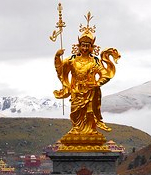
On the home page of this site is a photo of a painting. The subject is Longchenpa, the Buddhist sage of 14th century central Tibet. He was certainly not the first to discover “everything is perfect,” nor, by far, was he the last. The tradition he inhabited and to which he contributed in incomparable ways was founded upon the vision of non-dual reality characterized by emptiness, openness, inclusion and unity. In 1200 years there has been great elaboration, but no substantial revision of the essential knowledge base.

Its earliest proponents (Padmasambhava) filtered north in the 9th. C. from the Swat Valley at the border regions of Afghanistan and Pakistan, a key territory in the American war (now occupied by the Taliban), through the Hindu kush to western Tibet, surviving and/or integrating the influence of indigenous Bon practice already known as Dzogchen and spreading east from Mt. Kailash to China and Mongolia.

Tibetan Buddhism has a number of schools, each with a slightly different version of the essential teachings. The oldest school, Nyingma, structures a gradual path, a course of nine levels (yanas) of achievement in education, purification and transformation. The highest level, ati yoga, or maha ati, originally articulated by Longchenpa, represents a leap into the pinnacle teachings of Dzogchen. The lower yanas (concerned with sutras) are accepted by all the other schools. The highest yanas, tantric Dzogchen, remain the deepest heart of Nyingma practice.

In the case of all major religious traditions, a historical thread of mysticism with non-dualism at its core can be found. In the case of Christianity, it was the Gnostics. In Islam, it was/is the sufis. In Judaism, the kabbalists; in Buddhism, it is Dzogchen. In each case, these sects diverged from mainstream teaching, favoring direct transmission and cultivating direct apprehension of non-dual realization. Persecution, denial and marginalizing the mystics started early and to some degree has continued to this day.

The ‘path’ to realization in traditional theology was, and largely remains, under the direction and control of mainstream hierarchies defining the structure and extended nature of finely articulated relativist dogma in the form of spoon-fed courses of  study and ritual. Realization depends on deference, scholarship, patience and, most of all, an orientation to the future prospect of liberation.

Language, in subtle ways, corrupts our comprehension of the non-dual view. Tibetan Buddhism offers our ‘essence nature’ or ‘Buddha nature’  as a fundamental principle, that we are not here to become something we are not, but to uncover what we already are–or, to be more precise, what already is. We are not stained by original sin. Our essence is already pure, intrinsic, indestructible and it is only our confusion that stands in the way of realizing our true nature.

All well and good. However, in the Dzogchen view, which is actually no view at all, ours or mine do not exist. There is no one to recover from confusion. There never was confusion, nor was there ever clarity. A relative path does peel away confusion–up to a point. Dzogchen departs from this approach, hence is called the pathless path. Realizing all of this is the reason Longchenpa could ‘laugh at the sky’ in the first place.

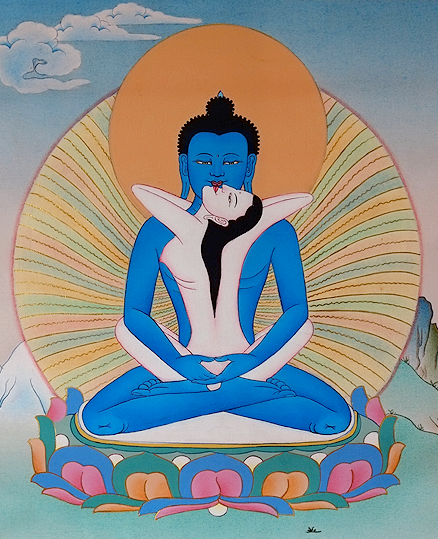
samantabhadra-thangka_1000x
                     Samantabhadra

In cutting through confusion, we do not realize luminosity separate from someone else’s. In the shimmer of timeless awareness, there are no others. We see only one thing which is not even a thing at all. We do not see our nature, separate from Nature. We are not even beings experiencing Being. We become Being itself, not separate from Self–which has no attributes, is unconditional, cannot be adequately described in academic or any conversational language since language–at least English–resides in a dualistic fame.

Poetry comes close. As Longchenpa describes with inspiring poetic versatility (reflected in the immensely skillful translation of Richard Barron) in The Treasury of Dharmadhatu, Reality only knows one thing, beyond all description, beyond positive or negative, beyond all causation or attributes: the essence of all things is equal.

Samantabhadra is regarded as the primordial Buddha, the anthropomorphic form of all Buddhas. He is depicted metaphorically as the realization of Dzogchen, an expression of the most extreme impermanence possible–a state in which there are no discrete moments to be identified or grasped. The concept of now does not exist here. Any attempt to contemplate, arrest, understand, attach goals, to accomplish anything or to contrive causality instantly creates duality and thus inequality.

He is not regarded as the messenger of primordial purity, but the message itself. He is not a teacher. He is the teaching. He is the embodiment of non-action, of Being without source or cause. Goal-orientation is not only not required, but an impediment to the truth Samantabhadra displays. No liberation can be forthcoming until the drive for attainment is relinquished.

All things being equal, there is no good or evil, no right or wrong. This is the Great Perfection. In this domain, one might wonder if meditation is even required, or if it’s any use whatsoever. And indeed, is there really any  difference between conventional meditation and post-meditation? Whether one is meditating or not, if all practice and behavior exist in a context of insufficiency and there is nothing save an endless treadmill spanning numberless incarnations inching toward a virtually unattainable perfection, then one might well choose indifference…or amoral indulgence. Unfortunately, some of the best known and most influential teachers have succumbed to the temptations of copulation and inebriation.

Does the equality of unchanging ineffability implicate a value-free state? What about morality? What about karma? What about this world awash in conflict, deprivation, exploitation and suffering in all its forms? No. Dzogchen may be regarded as non-meditation, the removal of every impulse or vestige of ‘doing’–and especially to the extinction of the witness.

Extinction of the witness, the awareness constantly observing and evaluating our every thought and action, is the attainment attributed to the historical Buddha. It is intrinsic to the ultimate knowing. It is another aspect of extreme impermanence known as Presence. There can be no true Presence if an object of consciousness exists. Because the Great Perfection arises with an inseparable and enveloping compassion, the adept is suffused with action just as surely as the practitioner of conventional incremental spiritual practice.

Attempting to contrive this condition is a sure way to forego any possibility of its dawning. Certain things are sure: the bliss of Being is not a state of isolation. It is a state of union. Its limitless view is elevated by equally limitless compassion in which moral choices in the midst of perfection remain as natural as breathing. The doors and windows are all open. The roof is blown away. All beings, who in essence are none other than light, stand naked in their endlessly inventive, unceasing and often desperately comical attempts to adorn their existence with permanence.

Yes, we are all doing it. And we are all–save an infinitely small cadre of seekers– ultimately doomed to fail. Ironically, the one who crosses the bridge to that extreme impermanence is most fully in this world beyond all imagination, retaining and expressing the freedom–the imperative–to act on behalf of all beings in accord with a union of relative and absolute guidance. The distinction between the two no longer exists.

Fortunately, since this pinnacle of perfect equality is so rarely attained, let alone stabilized, the imperative for moral action remains present for the rest of us at every moment. All decisions and actions still exist within that perfect field of equality, even as every perception, decision and action remain expressions of our confused view. Here, the survival instinct, the human drive for sensory pleasures, all compulsion and resolution, aspiration and failure, awakening and falling back to sleep, every breath arising at the nexus of samsara and nirvana, resides on the cusp of an exquisite poignancy, humor and bewildering inevitability. Arriving at this clarity, experiencing the perfect equality of everything, yet never forgetting every act matters in this troubled world, is the moment when you can, as Longchenpa did 650 years ago, only tilt your head back and laugh at the sky.

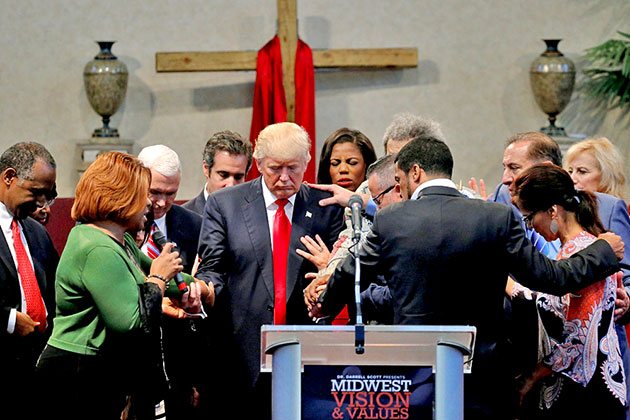
Evangelicals and Trump: A marriage made in….USA.

What is it with evangelicals and Trump? He can do no wrong. In fact, the wrong-er he gets, the more they genuflect. Even now, as he turns every press briefing in the midst of a surging pandemic into a campaign rally. Even as he stands by while people die by the hundreds, especially in New York. Why?

Because, of course, he’s a messenger of God.

Let’s take a very cursory tour through religious history, brought to you by someone who is not at all a religious scholar. But bear with me.

Through the earliest period of Christianity, there was a debate. Did Jesus believe everyone and everything is the Light of God? Or did he believe only He is the light of God? The Gnostics believed everyone—everyone—is the Light of God, that divinity dwells within and that the Light can be directly experienced. It cannot be given nor taken away. You’re It already.

If that’s all true, then who needs a church, right?

The Patriarchal clergy, the Church, came to believe, conveniently, that only Jesus was the Light of God and the only Way to God was Through Jesus and the only Way to Jesus was Through the Church. God was objectified and the religious monopoly was born. You are a sinner and the divine Light does not live in you and only the Church can tell you how to get some.

Constantine became the first Christian Emperor, promoting the faith and merging the Roman Empire with The Church in 325 AD. The State became the Holy Roman Empire and the Church became its spiritual ally and instrument. The first fascist state: the union of corporate spirituality with the institutional power of the state. So began the Holy Reign of Terror of the Church–ruling by fear, torture, extortion, intimidation, disempowerment (and disembowelment), theft and other forms of abuse. There was, in effect, no difference between economic and spiritual subjugation.

The Evangelicals of today want a return to that world: USA = Holy Roman Empire redux.

The first thing the Church did was identify and attack heretics. Calling someone a heretic was the way to consolidate and maintain power by demonizing all opposition and recruiting the flock –energizing the base– to assist in meting out retribution for ideological impurity. Sound familiar?

The original heretics were the Gnostics–the ones who believed that everyone is the Light. They were attacked and erased because they believed the Light of God was in everyone….. or, what might be a modern equivalent, that immigrants are people.

America has always believed itself to be the holiest among nations. But now, the authoritarian structure of Evangelical Christianity has merged perfectly with the pursuit of ideological purity by the Republican Party. Amerikkka on steroids.

Together they root out and demonize heresy wherever it lies. The primary heretics today, just as in ancient times, are the ones who believe the Light of God is in everyone and everything and everyone has equal access to the divinity within.

Today’s heretics, like the Gnostics, are the absolute Devil. Egalitarianism is heresy. Multiculturalism is heresy. International cooperation is heresy. Racial equality is heresy. The USA is now a lawless nation not subject to any restriction other than its own spiritual law—a cloak  gathered upon the opportunistic shoulders of….yeah, you guessed it: Donald Trump.

And for the Evangelicals of today, just like the Holy Roman Empire and the Catholic Church of the First Millennium, money and power are the measure of your spiritual worth. For them, the nation is the body of the Church and thus only the pure, the true believers, may enter (or vote). The President is the Holy Father who is burdened by the Cross of Persecution placed on his shoulders by the devils (Deep State, media) seeking to take down the Church. The ideas of the heretics are everywhere, posing as reason, logic, evidence and the rule of law. Or democracy. Especially democracy.

The work of the Devil is everywhere, making deceit, surveillance, secrecy , cruelty, usury, conspiracy, extra-legal acts and violence legitimate tools of the Church/State. Because those are effective tools against the Devil.

In the eyes of evangelicals, Trump is the Pope of the New Church, seeking Imperial Legitimacy as the voice of God Herself. Oops. That’s another work of the Devil, imagining God as female. Trump’s (unconscious but convenient) design is to disrupt and expose heresy, i.e. the aforementioned belief in law, reason, logic and evidence. Only He, like the Pope, defines what is right for the nation. Only He stands between the nation and Chaos, even as he becomes the primary source of chaos. Only He can protect the body of the Church. Create a crisis, use it to grab more power, wash, rinse, repeat.

Purity is to be defined and established by policy, outlawing heresy in all its many forms. Heretics are hiding in plain sight. They are brown, black and yellow, foreign, non-European, poor, disempowered–and especially uppity females. They are storming the Church. They are ecumenical. They are sad and dangerous fools who think love is love. They worship false gods such as equality, self-determination, intrinsic divinity and the social good. They also believe actual humans lives are worth saving. They are to be rooted out by any means necessary.

The flock is preparing for that day.


Covid-19 Meets I Ching

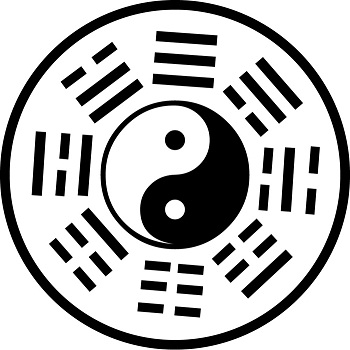
Turning Point (24)

Shock (51)

The I Ching is an ancient code expressing laws of nature. This accumulation of Taoist wisdom is not specifically about human nature. It’s about the nature of Nature. We can interpret these expressions, represented as hexagrams, as we would mathematical formulae. The permutations of meaning expressed by the 64 hexagrams of I Ching reveal a subtlety normally beyond our commonplace awareness. Unpacking them permits us to enter the realm of InterBeing, the dynamics of the web of life itself.

The combination of these two hexagrams, Shock and Turning Point, appeared as a response to a specific inquiry about the meaning of Covid-19. Accordingly, my amateur status notwithstanding, and despite stretching the primary application of I Ching beyond personal concerns, I interpret these two hexagrams in two ways: the first as abstract expressions of energetic laws of nature; the second as they imply emotional, rational and spiritual dynamics expressed in action.

The first hexagram is divided into three bi-grams. From the bottom up, the first bi-gram demonstrates a strong yang (solid) line lifting upward and outward. The implication of this yang force is that instinct arising deep in somatic being drive one’s perspective and one’s actions. Instincts are strong, yes, but may also be fearful and restricted by tradition. There is certainly a character of cultivation, creation and accomplishment here. Yet the energy of this basic yang impulse also overlooks the higher aspirations of production, benefitting others beyond one’s narrowly defined group.

Likewise, the yang line in the middle bi-gram has a strong character of restricting the free flow of what is rising from those instinctual drives. This yang line is like a closed gate, turned toward the first bi-gram than the third. In other words, generosity, vulnerability and more expansive views of the world, not strictly limiting oneself to the instinctual self or to one’s immediate group, with a capacity to look beyond reflexive fear are far more desirable and congruent with the open and accessible upper tri-gram.

Hence, we are given opposing ways to respond to the shock of having our worldview shaken or even destroyed by COVID-19. The questions framed by this reading relate to different planes of perception. On the physical plane, what our bodies know doesn’t require interpretation. On the rational level, we have to choose which direction we will turn for relationship, comfort and collaboration. In the realm of imagination and intuition, we explore and gain insight into the qualities of relationship providing fulfillment, direction, challenge and expansion.

The key emotion connecting all of these questions seems to be vulnerability—a sense that by remaining open–or, opening the gate in the middle bi-gram, as it were, shown in the second hexagram–to uncomfortable conditions and fearlessly sharing personal truth, we will discover the answers to every other question. We will also find the formation of relationships a natural and effortless process leading to those answers.

Covid-19 is stripping most of us—though evidence suggests that we can exclude the banking, investment, CEO class and most politicians–of all pretense. The superficialities of life are being stripped away. We are in deepening shock as the multiple vulnerabilities of our society are exposed. Yet the cultivation of relational acts of resilience are already rising broadly and creatively.

Hexagram #51—The Arousing (Shock)–changing to Hexagram 24–Turning Point demonstrates a strong shift to a more open, congruent and dynamic relationship arising from a clear-minded and unobstructed manifestation of our highest ideals in material actions. The shock of dealing directly with the threat of a potentially deadly illness is, ironically, galvanizing us to engage with the world in restorative and resilient action. This is our Turning Point, but it won’t be fast or short. A period of gestation is required, a time to gather strength and durability.

Much is being written about the ways people respond to the rolling disaster of bad news about the climate, all of which contribute to an increasingly dire prospect of a future radically disrupted from the version of Modernity we’ve enjoyed in the past. As if climate predictions alone weren’t enough of a terminal diagnosis? Covid-19 as well as future pandemics, including drug-resistant bacteria, add to a high-risk future. They may not portend catastrophe, but at the very least they undermine the sense of security we might have enjoyed as a species.

These hexagrams demonstrate that while Shock may describe the initial impact of bad news, the more fundamental impact of our current predicament is one of removing the last remaining shreds of complacency, casting us deeper into the turbulence of uncertainty and portending a volatile future. New pieces of the picture of a future beyond our control come in the form of new reports, news stories, scientific proclamations, new aspects of how natural is responding to the human-driven distortions of our world.

One might even say anyone paying attention to the news is now in perpetual, unexpected and deepening shock. We are all in various degrees of trauma, desperation, grief, panic, denial, exhaustion, rationalization or hopelessness, all of which together may be categorized as stagnation,….while, curiously, we may even simultaneously claim a sustaining determination or unbreakable resolve.

There is no safe haven. Further shock either drives us deeper underground into an insulated and isolated cavern of despair—or—awakens us to a Turning Point, casting aside what has not been working, yielding an even greater resolve to seek partners, to nurture intimacy, to repair and restore what can be salvaged from the wreckage, to identify and adhere to vital principles to guide our actions now.

Each of these shocks reinforces and underscores the mutability of nature—and our mutability within nature. They are messages reminding us that WE must find the capacity to change and to quicken the pace of change to meet the conditions unfolding before us. This is no longer about ‘fixing’ anything. The greatest shock of all is the accumulation of news telling us the possibility of fixing the dramatic unfolding of catastrophe on multiple fronts is slipping through our fingers.

Now is the time for adaptation—and not in a superficial way. Adaptation is what we can call the nature of the change we seek. The Deep Adaptation Agenda arrives as a decision to use the shocks we are receiving as fuel, to fully feel them, to permit ourselves to remain vulnerable to them, to restore a new freedom, to restore movement, to gather and direct our energies to drive more creative and innovative responses to the blows now being delivered to Modernity in rapid succession.

Reconciliation I: Peace as Rebellion

The fourth of the Deep Adaptation 4Rs framework, along with Resilience, Restoration and Relinquishing, is Reconciliation.  We imagine its meaning to be about restoring and sustaining a state of peace, resolving past conflict and, at the very least, designing for the resolution of future conflict.

We do not imagine all conflict can be resolved. Far from it. In a collapsing world, there is very likely to be increased conflict. Reconciliation refers to a consciousness and a versatility with practices most likely to resolve small and large scale conflicts in ways that extend concentrically from an ethical and practical center.

In the simplest terms, achieving peace in an increasingly turbulent world requires resolute and focused personal practice. The internal condition might be more correctly called equanimity, a capacity to respond to changing circumstances without being reflexively triggered into anger, fear, jealousy, aversion, indifference or pain. But not being triggered is not quite enough. Response-ability means being moved to act.

In this alienating and isolating world, setting one’s vertical compass to generosity and gratitude may feel good, but if we’re not also orienting horizontally to confront the mythologies (scientific materialism, separation) and operational practices (exploitation and violence) of modernity,  which establishes hierarchies and treats them as biological laws, we are committing an act of blind privilege. It’s not entirely useless, just incomplete.

How do we arrive at equanimity? Borrowing principles from both modern and ancient psychology, we can develop the skills necessary to improve our access to equanimity and we can improve our stability in it. But as long as there is conflict in the world between nations, ethnic groups, tribes, families or individuals, we are not in a state of peace. We may find a personal non-dual view, an oasis within the collective dualism, like vacationing at our own personal monastery, but we cannot permanently turn our backs on the origins of conflict all around us.

Any conversation about ‘getting there,’ arriving at the desired internal state, has to do with identifying and removing obstacles to our direct access. This inevitably requires an exploration and discovery of the many ways we remain in a state of self-deception. We are called to identify every self-limiting belief, every flawed construct, every incongruent intention and every addictive behavior that stands between us and an authentic experience of equanimity. Not the false equanimity of indifference. Not the by-passing of real emotion, but an authentic capacity to be with. Along the way, we might also have to reconcile conflicting beliefs about our own identity, asking and clearly answering the question, “Who is experiencing this peace/equanimity, anyway?” and perhaps most importantly, “How do I find it again after I lose it?”

All of the foregoing constitutes what we might call a “path” to peace, a method or a checklist of issues to resolve before we can say we “are” peace. Take out the dustpan and get behind the furniture, straighten out those sheets on the bed. Take out the trash. Then we will have peace. When there is nothing in the world (out there) to shake us from our oasis of equanimity, then we will be immune to the temptations of conflict. Then we can be compassionate. Then we can be mindfully open to whatever arises in our world without reacting thoughtlessly.

But alas, no. There is no path “to” peace, just as there is no path “to” realizing our true nature. Yes, there are practices to develop our skills, perfecting our access to equanimity. We may imagine fully awakened mind as the fruit of steady practice and incremental refinement of specific skills. Yet, upon closer examination, there is no denying the “fruit” of all that practice can only bring us back to the seminal realization that what we call a peace/process is already our nature. There is no way to any such goal. We are already there.

If we accept this premise, that there is no path, no outcome and no fruit of any labors, then there is no far-off objective of our practice that is only realized after a lifetime of disciplined pursuit. The only way “to” the goal is through direct realization, here, in this moment.

What are the components of a direct access to peace that serves each of us right now?First, cut through the illusion of a separate Self. One needn’t become a scholar of the origins and historical, cultural, cosmological or spiritual propagation of this flawed idea so much as a relentless inquisitor into the direct effects of holding it. Believing in the separate Self requires the existence of the Other. Without the Other, the only conflict that can exist is within the One.

Thus, all manifestations of conflict are internal in nature and origin. Every moment we spend out of alignment with this truth, which cannot be modified, enhanced or diminished, we abandon our innate wholeness and contribute to further conflict within the Whole.

Second, yes, there are a plethora of psychological and spiritual metaphors, conceptual frames, processes and exercises that define peace and may enhance our skill in achieving more direct embodiment. I’m not anti-intellectual nor am I anti-psychology in the least. Yet every conceptualization, rendering of thought, planning, consideration or representation of the state of peace is in essence an effort to ‘get there.’ Ultimately, there is no ‘getting there.’ There is only there. There is no other way there except to be there.

Third, whether we are being there, getting there or lost somewhere in between, there is nothing to be done. There is no action, there are no steps to take, no conceptual progression to save us or guide us. Inaction is also not the way. If there is a way, it is through non-action. Or, as it may sometimes be put, the direct realization of a state of peace is neither being there nor getting there, but somewhere in between. That is the territory in which an immense creativity resides, where something powerful and transformational is liberated.

Finally, the only matter left to this brief consideration of the true embodiment of peace is that appropriate responses are required in a world far from being aligned with the notion of no-self, which preserves and operates upon the presumed reality of the Other and which believes the only way to address conflict, or any problem, for that matter, is through direct oppositional action.

In this context, peace is rebellion. Peace lives outside the consensus frame. Peace becomes a relentless, unswerving and unapologetic commitment to one’s inner truth. And we become its guardian. It’s not a solitary truth whatsoever, as realization becomes a dynamic imperative so purely and clearly requiring engagement that there is no denying it, rationalizing or obscuring it. Arriving at that clarity is an eyes wide open, fearless and undaunted continuous journey into and through the full depth of one’s own suffering–to the point at which a magnificent, clear, fierce and uncompromising universal compassion dawns. Here, the impulse for collective Reconciliation awakens.

COVID-19: Rite of Passage

I’ve been receiving regular emails from Michael Meade for years. They are invariably timely and relevant topics full of the wisdom of Interbeing.

Today (#166) he spoke of consciously descending into the inner world, walking into the dark with our eyes open, as it were.

We are being taken down, not by choice but by necessity, and in yet another new way, to realize our true condition. As we look around us in every direction, we are witnessing decisions being made (or avoided) about how to prepare for, interact with, prevent or deal with a global pandemic. At the same time we are directly experiencing our consciousness undergoing an accelerating transformation by this phenomenon.

We cannot help but notice and examine this phenomenon as a global encounter with the biological plane of existence, a natural response of the living planet reminding us of our direct and integral connection with the biological world, the biosphere undergoing change in response to human actions. There’s no escape: this is us. Yes, we will have to think and feel our way through, but the way through also requires we discern and consider carefully the message of the crisis.

The virus promises to be (if not already) a profound response to our hubris, already arresting Business As Usual and laying bare the degree to which we take for granted the structures and comforts of modernity. All those systems, from the stock markets to commerce to transportation to the systems of mutual care are all derivatives masking our relationship with the natural world. As the mask of modernity is stripped away, we see our own true face.

The unceasing progress of the virus permeating the population is already testing the health care system and governance. It is already laying bare the income disparities, the vulnerability of large sections of our population to unanticipated costs, the marginal financial safety of millions, the degree to which the social safety net has been shredded, the lact of back-up systems for caring for ourselves in the most basic of ways. And, as well, the deeply damaging selfish and self-absorbed womb of illusion in which so many, most notably more than half the US Senate, live.

There, the denial of a pandemic follows and conforms to the spinning of falsehoods into War, the denial of the financial catastrophe of 2008, the denial of racism and the denial of climate change. Today, all we see from them is desperate bargaining to avoid both economic and psychological depression and to prop up their precious allegiance to exclusion, dominance and scarcity.

The effects of this rolling emergency are already impacting our collective imagination–the deep imagery of what America believes it is and what our relationship is to others beyond our borders, the unseen intimacy of our relations with distant strangers and the basic equality expressed as our vulnerability to disturbances in the biosphere. The dream of separation is dissolving. America as a gated community, as an impregnable suburban sanctuary is disappearing.

We are being dragged to wake up from the mythology of exceptionalism, the mythology that we are not in each other’s care at all times; the mythology of being able to construct  a fortress of uniformity in which we can continue endless bargain-shopping, safe from foreign influence; the mythology of continuous expansion. Reactionary forces are tightening their grip on their fantasy that continuing to dance will keep the music playing, that appearance is reality, that saying it’s true will make it true.

Nope. In the immortal words of Guy McPherson, Nature Bats Last. And we are not prepared because we haven’t learned that lesson. This phenomenon has arisen from the depressed immune system of the planet. It is about to expose our deepest flaws, our tenacious grip on the surreality of separation, invulnerability, of superiority, of our belief in false characterizations of Nature, of some assumed mastery in the world. Continued denial of who and what we are will now take us deeper into the Deep Self to wander and sow untold pain until we either die or are transformed.

This is the choice commonly faced by the addict who descends further into darkness until an opportunity for light to enter becomes possible. The virus is an opportunity for us to meet our addictions. But it is so often a near death experience and there’s no guarantee we will emerge any closer to wholeness. Will this be our bottom? Will this be the moment we realize caring for each other and caring for the earth are our only collective imperatives? And that they are the same thing? Will we see any new light at the end of this tunnel?

Learning To Die in the Anthropocene

In a chilling, factually grounded and provocative 2015 book, Learning to Die in the Anthropocene, Roy Scranton describes his tour of duty in Iraq in 2003 as an exercise in facing death every day as he departed the relative safety of his protected encampment in a Humvee, armed, armored and backed up by the awesome firepower of the US Army.

To be constantly facing death required an assembly of valued resources, one of which was an 18th Century Samurai manual, the Hagekure, which advised, “Meditation on inevitable death should be performed daily.” He took the advice to heart, eventually adopting an attitude as he headed out each day that he was “already dead.”

He then proceeds to draw the analogy between his experience in Iraq and the human role in driving climate change; namely, that we will do almost anything to avoid naming our true predicament. We humans in the Anthropocene, named for our historically unprecedented position of being a single species driving planetary geological change, have attended a terminal diagnosis for quite some time, which we know, left untreated, will spell the death of modernity including mass extinction, possibly even our own. We humans who, at least in the developed world, have become so expert at denying death, now see The House of Modernity we have built being threatened to its foundations.

Have we been providing the required treatment of the condition? No. Not even close. And for the past 15 years, out on the fringes of climate science, there has been a rising chorus of voices (and data) telling us we are already “already dead,” that there is too much damage already baked into the atmosphere and the oceans to escape or reverse course. No one knows for sure how long it will be before much more significant impacts will roll across the globe, particularly because most predictions have turned out to be conservative. It may be 10, 30, 50-80 years or more. We don’t know. What we do know is that we have procrastinated, and continue to do so, for no good reason.

hurricanes-storms-hero-1-1024x684-1
Credit: dark-mountain.net

How do we process all this? What does that mean in terms of our attitude, our actions and our philosophy of life? What is a meaningful way to live now? What are the choices we have to make in this increasingly uncertain time?

Scranton asks, “What does consumer choice mean compared to 100,000 years of climate catastrophe?” Really. Suddenly, how important is it that we can choose from 25 different kinds of washing machines when water security could be impaired long before that machine is scheduled to die? Or, for example, we don’t know exactly what conditions will dramatically impact global harvest….but can we say governments are truly prepared for such a scenario? No.

We are suddenly awash in philosophical questions for which there are no instruction manuals. If, as a French philosopher mused, to philosophize is to learn how to die, then we have entered a new philosophical age. We have to learn how to die not only as individuals, but also as a civilization.

What does that mean, “Learning to die?” The daily context of war is one thing. What of our everyday world?

Let’s put it this way: I meet the basic qualifications for being an elder. I take that label seriously in the sense that it is my social duty to convey whatever wisdom I have accumulated in the course of my life, whatever my vision of a just and equitable world that serves all and includes all has come to be, however expansive that view may become, to younger generations. I have been fortunate in being able to live a full life, and particularly for being able to devote myself to what is most important right now. That life is also taking on the inevitable risks and obstacles and trappings that come with age. I am undeterred.

Even though I could say, with the exception of seeing no truly significant collective action on climate change and the virulent rise of fascism at home and abroad, my dreams have not been entirely stolen. To my own child and other next-generation members of my family and to all their age-cohorts across the world, I would say, “Your dreams have been (at least partially) stolen by me and my generation.” That is the true shape of our predicament and obligation. But by virtue of my complicity and that of my generation and the ones before us, you are now forced to contemplate the death of something far greater than any individual.

Their children’s dreams, which is to say the opportunity to live in a thriving, low risk, equitable and just society with a generous opportunity to lead a fulfilling life of their own choosing, have been appropriated by conditions set in motion by previous generations and will thus be more difficult to realize. The twin mythologies of endless growth and ecocide without consequences are dead. By the time their children mature, the transformation we have set in motion in the name of building our House of Modernity will be well on its way. For them, a strong, intensely focused resolve to live by life-affirming values will be an even greater challenge.

Beneath our well-constructed and endlessly adorned personal identities, beneath our striving and our plans, our coping strategies, our denial, anxiety, fear and uncertainty, beneath impacted layers of personal history, the wounds of family and the trauma and separation imposed by this culture, there is a timeless reality, deeply and endlessly compassionate, unafraid, loving and creative. Our task is to access, develop, and share that intrinsic nature, building our capacity for unconditional love, fulfilling relationships, mutual-reliance, trust and courage. This is an initiation like no other. It is our final loss of innocence. Time to really grow up. And time to grow young, to regain an original innocence that will sustain us for the future.

Stephen Jenkinson describes love as “a way of grieving that which has not yet slipped from view’ and as ‘an active form of grieving that doesn’t require sadness.’ The courage, the skill, the intelligence and the love we need right now do not require sadness. But they do require we acknowledge our grief and pass through this portal with our eyes open, leaving behind the old world as we prepare to meet and thrive in the coming world. It’s time to elevate our game.

Kali Takes The World II: Baba Yaga

By Vera de Chalambert

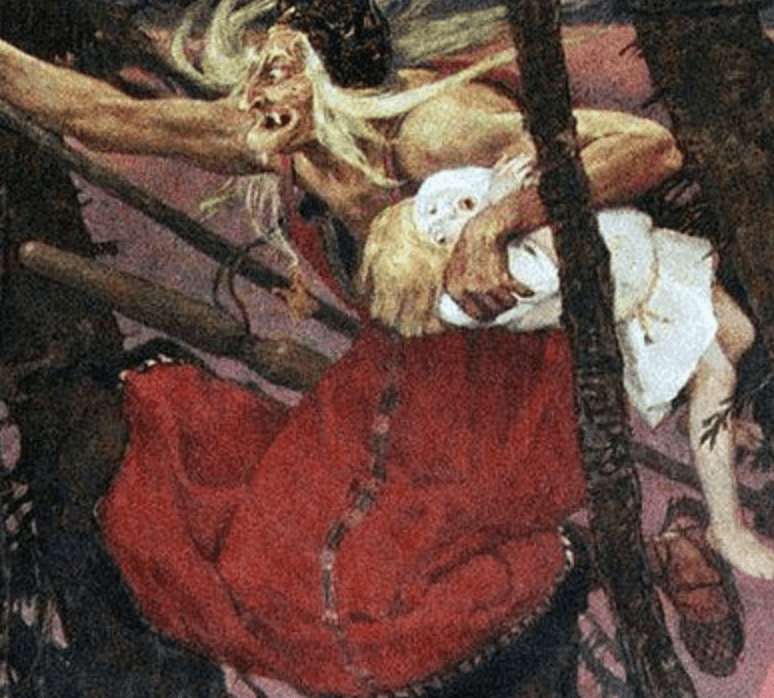
She appeared out of nowhere, as if from an explosion of smoke thrown by a cheap magician while I was meditating on another goddess. It was a mix of vision and cartoon unfolding on my confused mind-screen. She smelled like cemetery earth from my father’s recent burial. Her hair was white, disheveled, as if on fire, her nose was a huge hook, warts and all, just like I imagined it as a child when she still terrified me from the corner of every dark room. Baba Yaga, the infamous dark hag, the evil witch of every Russian fairytale, the one who eats children and lives in her house on chicken legs and rides a broomstick, was in my room and in my face, and she meant business. Her demeanor was urgent. She barked with a deadly seriousness, shoving a femur bone in my face. She spoke in Russian, “Hold on to your bones!” Then she was gone.

I felt shaken. The experience felt so real that I wondered about my grasp of reality. I would have been thrilled with a vision of a goddess… but a fairy tale character? From the Jungian psychoanalyst Jean Shinoda Bolen I would later learn that archetypes and especially goddesses appear to us as they damn well please—cartoon fairy tales, illustrious rooftops—and that when you are handed bones, that’s an initiation, if she’s ever seen one. I learned that Baba Yaga was a primordial form of Kali even before the Indo-Aryan march across the Russian steppes. Most importantly, as the next cycle of my personal dark night unfolded only a few months later and I began moving through the devastating pain and disorientation of divorce, I returned again and again to the wisdom of the hollowness of bones. I committed to keep choosing truth over safety, the real over the convenient. I embraced the groundlessness of the Mother’s hut on chicken legs. I wailed in her dark woods until I had no voice. I let her make a stew of me. Vast emptiness, no holiness. She offered only truth.

There comes a time when nothing is meaningful — except surrendering to Love.
~ Rumi

Today, our very own postmodern Kali Yuga is upon us. The old world with its illusions of certainty and predictability is coming to an end. The Mother in her holy chaos is pulsing through every crevice of the planet, beginning her dance of change and transfiguration in the collective field. If you listen deeply, you can feel it too; we have been handed bones. I believe that Hurricane Harvey marks the first glimpse of what Andrew Harvey and Carolyn Baker in their brilliant upcoming book Savage Grace call the Dark Night of the Globe, a period of unprecedented global crisis, climate disaster, dissolution of old templates, and if we allow it, collective spiritual initiation. They prophesy that we are entering a dance that will either mark the end of civilization as we know it and possibly even human life on the planet or will force us to dive into the Mother’s cauldron of transfiguration and arise as what Andrew Harvey calls ‘divine humanity.’

In bemoaning the absence of the rights of passage in our culture, Marion Woodman explains the importance of undergoing a psychological or spiritual death. She says that unless we experience “a period of being in the dark hole of chaos, followed by a rebirth—then people don’t truly grow up.” She explains that in old cultures the young had to believe that during their coming-of-age rituals, they might die. This is how they would have to prove that they are mature enough to enter the adult world. Like it or not, for good or ill, this dark night of the world soul is upon us. And in the absence of rituals, this is all we’ve got as a global initiation into adulthood. Perhaps only such a deep collective reckoning can trigger the kind of spiritual maturation that is called for by our times. Only God knows if it will be enough to lead us to abandon our narcissistic notions of spirituality, to let go of the false promises and psychopathic tendencies of capitalism, to humble our hearts before the great Transparency, and to rise like the Mother for all living beings.

Hecate

In ancient Greece, its own dark crone goddess Hecate was known as the goddess of the crossroads. It is at the crossroads that we find ourselves. In The Dark Places of Wisdom, Peter Kingsley says: “If you’re lucky, at some point in your life you’ll come to a complete dead end. Or to put it another way: if you’re lucky you’ll come to a crossroads and see that the path to the left leads to hell, that the path to the right leads to hell, that the road straight ahead leads to hell, and that if you try to turn around you’ll end up in complete and utter hell. Every way leads you to hell and there’s no way out, nothing left for you to do. Nothing can possibly satisfy you anymore. Then, if you’re ready, you’ll start to discover inside yourself what you always longed for but were never able to find.”

We are at the crossroads now and there is nowhere to run. Our world is dying and so the call from the deep is strong. The work before us is uneasy and long, but great powers work by our side. And it is only from this place of darkness, of radical uncertainty, of coming to the edge of all our limits, the end of all our old stories, that something new within our soul might emerge. Life is roaring in dialects of Kali—asking us to get real, to get committed to our spiritual lives, to each other, and to this world. To tolerate the growing pains of the dark nights given to us. To get exceptionally honest and do our shadow work. Are we willing to give up our spiritual materialism and surrender the accolades of the false paradigms of success? Are we willing to dare self-disclosure, to reveal how imperfect and lonely and messy it is to be human? Are we willing to meet our grief, our confusion, our heartbreak—the very real uncertainty of it all—and not send suffering into exile? The Mother has no orphans. Dr. Martin Luther King used to say, “We must meet suffering with soul force.” The Mother is the soul force.

The truth is that Kali has always had the world. Marrow of time, oracle of holy change, she is the great gate of transformation through which all must pass. Her medicine is darkness. Her initiation is by fire. Appearing in difficult periods of transition—death, disease, divorce, loss of structure—she is the devi of disillusionment. It is said any contact with her transfigures the soul. From the moment the Mother birthed the universe of her holy dark womb to the instant she swallows it up again, we are hers, and she only ever asks one thing: when all is stripped from you, what remains? Whatever your answer, she will throw it up against death. So we must listen deeply now. Our planet is in crisis. We live in messianic times. And, tag, you are it! We are not free until we are all free. So, what are you willing to rise for? What is your True North? What do you sit and stand for? What are you willing to give up for it? If all that can burn is burned up, what remains?

She rides in on a tiger, magnificent and fierce. She wields weapons; she slays demons. But, we are in the long game now. We must remain vigilant, relentless, grounded in the Real. We must pray and prepare. The night will be long. The night will be dark. The forces of separation are great. But She IS here now, and in the late hour, when all hope is lost and all that we most loathe to give is stripped from us, she will rise, even more terrible, as only Love can be. And She will win.