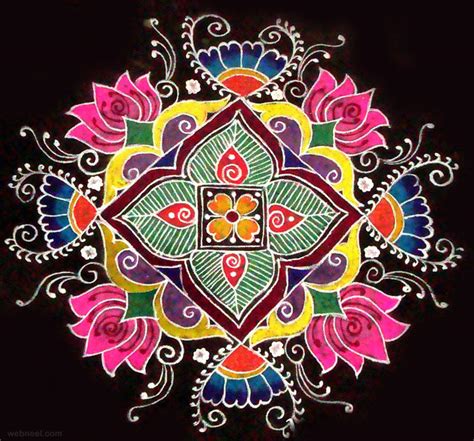
Kolam: An Essay in Flour

A kolam may itself be an essay, non-linear and made with the intention of dissolution, but if so, it’s a different species of essay. It is an invocation that embodies history, the soul of a culture, the longing of an individual, the connection of a family, the collective imagery of a community seeing and seeking the divine in everything and externalizing the yearning to be reunited with it.

Kolams are typically made in front of the home. After preparing the ground, sweeping, leveling and dampening so the flour will set and hold better, the woman of the house creates the kolam every day at dawn. Every day. It is sacred, but not static, being wholly subject to weather, rain, wind, and foot traffic. It is an inviting source of food for insects or birds-and deliberately so. Its layered expression is infinitely variable, beautiful, colorful, inspiring, and dramatic…and a lesson in transience.

A kolam might be considered an essay or a poem, a snapshot generating numberless words, an affirmation of harmony, a humble renewal of interconnectedness. It’s a wish and a blessing-changing daily-an altar at which one might contemplate the present moment. Although its borders are defined, it expresses the nature of relationship of everything with everything. Can writing even be equal to a kolam? That question is like asking whether reading a book about modern art is equivalent to walking through a modern art museum: one is a two-dimensional and time-limited artifact; the other, immediate in four dimensions, engaging all your senses, blowing apart your default assumptions about time and space. 

Even though it may be ancient, a kolam, like much of modern art, moves–even while standing still. It skitters through time, culture, rousting sleeping archetypes, connecting past and future, uniting the inside and the outside in timeless postures. It’s often a passageway into deep pictures; evocative, visceral, full of the imagery of one’s personal and tribal or even ancestral history. Unlike a traditional essay, linear, limited by thought, convention, language, having no prescribed ritual of creation, being more individualistic in its place-making, a kolam, through the prescribed ritual of materials, is a more democratic and inclusive expression of an individual or a collective place in time. How could the two be considered equal?

The economy of a written essay is restricted to conveying knowledge by acquaintance. The terms of exchange are limited. In any of its traditional forms, it cannot include a transmission of direct experience. A kolam is not an essay in that sense as it conveys knowledge more directly, connecting the creator to a stream of historical knowledge as well as creating new knowledge in that direct experience. And like any other art object, it’s open to infinite interpretation.

So much is contained within even one photo of a kolam. I don’t believe I’ve written anything that compares to it, other than possibly poetry, taking far fewer words than what is thought of as essay. My essay might describe most everything that a single picture conveys, but it would be doing so in a far less compelling medium, one that might well give words to adolescent simplicity or even practiced adult elegance, like the communal journey of a single kolam. But I don’t recall ever approaching with words what a single image can evoke, a multidimensional direct experience, attracting one’s attention and lighting up multiple centers of conceptual and spiritual response. 

Writing can do that, perhaps. Words cannot truly be distinguished from the writer on any topic, whether the topic be kolam itself, modern art or anything else. Can the act of creating a kolam be distinguished from the maker? Not at all. It is an individualistic expression, yet still infused with the flavors and tangled threads of a long tradition. Is the maker dissolved into the image; or even re-made in its making? Isn’t that the objective, after all? Is a writer ultimately contained, reified within, or disappeared into the after-image of an essay—or is the writing merely an image of the writer—recapitulating the illusion of objectivity? 

The more play there is at the boundaries of each, the more they dissolve. A kolam may itself be an essay, non-linear and made with the intention of dissolution, but if so, it’s a different species of essay. It is an invocation that embodies history, the soul of a culture, the longing of an individual, the connection of a family, the collective imagery of a community seeing and seeking the divine in everything and externalizing the yearning to be reunited with it. It is a visual representation of the integral nature of earth, sky and spirit, not unlike a Buddhist sand mandala.

Can writing become a mandala? A linear process evoking a non-linear experience?  That’s a description of poetry, is it not? A kolam is already such a mandala, in its conception, its making, its conclusion and its ultimate destruction. The symbolism of kolam may not be as complex, but to attempt to convey all of what it is in words risks becoming a sterile derivative of the experience. Can writing become mandala containing the writer, the object of writing, the reader, indistinguishable, in a single flowing fractal as much as an experience of kolam? 

Can a writer become that? Why not? But if such is to be, the act must stretch across boundaries, become pure aspiration, teasing apart in an extended in-breath all the distinct elements and personal images essential to its construction–followed by an out-breath of their ultimate inseparable nature. A successful attempt at such a thing would be immediately apparent, breath-giving and breath-taking.

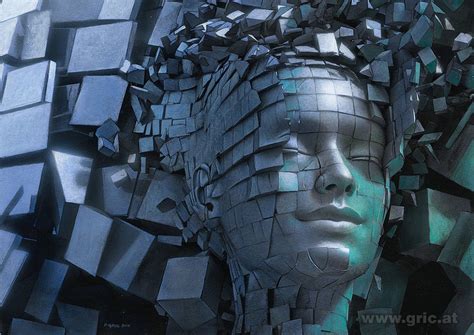
Trying

When the boundaries of this individual separate body begin to soften and space becomes continuous such that retaining an identity as a separate body becomes an afterthought, what opens is the ubiquity and uniformity of space, even merging with space, accompanied by a profound sense of unity with all phenomena and an undeniable sense of the body as an incidental event.

Meditation, or at least the intention of doing so, can be fraught with seeming contradictions and cognitive quandaries. Without intention one might never enter its labyrinth of mysteries. But at the same time, intention is also the first thing that reifies identity, removing us one step from the discovery of its benefits. By forming intention, we know ourselves. We become ourselves. By means of meditation, we embark on a journey into our true depth. Upon forming an intention, the next step is action. A set of actions might include recalling sensations, mental constructions and physical actions all designed to induce a desired condition, however we might conceptualize it. We become well-practiced in the art of self-induction: setting up a space, adding objects of meaning, determining the conditions of sound and temperature and physical support, and letting distractions fall away. Or so we tell ourselves.

Only then can we sit. And what is next? One of the first things to happen is we become more acutely aware of inner space and outward appearance. My habit is to find a position of comfort for my body, check my breathing, check my body parts, my alignment, my level of relaxation and to settle further into the ground. Many people, myself included, have been trained and inducted into preliminary rituals, recitation, mantra, all of which speak of refuge or supplication on my personal behalf, promises make to myself of what will accomplish in this session or in this lifetime. It’s not a leap to suggest that these very prayers, spoken immediately before entering a space in which we remind ourselves that me our mine have no true existence, impose a structure on the process which is curious at the very least, if not even counter-productive.

Then we get down to the business of meditation which, in the case of Dzogchen, is ultimately devoted to not trying, not constructing, not waiting for something, surely noticing the comings and goings of mental activity, but not stirring the pot. Shamatha, the practice of calm abiding, is often described as watching the arising and disappearing of ripples on the surface of the mind, as if on a mirror. Shamatha segues into Vipashyana, also described as a deeper practice of noticing the movement of thoughts like fish beneath the surface of that pond. Together, these two considerations merge into what Dzogchen literature refers to as contemplation—becoming the mirrorIt is from this contemplative state that a full transition into an experience of immediate intrinsic Awareness becomes accessible.

As we all know, the way to contemplation is littered with antidotes, deliberate acts of correction, more closely associated with the sutra system, a conceptual process of which I daresay I am a master. For a long time, I acted as if the point of meditation was to discover the perfect antidote. They come in clusters from disparate sources, or they arrive singularly with a great and deep ‘aha!’ New ones arrive all the time. Old ones are retired or forgotten. I don‘t even remember most of them now. At times the effect of employing antidotes felt like cutting a diamond, as if one day there I would discover the perfect antidote and thereafter the light would shine effortlessly through me. A different perspective might be that I was gradually wrapping myself in increasingly restrictive garments—collectively becoming a straight-jacket of admonitions—until I was immobilized and nearly void of the most precious resource for continuing–ease. Meditation under these circumstances is neither fun nor effective. 

The irony of this entire process is that only by first identifying oneself as a separate entity in the larger field of phenomena, repeatedly following a specific series of practices and instructions from a teacher, does one even begin to have a chance of entering a state of subjectivity in which the boundaries of self may begin to dissolve and an authentic non-conceptual condition of becoming one with external (objective) phenomena may arise. More than experiencing that Oneness, what previously would be regarded as separate and external phenomena are now perceived as being of our own creation—and, also of being equally created by what the dualistic mind would name as something out there.  

We can only regard this progression of practices as a series of imputed causes and conditions determined to become the foundation of realizing an unconditioned state, that which is uncreated. Much of what we adopt in preliminary meditative practices is the layering of antidotes—progressively conditioning our experience to achieve what we identify as objectives, only much later comprehending the intelligence of eliminating all antidotes, deliberately undressing the layers of mental constructs which obstruct our access to the direct experience of unconditioned reality: emptiness.

Admittedly, the balance between using or discarding antidotes is a delicate and increasingly subtle process. And the very trap intrinsic to that enterprise is to regard it as a process, when in fact, as the truth of unconditioned reality emerges, it’s not subtle. It can be dramatic. And realizing the truth of the unconditioned state, the state in which the very idea of an antidote becomes entirely foreign, is so different, so far removed from anything having to do with antidotes that we might well wonder what we were wasting our time doing for so long when it becomes obvious that what we imagined was so far away, beyond our grasp, is actually right here all the time.

When intimations of dissolution arrive, when the boundaries of this individual separate body begin to soften and space becomes continuous such that retaining an identity as a separate body becomes an afterthought, what opens is the ubiquity and uniformity of space, even merging with space, accompanied by a profound sense of unity with all phenomena and an undeniable sense of the body as an incidental event. Not a random event, nor even co-incidental, but merely a construct associated with this particular consciousness. I am adopting this impermanent form, flawed and wondrous in all its many ways, as a means of transportation, a vehicle of experience, exploration and restoration.  It is my teacher. It is my co-creator. I am its student.

This is surely a transitional state to a global experience of immediate intrinsic Awareness, the Primordial State, a softening into a realm no longer solely nirmanakaya, the form body, also not entirely sambhogakaya, the energetic body, with the full dimension of dharmakaya, the complete dissolution of any boundary between inner and outer awareness, only a breath away. The intimations are of a deeper awakening in which all three kayas are fully distinct even in their inseparability. Not only present, but fully apparent, neither being nor not being. 

Their manifestation is not a matter of doing anything other than relaxing deeper, again and again, at every indication of interruption and intrusion of conceptual process. There is no trying here. In fact, the primary condition is two-fold: relief and confidence. Confidence in the gnosis to which one is introduced, confidence in one’s capacity to recapitulate these conditions, and profound relief in the knowledge that trying no longer serves any purpose. There is only un-trying. There are no longer any antidotes in the gallery of choices. There is no longer a gallery. There is only the panorama of endless, bottom-less and uncreated seamless unity. The inevitable realization appears: with all the trying of the past, what was I ever thinking? 

Wilderness

America is a land originally occupied by casualties, fugitives, dissidents, pirates and radical escapees of the European monarchical and religious order. And ever since, what’s been largely, either inadvertently or deliberately overlooked for three, maybe four hundred years is that the western definition of wilderness was always the property of the invader, the settler, the colonizer.

Wilderness conjures images of foreboding, of desolation, a mythic utopian vision of the undisturbed, uncharted pristine state, a territory beyond imagination, beyond human centrality, unspoiled by human presence and the inevitable resulting abuse until it’s eventually overrun by ‘progress’ and becomes defined-and defiled-by that presence. Only then do we adjust our yearnings, mourn its loss and start looking for another wilderness to relieve us of our angst…or guilt…or to satisfy our insatiable quest for new worlds to tame.

What we imagine there is to gain out of that process is a sense of ownership, perhaps even control. And even though any remaining actual wilderness is long gone, we operate as if there will ever be more, as if our personal inner desolation or pristine nature, our loss of home, is always renewable, can always be recovered, that our sins can always be absolved. Our investment and belief in wilderness, like our belief in imagination itself, is total.

It’s been a universal human trait since the beginning of time to explore the wild, to move outward beyond boundaries, to redefine one’s place, to satisfy a primal urge to seek sustenance in the unknown, to venture onto our own unconscious, to assert personal independence and a renewed sense of belonging to the world. These are the primary extractions. We might include a timeless motivation to escape being relentlessly subsumed into the homogeneity of culture and to reconnect with the heterogeneity of the wild. We explore to know ourselves in re-enacting the imagery of relationship with the unknown and the more-than-human.

What is commonly found in wilderness, or what could now more accurately be called protected lands, in the exploratory process, may enrich our lives, at least temporarily. We may be driven by the dulling of our senses in the urban landscape or an ever-present but barely acknowledged solastalgia, the suffering and grief of being uprooted, homeless. Yet long before there was any such thing as protected land, exploring wilderness, at least in America, also became synonymous with progress. And that progress has brought a world in which every form of wilderness continues to be transformed in ever more sophisticated ways. Ironically, imagining one can escape that commodification (even for just a short time) somehow inevitably leads to its increase.

When the human population was much smaller than its current size, before the carrying capacity of the earth had been exceeded, that wilderness in its iconic state did still truly exist, calling upon the human longing for….what?…a challenge, to continue the indomitable impulse to improve our future, for wholeness? The fulfillment of a narcissistic urge for notoriety, fame, adulation? A purely economic interest? Or just peace and quiet? The relentless commodification of every possible resource, now including attention itself, has always been a dominant motivation. And let’s not overlook the myth of returning to our origin, the original Garden. There’s weight to all of these scenarios.

America is a land originally occupied by casualties, fugitives, dissidents, pirates and radical escapees of the European monarchical and religious order. And ever since, what’s been largely, either inadvertently or deliberately overlooked for three to four hundred years is that the western definition of wilderness was always the property of the invader, the settler, the colonizer. The exploratory enterprise into the vast territories of the Americas was also an enactment of Divine Right, spurred by the Papal Bulls of the 15th and 16th centuries declaring indigenous people to be less than human, fueling the promise of riches with ecclesiastical benediction. If that empire required the eradication of indigenous populations, either by intent or by accident, it never occurred to the occupying force that the territories in question were not wilderness at all to those who lived there, but sovereign territory, the nature and dimensions of which the settlers could not even imagine.

Sustaining the American mythology of wilderness is a solution to something. It gives buoyancy to possibility. Yet modern American culture has never quite satisfied a longing for place, and that wanderlust is both a response to existential homelessness, a sense of not truly belonging to the land, and a temporary escape into actual homelessness that wilderness represents. That escape is ironically motivated by pre-cognitive yearnings for a sense of relatedness to the natural world which we experience at a somatic level, but which has been entirely coopted and twisted by modernity into a reaffirmation of the individualist ethos of America. We may be able to superimpose ‘home’ on what was once wilderness, but what we now call home does not in itself constitute indigeneity. In many respects, home is now a wasteland of the banal, the superficial, in which multinational corporations own the mythology and harvest revenue from it by exploiting our psychic attachment to the idea of wilderness combined with the myth of individualism. The Anthropocene at work.

Your homelessness leads you by the nose to the next solution. So, nobody should be shocked that every solution we come up with deepens the problem the solution was designed to solve.

—-Stephen Jenkinson

Regardless of where the urge to occupy wilderness originated, at some point it morphed into something much more than any original or merely personal reason to go beyond the horizon just to see what’s there. In the face of accumulating encounters with other cultures already embedded in what we (western explorers and American settlers) persisted in calling wilderness, the enterprise became something very different from the original vision.

In what has since become a central tenet of the mobile tableau of modernity, the vision of exploring the unknown is equated with the drive for perpetual growth, a messianic mission promoted with religious fervor to ‘improve’ life for ‘everyone’ while looking away from the true costs. Recruiting enthusiastic compliance with the program has not been entirely successful. Having a dwindling supply of authentic earthly new worlds to conquer, human imagination is captivated with doing more than gazing at the heavens, but actually exploring space–which of course continues largely without human participation, but occasionally goosed by the chest-beating of the uber-wealthy. The mullahs of physics and biology reach into the mysterious territories of sub-molecular function, even into the vast spaciousness of individual atoms where matter and energy are barely distinguishable. The nature of the human mind continues to inspire and baffle.

Preserving the fantasy of European ‘discovery’ has been a key North American enterprise ever since the origins of its nation-states. Erasure of the indigenous equates the encroachment of wilderness with the creation of home and the ethics of growth, as if history only began with the colonial project. And now, as an alternate narrative of what America exactly was before colonial occupation gains firmer footing and takes hold in popular consciousness, powerful backlash comes from those still asserting that America was a natural and cultural wilderness before white men set foot on its shores. For them, anything pre-dating coloniality does not matter nor did it even exist. Imagine the dissociation necessary to deny all of that violence. Colonial America may have been an escape from empire, but it immediately seeded the creation of a new empire, an ongoing occupation of what is still regarded as wilderness in virtually every elementary school in America.

The nomadic vanguard (a term coined by Patrick Turner in this essay in New Critique), is a property of American coloniality essential to America’s creation story. We were born from a nomadic vanguard and America would not be America without one today. The fact that there are no physical wildernesses left doesn’t deter us from endowing the entrepreneurial spirit with the same ethos of coloniality that occupied and exhausted every inch of territory from sea to shining sea, and which now seeks to invade and claim every inch of ‘market’ space as well, either by data management, surveillance or AI.

In that sense, the new explorers are the old explorers reinvented with more sophisticated tools, sales tactics, marketing and lobbying power to stake out economic territory and collect every possible advantage provided by the corporate state. They may even be enacting admirable features of the American Story, but like it or not, they are still extending and deepening the reach of empire, a story of extraction, exploitation and repression which has not changed in any substantial way.

We are confused about wilderness and fighting over what requires preservation and how to do that. We cannot continue to promote a pioneer ethic without recognizing its true consequences and the empty nobility attached to it. The nomadic vanguard of today is attacking the remaining shreds of what should properly be recognized as real wilderness, not the coopted mythical wilderness of yore.

Transraciality

The decolonized body, the intrinsic expression of core relationship & connection, the energetic body of creative awareness, that metabolizes experience continuously without grasping or regret or shame, the expressive body of subjective integrity, is the transracial body.

Anyone taking a serious look at one’s own attitudes about race these days is bound to get into some uncomfortable territory. It’s often said that looking at privilege is not enough or maybe looking at history is not enough. But however we go, we will quickly discover that the story widens far beyond our initial impressions or personal experience. The previous post was a suggestion that a white body is much more than skin deep. Privilege and bias are carried deeply in our ontogenetics, our body imagery, development and movement, the fine tuning of our limbic systems, our internal radar where potential threats and opportunities are processed.

Whiteness isn’t likely to think it needs emancipation from privilege or supremacy any time soon. What we are seeing now is a full-throated backlash against the dismantling of systems of oppression which are essentially class-based. Racist tropes are being used to preserve them. So, on one hand, we can say whiteness is already ‘free’ in some respects while being simultaneously diverted from seeing the class structure of its own oppression. True emancipation must mean emancipation for all, but its connection with race is undeniable. Maybe liberation can be interpreted to indicate the collective beyond racial distinction. Inasmuch as there is a white body, a colonized body, a body conforming to ideology as much as biology, regardless of race/ethnicity, and if we are ready to acknowledge the full implications of it, then liberation is as good a word as any to refer to the deconstruction of systemic oppression, racial or otherwise.

The forces opposing the dismantling of oppression like to say the future of Western Civilization is in the balance, as if that defense overrides any other consideration. I tend to agree. And that’s precisely why we must persist in grinding away at the machinery of narratives, epistemologies and exclusionary tropes of modernity, separating the trash from the recyclable, as it were, the propaganda from the truth. We do that by examining the wide and deep effects of policies, ideologies, social practices. That examination process is what’s being called ‘woke.’ and of course it’s the agents of oppression that hold that term to ridicule.

What’s at stake in this conflict is who gets to decide the nature of truth. How do we avoid following the cycles of the past, ensuring our own collapse on an unprecedented, and possibly terminal, scale? I don’t intend to digress into the origins of Western civilization, but I am reminded that the philosophies, governance, social and mercantile structures of Western Civilization did arise at the edges of desert, spreading to Greece, Rome, northward and and westward from there.

Western (white) thought has brought us modernity, capitalism, systemic exploitation, racism on a global scale, religious oppression, the destruction of the natural world, climate change and is now doubling down on all of it. Among the many effects climate change brings us is the loss of arable land due to desertification as well as what are now also called deserts of the ocean, barren areas of increasing size no longer sustaining thriving ecologies. Dismantling racism is among the reallocation of resources we must accomplish, reclaiming the cognitive desert, before (western) civilization returns to its literal origin.

I previously suggested the cultured body, the colonized body is the objective view, entirely dependent on sustaining the separation of subject and object, perpetuating the Other as a means of cementing identity. Identity is a key feature of the ‘objectivity’ of the colonized body. And to the extent that we continue to think and act according to a reified ‘objective’ view, we sustain our separation from the world as a living, entirely integral, continuously emergent matrix of which we are a (small but powerful) part. As a sustaining principle of the objective view, identity has run its course. I might even say identity, particularly including but not at all limited to white identity, is now an obstacle to our continued survival.

The decolonized body, the intrinsic expression of core relationship/connection, the energetic body of creative awareness, the body that re-members, that metabolizes experience continuously, spontaneously, without grasping or regret or shame, the expressive body of subjective integrity, is the transracial body. This is not the multi-racial body, but something else. The transracial body is a matter of consciousness, not identity, and also not the property of any single race, ethnicity or ideology. The transracial body, a term offered by Bayo Akomolafe, is also not an activist. Transracial awareness, if it can be connected to Liz Koch’s core awareness, is not about doing. It’s also not even really about belonging in the sense it is normally meant.

Unless we are quite clear, the very word ‘belonging’ conjures a binary, defining boundaries, or easily slips into grasping at some distinction between us and them. We ask, to what do we belong? If we see the path as one of returning to subjectivity, then everything, the inanimate, the animate, events, people, thoughts, is us and we are all actors within us no matter what we do or who we are. In this sense, using the word belonging can become an intrinsically flawed linguistic trap. Cultivating the subjective view becomes the portal to the transracial view, collective liberation, belonging to the whole. 

Transracial awareness is not even really about being, not in any fixed sense. But it is about being-with, becoming-with. When we hear indigenous leaders speak, or anyone speaking from the ground of ancient wisdom, when the words resonate somewhere within us other than the thinking mind, when they strike us in the heart or at a level of deep and quiet intuition that still recognizes the truth, when it feels as though the words open up the very earth, it’s because they speak from the subjective view, from a deep and imperturbable (albeit troubled) love as well as an immense heartbreak. Such a person is not an activist in the conventional sense. The indigenous voice, the transracial voice is not the voice of activism as we generally know it. I wouldn’t even say the transracial voice, or the indigenous voice is post-activist in the sense that it is not occupied in opposition to something or someone Out There. 

The indigenous/transracial speaker is not a messenger. They are the message. The transracial voice, the voice of core awareness, is not a teacher or a communicator in any conventional sense. They are the teaching. But those of us who still see the world from the objective view, who still struggle with issues like helplessness, shame, guilt or solidarity, who seek ways to interrupt and dismantle the systemic inertia, those for whom the low-hanging fruit of self-comforting gestures feel discordant, stale and superficial, those of us who have not fully recovered from being captured, conditioned and colonized into objectivity, may regard our recovery as emergence into post-activism. 

The recovery of core awareness and emergence into transracial awareness is accessible to anyone. It is surely more difficult for some than for others to realize, but we don’t have to know our personal lineage or commune with an ancestral group to find it. There may well be right times for allyship or solidarity as we most often think of them. But from the recovery of intrinsic integrity arises an inherent solidarity in the form of recognition beyond color, beyond identity, a resonance with shared reality, shared trauma and shared power. It’s not a tribal thing. It’s a human thing. And your forebears may not have had it. But if they did, or however you discover your own version, the linkage is timeless, unbound by any territory, tribe or cosmology. It is always with us, albeit dormant, because it is our intrinsic nature. It is our birthright. It is what we are indebted to. It is the true seat of agency in this confused and corrupted world. 

What is Psoas?

Psoas is not only a material link between the dense body, instinctual motivations, the limbic system, the sensuous connection between the upper and lower body, but a process linking the animal and the spirit body.

Based on a personal history as a medical professional and somatic practitioner with background in martial and contemplative practices, these comments are long overdue. Liz Koch is bringing fresh clarity and innovation to this tradition as she breaks new ground in understanding integral structure and function: the body as process.

The story of every body is written in an ever-refreshing pixelated environment, an ocean of shifting light and motion, multitudes of biochemical gates constantly opening and closing. There is no permanent story. There is only a whirlwind of accumulation, adaptation and shedding around a seemingly constant and ever-mysterious core of sentience, practice, and belief, processing, light undergoing re-creation, temporarily held in a limbo of semi-existence, and constantly evolving.

Discovering and living in that core intelligence is to live on the ground, I daresay in the ground, to live in oneself in a deeper way than most of us know or imagine. It is also to redefine the meaning of self as well as relationship. There is also a superimposed cultured body, the body shaped not only by ontogeny, physical development and the family milieu, but also by the philosophies, commercial, social and political practices of modernity which objectify the body as we become removed from the fundamental nature of humanity as beings worlding the world.

Being conditioned to cultivate a subjective self while objectifying the body is to become lost, to remain in the world but not of the world. This is an ongoing ‘decontexualization’ separating us from the most intimate internal process, and thus also from the larger milieu, distorting a conscious interactive fluid sense of being and place. To be more precise, real embodiment, according to Koch, is to reconnect with the animal body, animal knowing, the subjective experience of being and becoming ourselves and the world, and of being created by the world. It is to shift from the world as object to the world as subject, which is to approach the dissolution of Other.

For Koch, psoas is a sense organ, though conventional western anatomy considers it a muscle. Its function is a material path to orienting our somato-emotional experience, awakening this subjectivity, which is a deeply enlightening and enlivening path. It is the perceptual vehicle not only of descent into core experience, but of the material connection between the energetics of grounding, our connection to the earth, response-ability to place and self and the felt sense of integrity. It also transmits the ascending character of spontaneous (rather than calculated) presence, the energetics of a whole being responding to gravity in a restorative way and moving from a living center, immersed in a continuous flow of feeling, creativity and intuitive connection to dynamic possibility. Except that arriving at this quality of integrity also undermines our habits of creating and perceiving Others. This is a profoundly awakening experience. 

Psoas (I hesitate to objectify it by calling it ‘the’ psoas) is not only a material link between the dense body, instinctual motivations, the limbic system, the sensuous connection between the upper and lower body, but a process linking the animal and the spirit body. Rationality remains an essential function meditating instinctual motivations, functioning to connect the limbic system and the animal brain with the fulfillment of spiritual aspirations, the activity of the cortex, bridging the experience of the world as it is and the motivations and formulations defining the pursuit of a fulfilling path.

In a dry anatomy lab, medical students learn the physical location and quality of psoas as a pair of structures and connective tissues along the back wall of the abdomen arising from and adjacent to the spine, stretching from the lower ribs, traversing the transitional curves of the spine, through the pelvis all the way into the hip. And in that inert context, it mechanical functions can be defined according to its geometry and power dynamics.

But in the living state, the muscular and connective tissue relations of psoas include intimate communication with the rhythmic rising and settling of the diaphragm, the stabilizing fascia of the lower spine, reaching around the abdominal wall to the crest of the pelvis, down through the pelvic organs and through the hammock of muscle stretching across the pelvic floor to finally embed itself as a subtle but powerful primary mobilizer of the hip. Normal psoas is related to the aliveness of the muscular hammock spanning coccyx to pubis, mediating generative relations to the earth and the sky, the gross and the subtle, the energetic, the electro-magnetic, the physical and the metaphysical, taking and giving away, becoming, arising and disappearing.

From an evolutionary view, homo erectus undergoes a lengthening of the psoas to permit a fully upright posture. The unfolding of these events is still fraught with limited or distorted function. Many bodies, formed as they are by culture, bodies of every ethnicity and race, remain in conflict with themselves regarding the interaction of psoas, the abdominal muscles and the powerful erectors of the spine. Distortions of the poses may have antecedents in the earliest experiences of life and trauma of every variety. It’s a delicate balance rendered there, easily descending into either torsion, rigidity or collapse. We’ve all seen it and most of us know it. But in the best of worlds, psoas mediates a responsive attention and motility in a body that doesn’t need to adopt complex compensatory and increasingly rigid patterns to marshal its reserves or experience its own capacities.  

What we know and see and feel in western culture is the image-making apparatus set to convince us of the dominance of more superficial musculature of the trunk: spinal erectors and the abdominal wall. We internalize the messaging of the patriarchy in the ways we present ourselves to others, in how we move and respond to the murmuring of emotion in our social relations, in how we exercise, fortify and protect ourselves against what we perceive as a competitive and even perpetually threatening world. The externalized conflict is expressed as superficiality, as progressive dissociation from lived experience, as the disconnection we have wrought upon ourselves in pursuit of the ideals and ideology of individuation, independence, competition, dominance, and our profoundly mistaken reliance on purely rational approaches to ‘problems.’ 

White privilege is a field of action permitting–even demanding– we get away with denying the wild, the erotic, the darkly and brightly creative, the subtle sensuality and continuous effervescence of the sacred. Re-sacralizing—or restoring a capacity to process experience more fully involves a literal re-centering of our attention to a different locus, a different viewpoint not so much about who we are but what we are. That locus is the energy center known by the Chinese as dantien, by the Japanese as hara, the Hindus as the swadisthana chakra. These words all refer to roughly the same thing: the source of power or intuition, the creative center of subjectivity, Koch’s ‘core awareness,’ a self-balancing, self-generating healing and restorative source, the descent into ancient wisdom, the alchemical cauldron that is the fluid, in its most primal function, keystone of human structure, the sacrum.

The systemic legacy of colonialism is white supremacy. We’ve witnessed the postures and behaviors of white supremacy in the most graphic forms and countless images of people of color being brutalized and killed. But that is a mere whisper of the deep and long history of dominance expressed in the movements, gestures, tonalities and finalities embedded in cultured white and black bodies. The non-verbal micro-rituals defining power, the learned gestures of deference and submission, the careful constraint of expression, the rigid hierarchies deciding who and when one may be permitted to assume one’s full stature, to fully inhabit one’s generative and creative integrity, to give voice to intrinsic intelligence beyond intellect. 

Historically marginalized people who assume their full stature (whether standing or kneeling) may be perceived as a threat to the prevailing power structures. The full access and activation of the muscles connecting the animal body to the soul, one’s relationship to the midline, the feet firmly planted, the unflinching gaze, the voice firm and direct–that quality of definitive physical presence without rigidity, aggression or retreat, unimpeachable moral certitude clearly speaking unassailable truth, that expression of intrinsic power communicates an integrity and expressive capacity that directly threatens the systemic barriers devoted to keeping those qualities of awareness and fearlessness from spilling out into the wilds beyond the limiting corrals of truth defined by whiteness. Those entirely conditioned in the epistemologies of whiteness cannot even comprehend such a thing. It’s immediately triggering to the hyper-defended identity of whiteness. 

Women are particularly subjected to those constraints as Susan Griffin articulates so well in her book of essays, The Eros of Everyday Life. We live under a tyranny of abstract thought at the expense of feminine life force. Women continue to be deemed inferior because they cannot be objective, because they typically live closer to the cycles of life and death than men, because they swim in a hormonal soup of creative eroticism, because they are subject to the turbulent and unpredictable, uncontainable currents of emotion or maybe they live somewhere beyond the fortress of rationality in which white patriarchy hunkers down. Historically, even the inclination of the pelvis was regarded as evidence enough of female inferiorityHow much further from an authentic comprehension of biology, sensuality and erotic vitality could that possibly be?

The body is and continues to be a key battleground in this era of late-stage capitalism and the deconstruction of the legacies of modernity, supremacy and domination. It’s a long and complex journey. And we may not have as much time as we think to recover the animal within. But the closer we look, the more we will find our true selves there.

What is a White Body?

Just as external ecologies have been transformed, disrupted, or wiped out altogether, our internal ecologies have been tamed, altered and subjugated to conform to ideology (and the dominant narrative) rather than biology.

Most of the conversation (if we could even call it that) about race in America centers on identity, the most superficial designation. Then we talk about whiteness and blackness, imagining characteristics of those identities, drawing ever finer distinctions between ethnicities, behaviors, modes of thought, rituals, treating them as if they’re intrinsic–ontogenetic. When we speak of yet another proposition– white bodies– the conversation hardly ever touches the truth. Whiteness is a construct, nothing quite as fixed as it seems. We’re talking about conditioned bodies, bodies manufactured by culture. 

Part of what white-skinned people have been conditioned to become–at least in America and most likely everywhere else– starting more than a handful of centuries ago, along with scientific materialism and the supremacy of epistemology over ontogenetics, relies on subjugating intrinsic wildness. Just as external ecologies have been transformed, disrupted, or wiped out altogether, our internal ecologies have been tamed, altered and subjugated to conform to ideology rather than biology. Manifesting whiteness in the world, the expression of whiteness, has become, with the rise of colonialism, capitalism and Puritanical Protestantism, the exercise of that supremacy over every form of wilderness, including land, people and especially the untamed within. Whiteness is trained since birth to be the face of modernity in that body, as a body. It’s almost entirely unconscious because we have so few (and rapidly disappearing) alternative models. 

By inference, there is also a corresponding Black body, not necessarily the intrinsic Black body or the indigenous body, but the black and white bodies undergoing perpetual remodeling by the culture, the culture whose structures and hierarchies of authority and validity seek a monoculture of conformity to the essential structure of the slave ship and the plantation.

White skinned bodies have been cultured by modernity to hold, move, express or deny themselves in particular ways, forging psycho-emotional armor, all of it entangling the prevailing definitions of authenticity, dominance and power relations, somatizing the source code, if you will, defining the internal relations, rationalizations and compartmentalization necessary to maintain the social structure. Likewise, black (and other ethnic) bodies are also cultured to aspire to that model of whiteness, entrained to a different source code (locking them outside the ramparts of white supremacy and privilege) to disconnect and so far as possible immunize themselves from the legacy of their own trauma (in the same ways white-skinned people are conditioned to immunize themselves from the trauma of racism and genocide), the experience of forced submission and every possible form of loss, passed down through many generations—to aspire to transcendence and at the same time to internalize the submission.

This is the systemic duplicity of whiteness that continues to be visited upon non-white people (with police as the enforcement arm), sustaining the presumption to define and hold an aspirational standard which is then, by a thousand cuts, rendered unattainable. In psychology this would be the classical definition of schizogenesis. The cultured body, regardless of color, conforms to different social expectations, behaviors, responses, modes of expression, movements, postures and even patterns of attention to make its way in the world. The character of that entire assemblage is conditioned in a multitude of subtle and not so subtle ways in schools, the workplace, by the institutions of governance, in the hallways, C-suites and interior spaces that define law, public character and acceptable social behavior. 

Liz Koch describes the cultured body (regardless of race) as the balletic pose, the military stance or, I might add, the hyper-tensive image of the tightly wound gym rat whose abdominals scream defensive aggression, as the body modeling power over. An image that springs to mind is all the CEOs of the oil majors standing side by side with their right hands raised as they take an oath before testifying to Congress (this week!), the disembodiment of the tucked-in gut, insulated by the protective paunch, the shallow breathing, the clenched jaw and the taut pelvic floor. We know they’re going to lie. They know they’re going to lie. And they fully expect to get away with it, just as they have for decades. There will not be an ounce of authenticity to it. That’s patriarchy. That’s whiteness. 

Along the way, those expectations and behaviors become conditioned in the flesh, even from childhood, as boys are taught to ‘be a man’ and girls are subtly steered away from authentic expression. These patterns become embedded in the character and communication within the physical structure itself. They are reflected in the windings and asymmetries of physiology and movement. The history is in the flesh, in neuro-muscular patterns, conditioned sensitivities and in the storms of neuro-transmitter release. The body tells the tale. The body speaks its mind. We are consciousness as structure. These patterns form the corral of embodied modernity, the colonized body expressing and perpetuating itself in qualitative patterns of attention, what we notice, the creeping (and creepy) narcissism of what we feel and what we do with all of it. 

There’s a great deal I agree with about Liz Koch’s understanding of whiteness in the body, but I think the historical context could be expanded, going back to the 15th-16th centuries or even earlier: the extreme greed cloaked in religiosity, Church-sanctioned genocide for the glory of God’s Kingdom, the integral nature of capitalism, racism and the Church. The denial of the flesh and mostly the denial of the feminine, the ascent of rationality, the glorification of abstract thought, intellect, and the separation from nature are all included. The roots of whiteness run deep, even into the conformities of the microbiome, what we regard as legitimate sources of knowledge, how we understand human development, what we define as sanity. They also run deeply into the flesh, into our bones, our diverted, co-opted and contorted values entrained and reified by the state, fueling the disparities and polarities of our time, now even threatening our very fertility. 

Chimerica

In America, the chimera is no longer a quiescent aberration, a deep and nagging sense of unfulfilled ideals weighing down every initiative attempting to bring those ideals closer to reality. America has become the chimera to its people, to other nations, to the planet itself.

The chimera is a mythical creature depicted in dozens of ancient cultures. It typically is a combination of characteristics of multiple animals, like a scorpion’s tail with a porcupine’s dangerous quills–and maybe bat wings. It could be part eagle, part leopard or a multi-headed beast as described in the Book of Revelations. It might be combination lion and goat or a fire-breathing dragon with a snake’s head at the end of its tail. It might even have tentacles like an octopus. The mythological horse, Pegasus, one of the most widely known mythic creatures, ridden by Bellerephon, battled and defeated a chimera. The Buddhist garuda is a chimera.

The point is, they are all fantastic, dazzling, imaginative and implausible. And scary. They are monsters, wild, contradictory in their visual character and confounding in their implications. Are they wise or dangerous? What is the message they bring with their presence? Do they bring any comfort? Is their sole purpose to comfort the afflicted or–you know, like journalists doing their jobs, afflict the comfortable? Is there any shred of benevolence in them or is their only function to shock and confuse us, to remind us of the depth, complexity and the power of the unseen, the omnipresent and occasionally explosive contradictions humans carry: our capacity for strength, perseverance and nobility, courage and righteousness contrasted with bursts of violence in all its many forms, always carrying a subliminal threat of a poisonous sting, or our capacity for monstrous hypocrisy and fraud?

Since America is turning so many different faces to the world simultaneously, reflecting the conflicts raging within, exhibiting the sharp divisions, the social and economic decline, the descent into warring spasms of rhetorical gas, rising brinksmanship, burning its way through saplings of truth on the forest floor, scorching its way through the previously armored but suddenly vulnerable old-growth giants of science and evidence-based reality, snapping the stinging tail of backlash, transforming social discourse into a cacophony of Babel, America is now a chimera. In America, the chimera is no longer a quiescent aberration, a deep and nagging sense of unfulfilled ideals weighing down every initiative attempting to bring those ideals closer to reality. America has become the chimera to its people, to other nations, to the planet itself. Which of its animistic tendencies and talents will manifest next? Which will dominate and determine not only our own future but the future of the wider world?

Attempting to reconcile its most aggressive and nurturing energies, America’s foundation of democratic ideals, its aspirations toward egalitarianism, its shining successes with its belligerence, hubris, rhetorical duplicity, its blistering and bloody failures, the contrast between forging a new role for governance on behalf of all people versus a zero-sum economic regime tilted entirely toward wealth at the expense of all else, the radical divide has never been deeper or louder or more obvious. The multi-headed beast is tearing itself apart as it is beset with challenges as never before, at moments showing exemplary generosity, at others breathing fire at friends, foes and its own people, struggling to sustain a facade of competence, solvency, invincibility, economic dominance, unity and political relevance.

The term Chimerica was originally coined (unwittingly?) to refer to the mutual economic dependence between China and America in matters of trade and global finance. It was not intended to refer to a monster whose diverse capacities would keep us guessing which of its demonic energies might next be unleashed. While China’s dependence on America may be declining, bringing the Chimerican condition to a close, we’re witnessing an American transformation into a chimeric version of itself which is an increasing threat to the safety of all. Deliberately prolonging the pandemic, guns and gun violence, economic disparity, racism, a barely functioning justice system (whose legitimacy is falling like sand through our fingers), the surveillance state, remote control warfare, and above all, climate misinformation, disinformation and denial—these are the multivariant threats Chimerica has become.

With regard to China itself, the economic, political, territorial and ideological divergence is deepening. The sabres barely remain in their scabbards. I’m not an apologist for China. The regimentation, uniformity and compliance required of Chinese citizens is becoming increasingly intrusive and pervasive. The limits on individuality and free expression are closing in. What China has done to the Uyghurs is a testament that there are no limits to their willingness to destroy divergence.

The strategy, depth and manner of Chinese economic hegemony throughout Asia and in the developing world, their relentless pursuit of their own self-interest regardless of any principle other than to extend and deepen that influence are unprecedented. And at home, for generations now, the Party has instilled an intense nationalism and pride throughout the nation. Picture the way Americans were acting throughout the world not long after WWII, feeling our oats in obnoxious and overbearing displays throughout the world. That’s China now, only more intense, with a more enlightened and strategic vision, careful, but determined to overcome any obstruction.

What I have never heard admitted by any American pundit or historian is a name for what’s happening here. It’s not mere opposition to America per se. It’s de-westernization, a de-linking from the western idea of modernity, from western economic influence, from western finance determining the rules of the game, from western ideas of self-determination (its own form of economic hegemony). While the United States has 700 military bases throughout the world, China has diplomats, technicians, engineers, development banks, consultants and political strategists blanketing Asia, South America & Africa.

China is embedding itself in 1000 different places, building massive infrastructure projects, cleverly currying favor and dependence, and conveying the message that the time of Western determination of the rules is over. Modernity in the image of the West is over. Not that that in itself is a good thing. It’s colonization in a different form. It’s still the Perpetual Growth Imperative, just not defined by Wall Street. Economic hegemony is undergoing a shift from West to East. China is so far ahead of the United States in this regard, it’s making the United States look like its feet are embedded in cement.

The original meaning of Chimerica may be on its death bed. I’m not really suggesting that economic negotiation and mutual dependency are already a thing of the past. But de-coupling is surely underway. De-westernization is taking hold in the world, promoted and financed by China, and among the biggest factors turning America into a multi-headed, multi-species, unpredictable, fire breathing dragon of its own, and getting backed into an economic corner. With all its might, the United States is no longer Pegasus. It’s much more likely to be using Pegasus to spy on you. The hollowness of “We’re number One,” is only going to become increasingly obvious. What happens when something that dangerous feels threatened?

The options are narrowing. There will come a time when China, determining the time, the place and the way it will assert itself, will take steps the US government will regard as aggressive. The United States will be tested. It will talk about safety. It will say the ‘American Way of Life’ is not negotiable or that ‘commitments’ to our ‘friends’ are not negotiable. But in Chimerica, the difference between war and peace is already blurring as industrial espionage, cyber warfare, disinformation campaigns and self serving social media become more intense, amoral and the stakes continue to rise. So also the distinction between safe and unsafe will get so muddy as to become indefinable. The chimera is America’s shadow. Because we are ignoring the world, forgotten our ideals and not lived up to our promise, China is going to bring out the beast in us.

Parallel Lives

Those other lives–are they from the past or future?–hover about me, weaving themselves into my consciousness intermittently, reminding me of the true dimensions and the nonlinear nature of reality. At times they help me realize the choices I’ve made in this life are made of the same stuff as the roads not taken.

From time to time, I could be idly musing, even concentrating on something, writing, listening to music, lying awake in bed or simply staring out my window and I am transported into another dimension, another life, a waking dream, a parallel life. I can indulge it, be distracted by it, be transported into wild fantasies, imagining a small but fateful alteration in a choice made long ago. I can spin it all into a shining and novel journey, the golden thread of an entirely different life leading to an entirely different now. A small course correction on a long journey, after all, can take you far from where you thought you were going.

We have the capacity to invent such possibilities, spin dramas and tell stories to ourselves that may appear to have no immediate benefit whatsoever. Then again, what about scenarios that feed back into this life in a beneficial way? How do they do that and what are the benefits? How many alternate lives have you imagined? What’s different about them from the one you’re living now? Who would you be if you had made one of those choices? Are there recurrent themes? That’s the appeal, isn’t it? Wondering about all the permutations of taking a different path from the one you find yourself on now? Maybe they come with more appealing outcomes. I mean, really, we all do contain multitudes, do we not?

I remember the cover from one of my all-time favorite albums, In a Wild Sanctuary, by Beaver and Krause, circa 1970. It’s a classic instrumental, and seminal for the genre. It included something I’d never heard anyone else do–and few have done since (except perhaps by simulation), other than Bernie Krause himself. He became a doctor of bioacoustics and spent his life recording sounds of the natural world, a forest, an ocean shore, wildlife, insect life, pond life, and turned it into music.

The original album cover was MC Escher’s print, Three Worlds. The point, I think, is that we don’t just live in one world. We are living in multiple worlds simultaneously, a timeless cloud of energies, perhaps even living multiple lives in parallel–or at least I am–and from time to time journeying into them, encountering myself in them and deriving a multiplicity of benefits from doing so.

Three Worlds, MC Escher.

Music is the vehicle of choice for me. Something about hearing an attenuated note dancing all the way to the edge of space, hearing a bass line erupting from beneath the ground, creativity utterly destroying predictability, screaming high notes ripping emotion from my chest, harmonies suggesting poignant intimacies even mimicking biology, lyrics awakening forgotten longings, buried images, synthesizing cultures and histories, awakening body memory, evoking lives un-lived, sending me far into the past or future. They become more compelling than anything else I could do.

As I catalog some of those lives, even trying to say what they are out loud or at least to myself, a theme emerges. I don’t fantasize about power. I am neither the occupant of the C-suite nor am I the attendant. I seek neither notoriety, adulation nor wealth. I am not a scientist or an academic. What I am is an artist…in almost all cases, a driven creative devoted to the art, whether it be music itself, poetics, monastic life, physical arts, ancient wisdom or the hieroglyphics of the future. An intrepid pilgrim journeying into the essential nature of things. Those other lives–are they from the past or future?–hover about me, weaving themselves into my consciousness intermittently, reminding me of the true dimensions and the nonlinear nature of reality. At times they help me realize the choices I’ve made in this life are made of the same stuff as the roads not taken. In this life, I become their channel. They interrupt me from time to time; they inspire me, overtake me.

Why is music relevant here? Because, as David Abram’s elucidated so well in The Spell of the Sensuous, the primal origins of language reside in the sounds of the natural world itself. The original words, the alphabet itself, might have been mimicry, imitating the sounds of the more than human world. I’m pretty sure it’s safe to say all music derives from the same thing. All instruments were once organic. So the evolution of language and music are rooted directly in the original sources of sound. And parenthetically, those sounds are disappearing . Most of what we hear now is anthropogenic sound, not unlike urban lights blotting out the stars. So music can take us down and in, way down into the thrumming, screeching, buzzing, breath-taking, expiring, creeping cackles and calls of the underworld, into the earth itself and the earth within.

Where was I going with all that? Oh yeah. I was going into the choices we make about which life we shall live. The rest of the chorus we bring along may be obscured, but my fantasies of alternate lives remain as repositories and reflections of whatever wisdom I may have gained and as consultants to this life, feeding that wisdom back to me. They are never fully silenced. Nothing we do can negate our imagination nor diminish the aspirations flowing between this material reality and any alternate scenario, nor the internal communication arising as a momentary pre-occupation with a more spacious possibility.

And anyway, all lives, if we are fortunate, lead to the same end, do they not? At least in the best of worlds they would. Every one of us would become the sum of that assemblage, deriving something of value from each, embodying a clear vision, unwavering passion and a pristine integrity of purpose. We would each have found our true voice and learned to act and speak as a channel for all the accumulated wisdom of multiple lives, past and future, accompanying and feeding us in pursuit of our unique version of being exactly what we are and nothing else. We would all enter tantric mind, the vast view of unlimited and unrestrained compassion and ever-flowing mercy, soaring and drifting like a condor, adapting, adjusting course with minimal effort on the shifting updrafts, surveying the landscape below, resting in the nature of mind, in the cracks between the lives we live and lives un-lived.

Our other possible lives are songs we are still composing, dances of memory recalling our primal nature. We can sing them to ourselves as we add chapters to this unfolding mystery, even as the great silence of our own doing descends upon this world. We can access our own dreams, ever pregnant and ever in labor, energies across time, across generations, a time-release of wisdom fueling this life, gently inching forward toward ultimate knowing.

The Inner Commons

Fortunately, attention is not a commodity to be plundered like a vein of raw material. It’s a renewable resource whose value never diminishes. The domain of the inner commons is where precious resources may be buried but not tarnished.

I’ve long thought we should all be compensated by social media for our contributions to their bottom line. Considering they regard my digital activity as a commodity to be harvested, I thought I deserved a kickback, or royalty, if you prefer. But alas, I never got one.

I thought it might be difficult, but disconnecting from sources of distraction to follow wherever my inner process might lead me was far more important; as we all know so well, it’s also necessary. Even more than necessary, with the distractions intensifying and the algorithms ever more refined as they reach into my amygdala or give me shots of dopamine, the act of unhooking has practically become an act of sedition.

Fortunately, attention is not a commodity to be plundered like a vein of raw material. It’s a renewable resource whose value never diminishes. We have the capacity to regenerate and explore the intangible wilds, connecting to the depth of existence, anticipating the unknown, a birthright of being human, where all we are and all we know becomes a springboard to all we can imagine. Deliberate acts of renewal sustain our imagination and creativity.  

Neglecting to swim in the sublime inner worlds of feeling and imagination generates distorted, disconnected, and addictive behaviors. Just as going into the enveloping silence of wilderness reveals an abundance so often ignored, or worse, never known, so descending into silence reclaims the inner wilderness. The domain of the inner commons is where precious resources may be buried but not tarnished. Continuously regenerating a capacity for uncluttered presence sustains our access to the vital wholeness and emergent nature of life.

If you think about it, competition for our attention has been ongoing forever but has only recently accelerated in reach and sophistication. The Catholic Church may have been the original multi-national corporation, as Dara Malloy calls it in The Globalizating of God, seeking broad and lifelong influence upon an individual psyche. Its function was (and remains) to define spirituality in its own image, to define religious thought, faith and ritual, to deny other manifestations of spirituality, to literally own God and influence how we focus our attention in all relations. The Church was the original wave of what is now called modernity. The Pope himself was the one who carved up the New World and decided which monarchs would receive the spoils. That enterprise presumed itself the zero-point of knowledge and morphed into the multitude of manifestations defining the vertical integration of attention and consumer behavior. The marginalization and extinction of outlying traditions was a cornerstone of empire and foretold the dominance of religion and its hegemonic designs on the inner terrain we continue to see today.

The simple act of turning off the cacophony of modernity to focus our reverence and awe on anything other than patriarchal monotheism is now a battleground. Institutional religion remains central to that conflict as a symbol (and instrument) of coloniality and exclusivity. In its most radically conservative forms, Christian Nationalism, the ‘originalism’ of Wahabbist Islam, even among ultranationalist Buddhists, it is the status quo, it is business as usual. It promotes an increasingly tortured tribal definition of prayer as devout and uncritical submission to (male) authoritarian hierarchy.

On the other hand, prayer and ritual have been part of how humans inhabited the world in all times and places we know, though it’s much more than mere submission, supplication or asking for personal favors. Prayer is invariably attended by silence, at least implicitly. It resounds with silence regardless of whatever sound, rejoicing or lamentation, may (or may not) accompany it. Supplication and prayer are all infused with stillness, a return to the primordial womb of creation. If modernity is all about doing, then prayer is a recovery of being. Prayer is an act of love, especially self-love. It leads us into the realm of paradox and movement, uncertainty and inquiry. It’s an act of reclamation and connection, bringing us closer to earth and closer to the deity, to the unity of each, whether mythological or material.

In its loosest definition, prayer is a catchword for humility, surrender, devotion and wholeness. It is an affirmation of belonging, reminding us of our place. Prayer can be a sensory adventure into hidden realms of nature, our nature. Laughter is prayer. Joy is prayer, by which we reach beyond ourselves, not to remind ourselves of a presumed personal relationship with an omniscient and omnipotent force, but to re-embed ourselves in relationship, in belonging with. It’s a perpetual doorway to the unseen. To pray is to open your heart and get out of your mind, whether nourished by ancient history, last week or this moment. It’s an invocation of the gifts of ancestors who continue to deliver their wisdom in a continuous release seeping into the soil of culture.

Rituals of allegiance and submission have become the objective of corporate presence in every aspect of life nowadays, to substitute for what once was an immediately accessible connection with our spiritual home. While churches turn increasingly into corporations, corporations have turned into churches. Instead of allegiance to a deity, we now declare fealty to brands, products, to the ubiquitous presence and seduction of ritual consumption, now framed as delivering all the same benefits we once received through family or community ritual practices restoring connection, wholeness and renewal.

This is the tragedy of the inner frontier. Such values are now associated not with places or group practices or the most intimate sanctum of mind, but with products. Patriotism substitutes for spirituality with America as the product. Starbucks is the ubiquitous church of the caramel soy latte. The supermarket houses myriad distortions of our primary connection to the true source of nourishment. Amazon has become the god of all gods, greater than Odin, Ares, Esu or Tutankhamen. Thou shalt have no other gods before me! Kneel!

(So, if you’re an agnostic, where do you go for a cup of coffee? Where do you buy a book or…….anything?)

In some quarters, the formalized practice of prayer or any of the common forms of mindfulness are being coopted as instruments of control. No wonder church attendance is declining so rapidly. There are also fewer blessings, offerings or sanctifications and a poverty of rituals grounding secular life in any ecumenical framework. Certain cultures or sects remaining true to such values, in which protecting the inheritance of overtly mystical practices in which God is immediate and personal, are deemed foreign, extreme or even dangerous. We need reminding that the nature of our god becomes the nature of our world. And it is these very disagreements about the nature of the deity, who owns it and how we use our attention to connect with wholeness which are hastening the collapse already upon us.

When our actions in the world are founded on devotion to a zero-sum lie, they become either rough, halting or tenuous. If we can face how disconnected personal and collective actions have become, we find ourselves circling around the truth of our brokenness–how truly heartbroken so many of us have become in this time of loss. Getting on our knees, figuratively or actually, may not be the (only) answer. But how do we imagine our actions can be entirely divorced from our beliefs about God, a supreme being, Pachamama, InterBeing, the Most Merciful One, ineffable spaciousness without beginning or end–or whatever its name may be? Which of your actions would you argue can be separate from any of that?

If we lived your lives connected to the inner wild while remaining connected to the outer world, how would that look? Or feel? Sitting with this question, I cannot help but see many of the expressions of devotion all around me as more bewildered and confused surrender, more disempowerment than prayer, most likely salved by another ritual visit to one of the new churches of our broken world.

Re-inhabiting the inner wilderness may not heal a broken heart, but it’s a start. It would surely remind us there’s so much more to lose, and to save.

The Easy and the Impossible

But honestly, tell me you can look into the eyes of stranger or even someone you know intimately without having this experience. Maybe not all the time, but with rising frequency. What do you see? A desperate search for signposts or guidance or truth or any modicum of trust?

My ex-wife used to say sex was either easy or impossible. There was no in-between. That was quite a declaration coming from a sex-therapist who helped people work through buried assumptions and emotional obstacles to healthy sexual relationships. I’m thinking the same principle applies to writing. It’s either real or it wanders off into strange and strained territory to become something else, like a mannequin, needing more and more layers of make-up to appear real, when actually, contrivance can never replace the spark of life. Even so, breaking through contrivance to live in reality requires more than a wish.

So it is with living nowadays as well, apparently. As the unraveling around us continues, the despair deepening and the warnings arising from diverse quarters, I spend another restless night processing the turbulence of the day in dreams, sensations, and images. I awaken without words to frame new (or ongoing) feelings, rising with aches and pains, old and new. I, like everyone else I suppose, continue to ride the rising tide of challenge and increasingly complex and fraught sense-making going on everywhere. In fact, it seems we’re all being continuously triggered and probably don’t even realize how vulnerable we’ve become.

I can’t look at anything anymore, food or energy prices, the tsunami of waste, the latest manifestations of systemic racism, nihilistic political agendas, vacuous declarations of so-called experts on cable TV, the creeping security state, looming mass evictions, the arrogance of empire giving oxygen to old tropes, the economic puppet show, the building wave of global (and domestic) refugees, the deepening divide over vaccination and especially the accelerating frequency of extreme weather events without looking at everything. Earth has a fever—we are all under its sway —and our behavior is approaching delirium.

I am unable to keep the blinders on or act unaffected. More and more comes packed into less and less, such that even the smallest encounters, like a simple hello, are loaded with import. If I applied the original adage to my current circumstance, I’d have to say with civic dialogue descending into chaos and governance hanging by a thread, with most everything we take for granted in upheaval, that life is approaching impossible. And it’s impossible to look away. If there is an answer, it’s to meet our vulnerabilities with unflagging courage, not retreat into a cocoon of falsehoods, to permit ourselves to be exposed, just as any sex therapist would suggest, remembering that hastily following impulses is a dangerous path and that love is stronger than fear.

But honestly, tell me you can look into the eyes of stranger or even someone you know intimately without having this experience. Maybe not all the time, but with rising frequency. What do you see? A desperate search for signposts or guidance or truth or any modicum of trust? Knowing we’re all undergoing a something in common, everywhere from your bedroom to your community to every place beyond, we are thirsting for the sparks of life breaking through the mirrors, the robotic or performative nonsense, and we are drawn to them instantly.

Amidst all the talk and the growing awareness of our predicament, I wonder if what I am feeling (and seeing) is the true nature of collapse. I can’t imagine how you are metabolizing this ongoing trauma overtaking us, but it’s become a pandemic in its own right. Not only are our primal rhythms under assault, but water cycles, growing seasons, the jet stream, soil viability, ocean currents, all are wavering and fueling increasing damage and desperate grasping for stability. All the boundaries that define us, most of which are enactments of coloniality, are blurring in a storm of converging data from biology, neuroscience, psychology, and spirituality, not to mention political ecology.

We are trying to birth ourselves into an as-yet-undefined world beyond right and wrong—or at least we’d better be– because nearly everything previously defined by the sham religion of modernity as right and wrong is part of the prison in which we are all held. Right and wrong are being brutalized, stripped of meaning, contorted, ignored, rendered inert by capitalism and the nation-state, shuttled off to a state-run home for advanced cases of moral equivocation. No wonder the maps are blurring and there’s extreme behavior all around us.

Are we seeking something new or are we reclaiming something as old as earth itself? Are we diverging of converging–or both? As a white person living in a (formerly?) white dominated world built on the bones and ashes of non-white cultures, where do I look for guidance? The world I grew up in, when the polarities seemed clear, when it was easy to say which side I was on, is dissolving. How we think, how easily we are triggered, the default psychic frameworks we relied upon are under reconstruction. Justice and injustice. Racism and so-called equality. Authoritarianism and so-called democracy. Sexism and so-called gender equity. Even war and peace wear rhetorical masks mocking their convergence. We can’t not notice that virtually every principle we once thought clear, activism, the definitions of problems and especially solutions all exist within the framework of modernity now under challenge. That template, with its innate violence, exclusion and systems of control, arbitrarily drawn international borders, sacred systems of law, language, commerce, faith, ritual violence and spirituality is just not working anymore.

Where are the signs of life coming from? Who knows better than anyone about the malignant appeal and tenacious grip of modernity? Who stands in starkest contrast to whiteness as the standard of humanity? Who embodies the visceral legacy of enslavement, throwing white privilege into high relief, and gives voice to the necessity of becoming a fugitive from the hegemonies of western culture? What happens to our bodies as conflict rises, as we perceive deeper layers of conditioning, peering past the constrictions of cultural and linguistic structures to a multi-colored coat of a new way? Even if I declare a tenuous independence, that my body is not for sale, to be occupied or even subtly directed, that my body cannot be taken or its treasures plumbed as just another profit center, I don’t yet fully know what that means. I only know that going deeper into the sensations of change with a willingness to notice and feel everything is required.

Very little is easy anymore, not even hello, but we have yet to arrive at a new functional baseline. But one thing is crystal clear: the impossibility of modernity, which has taken 500 years to realize, externalizes more and more and offers only faux benefits increasingly removed from lived experience. Quo bene, as they say. Who still benefits from that ongoing construction? Only a vanishingly small minority.