State of Excess: II

The extremes to which which Qatar must go to create or procure the basic requirements of life combined with the rising risks of the entire Q22 effort are reminiscent of an off-world simulation, the illusion of abundance surrounded by an unforgiving landscape.

The Beautiful Game

The original plan forthe 2022 World Cup (Q22) called for nine new stadia in addition to three existing stadia. Since the approval of the plan in 2010, the building agenda has been scaled down to seven new stadia of varying capacities. A new metro system with a total length of 320 km will be completed in 2021. The entire effort will be a showcase for Qatari architectural design, engineering, urban planning, sustainability, transportation systems and fiscal management.

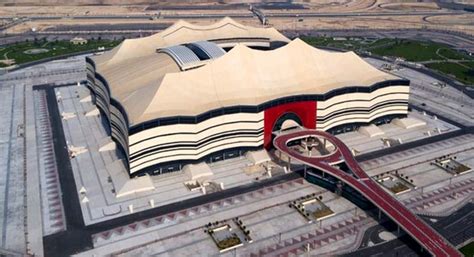
The design of the stadia will reflect aspects of Qatari and Islamic history and tradition such as a retractable roof in the shape of a tent, another reminiscent of traditional dhows used by Qatari fishermen as well as a design in the shape of traditional (male) Qatari headwear. There will also be geometric intricacies integrated into the designs echoing traditional art from across the Islamic world. Most of the new stadia will be repurposed after the Cup, turned into educational, sporting, healthcare and commercial uses with some components donated to sporting programs across the world.

All stadia will provide optimal conditions for players, match officials, spectators and media as they are equipped with retractable roofs and ultramodern (and in some cases solar-powered) refrigeration technology permitting year-round use. Each stadium will be a cocoon of comfort, preventing hot desert winds from penetrating while maintaining temperatures of 20-23ºC on the playing pitch while outside temperatures average 37ºC.

The dark side of accomplishing this massive task is that construction companies in Qatar hired manpower recruiters in numerous counties, Nepal among them, to dangle the benefits of working in Qatar. In a multi-year frenzy of semi-legal activity, these agencies charged recruits for costs, health checks, work permits, visas and airfare, in extreme cases totaling as much as $9000 each, an enormous sum for workers from one of the poorest countries on earth. The Qatari government was actively involved in this effort as well. A Nepali government investigation revealed direct (illegal) links between Qatari diplomats and the recruiting agencies. When the workers arrived in Qatar, they were already indebted to their employers who then paid only one-third of what they promised or in some cases withheld payment entirely for extended periods.

As of May 2017, over 400,000 Nepali migrant workers, half originating from a single indigenous group, had entered Qatar. They’ve had the lowest per capita income of anyone in Qatar. The $4B in remittances sent back to Nepal each year equal 20% of the entire Nepali national GDP, roughly equivalent to sixty minutes of economic activity in the USA. As the infrastructure build-out for Q22 is completed, further employment opportunities will dry up. This will have a significant impact on the Nepali economy, especially since Qatar and other Gulf states are seeking to diversify their labor base and raise the skill level beyond the primary sources of labor they’ve employed for the past decade.

Working 10-14 hours per day in extreme conditions without proper rest, sanitation facilities and living in sub-standard housing (often without wages), workers sustained an estimated 6500 deaths (from India, Sri Lanka, Pakistan, Nepal and Bangladesh) over a decade’s time, compared to a combined death toll of less than 30 construction labourers involved in the two previous World Cups. True, many of these deaths may not have been directly related to construction work. Nevertheless, that’s five workers from these countries dying every week since 2010 when Qatar was selected for the World Cup. Qatar barely investigated many of these deaths, classifying them as due to ‘natural causes.’

Even after the disastrous 2015 earthquake in Nepal, Qatar refused to allow workers to return to attend funerals or to care for their families. For years this modern-day slavery and indentured servitude went unchecked. In Qatar and the rest of the Gulf Cooperation Council states, until 2018, according to the kafala (sponsorship) system, all of this was essentially legal. Domestic help is treated the same way, and not only in Qatar.

Despite rising global criticism, as recently as 2019, a German broadcaster revealed video evidence that few of these practices had changed. Qatar started reimbursing recruitment fees to some workers in 2018 and enlisted over 200 contractors to comply. But determining the actual fees paid and to whom they were paid was a complication guaranteeing the number of workers reimbursed fell far short of the total deserving them. Some of the restrictions on worker movement were eased in 2020. Wages were increased 30% and employers were enjoined from retaining worker passports. Kafala was being dismantled. But as recently as March 2021, the Norwegian Sovereign Wealth Fund declared they would be investigating questionable labour practices across Asia, including Qatar and those specifically related to Q22.

Meanwhile, in the boardrooms, university departments and government institutions, Qataris crow about staging a carbon-neutral world-class event. Carbon-neutrality, however, does not magically appear in a carbon-neutral way. The financing, sourcing and procurement of materials, however sustainably produced, is entirely dependent on revenues from extraction: the sale of offshore gas and the labour extracted to build the venues, the metro system, the parks, the new airport, the hotels and all the other amenities and accommodations of the event.

There are multiple initiatives such as ‘Green Hospitality,’ investments in appropriate carbon offsets and ‘sustainable operation practices’ to support the ultimate carbon-neutrality of the World Cup. But it all depends on visitors using the metro, recycling all waste and using recyclable plastic water bottles, marking a turning point in the standards of the local tourism industry. Qatar is leveraging the World Cup to push the hotels to elevate their game. Fair enough. In this respect, Qatar is indeed implementing progressive climate initiatives, but only at great cost to human and natural capital.

Qatar As Off-World

The extremes to which this nation must go to create or procure the basic requirements of life combined with the rising multiform risks associated with the Q22 effort are reminiscent of an off-world simulation, an artificial biosphere, the illusion of abundance surrounded by an unforgiving landscape, barely sustainable except by extreme measures. Surely there are few places where the interdependence between humans and the natural world is more clouded. Qatar defines the combined rituals of extraction and separation, the mechanics of it, the exploitive nature of it, the psycho-spiritual harm, the mass psychology of compartmentalization and denial to such an extreme that here, life itself is turned into a resource to be mined, leaving devastation in its wake. There is nothing new here. Instead of treating human capital as foundational to a successful society, it’s being used the same way as their offshore gas. Burned.

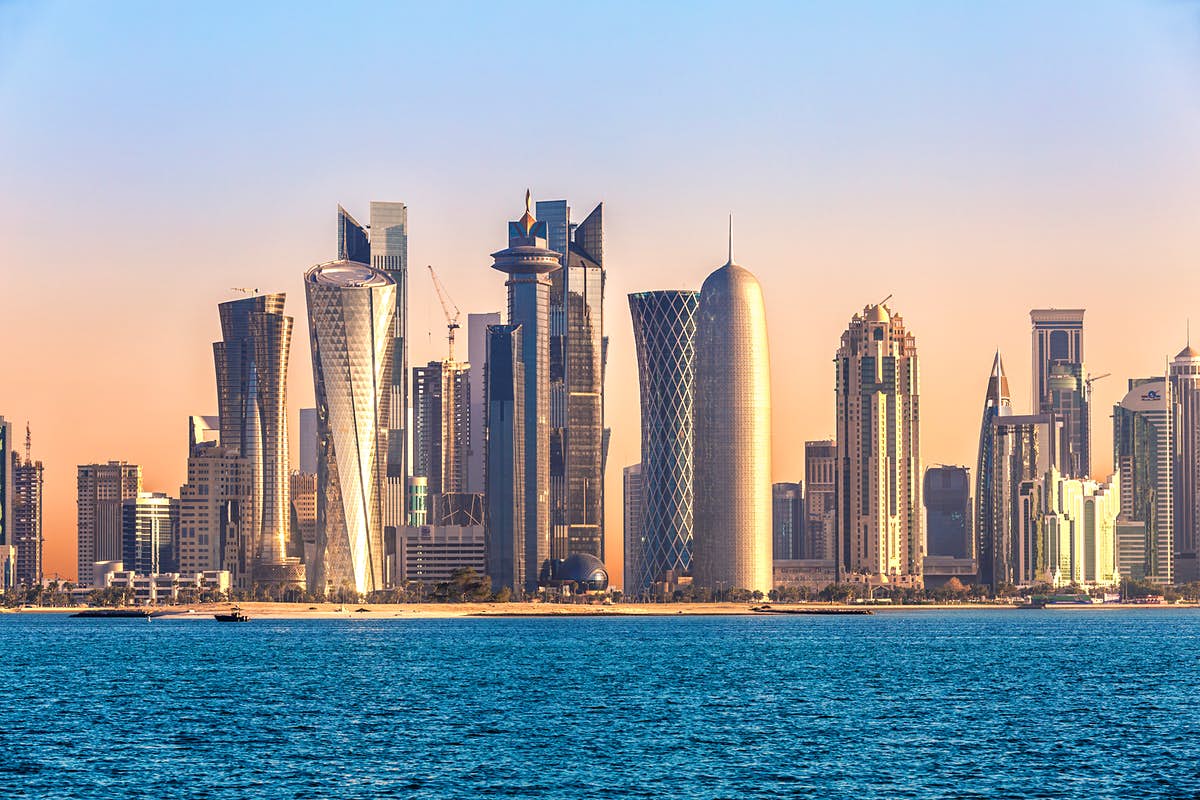
And here also is where the product of that denial emerges as multiple jaw-dropping architectural temples of sport, a gleaming futuristic skyline, steel and glass offerings to the gods of permanence, every comfort either accessible or constructed for the micro-managed spectacle of ‘earthly’ competition, sponsored by all the same ubiquitous multi-planetary corporate brands to be simulated and broadcast in endless detail back to the proletariat, attended by the international glitterati, entirely compatible with an artificial ethos of extreme resort living, creating new standards of excess, but without the inconvenience of interplanetary hyper-sleep. This is not some dystopian future. This is now.

Qatar and the other Gulf States are in a special class of nations driving the global legacy energy system, where the belief in their own illusions is reinforced at every turn while the reality of barely restrained plunder and its real-world consequences is cloaked in PR campaigns and market-speak. By the extremity of their lifestyle, they symbolize an apotheosis of Western nihilism, the radical divorce from ecological foundations and our headlong drive to collapse. There is only a contorted facsimile of belonging here.

One might argue that Qatar is doing everything right. They are conserving their natural assets, diversifying their $300B sovereign wealth fund to hedge against oil price fluctuations, investing in prime real estate in London and New York, shopping malls in Turkey, renewable energy projects in Sub-Saharan Africa, private and public companies throughout the world, venture capital and global tech. They’re catering to international tourists. They’re aggressively reducing methane leakage from their drilling platforms, redesigning their desalination plants, planning for their future and building their renewable portfolio.  But at the same time, as their national carbon footprint falls, the risks are not disappearing: inundation by a rising sea, draining what little aquifer they still have, poisoning the life of the Gulf, human rights, the rights of nature, the living nature of earth.

Bismillah-ir-rahman-ir-rahim. In the name of Allah, The Most Gracious and Compassionate, The Most Merciful…

This sacred phrase, known throughout Islam, is repeated throughout the Qur’an. It is said to contain the essence of the entire Qur’an, even the essence of all religion. With the most receptive heart, utter devotion and with the purest of intentions, practicing Muslims speak these words on a daily basis. It’s not that Qatar is pursuing selfish gains or profit for its own sake. In a devout Islamic nation such as this, largely governed by Sharia Law, leaning into the Wahhabism of Saudi Arabia and the community of its brethren nations, that would contradict religious teachings.

I began by calling Qatar an extreme example. Yet who is to say any nation cannot pursue the benefits of its wealth, share them among its citizens and showcase their skills and generosity to the world? Therein is the advancing and crushingly poignant reality: Qatar, like virtually all nations, no matter how many times the words may be repeated with utmost sincerity, is not on a trajectory to lasting peace or beauty as the Qur’an might have us believe. It cannot reconcile its extractive practices with the costs. Qatar, like the rest of the world, to a greater or lesser degree, is stuck in the same cycle of addiction and shortsightedness. Even with all its so-called wealth, it cannot save itself. This is our ultimate poverty.
State of Excess: I

If there were a single place, a petri dish of the fatally hedonistic culture of extraction, consumption, and the gaping wound of interrupted reciprocity, sustained by an illusion of abundance, it might be found among the Gulf States of the Middle East. Qatar is one of these.

The extractive economy is a daring game of chicken we’re playing with ourselves. It’s always been a necessary part of our micro-reality, but only recently have we reached a scale of malignant self-destruction doing irreversible damage to the living environment. We take it for granted as an indispensable feature of modernity. The term ‘climate’ should rightly include extraction among its many references. If applied to the whole of life, climate is not solely about atmospheric or oceanic conditions or the many thousands of other biological effects; it is also about our external and internal worlds reflecting each other. The climate of earth is collapsing. And we are collapsing with it.

If we trace the acceleration of the global warming effect, the loss of ice, acidifying oceans, the threats to food chains, the Sixth Great Extinction, wild tantrums of weather now commonplace, all are paralleled by massive concentration of wealth, the degradation of civil discourse, attacks on science, the corruption of democratic norms, the influence of dark money in politics, feudalization of the economy, spiritual malaise, the destruction of capital in all its forms and the ever-intensifying jockeying to secure vital natural resources. It is a hollowing. Earth as an object of hostile takeover. None of us can truly breathe anymore.

If there were a single place, a petri dish of the fatally hedonistic culture of extraction, consumption, disconnection and the gaping wound of interrupted reciprocity, sustained by an illusion of abundance, it might be found among the Gulf States of the Middle East. Qatar is one of these, perhaps second only to the United Arab Emirates for a standard of living supported entirely by extraction yet deeply insulated from the consequences. Qatar is a parable of earth.

The citizens of Qatar are not oblivious to the issues. Popular sentiment clearly acknowledges the primacy of global warming, the causal relations between fossil fuels, pollution and climate change. They are acutely aware of urban congestion and resource management. Even though government officials, academics and civil society share a consensus that something must be done (not only about the traffic!), personal lifestyle adjustments hold limited appeal. Qatar produces 7000 tons of trash daily. Yet no recycling program, no matter how expertly designed or promoted, can mitigate the emissions from local plants producing 20,000 tons of cement every day. Such a functional disconnect is the definition of un-sustainability. In this semi-constitutional absolute monarchy, ruled by a single family for nearly 200 years, the Emir, Abdullah bin Hamad Al Tahni, has the last word. There are no democratic mechanisms to shift policy as far or as fast as it must go.

The marvel of climate change can be reduced to numbers, but they don’t—and can’t—plumb the depths of the flawed outlook, the psychological mechanisms of denial, except perhaps by applying an analogy of autoimmunity. We are attacking ourselves. The sensual appeal of lifestyles are so comfortable that the thought of any substantive shift in priorities never reaches critical mass. In Qatar as much as anywhere, an inexorable series of self-destructive and irreversible decisions are being made. They are now accompanied by promises to change, failure to change, the cycle repeating with rising guilt followed by self-deception and dissociation. These are the behaviors of an addict. Not all of humanity is addicted, but the addicted are leading the rest of us into the abyss.

Qatar is small. Its total area is only three times greater Mumbai or half the size of Vermont; or, if you prefer, seven times the size of greater London. The amount of arable land per capita is a vanishingly small .005 hectares. The population, having grown 400% since 2000, is still less than three million, but only 12% are citizens. The remaining 88% are foreign workers, largely from South Asia, including hundreds of thousands of unskilled and skilled labourers who came to participate in the promise of Qatar’s selection as the site for the 2022 FIFA World Cup. The influx of expats is the reason 70% of the population is between the ages of 25-54 and the reason Qatar has the highest ratio of men to women in that age group in the world, 5:1. But perhaps there’s another reason. In this small group of patriarchal states, restrictions on women’s behavior and movement and the absence of laws clearly criminalizing domestic violence are driving women from these countries altogether.

Qatar is living a schizophrenic culture of extremes—at a precarious edge between the inevitable consequences of extraction and the countervailing abundance it provides.  There is world-leading prosperity, the fourth-highest per capita income behind only Macau, Luxembourg and Singapore. There is high growth, and to the degree possible with average summer temperatures exceeding 40ºC, an illusion of separation from the elements, from anything remotely related to the lived experience or diversity of a jungle, a coral reef or a wooded mountain.

It’s also a tourist destination of mega-theme parks and giant shopping malls, man-made islands and a soon-to-be opened aqua resort with underwater hotel suites. It is known for its architectural design and cultural beauty, and as the leading financial service center of the Middle East. Qatar boasts world-class universities, sports venues, a highly educated technocratic class and its own stunning collection of ancient and modern Islamic Art. The unemployment rate is a microscopic 0.08%. Even though it imports most of its food, it has reclaimed thousands of hectares of desert through irrigation schemes to produce hothouse crops.

L’Essence de Vie

The impact of less than three million people on the global condition may be miniscule, yet the impact of Qatar is far greater than its small numbers would suggest because of extreme energy inefficiency. How is that irrigation supported? Qatar has near-zero surface water and less than 100mm/y in rainfall, 80% of which runs off into the sea. Natural renewable water resources have been estimated at 71m3/per year per capita, far below the water poverty line of 1000m3/y/ca.

Ninety-nine percent of municipal water is produced by energy-intensive conventional thermal desalination. Qataris use 500 liters of water per day per capita (132 gal/d), twice the global average. The water coming out of the tap, the water for washing $2B worth of cars (more than one for every two people) every day, the water for swimming, water for the fountains, the landscaping, the reflecting pools, the water for wudu (ritual cleansing), every bit of water used in Qatar including most of what is used to grow food is also bringing the Persian Gulf closer to becoming a dead zone. And even though Qatar claims the tap water is safe for drinking, most everyone drinks only bottled water.

Sixty percent of all global capacity for extracting fresh water from the ocean is in the Gulf States. There are over 1000 desalination plants ringing the Gulf from Kuwait to Saudi Arabia, from Bahrain to the UAE and Oman. As demand continues to rise, new and larger ones are constantly being built. Together they are impacting the salinity of the Persian Gulf, releasing hyper-saline water with chlorines into an ocean that already has a 25% higher saline content than the average ocean. By 2050, the salinity of the Gulf will be more than twice that of either the Red Sea or the Mediterranean.

Desalination plants also release sulfur dioxide into the atmosphere in quantities exceeding international standards. The Persian Gulf is already a shallow sea, averaging less than 50m deep. Combined with a high evaporation rate, insufficient freshwater replenishment and multiple sources of dumping such as animal farms, sewage, oil spills, industrial outfalls and fertilizer factories, along with desalination along the entire coast, not to mention the millions of gallons of oil deliberately released by Saddam Hussein during the Gulf War, the Gulf is slowly becoming a dead sea. Algal blooms known as the Red Tide, generated by heat and an influx of nutrients from anthropogenic sources, are reducing oxygen content, killing fish and intermittently forcing temporary shutdowns of desalination in some areas.

In recognition of the precarity of water resources, Qatar is building five mega-reservoirs, intending to store emergency supplies according to estimated demand in 2036. They will likely convert the surface of these reservoirs to floating solar installations, further dropping overall carbon emissions. But alas, only a drop in that bucket.

Climate, Energy & The Environment

Qatar has the highest per capita CO2 emissions of any nation except Kuwait, again, partly because of extremely inefficient consumption. Emission levels also reflect the extremely low natural biocapacity of the nation to produce the basics of survival, yet the population is entirely divorced from the costs. Water is free. Energy is free. Education and health care are free. Only one nation, Iceland, uses more energy per capita than Qatar, though Iceland’s energy is 90% geothermal, which delivers 4-5 times the energy of fossil fuels.

Qatar’s wealth derives from the third-largest proven natural gas reserves in the world (25 trillion cubic meters), mostly offshore, providing 85% of its national revenues. It also has 15 billion barrels of proven oil reserves and is a major exporter of petrochemicals and fertilizers. Unfortunately, Qatar considers natural gas to be “clean energy.” In fact, it’s only half as dirty as coal and emits as much as 10x more carbon than some forms of biomass—of which Qatar has none.

The government, in concert with twenty-two members of the Pan-Arab League, intends to diversify its energy base. This is a progressive plan, but it’s been slow to develop. There was no renewable energy base as recently as 2015. The current goal is to reach 20% renewables by 2030. This is not solely out of environmental concern, but part of a drive to save its natural gas for export instead of domestic consumption. A huge solar installation, Siraj-1 (700MW, 10 sq. km), is slated for commissioning in August 2021 and will be used in part to power a ‘carbon neutral’ World Cup. Siraj-1 will produce the cheapest utility-scale solar energy in the world. On the other hand, dust driven by desert winds will likely make it the most difficult solar plant to keep clean and operational at peak capacity.

Qatar’s obligation to the UNFCCC and the Paris Accords was, as with all other nations, to submit Intended National Defined Contribution statements declaring a commitment to sustainable practices, education, research and implementation of improved technologies to reduce emissions. The fact that 10% of its land area is no more than one meter above sea level, that 18% is no more than five meters above sea level and that 96% of the population lives in that zone is a stark reminder of Qatar’s vulnerability to sea level rise.

Nevertheless, the music continues, and even more loudly. As with so many other signatories to the Paris Accords, specific emissions targets were never declared, and all intentions were entirely voluntary and subject to change to any time. While they are demonstrating a commitment to mitigation and adaptation, the key statements in the INDC, virtually identical to similar statements of other nations, provide loopholes to choose development over environmental concerns at any time.