The Easy and the Impossible

But honestly, tell me you can look into the eyes of stranger or even someone you know intimately without having this experience. Maybe not all the time, but with rising frequency. What do you see? A desperate search for signposts or guidance or truth or any modicum of trust?

My ex-wife used to say sex was either easy or impossible. There was no in-between. That was quite a declaration coming from a sex-therapist who helped people work through buried assumptions and emotional obstacles to healthy sexual relationships. I’m thinking the same principle applies to writing. It’s either real or it wanders off into strange and strained territory to become something else, like a mannequin, needing more and more layers of make-up to appear real, when actually, contrivance can never replace the spark of life. Even so, breaking through contrivance to live in reality requires more than a wish.

So it is with living nowadays as well, apparently. As the unraveling around us continues, the despair deepening and the warnings arising from diverse quarters, I spend another restless night processing the turbulence of the day in dreams, sensations, and images. I awaken without words to frame new (or ongoing) feelings, rising with aches and pains, old and new. I, like everyone else I suppose, continue to ride the rising tide of challenge and increasingly complex and fraught sense-making going on everywhere. In fact, it seems we’re all being continuously triggered and probably don’t even realize how vulnerable we’ve become.

I can’t look at anything anymore, food or energy prices, the tsunami of waste, the latest manifestations of systemic racism, nihilistic political agendas, vacuous declarations of so-called experts on cable TV, the creeping security state, looming mass evictions, the arrogance of empire giving oxygen to old tropes, the economic puppet show, the building wave of global (and domestic) refugees, the deepening divide over vaccination and especially the accelerating frequency of extreme weather events without looking at everything. Earth has a fever—we are all under its sway —and our behavior is approaching delirium.

I am unable to keep the blinders on or act unaffected. More and more comes packed into less and less, such that even the smallest encounters, like a simple hello, are loaded with import. If I applied the original adage to my current circumstance, I’d have to say with civic dialogue descending into chaos and governance hanging by a thread, with most everything we take for granted in upheaval, that life is approaching impossible. And it’s impossible to look away. If there is an answer, it’s to meet our vulnerabilities with unflagging courage, not retreat into a cocoon of falsehoods, to permit ourselves to be exposed, just as any sex therapist would suggest, remembering that hastily following impulses is a dangerous path and that love is stronger than fear.

But honestly, tell me you can look into the eyes of stranger or even someone you know intimately without having this experience. Maybe not all the time, but with rising frequency. What do you see? A desperate search for signposts or guidance or truth or any modicum of trust? Knowing we’re all undergoing a something in common, everywhere from your bedroom to your community to every place beyond, we are thirsting for the sparks of life breaking through the mirrors, the robotic or performative nonsense, and we are drawn to them instantly.

Amidst all the talk and the growing awareness of our predicament, I wonder if what I am feeling (and seeing) is the true nature of collapse. I can’t imagine how you are metabolizing this ongoing trauma overtaking us, but it’s become a pandemic in its own right. Not only are our primal rhythms under assault, but water cycles, growing seasons, the jet stream, soil viability, ocean currents, all are wavering and fueling increasing damage and desperate grasping for stability. All the boundaries that define us, most of which are enactments of coloniality, are blurring in a storm of converging data from biology, neuroscience, psychology, and spirituality, not to mention political ecology.

We are trying to birth ourselves into an as-yet-undefined world beyond right and wrong—or at least we’d better be– because nearly everything previously defined by the sham religion of modernity as right and wrong is part of the prison in which we are all held. Right and wrong are being brutalized, stripped of meaning, contorted, ignored, rendered inert by capitalism and the nation-state, shuttled off to a state-run home for advanced cases of moral equivocation. No wonder the maps are blurring and there’s extreme behavior all around us.

Are we seeking something new or are we reclaiming something as old as earth itself? Are we diverging of converging–or both? As a white person living in a (formerly?) white dominated world built on the bones and ashes of non-white cultures, where do I look for guidance? The world I grew up in, when the polarities seemed clear, when it was easy to say which side I was on, is dissolving. How we think, how easily we are triggered, the default psychic frameworks we relied upon are under reconstruction. Justice and injustice. Racism and so-called equality. Authoritarianism and so-called democracy. Sexism and so-called gender equity. Even war and peace wear rhetorical masks mocking their convergence. We can’t not notice that virtually every principle we once thought clear, activism, the definitions of problems and especially solutions all exist within the framework of modernity now under challenge. That template, with its innate violence, exclusion and systems of control, arbitrarily drawn international borders, sacred systems of law, language, commerce, faith, ritual violence and spirituality is just not working anymore.

Where are the signs of life coming from? Who knows better than anyone about the malignant appeal and tenacious grip of modernity? Who stands in starkest contrast to whiteness as the standard of humanity? Who embodies the visceral legacy of enslavement, throwing white privilege into high relief, and gives voice to the necessity of becoming a fugitive from the hegemonies of western culture? What happens to our bodies as conflict rises, as we perceive deeper layers of conditioning, peering past the constrictions of cultural and linguistic structures to a multi-colored coat of a new way? Even if I declare a tenuous independence, that my body is not for sale, to be occupied or even subtly directed, that my body cannot be taken or its treasures plumbed as just another profit center, I don’t yet fully know what that means. I only know that going deeper into the sensations of change with a willingness to notice and feel everything is required.

Very little is easy anymore, not even hello, but we have yet to arrive at a new functional baseline. But one thing is crystal clear: the impossibility of modernity, which has taken 500 years to realize, externalizes more and more and offers only faux benefits increasingly removed from lived experience. Quo bene, as they say. Who still benefits from that ongoing construction? Only a vanishingly small minority.
Solidarity, Somatics and Psychosis

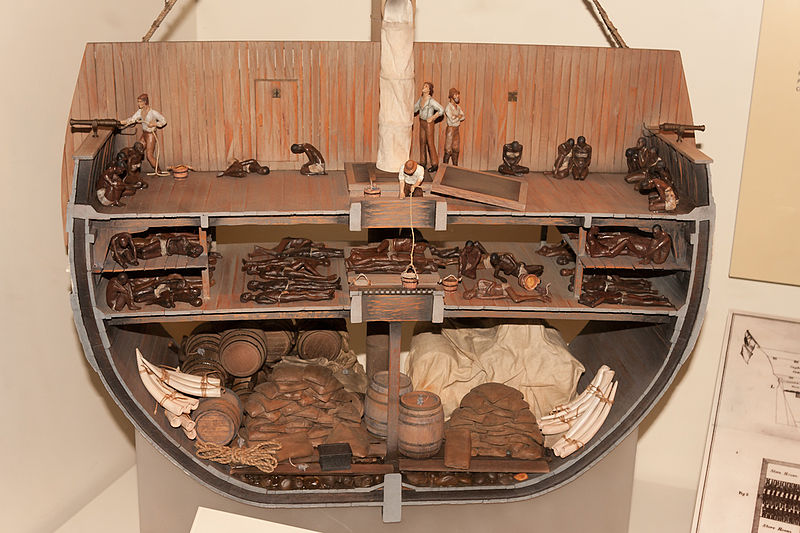
The classic design of the vessels transporting the kidnapped, the brutalized and dispossessed, the colonized masses brought from Africa to the New World, endures to this day in the forms and structures of patriarchal capitalism: social stratification, marginalization, income inequality, racism, limited or blocked access to the means of acquiring wealth, property, equal justice or the general benefits of living your own dreams. White people may still enjoy the freshening breezes of the upper deck, but the metaphor still applies to nearly all of us today. It is only a matter of degree.

Yet even in the darkness, the impossibly close quarters and squalor of the lower decks, the light of freedom and joy never died. Dislocation does not extinguish the longing for home, burning to this day in the literature, art, music and poetry of the oppressed. It is in these ceremonial forms of breathing together that solidarity is affirmed. That yearning comes to life in the reverence for the journey, the longing to recover the sacred, to resolve the diaspora with the free and full habitation of a transformed body in a new land, even if that land only exists as an aspiration in the hearts of the wanderers. 

Four hundred years later, it is not only the ones who bore the lash who still cry out for home. Neoliberal economics, by commodification, relentless extraction and by the absence of any loyalty to genuine community and because it refuses to regard the earth as anything other than untapped economic potential, renders all of us landless on the new plantation just as it does in the foreign territories, occupied, re-colonized and subjugated by the weapons of finance and law. If those fail, force is applied.

These conditions, specifically the hierarchies of privilege, the tightening grip on the lash, the systemic racism and the use of money as a bludgeon, the predatory financial order and all the other inequities accompanying its regime, remind us that we can lose anything at any time. And indeed, since our relation to earth is much more than merely to a potential source of revenue, everything is being taken from us, incrementally, every day. Manifest destiny operates upon the collective body now just as it did in centuries past upon the territories of the indigenous.

Modernity is a rationalization of the wild. It is a leveling. Anyone noncompliant; anyone who dances, breaks the rules, bends time, looks beyond the borders, meets with other bodies, dwells outside the boundaries of sanctioned connection, imbibes the nectars of the sacred, seeks wisdom from forbidden sources, cries out for justice or draws outside the lines may be indulged with limited tolerance. Some will be infiltrated, criminalized, surveilled, tracked, deported, bludgeoned, jailed or killed. The rest, at least figuratively, become fugitives.

These and others like them, the restless, underserved, disenfranchised and denied, the ones living outside today’s inverted definitions of “freedom,” and “opportunity,” the ones discarded by the “free market” are the ones deserving of our solidarity. But they’re not the only ones being damaged by the paradigm of dominance and exclusion. However the systems of power continue the privatization and destruction of the commons is our disenfranchisement in real time. 

The Freudian definition of psychotherapy is that in exploring and expanding the psyche we reclaim territory. Our wounds back us into corners and make us small. Our addictions limit our capacity for outreach and connection. All the consciousness work we do is to reclaim territory, to halt the narrowing and to expand our view. Modernity rounds the edges and flattens consciousness, narrowing focus to channel and facilitate the pursuit of illusory solitary happiness. Bayo Akomolafe calls it gentrification. When we open psychic territory, we push past the limits of convention. We enter the wilds, tearing through the fences of what we know. We recover expansion and breath.

As David Abram reminds us, the original meaning of psyche was about breath, the wind or spirit of life. When we (re) occupy the wilds, we are learning to breath again, to fully inhale the spirit of life and the common territory of choice and possibility we all inhabit. Sitting and breathing is the most elementary practice of contemplative traditions. In doing so, we typically only think of ourselves, our solitary and separate bodies and the spirit, or psyche, of our existence. We inhale, filling the self, partaking of the esprit, the ruach, the motivating energy of being, momentarily narrowing our focus to this body, this consciousness, this moment, cyclically relinquishing the territory of awareness we just claimed, releasing into the non-dual self, into the unity of all consciousness, eliminating all boundaries and expanding to occupy all the territory we abandon in our pursuit of Self. We infuse ourselves with psyche

Psychosis names an abnormal state of the psyche, a condition of separation from the essence of being. We become lost to the potential of cyclical expansion and contraction of spirit embedded not only in the simple movement of air, interacting with the flow of breath essential to language. The expression of sound, the original musical intonation of nature, the stops and starts, the shapes of the throat, lips and tongue are rooted in the original sounds and symbols of our relational self. They were orienting, defined community, interspecies dynamics and expressed the ebb and flow of interdependencies upon which group survival depends. To become, over millennia, progressively separated from and to lose all sense of relationship between language and natural world, to permit indigenous languages and their ways of knowing the world to be lost is a mark of the deepening journey into mass psychosis

We lose our breath until we can’t breathe at all.

Breaking free of the mass psychosis is not simply a matter of breathing or language. It’s a much deeper process of conspiring to access and know our bodies in relation to earth in a different way. The energetics of reductionism, scientific materialism and neoclassical economics drive a widening gulf between humans and nature, from the full-bodied, erotic conversations between humans and the seasonal textures and interactive exchange of wisdom held in sacred sounds and labels of obscure and unique mind-states for which there may be no equivalent in any other language.

Recovering indigenous history is more than recovering stories. Embodiment includes discovering the architecture of authentic freedom, sharing the history of our bodies, exploring the interpenetration of culture and somatics, coming to our full stature, bringing the diaspora home to place and community, recovering belonging, power and perspective, connecting with ancestral voices bending time and preserving the libraries of wisdom contained in disappearing languages.

As Alnoor Lada declared in a recent issue of Kosmos Journal, solidarity is a direct erosion of the structures of oppression, the powers anchoring domination. Reclaiming the past informs the possibility of changing the present. Acting from a different set of values, breathing together, healing from the mass psychosis by breathing with our ancestors, redefining our identities, reconnecting to deities rendered remote and quiescent is a direct affront to the forces of economic dislocation that would erase the past and reframe history as the solitary pursuit of self-interest.