Delusion

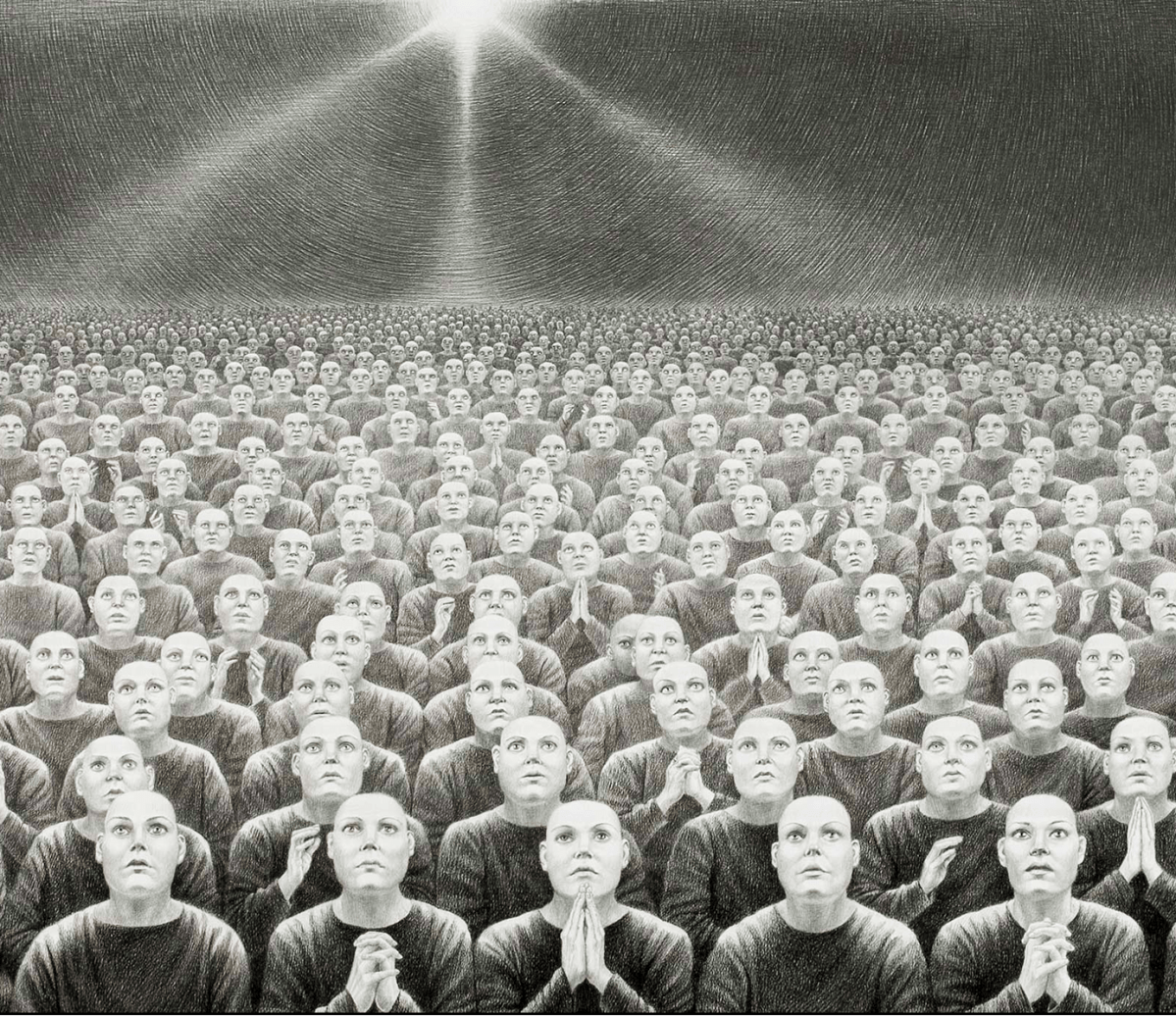
It is so painful that now, given the helplessness of it all, whatever humor there may once have been in the infinite variety of human foibles is subsumed by the poignancy and terror, the desperation and bewildered hatred at the heart of mass delusion.

One of the things meditation can be is a discovery of what about us doesn’t change and releasing identification with everything else, freeing oneself of all obstacles to becoming anything other than vast space.  This means dis-identifying with form: sensation, feeling, structure, any imperatives including body, time, desires, mental journeys, memory, gender…even meditation itself. For me, that especially includes impatience. To whatever degree I may approach such a condition, the practice becomes non-meditation.  Non-meditation is the essence of Dzogchen. 

Gazing is an auxiliary practice of expansion, the elimination of distraction and finding what I have come to call integrity. Exploring what integrity means is to approach wholeness not only mentally, but also to explore its physical components. Coming into full stature in the practice of gazing is to embody a physical architecture of integrity, which is not separate from the integrity of mind. Opening to compassion is the point. Approaching integrity of the body is to create space for breath, rising into a connecting and expansive heart-space, expanding into fullness. 

Premature dis-identification with feeling or ignoring the presence of unresolved conflict (by-passing) will always get in the way of the integrity we seek. The presence of strong feelings will hinder the longer-term clarification process. There are plenty of ways to work with feeling, but however one addresses that process during or in post-meditation, it will benefit quality of life and practice. Ignoring incomplete emotional clearing will obstruct the benefits of time spent in practice. Not that practice must be interrupted or delayed, just that a short and long-term emotional clearing process belongs as a part of practice. Either succumbing to by-passing or imagining the emotional work ceases at some point is a form of delusion and will undermine our capacity to inhabit our full stature and reap the benefits of sustained and careful attention to the full expression of integrity.

Assuming the emotional and physical architecture of integrity becomes a natural platform and a capacity to cultivate compassion, from which we may even sense the massive field of human karma, from those closest to us to the most remote strangers. Becoming permeable to and connecting with karma that is not our own, to witness and hold it without being affected or thrown off balance, remaining on one’s perch, as it were, is only sustainable if it’s  based on authentic compassion, which is itself an intrinsic quality of integrity. This is the achitecture of freedom.

From this stance, Bodhicitta and Compassion become identical. They can only come from full integrity anyway. Not immobile or rigid, merely steadfast. From this platform of integrity, compassion and bodhicitta become one as they are expressions of the same thing: the mind of enlightenment. 

Gazing into the ocean of human karma, the delusions overtaking a large portion of humanity become manifestly clear. In the grip of delusion, so many are stuck, trapped in an uninterrupted and tortuous cycle of wandering, being whiplashed back and forth between the first two Noble Truths, the truth of suffering and the root of suffering. It is so painful that now, given the helplessness of it all, whatever humor there may once have been in the infinite variety of human foibles is subsumed by the poignancy and terror, the desperation and bewildering hatred at the heart of mass delusion. 

Take Trump himself for a moment. His delusion has always been apparent. And if one could momentarily set aside the wreckage left by his personal delusion, the naked and lost nature of this profoundly damaged being, he could even become an object of pity. But at some point, not only have his delusional transgressions become criminal as the relative legal world would define them, but he has dragged many millions into his orbit of self-serving chaos. How is this possible?

I think of Trump followers as those whose lives were already being lived at the edge of delusion. Inside their anxiety, resentment, victimhood and self-pity was a simmering anger with no socially sanctioned outlet. For Trump himself, seeing none of the familiar limits that most others see, the outlet has always been to push the envelope of propriety with a combination of entitlement and victimhood perpetually skirting the edges of lawlessness. Why, after all, shouldn’t he have whatever he wants? And anyway, who’s going to stop him? Who has the nerve to stand up against his audacity?

The American Dream has not been working for his people. For them, it crashed long ago. It was being systematically undermined by the plutocrats, bankers, politicians on the take, CEOs and various other capitalists (AKA sociopaths) in positions of authority. Those whom I regard as deeply lost in this cycle of hunger, resentment and rage were ready for the plucking. Yes, they’ve been exploited and played by the relentless and sophisticated divisive messaging and legislative agenda of the Republican Party for decades while simultaneously being misunderstood and abandoned by the Democrats. All it took was certainty, a certain braggadocio, someone who not only gave voice to their seething anger but who resonated with and could embody their own simplistic, zero-sum view. 

From a distance, it’s all profoundly painful. That doesn’t mean I forgive or appease them or don’t resist them, because what they’re doing is trying to draw everyone else into their world while also destroying any alternative to their view, while Trump plants his delusions deeper into their receptive brains, by any means necessary. They cannot be permitted to succeed. But at the same time, the rest of us have to create a world that demonstrates the misguided futility of their quest.

The Leftist reality is more nuanced, less black and white. Of course, it is. And that’s why it’s been under attack for so long. The world view of the Left could never appeal to or alter the mass delusion of Trump world. It’s not selfish enough. There’s even speculation now that direct economic benefits will not break through the Trumpian hive-mind. It’s not a zero-sum vision. What passes for the inner sanctums of the Democratic Party in America may be equally deluded with some of its own toxic certainties, confusion about whiteness, their corporate view. And also similar to the right-wing is their steadfast belief that they are absolutely not deluded. Their submission to neocolonial capitalism is more subtle. The forms of grasping and exploitation are less overt, remaining in constant tension with forces of generosity and mutual dependence. In Trump world, no such tensions exist.

Referring back to personal practice, just because of what it already is, I’m being as deliberate as possible about dissolving every boundary between self and not-self, between external and internal. For brief moments I may skirt the edges of non-duality. In other words, leaping over physicality or presence into what is nothing but space, softening materiality, feels like a recapitulation of the dissolution of death itself. In fact, every instruction, every sitting, every incremental step toward realizing self-knowing Awareness is a practice for the end of life. Every sitting is an encounter with my own death as if my sole concern is noticing the Nature of Mind, noticing all phenomena as the natural emanations of Mind, empty in nature. 

This is precisely a rehearsal for the bardo experience. This is the space of death, the journey through the bardos, of being finely tuned to the signs and signals of that journey, not skipping over or impulsively mis-interpreting anything, not being distracted, frightened, grasping, descending into desire, mentally chasing after every shiny object nor being afraid of any appearance that may arise. This is also a metaphor of this American moment. We are traversing the bardos, facing the conditions of our death and next life, defining the terms of a national rebirth.

The act of accessing the three kayas of Vajrayana, empty essence, lucidity and compassionate energy, realizing their inseparability, is also the personal journey into the three bardos happening every time your ass hits the cushion. Well, America’s ass is on the cushion. Our national karma and transition are playing out daily before our eyes. We’re being bombarded by demons, black arts, wrathful deities, apparitions, deniers and false prophets, the viral hallucinations of Trumpism dressed up as public discourse. But let us not be fooled. Let us remain focused and steadfast in our integrity, determined to remain in our dignity and full stature.

One important question continues to poke its nose into my space. We live within the machine, the zombie machine defined by and driven by late-stage capitalism, fundamentalism and whiteness determined to emerge triumphant and unscarred from the death throes of the Enlightenment. The machine has always offered the illusion of control. We may be able to personally or even in ephemeral enclaves or in our brief sitting time reject the machine, believing we can temporarily overcome its influence or live (or imagine we are living) outside its control and we may thoroughly reject the illusion of control. But if we are not also dismantling the machine, pointing out delusion, naming its impotence and offering an alternative, what are we doing? Practicing for our death while watching America meet its demons in this transitional time while standing for the terms of our rebirth is the only game in town.

Fearlessness

If we have no fear, there is no thinking. No conceptual mind. And vice versa. No thinking, no fear. —Tsoknyi Rinpoche.

Thinking and fear are inseparable. I mean the analytical, deliberative and conceptual nature of our waking process coupled with a vague anxiety about either the past or the future. Labeling this largely unconscious and pervasive condition a defense mechanism—the opposite of a direct somatic interaction with the world– opens a portal into a rich, yet largely hidden dimension.

By whatever means, we all benefit from noticing and softening the dominance of conceptual mind whenever possible. We sense the value of alternative ways of knowing and, if we’re fortunate, gain some facility with them. But such explorations can quickly become muddy and complex with counter-intentions and conceptual intrusion. Ultimately, when the intention is to get out of our minds, the prime directive is deceptively simple. There’s nothing whatsoever to do.

Relaxing analytical mind and entering the axis of heart-mind and direct somatic experience is a dive into the deep pool of emotions and primary motivations, often blocked by uncertainty and fear. Everyday thinking (for most) is about competency and approval (in an imaginary future), driven by fear of not having things we want and not having enough time to get them.

Foremost among these is a desire to accomplish something, and quickly. For many, the thinking process is all about being somebody, reaffirming an identity, the face we turn toward the world. Acting swiftly and with confidence is the strategy to adorn our identities with permanence, constantly overlooking the fact that, in reality, there is no one to be.

Looking at this bubble of fear and deflating it is profound. Fear, it turns out, is not a permanent condition. As soon as the natural defense mechanisms to hide it are recognized, it’s possible to dial it down, sometimes to near zero, for extended periods of time. True fearlessness, the absence of thinking, may come as rare and transient moments of profound somatic presence. It may be cultivated or arise spontaneously.

Thoughts of the past or future are a defense against full somatic presence is ego’s panic. Ego is fragile and always needs reinforcement and protection. None of my fears or the illusory protection they provide is ‘me.’ ‘I’ would always rather be somewhere else, watching the entire crazy, helpless, endlessly entertaining creative process of building these defenses, which under scrutiny dissolve like so many sand castles before the incoming tide.

Viewing the climate issue through the lens of a perpetual fearful state, our individual and collective responses orient around fear-based rational metabolizing of data and formulating rational responses. That doesn’t mean we are deliberately denying or condoning the denial of our deeper emotions. But it certainly can mean we are giving short shrift to them, as if focusing on doing the same thing over and over again will distract us from the discomfort of realizing we have not altered our course from its suicidal path.

Conventional activism is not reducing global emissions. What fears construct the bulwark and what feelings lie beneath our failure to alter this failing strategy? What if the way we think about global problems is how we perpetuate them?

An alternate approach is Deep Adaptation: taking a fearless look into the darkness, unpacking our fears and listening deeply for the gifts within. Experiencing the grip of fear, whether momentary, profound or incomplete, propagates as a gift and manifests as enlightened intent. True fearlessness lies at the nexus of empathy, enlightened action, equanimity (in the face of subtle and/or uncontrollable forces) and the softening of ego. It is where uncertainty meets trust, where structure meets chaos and doesn’t recoil, where empowerment, joy and compassion intersect. This is the path of Deep Adaptation.

These qualities naturally and spontaneously subvert the life-long conditioning of the fear-based, selfish (and self-denying), rational, zero-sum paradigm and maximally defended hyper-ego of modern culture, politics and economics. To be fearless is to operate outside the perversion of today’s inverted totalitarianism. To place oneself so far outside the norm is a revolutionary condition. In fact, fearlessness is lawless, at least in the sense of operating in the present moment, outside a set of unwritten laws governing acceptable human interaction. I am talking about the absence of fear, not bravado, not a jacked-up boundless courage in the face of fear.

To live outside the law you must be honest……..Dylan.

The dominant paradigm exploits fear to condition behavior, more so now than ever because the messaging has become so sophisticated and the drive to monetize our emotions so strong. That messaging tells us when we are afraid, we must look to ourselves as the source, not to the daily deluge of mass indoctrination. The individual is pathologized. These are the mechanisms of social control.

The origins and mechanisms of fear in our lives all serve a purpose. At the same time, we can reflect on our beliefs and reflexive responses to everyday events, appetites and needs to consciously explore alternative strategies. Extending this deeply resilient and adaptive practice to the collective context exponentially increases complexity.

As we determine effective pathways to justice, it’s increasingly clear that turning off discursive mind enhances our capacity for fearlessness. This is now the cutting edge of transformative group practice, in which the presence of fear can be named, exposed and collectively defused. Cutting through the defenses and obscurations involves unwinding the triggers and layers of fear we’ve accumulated since birth–or even before.

The clarity we can build and the resulting behavioral changes eventually become automatic. Such a process may be called by many names. I call it the Buddhist long game: the transformation of mind. Every such path of inquiry into fear is a journey into the heart of suffering. This is one thing we all share. Ultimately, all practice is directed toward one simple truth: the majority of emotional (not instinctual) fears driving us, tenacious though they may be, are illusory. We may have our story about them, yet they have no true objective source. Which is not to say fear can merely be dismissed; not at all.

Compassion is closely related to fearlessness. Situational compassion expresses empathy and responds to the suffering of others in a direct way. Absolute compassion is an encompassing awareness of the profound commonality of human experience, the suffering and bewilderment at the heart of being human and related confusion about the difference between what is real and what is actually true. Holding such a view while surrounded by an ocean of fear without being affected by it is nearly unimaginable. Yet fearlessness grows with compassion. And vice versa. They are inseparable. Absolute compassion is entirely incompatible with fear.

In stepping through the gateway of compassion, we step into fearlessness. True compassion cannot fully manifest without realizing all phenomena exist in a supremely expansive state of equal-ness. There is no distinction between enlightened fearlessness and compassionate intent or any other way of being. Many of our fears are variations of denial—self-imposed disempowerment. They are responses to familiar threats to which we have become habituated. They become comforting costumes layered upon core reality. Over time they shape a fixed identity, as if abiding fear becomes a reassuring view of our selves.

Nowhere is this dynamic more apparent than in relation to the existential threat of climate change. But fear is typically subject to causes and conditions and can be reviewed by cognitive mind. Discovering and breaking through every form of denial about our future is a central principle of Deep Adaptation.

We might assume fearlessness is a matter of will. But let’s not confuse conceptual knowledge for wisdom. Knowing more will never take us to the truth of fearless intent. Wisdom comes by inquiring ever more closely and deeply–with a bottomless compassion for oneself–into the sources and nature of our fears (and denial) and liberating the energy and clarity stored within. Exercising will is more like counter-phobia, throwing a cover over that clarity and burying it further from sight.

The distracting activity of mind and the accompanying dance of denial is often symbolized as an untamed mustang. It is attractive, seductive and wild. Fearlessness is the ability to recognize the beauty and spontaneity of that wildness without being seduced by it.

The fearless one sustains an unflinching gaze into her own suffering, compromise, limiting beliefs and behaviors. The fearless one acts with a compassionate intent that holds fear, hope and separation as having no substance, no traceable origin or destination, no firm ground at all.

The fearless one is willing to sustain the consequences of living beyond convention, even if it means putting one’s own safety at risk, not solely to place a spotlight on the entrenched nature of the dominant paradigm, but to engage with it in fresh and creative ways, transmitting a highly contagious view of the possible: a world in which there is no true enemy. The fearless one affirms there is enough for all, there is unbroken relationship with all; there is infinite choice and nothing to do but create.

In this condition we glimpse our true nature. It can shake our world, arousing awareness of our fears and the sway they hold over us. The fearless one even evokes our fear of fearlessness with a gentleness that melts our defenses, exposing our vulnerability and the artifice of our times.

The fearless one opens possibility for something new, a vast, spacious and timeless freedom we know in our hearts is possible, yet which, without the support of others, we are barely strong enough to sustain more than a few moments at a time for ourselves.

What might a culture of fearlessness or fearless collective action look like? There are surely many examples, some deliberate and some spontaneous. Can all political initiatives be about dismantling the mechanisms and structures of fear? Many of them already are. To explore these pathways, interrupting our pre-occupation with individual identity and survival, is to unfold into fearlessness, to enlarge our sphere of action, to embody compassion, to forge justice, to break through the familiar into a new and fresh territory of freedom–and invite others to do the same.