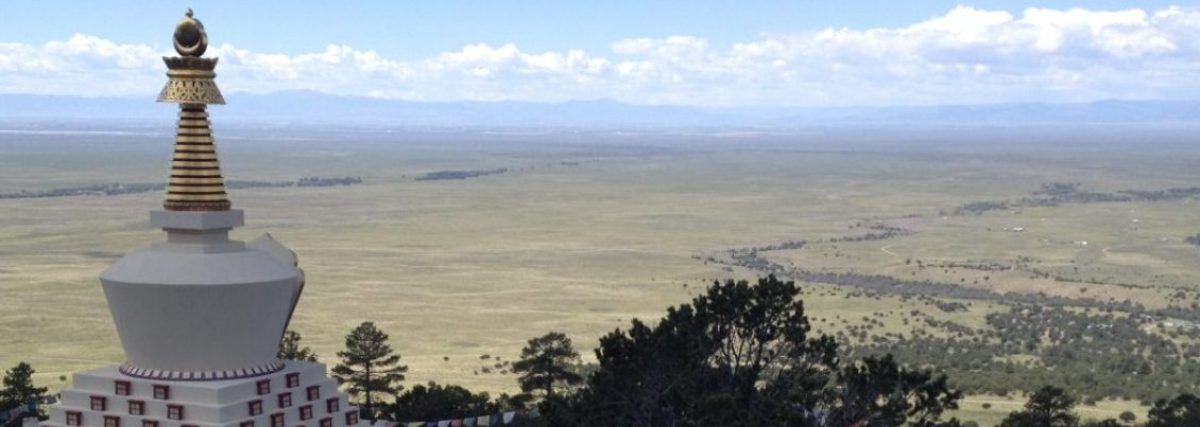
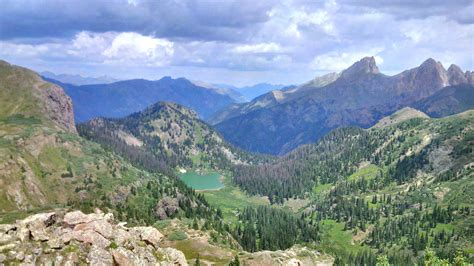
Wilderness conjures images of foreboding, of desolation, a mythic utopian vision of the undisturbed, uncharted pristine state, a territory beyond imagination, beyond human centrality, unspoiled by human presence and the inevitable resulting abuse until it’s eventually overrun by ‘progress’ and becomes defined-and defiled-by that presence. Only then do we adjust our yearnings, mourn its loss and start looking for another wilderness to relieve us of our angst…or guilt…or to satisfy our insatiable quest for new worlds to tame.
What we imagine there is to gain out of that process is a sense of ownership, perhaps even control. And even though any remaining actual wilderness is long gone, we operate as if there will ever be more, as if our personal inner desolation or pristine nature, our loss of home, is always renewable, can always be recovered, that our sins can always be absolved. Our investment and belief in wilderness, like our belief in imagination itself, is total.
It’s been a universal human trait since the beginning of time to explore the wild, to move outward beyond boundaries, to redefine one’s place, to satisfy a primal urge to seek sustenance in the unknown, to venture onto our own unconscious, to assert personal independence and a renewed sense of belonging to the world. These are the primary extractions. We might include a timeless motivation to escape being relentlessly subsumed into the homogeneity of culture and to reconnect with the heterogeneity of the wild. We explore to know ourselves in re-enacting the imagery of relationship with the unknown and the more-than-human.
What is commonly found in wilderness, or what could now more accurately be called protected lands, in the exploratory process, may enrich our lives, at least temporarily. We may be driven by the dulling of our senses in the urban landscape or an ever-present but barely acknowledged solastalgia, the suffering and grief of being uprooted, homeless. Yet long before there was any such thing as protected land, exploring wilderness, at least in America, also became synonymous with progress. And that progress has brought a world in which every form of wilderness continues to be transformed in ever more sophisticated ways. Ironically, imagining one can escape that commodification (even for just a short time) somehow inevitably leads to its increase.
When the human population was much smaller than its current size, before the carrying capacity of the earth had been exceeded, that wilderness in its iconic state did still truly exist, calling upon the human longing for….what?…a challenge, to continue the indomitable impulse to improve our future, for wholeness? The fulfillment of a narcissistic urge for notoriety, fame, adulation? A purely economic interest? Or just peace and quiet? The relentless commodification of every possible resource, now including attention itself, has always been a dominant motivation. And let’s not overlook the myth of returning to our origin, the original Garden. There’s weight to all of these scenarios.
America is a land originally occupied by casualties, fugitives, dissidents, pirates and radical escapees of the European monarchical and religious order. And ever since, what’s been largely, either inadvertently or deliberately overlooked for three to four hundred years is that the western definition of wilderness was always the property of the invader, the settler, the colonizer. The exploratory enterprise into the vast territories of the Americas was also an enactment of Divine Right, spurred by the Papal Bulls of the 15th and 16th centuries declaring indigenous people to be less than human, fueling the promise of riches with ecclesiastical benediction. If that empire required the eradication of indigenous populations, either by intent or by accident, it never occurred to the occupying force that the territories in question were not wilderness at all to those who lived there, but sovereign territory, the nature and dimensions of which the settlers could not even imagine.
Sustaining the American mythology of wilderness is a solution to something. It gives buoyancy to possibility. Yet modern American culture has never quite satisfied a longing for place, and that wanderlust is both a response to existential homelessness, a sense of not truly belonging to the land, and a temporary escape into actual homelessness that wilderness represents. That escape is ironically motivated by pre-cognitive yearnings for a sense of relatedness to the natural world which we experience at a somatic level, but which has been entirely coopted and twisted by modernity into a reaffirmation of the individualist ethos of America. We may be able to superimpose ‘home’ on what was once wilderness, but what we now call home does not in itself constitute indigeneity. In many respects, home is now a wasteland of the banal, the superficial, in which multinational corporations own the mythology and harvest revenue from it by exploiting our psychic attachment to the idea of wilderness combined with the myth of individualism. The Anthropocene at work.
Your homelessness leads you by the nose to the next solution. So, nobody should be shocked that every solution we come up with deepens the problem the solution was designed to solve.—
—-Stephen Jenkinson
Regardless of where the urge to occupy wilderness originated, at some point it morphed into something much more than any original or merely personal reason to go beyond the horizon just to see what’s there. In the face of accumulating encounters with other cultures already embedded in what we (western explorers and American settlers) persisted in calling wilderness, the enterprise became something very different from the original vision.
In what has since become a central tenet of the mobile tableau of modernity, the vision of exploring the unknown is equated with the drive for perpetual growth, a messianic mission promoted with religious fervor to ‘improve’ life for ‘everyone’ while looking away from the true costs. Recruiting enthusiastic compliance with the program has not been entirely successful. Having a dwindling supply of authentic earthly new worlds to conquer, human imagination is captivated with doing more than gazing at the heavens, but actually exploring space–which of course continues largely without human participation, but occasionally goosed by the chest-beating of the uber-wealthy. The mullahs of physics and biology reach into the mysterious territories of sub-molecular function, even into the vast spaciousness of individual atoms where matter and energy are barely distinguishable. The nature of the human mind continues to inspire and baffle.
Preserving the fantasy of European ‘discovery’ has been a key North American enterprise ever since the origins of its nation-states. Erasure of the indigenous equates the encroachment of wilderness with the creation of home and the ethics of growth, as if history only began with the colonial project. And now, as an alternate narrative of what America exactly was before colonial occupation gains firmer footing and takes hold in popular consciousness, powerful backlash comes from those still asserting that America was a natural and cultural wilderness before white men set foot on its shores. For them, anything pre-dating coloniality does not matter nor did it even exist. Imagine the dissociation necessary to deny all of that violence. Colonial America may have been an escape from empire, but it immediately seeded the creation of a new empire, an ongoing occupation of what is still regarded as wilderness in virtually every elementary school in America.
The nomadic vanguard (a term coined by Patrick Turner in this essay in New Critique), is a property of American coloniality essential to America’s creation story. We were born from a nomadic vanguard and America would not be America without one today. The fact that there are no physical wildernesses left doesn’t deter us from endowing the entrepreneurial spirit with the same ethos of coloniality that occupied and exhausted every inch of territory from sea to shining sea, and which now seeks to invade and claim every inch of ‘market’ space as well, either by data management, surveillance or AI.
In that sense, the new explorers are the old explorers reinvented with more sophisticated tools, sales tactics, marketing and lobbying power to stake out economic territory and collect every possible advantage provided by the corporate state. They may even be enacting admirable features of the American Story, but like it or not, they are still extending and deepening the reach of empire, a story of extraction, exploitation and repression which has not changed in any substantial way.
We are confused about wilderness and fighting over what requires preservation and how to do that. We cannot continue to promote a pioneer ethic without recognizing its true consequences and the empty nobility attached to it. The nomadic vanguard of today is attacking the remaining shreds of what should properly be recognized as real wilderness, not the coopted mythical wilderness of yore.
 Spontaneous Presence