Is Deep Adaptation Mere Doomsaying?

Is Deep Adaptation simply scary talk? Unscientific hyperbole? Depressing fatalism?

The irony of climate hyperbole is that while many people disappear emotionally and become immobilized, there are also many who believe catastrophe is inevitable. They may believe the science and they may largely understand that scientific modeling has consistently underestimated reality, but they may not grasp the breadth of action required.

Yet, while we ruminate, the predictions for the future are coming true sooner and with greater impact than anticipated.

On the other hand, another form of gloom is to believe Business As Usual cannot be interrupted, no matter how dire the predictions become, because if the last 30 years is any indication, the system is rigged in the interest of the polluters. Greed and corruption trump science.

The more dire those predictions do become, the more dismissive the pushback from the CEO class and those who resist their own straw man of a top-down master plan for civilization and cling to their “liberty” until their last choking and overheated breath. For them, participating in collective action is about as likely as giving up their guns…or tax breaks.

What’s different about Deep Adaptation is that future scenarios are unpacked, differentiated and labeled: social collapse, climate catastrophe, species extinction and everything in between. Each of these terms can be further broken down into real factors and evaluated by bioregion. What is going to break down… and where…and when? And what is required of us? What resources are required to build resilience?

There is a speculative aspect to such predictions, of course, but we already know who is likely to be most impacted and soonest by advancing disaster — because it’s already happening. These domains are all thrown together in the rhetorical reactions to extreme climate futures, rendering them all more abstract and the likelihood of personal impact becoming unrealistically remote.

We also can’t reliably predict where and when the next catastrophe is going to occur, or its nature. We only know the ingredients for such events are in ample supply. This is less predictable than determining where the next avalanche is going to occur on a snow-packed mountain. Yet none of the existing efforts to shift policy, build out renewable networks, upgrade and decentralize energy systems, use resources more efficiently, develop new technologies, educate the public or retrofit infrastructures should be abandoned.

The most appealing aspect to Deep Adaptation is its implication for transforming our relationships. The demand is to determine our values and stop procrastinating. Let’s make the world we want Right Now. If the world is indeed on a path toward social collapse or eventual catastrophe, the human impacts are incalculable in terms of economics, social upheaval, displacement, potential resource conflict, food and water insecurity….the list goes on.

Equal to all these issues will be the impact on mental health, social cohesion, our outlook on the future, finding meaning in existence. We are called upon to define our core values — and value to each other — if we are to survive the magnitude of upheaval on its way.

Refocusing and empowering individuals to develop local emergency resilience strategies, i.e. preparing for social collapse, is something else.

First they have to recognize and break through existing denial. They have to shift out of habitual “me” culture to “we” culture. We have to examine the integrated systems on which we all depend so heavily. Climate impacts are not something that only happens to others. The more local strategies are articulated, the more tools exist to identify and address personal and community resilience, the more people are drawn from their bleacher seats to a place on the field to fully play the game. That also requires empowerment. There’s nothing empowering about doom saying.

Anyone claiming Deep Adaptation is doom saying must believe we can’t walk and chew gum. Even scientists who claim doom saying is not scientifically supported are, in effect, taking the denial position relative to what we already know and have seen with our own eyes.

Doomsayers do not generally have practical agendas nor are they even likely to develop one. Doomsayers have given up.

The cartoon characters standing on the corners holding signs saying, ”The End is Near” are only holding signs. It’s easy to call them crazy because they aren’t offering any practical remedies, no path to resilience, no restorative strategies. Deep Adaptation is doing that, not merely for the sake of giving people something hopeful to cling to, but to save real lives in a real future.

No one is suggesting we all build bomb shelters and stock up on canned goods. But when we start asking the right questions, it turns out there are many practical ways to redefine infrastructure for the sake of local resilience.

The critics of Deep Adaptation appear to believe our greatest hope lies in continuing to deny the magnitude of the problem, to continue believing the myth of perpetual growth and closing our eyes to the degree of our entanglement with each other and the natural world.

We have to examine the steps we’ve trod for 30 years and stop acting as if a different outcome will happen if we simply persist.

Anyone who takes an unfiltered look at the science and the record of popular responses and even long-term organized initiatives on many fronts, would have to conclude the record of success is slim — too little and too late. Which only leaves room for a different approach, a shift toward compensatory measures, getting our hands dirty with the realities of multiple interdependent infrastructures, local resilience, a long-term view, redefining the resource inventory and planning for either an immediate or a phased response.

To those who would claim Deep Adaptation is unsupportable doom saying, I would say many of us are already suffering in deep and mostly unconscious or unaddressed ways. The prime directive of all climate action (even every life) is to relieve suffering.

However we might be suffering as we contemplate a very uncertain future for ourselves and for younger generations cannot be allowed to prevent us from building a thriving, humane, brilliant and creative, life-affirming and resilient world in the midst of advancing disaster. What could be more urgent?

Deep Adaptation II

Jem Bendell arrives at his assessment of existing climate conditions to conclude that near term social collapse (within 10 years) is a certainty, mid-term catastrophe is likely and species extinction is possible. That’s his core platform. He is now the principal progenitor of what is being called the Doomasphere. Yet for us to proceed as if this is the only possible scenario is silly. Each of us may come to a very different subjective assessment on the issues of collapse, catastrophe, personal impact, timeline or helplessness/hopelessness. Every person will make their own assessment, regardless of its rationale, and arrive at a personal ‘temperature’—what they expect will happen over the next 10-50 years. This will become the basis of further inquiry, examining our assumptions and refining our perspective.

Second, Bendell’s reference to collapse and catastrophe only hint at the wide range of possible differences each of us may face depending on our location, climate and social conditions. An urban dweller will face different issues from a rural farm site. I have unpacked them and created a process to look deeper at our own attitudes about these issues and to form an outlook to address these possibilities in our own communities. However, as Bendell says very clearly in his initial paper, denial gets in the way of seeing clearly and moving forward. Hence, though it’s not as simple as we might imagine, denial in its many forms must be addressed.

Third, Bendell also alludes to values several times in his video interviews. But again, he is not explicit–nor do I think he should be. We have an opportunity—perhaps an obligation—to come to consensus about what we hold most important, particularly as we might anticipate conditions that will cause conflict. This is the territory of Reconciliation, determining what principles we will hold and measures we will create to reduce conflict.

I understand Deep Adaptation to be about reducing suffering. The deeper we go into the values, intentions and objectives for developing personal and collective local responses to the advance of climate disruption, the more clear it becomes that this is the primary directive.

Finally, as Bendell also indicates in multiple communications, the possibility of extinction implies the onset of rising fatalities due to displacement, the loss of infrastructure or support systems—the possibility of mass death, being personally impacted by community or family vulnerabilities, even our own death. That possibility may be very slim for some people and quite daunting at the very least. But again, here is where denial enters the calculations.

Imagine receiving a personal diagnosis of a condition, which, if left untreated, would definitely be terminal. Beyond the initial shock and grief, what would become most immediately important to you–a commitment to the treatment, the values on which you can no longer compromise or procrastinate, defining your community, deciding how you wish to live? Humanity is being given that diagnosis. Bendell has cut though a great deal of chaff to define the territory. It is up to us to explore it. That’s what Deep Adaptation means to me—discovering how we wish to respond.

Where Did Deep Adaptation Come From

Jem Bendell is a professor of sustainability and leadership at the University of Cumbria. In July, 2018, he published a paper, Deep Adaptation: A Map for Navigating Climate Tragedy. Based on his assessment of all available climate data, he reached a conclusion that Social Collapse is “inevitable” within 10 years, that climate Catastrophe is “probable” in the mid-term and human extinction is “likely.”

His paper received a dramatic response, all the way from highly critical reviews from scientists, social psychologists and others, to viral circulation and positive responses from the general public. Since that moment 18 months ago, over 100,000 people have downloaded the paper and many around the world have quickly become involved or connected in some way to this approach.

A Deep Adaptation Forum emerged in March, 2019, providing 10 different categories of engagement including an active community forum. The principles that drive Bendell’s approach are the 4Rs: Resilience, Relinquishing, Restoration and Reconciliation. In order, he’s talking about saving what we need, restoring what has been lost, letting go of what we don’t need and what needs to be done to reduce conflict as we enter more extreme climate conditions.

The issue of Deep Adaptation has significant personal and collective implications. What needs to be done individually; what needs to be done to build trust and confidence among people who wish to become involved at this level and what needs to be done collectively to address the world that is coming? These are not simple issues to untangle. But there is a vein of rational assessment, emotional clarity, creative potential and spiritual hunger that is being galvanized by this approach. I feel it and I’m in.

What I intend to be doing on this issue is to explore many questions arising around this approach to the climate emergency, finding clarity for myself and offering the same to anyone else who cares. I will also be exploring what needs to be learned, how to craft an accessible and fulfilling approach to Deep Adaptation for those wishing to become more involved and active in their communities.

Weathering Each Other

miami


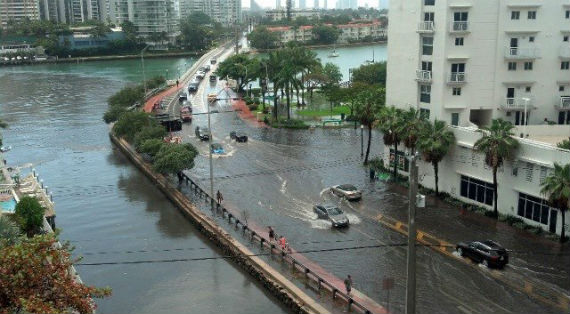
 The signs are more frequent and stronger now. Climate change is accelerating. To many, the sensation of being personally effected is inching forward and becoming more immediate. Those who might have imagined themselves immune or safe are seeing the floods, feeling the lapping of rising water, the storms, the heat and the fire.

To many more beyond the view of western media, climate change is already as real as the droughts, floods or rising seas already a part of their daily existence. The pace of change is accelerating. But while the distance is narrowing between an intellectual grasp of the issue and a direct intrusion of a destabilized climate into our lives, climate disruption remains an abstraction for many. Even so, it’s becoming obvious that to remain distant from the issue of climate change is to remain utterly dis-embodied.

Our bodies, being of the natural world, are materializing just as the planet is materializing. The weather is not happening “out there.” We have always been weathering each other. Only now is it becoming clear what that means. Being fully entangled with the natural world; the inner processes of our bodies are not separate from the outer conditions in which we grow and change.

But we’re not talking solely about bodies here. Consciousness is evolving and is equally entangled with the evolution of the planet. The boundary we imagine between inside and outside, between appearance and reality has never truly existed. It is a figment of our imagination. We can say the same about climate and the natural world. Weather and climate are not phenomena in which we live at all–where climate is some natural backdrop to our separate human dramas–but are rather of us, in us and through us.

We are subject to climate change in our bodies and psyches. We are expanding our view of the perplexing complexity of our connections, becoming aware of the trans-corporeal matrix, the body that sees through its own skin, to and through other bodies, the migration patterns of fellow creatures, the crystallization of water on rock walls, the curling toes of climbing animals, the rhizomal conversations of wild plants, the stories archived in the weathered rings of trees. We are literally one with the biological. All is being processed and recorded, the entire experience of emergence, in the transient, elliptical and toroid story we create and which is creating us.

How is that so? What seems to separate us as biological creatures, our physical boundary, is far less solid and more mutable than we normally imagine. Likewise, the psychic boundary, the consciousness differentiating us is far more real. We are “viscous porosities,” neither solid nor liquid, no more than temporary aggregations of a host of life forms, structural elements (collagen), an energy interface (ATP), a replicative blueprint (DNA) and intra-communication networks, participating with the environment in the creation and exchange of sugars, temperature, moisture, evolution and extinction, even light transformed by chlorophyll.

In fact, all communication is intra-communication. There is no objective separation between any elements of the biosphere. All communication occurs within that realm. There are no side conversations. Everything is part of the whole. At the same time, we are individual contractions of climate, “intra-acting” precariously with the planetary system, each according to our geography and culture, a fractal of the macro-dynamics of planetary change, biology and the micro-relationships in which we live every day.

As trans-corporeal beings, we are making the weather and the weather, created by our human partners, is making us. The idea of ‘externalized’ costs of climate change is a construction of the capitalist economic model. It has no reality otherwise. Those ‘costs’ do not appear merely as respiratory diseases, auto-immune disorders, disease vectors, lost species or degraded atmosphere, but also as cellular deposits, tissue invasions and incipient mutations.

Weather has always been a fundamental factor of our relations, crossing all imagined boundaries between bodies and species. In industrialized societies as in much of the emerging world, we are mostly insulated from weather in our shingled, weather-resistant, secure, durable and isolated domiciles. We want to keep the weather out! Being able to retreat into our vented and layered temperature-controlled shelters provides an illusion of control.

We are distanced, psychically and emotionally, from the realities of those who live much closer to and experience more directly the subtle and constant nuances of weather such that disruptions of the larger cycles of climate are more apparent. In fact, those very temperature control mechanisms that protect us from weather contribute to the very weather we are attempting to protect ourselves from.

To remain distant from climate change is to remain distant from our own bodies and from the community of bodies and non-human species. Yet, the notion of being a weather-maker, creating enhanced cyclones, drought and flooding as well as the internal consequences for others by our daily actions throws the ethics of personal responsibility into sharp relief.

I don’t know about you, but I notice simultaneous hyper and hypo-affective responses of my own, at times feeling urgency and at other times wanting to distance myself from awareness of the impact of my decisions–like air travel, especially–that are surely making others’ weather. At times I feel acutely responsible for all life and am thus aware of the minute decisions I make throughout any given day. At others I will deny any possible personal impact because I want no part of that burden.

Whether we want to know or care makes no difference. The ways we each create weather have, at micro and macro levels, an effect on everyone else’s weather. How do we negotiate or respond to the weathering we are receiving from others? Do we just insulate the attic? Turn up the AC? When the Philippines calls out Western nations for balking at compensation for cyclone damage, when the Third world demands compensation for the weather they are receiving or when the Marshall Islands are slowly subsumed into the Pacific, Western nations treat the equation more as a legalistic abstraction than a contemplation of direct (though delayed) responsibility for their losses–or even the loss of our own coastal real estate.

greenland

Likewise, the continuing objectification of nature permits us to release toxic chemicals in the belief that they will either be sufficiently diluted or that significant time will pass before any meaningful contact with humans will occur. Neither of these views accounts for a trans-corporeal planet. This is analogous to the way we view the linkage between environmental pollution and cancer rates. It is all couched in hyper-legalistic terms of denial that resist the quantification of linear causality or the assignment of financial culpability. The political modeling we get–influenced by energy interests, of course–is that we can continue to create your weather while forgetting that it is also our own bodies that are changed by it. The ethic of individual responsibility is overrun by entitlement.

When Hurricane Sandy hits, a drilling platform explodes in the Gulf of Mexico or parts of Bangladesh are submerged, it’s happening somewhere else to someone else. But when your house is consumed by a wildfire in California, all entitlement dissolves. It is no longer someone else’s problem. And you might become acutely aware of how your weather has been created by the collective action of your neighbors.

The line between “acts of God” and acts of men is increasingly blurred. In fact, the larger dynamic of climate change will continue to undermine and, if not substantially thwarted, will eventually render obsolete assumed or constructed political, economic and social boundaries we take for granted: such as nation-states and money. Increasing conflict will be inevitable to the extent it is believed national boundaries, national character, cultural norms, tribal roots and even language are sacred and must be preserved.

When we ask “was that (climate catastrophe) caused by climate change,” we are weighing responsibility. On our trans-corporeal planet, how do we deal with knowing that as we retreat into our self-contained shelters and isolated thoughts, we are creating distant conditions that are driving others out of their own such shelters?

We are not doing well with this.

How do we accept eating pesticides, depositing pharmaceuticals into each other’s water supplies, causing extinction among creatures that cannot adapt as fast as conditions are demanding? It’s all well and good to attribute agency to nature and to imagine the ways we are impinged. But the capacity of nature to act is constrained by time. Nature does not act as quickly as humans act.

Thus, the times are urgent. Let us slow down.

Trans-corporeality is a denial of denial-ism. Denial-ism denies human agency, non-human agency, and the collectivism at the heart of legislative remedies. Propagating the idea of human intra-action is slow. Yet it should not obstruct focused efforts to influence policy, which is to design instruments that materialize collective responsibility, broaden and hasten abatement of the uncounted damage, anticipating and adapting to the dissolution of so many boundaries along the way. Short of a universal adoption of trans-corporeality, such would be the best means of materializing an accounting that has so far been so elusive.

A generative collective response to the weather dilemma does not depend on a single social or political approach. We need multiple measures, even if they arise from within the paradigm that still objectifies nature. As our common dilemma upsets more of what we know and reveals more of what we don’t know, living and acting in both old and new paradigms simultaneously will still be an effective human way of ‘being there while getting there.’ Ultimately, what we will require is much more than policy to get ‘there.’ We will need a healing view reflecting the true nature of our entanglement with each other and the world.