
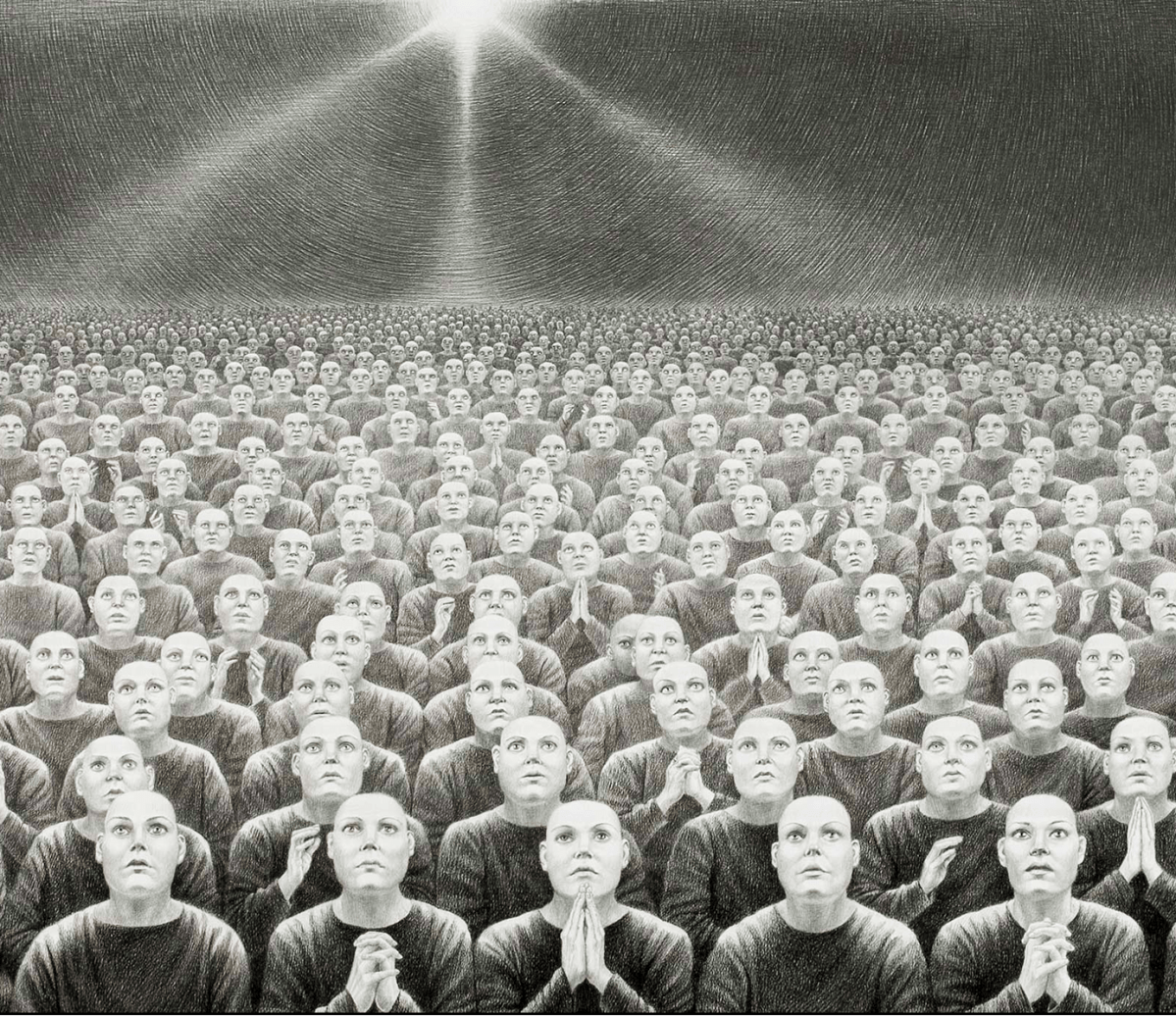
Delusion

It is so painful that now, given the helplessness of it all, whatever humor there may once have been in the infinite variety of human foibles is subsumed by the poignancy and terror, the desperation and bewildered hatred at the heart of mass delusion.

One of the things meditation can be is a discovery of what about us doesn’t change and releasing identification with everything else, freeing oneself of all obstacles to becoming anything other than vast space.  This means dis-identifying with form: sensation, feeling, structure, any imperatives including body, time, desires, mental journeys, memory, gender…even meditation itself. For me, that especially includes impatience. To whatever degree I may approach such a condition, the practice becomes non-meditation.  Non-meditation is the essence of Dzogchen. 

Gazing is an auxiliary practice of expansion, the elimination of distraction and finding what I have come to call integrity. Exploring what integrity means is to approach wholeness not only mentally, but also to explore its physical components. Coming into full stature in the practice of gazing is to embody a physical architecture of integrity, which is not separate from the integrity of mind. Opening to compassion is the point. Approaching integrity of the body is to create space for breath, rising into a connecting and expansive heart-space, expanding into fullness. 

Premature dis-identification with feeling or ignoring the presence of unresolved conflict (by-passing) will always get in the way of the integrity we seek. The presence of strong feelings will hinder the longer-term clarification process. There are plenty of ways to work with feeling, but however one addresses that process during or in post-meditation, it will benefit quality of life and practice. Ignoring incomplete emotional clearing will obstruct the benefits of time spent in practice. Not that practice must be interrupted or delayed, just that a short and long-term emotional clearing process belongs as a part of practice. Either succumbing to by-passing or imagining the emotional work ceases at some point is a form of delusion and will undermine our capacity to inhabit our full stature and reap the benefits of sustained and careful attention to the full expression of integrity.

Assuming the emotional and physical architecture of integrity becomes a natural platform and a capacity to cultivate compassion, from which we may even sense the massive field of human karma, from those closest to us to the most remote strangers. Becoming permeable to and connecting with karma that is not our own, to witness and hold it without being affected or thrown off balance, remaining on one’s perch, as it were, is only sustainable if it’s  based on authentic compassion, which is itself an intrinsic quality of integrity. This is the achitecture of freedom.

From this stance, Bodhicitta and Compassion become identical. They can only come from full integrity anyway. Not immobile or rigid, merely steadfast. From this platform of integrity, compassion and bodhicitta become one as they are expressions of the same thing: the mind of enlightenment. 

Gazing into the ocean of human karma, the delusions overtaking a large portion of humanity become manifestly clear. In the grip of delusion, so many are stuck, trapped in an uninterrupted and tortuous cycle of wandering, being whiplashed back and forth between the first two Noble Truths, the truth of suffering and the root of suffering. It is so painful that now, given the helplessness of it all, whatever humor there may once have been in the infinite variety of human foibles is subsumed by the poignancy and terror, the desperation and bewildering hatred at the heart of mass delusion. 

Take Trump himself for a moment. His delusion has always been apparent. And if one could momentarily set aside the wreckage left by his personal delusion, the naked and lost nature of this profoundly damaged being, he could even become an object of pity. But at some point, not only have his delusional transgressions become criminal as the relative legal world would define them, but he has dragged many millions into his orbit of self-serving chaos. How is this possible?

I think of Trump followers as those whose lives were already being lived at the edge of delusion. Inside their anxiety, resentment, victimhood and self-pity was a simmering anger with no socially sanctioned outlet. For Trump himself, seeing none of the familiar limits that most others see, the outlet has always been to push the envelope of propriety with a combination of entitlement and victimhood perpetually skirting the edges of lawlessness. Why, after all, shouldn’t he have whatever he wants? And anyway, who’s going to stop him? Who has the nerve to stand up against his audacity?

The American Dream has not been working for his people. For them, it crashed long ago. It was being systematically undermined by the plutocrats, bankers, politicians on the take, CEOs and various other capitalists (AKA sociopaths) in positions of authority. Those whom I regard as deeply lost in this cycle of hunger, resentment and rage were ready for the plucking. Yes, they’ve been exploited and played by the relentless and sophisticated divisive messaging and legislative agenda of the Republican Party for decades while simultaneously being misunderstood and abandoned by the Democrats. All it took was certainty, a certain braggadocio, someone who not only gave voice to their seething anger but who resonated with and could embody their own simplistic, zero-sum view. 

From a distance, it’s all profoundly painful. That doesn’t mean I forgive or appease them or don’t resist them, because what they’re doing is trying to draw everyone else into their world while also destroying any alternative to their view, while Trump plants his delusions deeper into their receptive brains, by any means necessary. They cannot be permitted to succeed. But at the same time, the rest of us have to create a world that demonstrates the misguided futility of their quest.

The Leftist reality is more nuanced, less black and white. Of course, it is. And that’s why it’s been under attack for so long. The world view of the Left could never appeal to or alter the mass delusion of Trump world. It’s not selfish enough. There’s even speculation now that direct economic benefits will not break through the Trumpian hive-mind. It’s not a zero-sum vision. What passes for the inner sanctums of the Democratic Party in America may be equally deluded with some of its own toxic certainties, confusion about whiteness, their corporate view. And also similar to the right-wing is their steadfast belief that they are absolutely not deluded. Their submission to neocolonial capitalism is more subtle. The forms of grasping and exploitation are less overt, remaining in constant tension with forces of generosity and mutual dependence. In Trump world, no such tensions exist.

Referring back to personal practice, just because of what it already is, I’m being as deliberate as possible about dissolving every boundary between self and not-self, between external and internal. For brief moments I may skirt the edges of non-duality. In other words, leaping over physicality or presence into what is nothing but space, softening materiality, feels like a recapitulation of the dissolution of death itself. In fact, every instruction, every sitting, every incremental step toward realizing self-knowing Awareness is a practice for the end of life. Every sitting is an encounter with my own death as if my sole concern is noticing the Nature of Mind, noticing all phenomena as the natural emanations of Mind, empty in nature. 

This is precisely a rehearsal for the bardo experience. This is the space of death, the journey through the bardos, of being finely tuned to the signs and signals of that journey, not skipping over or impulsively mis-interpreting anything, not being distracted, frightened, grasping, descending into desire, mentally chasing after every shiny object nor being afraid of any appearance that may arise. This is also a metaphor of this American moment. We are traversing the bardos, facing the conditions of our death and next life, defining the terms of a national rebirth.

The act of accessing the three kayas of Vajrayana, empty essence, lucidity and compassionate energy, realizing their inseparability, is also the personal journey into the three bardos happening every time your ass hits the cushion. Well, America’s ass is on the cushion. Our national karma and transition are playing out daily before our eyes. We’re being bombarded by demons, black arts, wrathful deities, apparitions, deniers and false prophets, the viral hallucinations of Trumpism dressed up as public discourse. But let us not be fooled. Let us remain focused and steadfast in our integrity, determined to remain in our dignity and full stature.

One important question continues to poke its nose into my space. We live within the machine, the zombie machine defined by and driven by late-stage capitalism, fundamentalism and whiteness determined to emerge triumphant and unscarred from the death throes of the Enlightenment. The machine has always offered the illusion of control. We may be able to personally or even in ephemeral enclaves or in our brief sitting time reject the machine, believing we can temporarily overcome its influence or live (or imagine we are living) outside its control and we may thoroughly reject the illusion of control. But if we are not also dismantling the machine, pointing out delusion, naming its impotence and offering an alternative, what are we doing? Practicing for our death while watching America meet its demons in this transitional time while standing for the terms of our rebirth is the only game in town.
The Root of Happiness

Bodhicitta is a way of connecting to other lives, of saying we are nothing without that connection and that our connection to each other is deeper than we can ever truly know.

Bodhicitta is a way of connecting to other lives, of saying we are nothing without that connection and that our connection to each other is deeper than we can ever truly know.

Four years ago, we were suddenly dropped into an alien landscape, akin to the toxic atmosphere of an alien metropolis. All plans, intentions, contemplations, associations and actions were transposed into the era of Trump.  Was this a dream, or was I waking into a nightmare?  The landscape was familiar, but somehow different, no longer safe. Everything, values, lifestyle, morality and an ever-fragile peace, balanced on a knife-edge.

I went through the motions of normalcy, repeating familiar patterns of activity. Yet nothing was familiar anymore. Everything seemed to require a little more intention, a little more clarity to become real. Insofar as I could become absorbed, focusing on something compelling or becoming temporarily lost, I was happy. But upon emergence from that condition, drifting back to the larger awareness, I was reminded in the next breath of a less stable and more threatening world, not merely in a physical sense, but in a deep moral sense. As we know, that condition has gotten much worse beyond whatever I might have imagined four years ago. Grief remains just below the surface. Happiness–true equanimity–has become much more elusive. 

There are those who would surely have said then, “Welcome to reality, dude!” As if not much had really changed. After all, we’d been on this trajectory toward dissolution for a long time, they might say. And I would have agreed. But no, with the election of Trump, dissolution went geometric. Ever since, we have amplified the suffering of the many for the sake of the happiness of a few. The great irony of that electoral decision made by so many is the belief that they would be spared the consequences of the agenda they had just endorsed with their vote.

Which brings me to ponder happiness itself. We might well ask what that was or how those who regarded Trump as a threat multiplier of unknown proportion would know it when they saw it. In truth, however, when it comes to happiness, all of us fall into the same category. Those who voted for Trump would have been mostly unhappy for a long time (never mind how they might have defined happiness), though if I ever suspected they might have seen that Trump could not (nor was he inclined to) resurrect the American Dream for them in the way they most desired or believed was possible. Or, if he had made a serious attempt, it would have come at great cost to the cohesion of the nation (as it is now), not to mention our international stature, all of which happened anyway.

More precisely, I think about how I think about happiness–because the answer to that question has a lot to do with whether I am happy or not. The intention to be happy is innate to many decisions every day; but what does happiness now mean as the era of Trump has taken so many significant and profoundly disturbing turns? We’d better know what it is, because we’re gonna have to work harder for it.

Dharma regards everyday happiness as transient since it’s entirely based on a dualistic view. Happiness is defined as the absence of suffering, but for there to be happiness at all, there must be something we call suffering. Happiness may be a benefit we wish for others by our aspiration and our action.  We may wish everyday happiness for everyone, as if the satisfaction of having “enough” is sufficient, even if it’s temporary. Beyond that, we wish for a release from the cyclic behaviors that drive us to seek happiness in ways that are not satisfying…or may even damaging to ourselves or others.

The metaphysical perch from which we view happiness is bodhicitta, a comprehensive compassionate view. We want to enjoy the relative happiness that flows from realizing the Four Noble Truths: the universality of suffering and the fact that there is a (Eightfold) path through suffering. We extend that wish to those who are experiencing the suffering of pain and the suffering of change. We extend these wishes to those closest to us and can also extend it to everyone in general.

Beyond our immediate circle, there are those to whom we do not feel close. We may feel neutral or even indifferent, but we can extend a wish for happiness to them. There are still others with whom we have a negative history and residual negative emotion. It’s more complicated to erase negative emotions completely, to extend a genuine wish of happiness to such a person because negative feelings don’t just dissolve upon request.

To transform negative emotions into unequivocal, refreshing, clear and unlimited positive regard is not trivial. Not is it an act of mere will. It is a deliberative process, sometimes a sharp reality check requiring that we go beyond what we merely wish to be true to true forgiveness and compassion– for ourselves as well as for another. At the heart of those judgments about others, I am likely to find a judgment about myself, which may itself arise from a painful incident buried in the past. It is only in looking at the origins of those judgments, at the emotional anchors and core beliefs that hold them, that they can be seen for what they so often are: self-cherishing stories, baseless assumptions, limited beliefs. 

I’ve practiced this with romantic partners, family members, a former spouse, a former supervisor, co-workers and even former friends. Admitting the deep attachment we have to our judgments about others is often slow and careful (not to mention uncomfortable) work, especially if we believe we have been personally wronged. But working through the resentment or anger to an authentic clarity is possible.

We can form honest intentions about others that we disliked at one time. Yet some measure of animus might creep back. One might manage an authentic wish for a moment but find it difficult to remain in that clarity for an extended period. It’s unsettling to realize that if I was standing in front of someone I disliked, transmitting an honest wish for their happiness, they might get the idea that I liked them.  Kinda like the way the Dalai Lama refers to the Chinese: my friend, the enemy. Could I do that face to face with a Trump supporter, a racist neo-Nazi?  They might think we could be friends, which would present even more challenging circumstances. With certain people, I’m not so sure I could tolerate that. We simply resist letting go of the hardened ways we see certain people. This gets tricky, doesn’t it? But neither does it mean I have to agree with or condone the views of any random Trump supporter.

Shantideva famously said that there is no such thing as happiness in samsara. He was referring to a previous statement he made about happiness in which he declared that the only true happiness derives from completely renouncing self-cherishing. Any wish for happiness or action toward happiness based on self-cherishing (What about ME??) would be dishonest, illusory and ultimately futile. Everyday happiness is a product of causes and conditions, meaning it is bound by time and therefore impermanent. Shantideva is saying that any such happiness is not true happiness. From the absolute perspective, anything that arises from causes and conditions has no intrinsic reality. No matter how much we avoid suffering and no matter how successful we are, the entire charade is a product of the fundamental mistake of believing in the existence of our separate identity. Removing ourselves from that view, suddenly neither happiness nor suffering have ever existed.

Of course, this is an idea that runs directly counter to our sensory experience. But again, neither our perceptions nor emotions have ever had independent (permanent) existence. Yet, neither are they non-existent! We are left with a perfectly clear choice to continue cultivating the bodhicitta of compassion that doesn’t take sides–which is to say, no matter how we voted, we are all equal in our lifelong dance with suffering and change.

If letting go of judgments seems difficult, it’s likely because those judgments reinforce our sense of a separate identity There is no need to deny the reality of our feelings and emotions so long as we don’t get hung up believing that there is any true substance to them…or, for that matter, to the feeler. By continuously reinforcing separation, every “self,” becomes a unique pattern of inattention to the larger reality in which it lives.

We can hold the great paradox of the truth of appearances while still being mindful of their ultimate non-existence. True compassion, without making any distinctions about who deserves it or not, views all emotion, happiness and suffering as equal in nature, arising from a trance-like belief in the reality of opposites. We can still be happy…realizing that suffering will inevitably be a part of that relative happiness.

Taking this view into the practice of aspiration or active bodhicitta, we can project our compassionate intentions knowing that to fully overcome self-cherishing may be out of reach–at least in this lifetime. For now, we simply do the best we can.

A supremely spacious clarity is a prerequisite for accessing the source of happiness. From that source, happiness becomes a view as vast as space, an uninterrupted flow of sensation and feeling without attachment, an expanding, unimpeded, infinitely inclusive condition of holding all that is. Everything is included: all events (including the assemblage of events that is Donald Trump), all sensation and all emotion. No need to deny anything. On the contrary, everything can be used to energize our view in every moment. If that condition of possibility can be formed, arising unimpeded according to one’s capacity, then anything can arise in that space. 

Does such a condition exist outside of ego-consciousness? What is “happiness” not arising as an object of intention? Do we call it happiness at all? If happiness can exist as something other than an object of “my” intention, then who is the “I” that is forming the wish?

Contemplating the supreme spacious quality found at the root of happiness, I do not create or wish happiness for myself. I don’t wish for the happiness of a single separate identity, “me,” to become just another passing object of attention. I seek happiness with no object, which is to say a wish of happiness for all others. Resting in the root of that happiness itself, arising spontaneously without intention from a dynamic spacious nature, being “uncreated,” as it were, it becomes entirely natural to extend it to all others.

I project a wish that others will also connect to that root. Inherent to such a wish is the knowledge that we are all connected by and as the root of happiness. We are not simply connected separately to some ineffable source of happiness. Our connection to each other is that source. The nature of happiness is identical to the true nature of everything; we can’t separate the source of happiness from the source of compassion, from the source of loving kindness or joy. They are all inseparable from each other.

Our work is more than the formation of wishes. It is the active removal of all obstacles to a connection to the source of happiness. Believing we are ever separated from the root of happiness or, for that matter, from any of the Four Immeasurables is the obstacle to overcome. In the non-dual view, since there is no such thing as happiness (or suffering), connecting to the root of happiness, already pure, goes to the heart of the Mahayana view. True happiness and compassion arise in natural abundance from the same timeless and ineffable source: the realization of emptiness.

The nature of happiness becomes known as appearance imbued with the truth of emptiness in which the very idea of happiness itself has no true existence. In every time, even as Trumpism mutates into post-Presidential threats yet unknown, that is precisely why it holds unlimited potential.