Tribute to Joanna Macy
The Great Lady of Deep Ecology Has Left Us
Let This Darkness Be a Bell Tower
Quiet friend who has come so far,
feel how your breathing makes more space around you.
Let this darkness be a bell tower and you the bell.
As you ring, what batters you becomes your strength.
Move back and forth into the change.
What is it like, such intensity of pain?
If the drink is bitter, turn yourself to wine.
In this uncontainable night,
be the mystery at the crossroads of your senses,
the meaning discovered there.
And if the world has ceased to hear you,
say to the silent earth: I flow.
To the rushing water, speak: I am.
Reiner Maria Rilke
I awoke for no reason at 11:45 on Saturday night, July 19, just as the message notifying us of her passing landed in my inbox. But it wasn’t until the next morning, opening the Caring Bridge thread, now with over 130,000 visits, that I had a good and solid cry…for her loss, for the world without her, for a moment of feeling utterly bereft and so profoundly alone, as if I had lost my footing and was now falling into empty space; tears of resolve to embody the Turning; tears of grief and tears of healing. Tears of love given new footing.
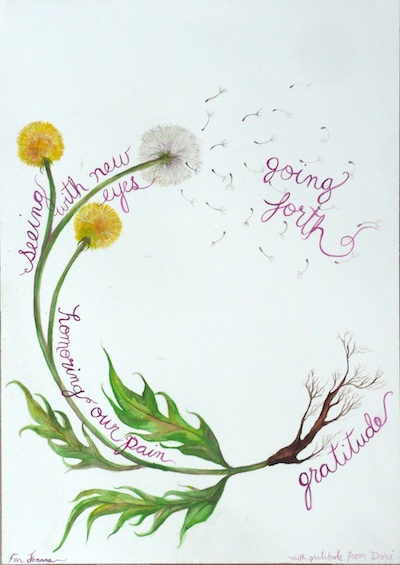
How do we live with such great loss? The same way Joanna encouraged us to meet every issue, every new beginning, every setback. First with gratitude, for life, for all we have, for all that is not lost. Second, by honoring our pain for the world, going into it, meeting it, allowing ourselves to be enveloped, not only by personal pain, but by the universal pain of all sentient beings, witnessing the contortions of climate and all the social and psychological dislocation that has already occurred and all that is yet to unfold. Finding compassion for the one who is in such pain, for the multitudes struggling with fear, uncertainty and their own losses, recalling our kinship with all life, a path forward begins to appear.
Gradually, our eyes open to new possibility. Joanna often expressed the three possible responses to the crisis: throwing our bodies into the gears of the Machine, creating new institutions, and changing our own consciousness. Here, we mostly see blossoming evidence of new institutions and increasingly sophisticated strategies to resist the capitalist expansion. Woven throughout those initiatives is the continuously awakening and highly articulate refinements of consciousness that must accompany everything else. Indeed, it is consciousness that drives the creativity we see here.
With that new awareness, with every breath of effort to disengage from the narratives of empire, we meet ourselves, cracking the egg that now limits our growth, birthing a new vision. As Joanna put it, seeing with new eyes.
Chogyam Trungpa famously said, ‘Dharma is the realization that ending is not possible.’ To put it another way, Buddhism continuously negates arrival because at the completion of the Path, there is no ‘place’ to arrive and no ‘one’ to be there. There can be no finality. The entire Buddhist path is about perpetually arriving at a non-existent destination.
Joanna embodied the union of Path and Result, the awakened nature of love itself. Being with her, there was no distraction, no retreat into ego, nothing to defend. The only attachment possible was to that love and to share it naturally, fully. With her, we stepped into the spell of becoming love for the world.
The disappearing destination puts identity on very shaky ground, just where it belongs! The paradox of there being no there there lays bare the modern world’s desperate pursuit of permanence in a vast field of impermanence. Everything must end, yet existence & non-existence are coexistent, entwined as lovers, as often depicted in Tibetan iconography, reciprocally transforming, reminding us that transformation comes through the union. There is no solitary path. To embody this is beyond path, beyond destination, beyond conventional activism or advocacy. This is the paradoxical essence of disappearing presence. The bodhisattva must leave for us to occupy our own nature more completely. An unresolvable koan!
Joanna, a shining being, even in her absence, becomes more present. This was her final gift—to reveal the ambiguity of being/not-being, the forever fragile home of the deepest grief, the greatest love and the most profound compassion. To live in that ambiguity with the same compassion that flowed from the heart of her being becomes our charge. Our gratitude and love for the gifts she so generously offered, and now for her presence/absence is as deep as her love for this world.
Chaos, Complexity & Emergence II
Elaborations and Conclusions
As indicated in the first post on this topic, emergence is a property of living systems greater than the sum of its parts. Emergence is evidence of a form of self-awareness that collects data and intelligently chooses a path of adaptation, resilience and survival: a future that departs from the past is always in the making.
The flow of life may seem predetermined because we depend on the accumulated intelligence of eons of experimentation. But it is also spontaneous because life has never foregone its experimental essence. It is always confirming the essence nature of reality, emptiness, the absence of any independent nature of anything. It is what the sacred texts and the Tibetan tradition call dharmakaya, the root nature of reality, the source-less source of everything. I am using the word flow from Neil Thiese’s Notes on Complexity, to point out that what Buddhists mean by emptiness is not a static condition, but a platform of infinite possibility from which all events, from the quantum to the atomic, molecular, cellular, and more complex systems arise. It would seem that emptiness and emergence are cousins, at least.
That nature is ‘empty,’ is confirmed by the behavior of sub-atomic particles, revealing that there is no self-sustaining independent quality of either matter or energy. At the quantum level, matter and energy are interchangeable, and changing so fast they might as well be both at any instant. Tuning our awareness and receptivity to this level of reality in which appearances and emptiness are virtually equally real requires that we modulate the pace of our subjective process, the activity of mind. We must slow down. When we imagine this primal effervescence, we may be cultivating a more substantial connection with things as they are (and aren’t), and how they become what they are. In other words, only by fully settling into stillness may we understand the nature of motion. Nothing is truly fixed. Emergence is universal property of life.
Observing the self-organizing nature of living systems from the cellular to the galactic, the limitless creativity of organic life seduces us, baffles us, mystifies us, torments us, and inspires us. We have no choice but to investigate, to throw ourselves into the unknown and unexplored, teasing it all apart, to ‘know’ its nature (our nature), and to derive meaning from that exploration. Or, we can step back, soften our gaze, relinquish the need to know, and relax into a completely non-judgmental, curious, widening view of non-engagement, wu wei, non-doing.
Seeking permanence by attaching ourselves to what is essentially tenuous and impermanent is to overlook emergence entirely, the ongoing complexity of autopoeisis. Living systems are driven to repeat the past and may do so endlessly, but only as long as conditions remain unchanged. A system is not constantly looking for the new. Its resilient capacities may be dormant, but it will synthesizing the new when conditions demand it without needing to ‘know’ anything because it already knows itself. There is no seeking, no analysis, no meta-contemplation. Emergence is self-generating and entirely organic. It’s the changing dream of Being, coming true in every moment.
There is no right time and no benefit to dwelling on appearances. Impermanence is the law. Even conditions that appear to be without motion exist within the law. There is always activity; cessation is always burning through. Though the principle of emptiness says there is no true substance to anything, we must still, as C.W. Huntington, Jr points out, have some way of referring to what we are talking about. Even the symbol zero, implying formlessness, suggests that formlessness is a thing. emptiness is not a thing. Ultimately, there is nothing other than the appearance of form, only a suggestion of materiality. Like the Tao, form and formlessness are wedded in a way that makes them indistinguishable, an ineffable blending of the two. At this level, no values can be assigned to phenomena. Everything is simultaneously real and apparition. This is the accepted ground of reality.
The emergent heart of biology is expressed in the ongoing transition from form to formlessness and back again, phenomena arising from and returning to nothing whatsoever. The methods of modern science may reveal its mechanics, but beyond all mechanics, emergence is the home of consciousness and connection. Life as communion, far beneath intellect, beneath seeking, beneath completion or incompletion. Here, neither categorizations nor judgments apply. In the absolute belonging of no body and no-self, we give ourselves to perpetual emergence, with no agenda, no attachment, no past, and no future.
Within the ecosystem of earth, any phenomenal emergence is a passing manifestation of spontaneous invention. Beneath this dynamic, beneath cause and effect, is an economy in which nothing is gained or lost. All accounts balance. There is no linearity, only the unwavering tension of apparent polarities bound by a mysterious attraction. Only the intelligence of impossibly complex systems processing data in nano-moments, having no goal, no direction and no imperative other than to continue exists. There is no chaos here, nor any determinism and no breaking of boundaries because no actual boundaries exist.
Neither right nor wrong exist here, nor do good or evil, as the unceasing nature of emergence resists any arbitrary value assigned to a single event. In absolute terms, any categorization of phenomena by any value system has no relevance. And to whom would it even be relevant? It is only we humans who believe in rational absolutism, who have taken rationality to its self-terminating apotheosis. What lies beyond rationality is difficult for conventional consciousness to grasp and flies in the face of anthropocentrism because every valence we place on thought or action, all form, arises solely from a need (referring to the original post) to make life safer and more predictable. By hovering in an intermediate zone between materiality and apparition, we attain a lucidity that comes with awakening from the dream of samsara. We enter a quality of freedom infused with compassionate intent, the ethical and moral engine for all action. To withdraw from the imperative of compassionate intent is to violate the mandate of life and descend into nihilism. In today’s world, it pains me to say, nihilism has gained an edge.
Even so, an autopoietic response to a continuously changing environment is constantly underway. We may cultivate our adaptive capacities through choice or circumstance, but what we normally think of as identity, an intangible presence, no matter how much energy we spend constructing its defenses, remains mysteriously impermanent. The only reality is process. Paradoxically, the change that emergence brings is a sanctuary, an omnipresent transitional state, where safety is upended, where all reification goes to die. At the emergent edge of life, we share a common journey. The existential issue of the moment is whether we can recover a mindfulness of belonging to each other. The earth system (because it cannot do otherwise) is reflecting our errors, showing us what we have lost and what we yet stand to lose by failing to find each other.
The somatic experience of emergence is happening so fast we struggle to process it all. Trauma is expressed as conflicting intentions, inhibited or constrained movement within the human system, translated as psychological conflict and inhibited expression. The influence of hormones and neurotransmitters are in conflict as they mediate incoming stimuli at the autonomic level, the lizard brain. Without resolution, a positive feedback loop is created. The sensitivity of the system increases, rendering us increasingly reactive to triggering stimuli. In emergent mind, the material of conflict becomes more accessible; the resolution of conflict dials down our sensitivity to a lower baseline.
We can all sense the acceleration of change. It’s destabilizing, making deliverance from accumulated social, historical, and environmental trauma ever more difficult. Multiple ongoing traumas such as war, racism, genocide, pollution, poverty, persecution, and displacement remain open to awareness and render us vulnerable. The impact of fractured communities and cultures, complicity with the extractive economy, rises even as measures to centralize the power and privilege of the few become ever more extreme. Unwinding from that violence requires all the presence, courage, and vision we can muster.
Emotional solitude is tenacious. Most of us carry memories of isolation, alienation, exclusion or marginalization in our psychosomatic experience. Beneath that we cling to our identities, reverting to the prime directives of modernity, seeking results, mastery, accumulation, as if a separate self exists in any ultimate sense. We each have varying skillsets for seeking and creating fields of intimacy to meet our needs. But without the maturity that an echoic outlook may bring, many of us do not routinely experience social resonance at all. Buddhist theory says our attachment to a separate self is the fundamental source of suffering–even as the narratives of modernity suggest our true salvation lies in more of the same. Loneliness, the deepest wound of all, is dependent on this very principle.
One could spend all day detailing the pandemic of modern alienation, dislocation, and dissociation from the natural world. In both a material and a spiritual sense, the creeping and persistent sense of homelessness deepens with the further degradation of the commons. The effect is subtle, pervasive, and increasingly corrosive. All of which makes it increasingly important to decelerate, to find refuge in a slower rhythm of emergence, refining the integrity of our presence, continuously dropping the reflexive grasping of the all-consuming personal self-improvement project. There is nothing to improve, and no one to do it. Everything has always been perfect, including ourselves.
While belonging may imply gain, the greater process requires us to also acknowledge loss. Loss is so pervasive that it is becoming a preoccupation of the post-modern psyche. If we are unable to acknowledge it, we are unable to grieve. If we are unable to grieve, we lose touch with the emergent edge of life, the chalice which sustains love and continues to open us to change and possibility and renewal. By grieving properly for loss, maybe we can also find praise for what is alive right now.
What I have been suggesting is that a deep comprehension of emergence puts us in touch with the inherent integrity of impermanence, interdependence, and emptiness. These three principles, the core conditions of life, are reflected in our acute observance of the nature of chaos, complexity, and emergence. They may be disguised from view, but they are always expressed in the heart of the mathematical equations, the philosophical constructions, and the emotional turbulence of our most troubling moments. Emergence is the raw, un-nameable realm in which life is always seeking the resolution of impermanence and unpredictability according to the realities of interdependence, and emptiness. We contact this vital principle, where possibility expands beyond measure, when we engage its timeless wisdom and compassionate intent.
 Spontaneous Presence