The Denial of Blackness

Blackness is disruptive, appearing from beyond the sharply codified ‘civilized’ landscape, arising from the relational, the tribal, re-enacting the alchemy of kinship, the recovery of natural authority, the intuitive recapitulation of one’s source, a perpetual invitation to and reminder of the inherent precarity of life.

Race is such a raw topic in America (and elsewhere) that I might well question what I, a white person, imagine I’m doing writing about race. I have no authority to be doing this, neither personal nor academic. But I’m not really intending to write about race. I’m regarding blackness as a construct. I am noticing an arrangement of ideas around what blackness symbolizes, to find meaning in that arrangement that reaches beyond race and intra-acts with mass consciousness. 

Small (b) blackness has been characterized by Bayo Akomolafe as a quality of being, as a metaphor beyond the constraint of racial identity. In the most general sense, blackness emerges as a statement about culture and history in a world—what we call Modernity, or if you prefer, late-stage capitalism—which itself is increasingly untethered to either history or culture. blackness is a quality of presence, consciously and unapologetically bringing history into the moment as a way of making meaning, making visible its intrinsic garments. In that sense, blackness is independent of superficialities like pigmentation. It’s an implication of the unexpected, an embodiment greater than physical dimensions. It is the language of uprising, a voice of the whole heart. It arises from instinctual guidance rather than the inertia of mass culture. It’s an expression of wholeness beyond the atomization and categorizations of modernity. It’s the fugitive self, the unchained, the unbowed, uncolonized by modern convention.

blackness is a mark of independence, whether momentary or perpetual. It is disruptive, appearing from somewhere beyond the codified ‘civilized’ landscape, arising from the relational, the tribal, re-enacting the alchemy of kinship, the recovery of natural authority, the intuitive recapitulation of one’s connection to an unregulated past, a perpetual invitation to and reminder of the inherent precarity of life. blackness is an escape, a temporary reprieve, however brief, from the Modern Plantation; it is also a recovery of something rapidly receding from human memory. 

blackness is not owned solely by Black people. It may be embodied by anyone, and its enactments are not trivial. As an elementary example, it’s Colin Kaepernick kneeling (at the sideline) and it’s Eminem kneeling (at the Super Bowl). It’s disturbing, enlivening, seductive, anarchic, and destabilizing. Its implications reside in hidden capacities, in the molecular algorithms of traits, inherited wisdom, communal practice, shamanic ritual borrowed from the bones of the more-than-human, in whatever remains of traditional cultures everywhere. It threatens to redefine self, family, social responsibility, community, and economy. It’s definitely an affront to the State. Most of all, it’s a crack, breaking through the cultural obscuration of existential alignments.

In the conquest of North America, settlers, refugees, religious extremists, and revolutionaries escaping monarchic Europe brought their treasured ethics with them. The entire project of Christianity since its origins had been the transformation of the primary spiritual relationships sustaining every culture it encountered.  Instead of relying on one’s horizontal and historical bonds with land, gods, tribal practices, and pagan customs, the unconverted were called to discard all of that and replace it with a vertical relationship to a single omniscient authority. And if they refused, they invited extermination.

Christian whiteness is built on a limited foundation of sacred rules and structures supporting, from an animist perspective, a narrow definition of God, to the exclusion of all other possible sources or views. Its relationship to the irrational, the lustful, the profane, the un-christened disorder of a complex, tangled and uncontrollable world is the essence of its original denial of blackness. blackness strikes fear in the heart of the modern Crusader. No wonder Christianity is obsessed with missionary zeal.

The morality of the Christian compendium of rules, aligned with capitalist interest, requires incremental repression and restriction. The denial must always be reinforced in ever more confining ways, at increasing cost, to manage spontaneous stirrings or any unbridled celebration of what institutional Christianity might regard as the ultimate threat—the discovery of divinity in everything, all the time. In this light, Christianity, for centuries and especially as it came to America, was always a radical departure from the typical inclusion of unseen forces, the witness of animal, of stone and sky, of forest and river in the cosmology of tribal cultures. blackness is a force of nature. If we do not know it, we cannot love it.  Resisting its resonant freedom relegates us to a life compacted in purgatory, neither fully arriving at the new nor being able to return to the old.

Europeans and white slavers from North America also brought their bias with them. It wasn’t on social or political grounds that slavery was undertaken. It was mercantilism supported by a religious certainty that any culture or people relying on anything other than the promise of eternal salvation could never be worthy of equality or the abundant promise of the New World. Even now, American religious extremists are still embedded in the belief that America was originally a religious endeavor in search of unimpeded freedom and that even democracy itself was sourced in religious principles, never mind what the Constitution or its framers might say. For them, church and state could never truly be separate, and some peoples are marked by God to remain eternally superior. Conversion can never even truly erase their primal nature. To Rome, conferring Roman citizenship to conquered barbarians of the North could never change their intrinsic identity. It only changed their allegiance.

The shadow of racism was never solely an issue of color; it’s an institutionalized denial of the pagan Other, the utter refusal to regard any vestige of social and spiritual structures of indigeneity worthy of equal regard.  And even after 400 years, Black people in America can never totally outgrow their roots even if they aren’t exactly familiar with them. They cannot live their way to authentic equality because blackness is unforgivable. Even behind the appearance of total assimilation, they are viewed, along with other ethnicities, Jews, Asians, and Native Americans, by many white people as beyond assimilation—beyond homogenization. 

Racism is much more than a denial of the dark recess of one’s own being. The purpose of structures and elaborations, both the subtle and obviously brutal controls, the hierarchies of the State, the elimination of Black history is to preserve racist preferences, to protect whiteness from any direct experience or confrontation with the Other. Unapologetic, full throated, fully empowered blackness today is the undoing of white hegemony. The more so it becomes, the greater the threat it poses to the privilege of white supremacy and the greater the violence employed to tame it.  

Globalization has been the project of the West for much longer than the appearance of neoliberal economics. Wherever it goes, cultures are undermined and slowly dislodged from their indigenous foundations, the ancestral, historical, cultural, and spiritual anchors that sustained them, to be discarded in favor of the religion of the market. Yes, globalization is a religion. blackness carries an intrinsic challenge to its narrowly defined cosmology. It implicates a receding past and a present increasingly beholden to the techno-driven bureaucracies and efficiencies of modernity. blackness can be an electric charge that shakes whiteness out of its delirium, its narrow view, its privilege, and complacency. blackness is a call to connect with the subliminal, the repressed, denied, and buried pre-colonial common human heritage. Its power lies in drought-resistant derangement, in its disregard for the ceremonies of exclusion, the protocols of inequality.

blackness is messy, uncontrollable, uncouth and…in opposition to the dominant ethic of the time, irrational. blackness is the paradoxical, unruly, weedy, muddy, and unpredictable ongoing-ness of person-making. It is the intergenerational transmission of rules from the inside out, from the ground up. It’s the inversion of Artificial Intelligence. It’s the continuous shedding of the memory of chains, defying the relentless marketing of the new ‘freedom,’ the pseudo-individualistic human whose authenticity is quietly digested by the modern anaconda, The Machine. And at the same time, blackness, wherever it manifests, recalls and breaks through the protocols of state-defined ‘freedom.’

blackness will always demand to be known, even if it is not speaking. It cannot be categorized. It resides in irrepressible social choreographies. It can be denied. It can be sequestered, controlled, or brutalized, but it will not die. Blockades of rules and regulation can be constructed to thwart it, silence it or to put it ‘in its place.’ But blackness will eventually make itself known because it is somewhere deep in all of us. It is the crouching jaguar biding its time, a savage lesson to the big-game white hunter, to supremacy in any form, to whomever may seek its submission.

blackness is in everyone’s ancestry. The catechism of the mainstream co-opting and monetizing the unconventional is a denial of ancestry, a denial of polyamorous culture for the sake of the sterile and the puritanical. The monomaniacal adherence to monogamy, monotheism, monoculture, monopoly, to a monolithic, monochromatic, and mono-typical digital world is the ultimate objective, a utopian flatland, the Great Reset, the ideal of the Metaverse, the erasure of culture, not simply the ultimate dominance of Western modernity, but the complete structural capture and eradication of blackness.

 

Growth

The pursuit of growth, the acquisition of more, being determined to grow the ‘success’ of one’s life, whether driven by a sense of inadequacy or realizing most of one’s life is now in the past, chasing certainties in ever more precarious ways, is to never grow old, to remain a prisoner of the cultural definition of success and failure. 

Modern culture is entranced with growth. It’s an addiction that’s completely out of control even though we know the consequences are washing over us like the building tsunami that they are. The growth imperative saturates not only economics and our material aspirations, but also spirituality. 

The sanctity of growth is so pervasive that panic ensues when growth slows down, and especially when growth goes negative. I can’t help noticing my personal inclinations implicated here as well, how devoted I am in my later years to what I name as growth, to whom I can yet be, the deepening of perspective, spiritual comfort, a continuous expansion into an evolving comprehension of life and doing the personal work of becoming worthy of the attribution of human. It’s a combination of learning, knowing, faith and loosely held certainties. Most of all, it’s become an ongoing inquiry into the mysteries of time, duration, the currency of living, aging, and death.

What’s also required in the personal growth space is uncertainty, not only a realization of what little is known, but an accommodation to what little I personally know and how I cling to what I claim to know. It’s a realization that the comfort of certainty, though always appealing, is a false security and that a willingness to continuously parse threads of belief and knowing are the primary components of a sustained orientation to openness. As if I must always leave room in the attic for something new, while also continuously choosing among the certainties I have for what can be re-examined or discarded. And besides, if I was to use the Mahayana as a guiding philosophy, much of what I name as “personal” growth is actually an excavation of our true nature, a mining project to unearth our innermost pristine, indestructible nature.

In the culture at large, a critical corollary of continuous growth is certainty. The culture is steeped in certainty, perpetually reinforcing its mythologies as certainties, hardening now into hyper-polarized camps. Whenever that certainty is threatened, either by scientific data, human experience, faith or religious belief, the response is invariably to arrogantly re-assert the inviolability of the primary mission of culture, the prevailing Story, even though that very certainty is destroying us.    

All around us, there is also the multi-billion-dollar enterprise in the past 50 years, what we know as the Personal Growth Industry. And here, as in the culture at large, are the same elements of the acquisitive orientation. More is better. Stephen Jenkinson and Paul Kingsnorth have each written about the deeply entrenched and unquenchable desire for more. The capitalist impulse is widely present in the monetization of the inner frontiers as in any other sector. And even though the premises of the industry are less certain, there is inherent danger in becoming entrenched in certainties about something as uncertain, as uncharted, as the human psyche. This pitfall is just as dangerous in the world of human improvement as in any other.

Economic growth has always been a form of taking, but has only recently become accumulation for its own sake. The identical character applied to inner journeys is what Chogyam Trungpa coined as spiritual materialism. Exploring at the edges of our inner wilderness is where we are truly tested. We can fall into the same trap of arrogance, applying ever more appealing rationalizations of the mysteries of life for the sake of ego gratification, and if one is sufficiently enterprising, monetize the entire experience as if it’s the most natural exercise one could imagine. This is a form of enclosure, a utilitarian, albeit satisfying, capture of our inner commons in parallel to what we see in the physical commons. This materialist model does penetrate the personal growth industry and some of the results are about as appealing as a strip mall. Or we can approach that wilderness with humility, care and patience, relying on time-tested spiritual sciences. There is immense benefit in shedding light into dark corners, exploring motivations, unconscious beliefs and hidden certainties that cause untold suffering and are driving us to the abyss. 

I’m wondering if how we approach growth is related to how we approach death. The pursuit of growth, the acquisition of more, being determined to grow the ‘success’ of one’s life, to extend one’s relevance, being driven by a sense of inadequacy, or realizing most of one’s life is now in the past, chasing certainties in ever more precarious ways, is to never grow old, to remain a prisoner of the cultural definition of success and failure.  Can the religion of personal and spiritual growth become just another means of paving our own paradise? Yes it can. What are we, as an aging population, not seeing as we pick through the vast buffet of offerings, pursuing the life-extending benefits of personal growth practices while mortality whispers in our ears? Is it that we must relinquish any attachment to growth or that there is nothing aggrandizing about chasing youth at the expense of living in the present?

The theory of steady state economic activity represents death to any capitalist, and to all but a tiny coterie of economists. The catechism “grow or die” demands there be no limits, that the idea of limits violates one of the core myths of humanity—that it is our destiny to continue our ascent to universal abundance, leisure and harmony, i.e. the platonic ideal, the Metaverse, disconnected from either history or nature. Implicit to that ideology is that endings do not occur. Limits are anathema. Have you noticed how many science-fiction depictions of an idyllic future include some form of victory over death? Conquering the wilderness is our destiny. Obstacles are temporary setbacks to be transformed into opportunities to transcend limits, to re-make ourselves and thus continue to fuel the myth. 

Limits are for Luddites, who were, after all, the original adherents to the ideology of steady-state economics. And of course, they were vilified then and continue to be the symbol of ignorant backwardness in the face of anything new, especially the ideology, brought to us by our technology overlords, that everything new is good, including new methods of social control, new weapons or even genetic experimentation. Growth is always better. Limits are for suckers.

Death, being an undeniable and inevitable limit, becomes a failure requiring maximum effort to push it off-stage. The slowing of growth causes gnashing of teeth among mainstream economists, which are all tied to the market, which lives and dies at the altar of growth and the outsourcing of death. And even knowing we are all on the way to death cannot fully cleanse the failure from it. We’re always trying to overcome the impending final failure. We’re trying to grow out of it. Failing to live forever is somewhat assuaged by demonstrating how successful we are at fulfilling our desires for more, by amassing wealth for its own sake. He who dies with the most toys, wins. Accepting failure is to accept the end of growth. 

Enlightenment is the spiritual ideal toward which we ‘grow’. The actual attainment of enlightenment, however unlikely, is depicted as a shedding more than an accumulation. Even so, the ideal symbolizes the end of growth, the end of time, and even the end of death. In this time, to accept failure and the end of growth would be widely regarded as a diminishment. Yet it could also be seen as its own deepening into one’s sacred time, into the truth of one’s life, becoming a model of the acceptance of death and failure as operating principles of life. To fully accept the reality of limits and the life-giving property of uncertainty is to let go of the ethics of More, to transform the profane taking for its own sake into an ethic of giving for its own sake. To deepen into our age, to accept limits, regardless of chronological age, regardless of whether the culture deems that age to be ‘young’ or ‘old,’ is to enter the all-too-rare space of what Stephen Jenkinson would call becoming an elder, becoming an ancestor, he says, worth claiming.

Because it does not retreat from the passage of time and can look with an unflinching gaze at both failure and success, standing on holy ground between the two, elderhood conveys an honest perspective about growth, failure, human agency, limits, and death.

Enjoyment

Awareness of awareness is a blank canvas. It has no qualities. It neither facilitates nor impedes the activity of discursive mind: thinking, feeling or sensation. It does not catalogue; it has no preconceptions, agenda or even capacity to invent anything. It simply is.

There have been periods in which meditation has felt stale, unfocused, lifeless, and boring. As if I’d lost my way. My motivation lags. I devise complex equivocations to delay, shorten or skip my sessions. If meditation is part of your life, perhaps this story is familiar.

I recently discovered something lurking at the edges of awareness. In fact, I don’t recall ever previously recognizing this presence. I realized it was enjoyment. I could not remember the last time I had simply enjoyed my practice or felt joy at completion. I’ve felt many other things including satisfaction, a sense of accomplishment and release. I realize the trap that having an objective can easily become. I am practiced in not having an objective at all. But reason creeps into what is essentially an escape from reason. At the same time, the urge to compose and enact an agenda arises repeatedly by stealth and becomes increasingly vexing until it is recognized and dissolved. Yet however many times that cycle is repeated, I don’t recall ever connecting throwing away the agenda with making room for enjoyment. 

When enjoyment suddenly became accessible, I wondered how I had managed without noticing that enjoyment had been absent. Grounding, revelation, equanimity, peace—many things arrive, but pure enjoyment wasn’t one of them.  There have even been luminous periods of discovery and moments of (seemingly) profound awakening which quickly drew me back to the bench with anticipation and wonder. But even in those times, I barely landed on the unique character of enjoyment. It was always refreshing, awakening, discovering, calming, clarifying, releasing, and maybe a healing leap into wholeness, or even emptiness. 

That was—and remains–the object of meditation, to explore emptiness. And don’t get me wrong, there’s nothing dry about emptiness. It truly is a journey into a brilliant realm of compassion, unity and spontaneity. It’s indelible. Whatever you know of that realm can never be erased. But what is the fruit of practice other than the non-dual view or even an open heart if not also enjoyment?

And it turns out enjoyment is a mere whisper at the edge between being and non-being, appearance and emptiness. Enjoyment has its own distinct qualities, enough to generate an authentic excitement about returning to the bench. But upon noticing all this, the enjoyment I felt was not always tied to the experience itself, but to an observation of the experience by the ego witnessing it. It was tied to an ego judging the quality of the time I spent in contemplation. That is different from discovering a pure enjoyment intrinsic to that state instead of a derivative of it, the identity of me being pleased with myself, congratulating myself for a job well-done.

Having a pleasant experience is certainly OK as long as we recognize the determination of ‘pleasant’ is an ego-state, following directly on the heels of our intention to take a vacation from ego. Indulging in a moment of ego determining whether the time we spend in contemplation is positive or negative seems counterproductive. Someone like Pema Chodron would be the first to say such an indulgence is directly contrary to the cultivation of equanimity, which is knowing that regardless of whether a particular session has pleasant or unpleasant feelings associated with it, that such feelings do not determine the value of that time. To give them any weight is a distraction from our original motivation.

Then what is the quality of enjoyment which is not an ego expression? How is it cultivated, or how do we return to it, even in the darkest of moments? The practice of Vipashyana is where enjoyment lurks, although to go looking directly for it like some hidden treasure is a fool’s errand. The objective of Vipashyana, pervasive or extraordinary seeing, is to establish a non-discriminating, pristine, unself-conscious seeing, learning to look directly at the root of mind itself without any evaluation or analysis. In this case, it is not merely to observe the source of mind, but also to become it. The extinction of the observer would be a great (and unlikely) leap, but it is still possible to observe the activity of discursive mind without being drawn into the drama.

Awareness of awareness is a blank canvas. It has no qualities. It neither facilitates nor impedes the activity of discursive mind: thinking, feeling or sensation. It does not catalogue; it has no preconceptions, agenda or even capacity to invent anything. It simply is. Even without doing anything to sustain this condition, one cannot help but relish it. This is no contrivance, no garden-variety psychological enjoyment; this enjoyment does not derive from ego. In fact, by this view we observe with exquisite bemusement the shifting games by which ego entertains itself, moving through the many games and dance moves attending its survival. 

This is enjoyment which does not dispel or hide or overcome emotion. But it can accompany us into any condition, meeting whatever arises, even what we normally consider to be negative emotions, all obstacles, all circumstances of opposition, even the terror of loss. None of these conditions go away just because we are looking from a different vantage point. We are not indifferent to them whatsoever, because, after all, they are us. But neither do they become paralyzing. The very fact that we can experience and know the possibility of having enjoyment in our pocket, regardless of our passing condition, tickling the edges of awareness, is a kind of refuge in itself, essential to our equanimity. 

Kolam: An Essay in Flour

A kolam may itself be an essay, non-linear and made with the intention of dissolution, but if so, it’s a different species of essay. It is an invocation that embodies history, the soul of a culture, the longing of an individual, the connection of a family, the collective imagery of a community seeing and seeking the divine in everything and externalizing the yearning to be reunited with it.

Kolams are typically made in front of the home. After preparing the ground, sweeping, leveling and dampening so the flour will set and hold better, the woman of the house creates the kolam every day at dawn. Every day. It is sacred, but not static, being wholly subject to weather, rain, wind, and foot traffic. It is an inviting source of food for insects or birds-and deliberately so. Its layered expression is infinitely variable, beautiful, colorful, inspiring, and dramatic…and a lesson in transience.

A kolam might be considered an essay or a poem, a snapshot generating numberless words, an affirmation of harmony, a humble renewal of interconnectedness. It’s a wish and a blessing-changing daily-an altar at which one might contemplate the present moment. Although its borders are defined, it expresses the nature of relationship of everything with everything. Can writing even be equal to a kolam? That question is like asking whether reading a book about modern art is equivalent to walking through a modern art museum: one is a two-dimensional and time-limited artifact; the other, immediate in four dimensions, engaging all your senses, blowing apart your default assumptions about time and space. 

Even though it may be ancient, a kolam, like much of modern art, moves–even while standing still. It skitters through time, culture, rousting sleeping archetypes, connecting past and future, uniting the inside and the outside in timeless postures. It’s often a passageway into deep pictures; evocative, visceral, full of the imagery of one’s personal and tribal or even ancestral history. Unlike a traditional essay, linear, limited by thought, convention, language, having no prescribed ritual of creation, being more individualistic in its place-making, a kolam, through the prescribed ritual of materials, is a more democratic and inclusive expression of an individual or a collective place in time. How could the two be considered equal?

The economy of a written essay is restricted to conveying knowledge by acquaintance. The terms of exchange are limited. In any of its traditional forms, it cannot include a transmission of direct experience. A kolam is not an essay in that sense as it conveys knowledge more directly, connecting the creator to a stream of historical knowledge as well as creating new knowledge in that direct experience. And like any other art object, it’s open to infinite interpretation.

So much is contained within even one photo of a kolam. I don’t believe I’ve written anything that compares to it, other than possibly poetry, taking far fewer words than what is thought of as essay. My essay might describe most everything that a single picture conveys, but it would be doing so in a far less compelling medium, one that might well give words to adolescent simplicity or even practiced adult elegance, like the communal journey of a single kolam. But I don’t recall ever approaching with words what a single image can evoke, a multidimensional direct experience, attracting one’s attention and lighting up multiple centers of conceptual and spiritual response. 

Writing can do that, perhaps. Words cannot truly be distinguished from the writer on any topic, whether the topic be kolam itself, modern art or anything else. Can the act of creating a kolam be distinguished from the maker? Not at all. It is an individualistic expression, yet still infused with the flavors and tangled threads of a long tradition. Is the maker dissolved into the image; or even re-made in its making? Isn’t that the objective, after all? Is a writer ultimately contained, reified within, or disappeared into the after-image of an essay—or is the writing merely an image of the writer—recapitulating the illusion of objectivity? 

The more play there is at the boundaries of each, the more they dissolve. A kolam may itself be an essay, non-linear and made with the intention of dissolution, but if so, it’s a different species of essay. It is an invocation that embodies history, the soul of a culture, the longing of an individual, the connection of a family, the collective imagery of a community seeing and seeking the divine in everything and externalizing the yearning to be reunited with it. It is a visual representation of the integral nature of earth, sky and spirit, not unlike a Buddhist sand mandala.

Can writing become a mandala? A linear process evoking a non-linear experience?  That’s a description of poetry, is it not? A kolam is already such a mandala, in its conception, its making, its conclusion and its ultimate destruction. The symbolism of kolam may not be as complex, but to attempt to convey all of what it is in words risks becoming a sterile derivative of the experience. Can writing become mandala containing the writer, the object of writing, the reader, indistinguishable, in a single flowing fractal as much as an experience of kolam? 

Can a writer become that? Why not? But if such is to be, the act must stretch across boundaries, become pure aspiration, teasing apart in an extended in-breath all the distinct elements and personal images essential to its construction–followed by an out-breath of their ultimate inseparable nature. A successful attempt at such a thing would be immediately apparent, breath-giving and breath-taking.

Wilderness

America is a land originally occupied by casualties, fugitives, dissidents, pirates and radical escapees of the European monarchical and religious order. And ever since, what’s been largely, either inadvertently or deliberately overlooked for three, maybe four hundred years is that the western definition of wilderness was always the property of the invader, the settler, the colonizer.

Wilderness conjures images of foreboding, of desolation, a mythic utopian vision of the undisturbed, uncharted pristine state, a territory beyond imagination, beyond human centrality, unspoiled by human presence and the inevitable resulting abuse until it’s eventually overrun by ‘progress’ and becomes defined-and defiled-by that presence. Only then do we adjust our yearnings, mourn its loss and start looking for another wilderness to relieve us of our angst…or guilt…or to satisfy our insatiable quest for new worlds to tame.

What we imagine there is to gain out of that process is a sense of ownership, perhaps even control. And even though any remaining actual wilderness is long gone, we operate as if there will ever be more, as if our personal inner desolation or pristine nature, our loss of home, is always renewable, can always be recovered, that our sins can always be absolved. Our investment and belief in wilderness, like our belief in imagination itself, is total.

It’s been a universal human trait since the beginning of time to explore the wild, to move outward beyond boundaries, to redefine one’s place, to satisfy a primal urge to seek sustenance in the unknown, to venture onto our own unconscious, to assert personal independence and a renewed sense of belonging to the world. These are the primary extractions. We might include a timeless motivation to escape being relentlessly subsumed into the homogeneity of culture and to reconnect with the heterogeneity of the wild. We explore to know ourselves in re-enacting the imagery of relationship with the unknown and the more-than-human.

What is commonly found in wilderness, or what could now more accurately be called protected lands, in the exploratory process, may enrich our lives, at least temporarily. We may be driven by the dulling of our senses in the urban landscape or an ever-present but barely acknowledged solastalgia, the suffering and grief of being uprooted, homeless. Yet long before there was any such thing as protected land, exploring wilderness, at least in America, also became synonymous with progress. And that progress has brought a world in which every form of wilderness continues to be transformed in ever more sophisticated ways. Ironically, imagining one can escape that commodification (even for just a short time) somehow inevitably leads to its increase.

When the human population was much smaller than its current size, before the carrying capacity of the earth had been exceeded, that wilderness in its iconic state did still truly exist, calling upon the human longing for….what?…a challenge, to continue the indomitable impulse to improve our future, for wholeness? The fulfillment of a narcissistic urge for notoriety, fame, adulation? A purely economic interest? Or just peace and quiet? The relentless commodification of every possible resource, now including attention itself, has always been a dominant motivation. And let’s not overlook the myth of returning to our origin, the original Garden. There’s weight to all of these scenarios.

America is a land originally occupied by casualties, fugitives, dissidents, pirates and radical escapees of the European monarchical and religious order. And ever since, what’s been largely, either inadvertently or deliberately overlooked for three to four hundred years is that the western definition of wilderness was always the property of the invader, the settler, the colonizer. The exploratory enterprise into the vast territories of the Americas was also an enactment of Divine Right, spurred by the Papal Bulls of the 15th and 16th centuries declaring indigenous people to be less than human, fueling the promise of riches with ecclesiastical benediction. If that empire required the eradication of indigenous populations, either by intent or by accident, it never occurred to the occupying force that the territories in question were not wilderness at all to those who lived there, but sovereign territory, the nature and dimensions of which the settlers could not even imagine.

Sustaining the American mythology of wilderness is a solution to something. It gives buoyancy to possibility. Yet modern American culture has never quite satisfied a longing for place, and that wanderlust is both a response to existential homelessness, a sense of not truly belonging to the land, and a temporary escape into actual homelessness that wilderness represents. That escape is ironically motivated by pre-cognitive yearnings for a sense of relatedness to the natural world which we experience at a somatic level, but which has been entirely coopted and twisted by modernity into a reaffirmation of the individualist ethos of America. We may be able to superimpose ‘home’ on what was once wilderness, but what we now call home does not in itself constitute indigeneity. In many respects, home is now a wasteland of the banal, the superficial, in which multinational corporations own the mythology and harvest revenue from it by exploiting our psychic attachment to the idea of wilderness combined with the myth of individualism. The Anthropocene at work.

Your homelessness leads you by the nose to the next solution. So, nobody should be shocked that every solution we come up with deepens the problem the solution was designed to solve.

—-Stephen Jenkinson

Regardless of where the urge to occupy wilderness originated, at some point it morphed into something much more than any original or merely personal reason to go beyond the horizon just to see what’s there. In the face of accumulating encounters with other cultures already embedded in what we (western explorers and American settlers) persisted in calling wilderness, the enterprise became something very different from the original vision.

In what has since become a central tenet of the mobile tableau of modernity, the vision of exploring the unknown is equated with the drive for perpetual growth, a messianic mission promoted with religious fervor to ‘improve’ life for ‘everyone’ while looking away from the true costs. Recruiting enthusiastic compliance with the program has not been entirely successful. Having a dwindling supply of authentic earthly new worlds to conquer, human imagination is captivated with doing more than gazing at the heavens, but actually exploring space–which of course continues largely without human participation, but occasionally goosed by the chest-beating of the uber-wealthy. The mullahs of physics and biology reach into the mysterious territories of sub-molecular function, even into the vast spaciousness of individual atoms where matter and energy are barely distinguishable. The nature of the human mind continues to inspire and baffle.

Preserving the fantasy of European ‘discovery’ has been a key North American enterprise ever since the origins of its nation-states. Erasure of the indigenous equates the encroachment of wilderness with the creation of home and the ethics of growth, as if history only began with the colonial project. And now, as an alternate narrative of what America exactly was before colonial occupation gains firmer footing and takes hold in popular consciousness, powerful backlash comes from those still asserting that America was a natural and cultural wilderness before white men set foot on its shores. For them, anything pre-dating coloniality does not matter nor did it even exist. Imagine the dissociation necessary to deny all of that violence. Colonial America may have been an escape from empire, but it immediately seeded the creation of a new empire, an ongoing occupation of what is still regarded as wilderness in virtually every elementary school in America.

The nomadic vanguard (a term coined by Patrick Turner in this essay in New Critique), is a property of American coloniality essential to America’s creation story. We were born from a nomadic vanguard and America would not be America without one today. The fact that there are no physical wildernesses left doesn’t deter us from endowing the entrepreneurial spirit with the same ethos of coloniality that occupied and exhausted every inch of territory from sea to shining sea, and which now seeks to invade and claim every inch of ‘market’ space as well, either by data management, surveillance or AI.

In that sense, the new explorers are the old explorers reinvented with more sophisticated tools, sales tactics, marketing and lobbying power to stake out economic territory and collect every possible advantage provided by the corporate state. They may even be enacting admirable features of the American Story, but like it or not, they are still extending and deepening the reach of empire, a story of extraction, exploitation and repression which has not changed in any substantial way.

We are confused about wilderness and fighting over what requires preservation and how to do that. We cannot continue to promote a pioneer ethic without recognizing its true consequences and the empty nobility attached to it. The nomadic vanguard of today is attacking the remaining shreds of what should properly be recognized as real wilderness, not the coopted mythical wilderness of yore.

What is a White Body?

Just as external ecologies have been transformed, disrupted, or wiped out altogether, our internal ecologies have been tamed, altered and subjugated to conform to ideology (and the dominant narrative) rather than biology.

Most of the conversation (if we could even call it that) about race in America centers on identity, the most superficial designation. Then we talk about whiteness and blackness, imagining characteristics of those identities, drawing ever finer distinctions between ethnicities, behaviors, modes of thought, rituals, treating them as if they’re intrinsic–ontogenetic. When we speak of yet another proposition– white bodies– the conversation hardly ever touches the truth. Whiteness is a construct, nothing quite as fixed as it seems. We’re talking about conditioned bodies, bodies manufactured by culture. 

Part of what white-skinned people have been conditioned to become–at least in America and most likely everywhere else– starting more than a handful of centuries ago, along with scientific materialism and the supremacy of epistemology over ontogenetics, relies on subjugating intrinsic wildness. Just as external ecologies have been transformed, disrupted, or wiped out altogether, our internal ecologies have been tamed, altered and subjugated to conform to ideology rather than biology. Manifesting whiteness in the world, the expression of whiteness, has become, with the rise of colonialism, capitalism and Puritanical Protestantism, the exercise of that supremacy over every form of wilderness, including land, people and especially the untamed within. Whiteness is trained since birth to be the face of modernity in that body, as a body. It’s almost entirely unconscious because we have so few (and rapidly disappearing) alternative models. 

By inference, there is also a corresponding Black body, not necessarily the intrinsic Black body or the indigenous body, but the black and white bodies undergoing perpetual remodeling by the culture, the culture whose structures and hierarchies of authority and validity seek a monoculture of conformity to the essential structure of the slave ship and the plantation.

White skinned bodies have been cultured by modernity to hold, move, express or deny themselves in particular ways, forging psycho-emotional armor, all of it entangling the prevailing definitions of authenticity, dominance and power relations, somatizing the source code, if you will, defining the internal relations, rationalizations and compartmentalization necessary to maintain the social structure. Likewise, black (and other ethnic) bodies are also cultured to aspire to that model of whiteness, entrained to a different source code (locking them outside the ramparts of white supremacy and privilege) to disconnect and so far as possible immunize themselves from the legacy of their own trauma (in the same ways white-skinned people are conditioned to immunize themselves from the trauma of racism and genocide), the experience of forced submission and every possible form of loss, passed down through many generations—to aspire to transcendence and at the same time to internalize the submission.

This is the systemic duplicity of whiteness that continues to be visited upon non-white people (with police as the enforcement arm), sustaining the presumption to define and hold an aspirational standard which is then, by a thousand cuts, rendered unattainable. In psychology this would be the classical definition of schizogenesis. The cultured body, regardless of color, conforms to different social expectations, behaviors, responses, modes of expression, movements, postures and even patterns of attention to make its way in the world. The character of that entire assemblage is conditioned in a multitude of subtle and not so subtle ways in schools, the workplace, by the institutions of governance, in the hallways, C-suites and interior spaces that define law, public character and acceptable social behavior. 

Liz Koch describes the cultured body (regardless of race) as the balletic pose, the military stance or, I might add, the hyper-tensive image of the tightly wound gym rat whose abdominals scream defensive aggression, as the body modeling power over. An image that springs to mind is all the CEOs of the oil majors standing side by side with their right hands raised as they take an oath before testifying to Congress (this week!), the disembodiment of the tucked-in gut, insulated by the protective paunch, the shallow breathing, the clenched jaw and the taut pelvic floor. We know they’re going to lie. They know they’re going to lie. And they fully expect to get away with it, just as they have for decades. There will not be an ounce of authenticity to it. That’s patriarchy. That’s whiteness. 

Along the way, those expectations and behaviors become conditioned in the flesh, even from childhood, as boys are taught to ‘be a man’ and girls are subtly steered away from authentic expression. These patterns become embedded in the character and communication within the physical structure itself. They are reflected in the windings and asymmetries of physiology and movement. The history is in the flesh, in neuro-muscular patterns, conditioned sensitivities and in the storms of neuro-transmitter release. The body tells the tale. The body speaks its mind. We are consciousness as structure. These patterns form the corral of embodied modernity, the colonized body expressing and perpetuating itself in qualitative patterns of attention, what we notice, the creeping (and creepy) narcissism of what we feel and what we do with all of it. 

There’s a great deal I agree with about Liz Koch’s understanding of whiteness in the body, but I think the historical context could be expanded, going back to the 15th-16th centuries or even earlier: the extreme greed cloaked in religiosity, Church-sanctioned genocide for the glory of God’s Kingdom, the integral nature of capitalism, racism and the Church. The denial of the flesh and mostly the denial of the feminine, the ascent of rationality, the glorification of abstract thought, intellect, and the separation from nature are all included. The roots of whiteness run deep, even into the conformities of the microbiome, what we regard as legitimate sources of knowledge, how we understand human development, what we define as sanity. They also run deeply into the flesh, into our bones, our diverted, co-opted and contorted values entrained and reified by the state, fueling the disparities and polarities of our time, now even threatening our very fertility. 

Parallel Lives

Those other lives–are they from the past or future?–hover about me, weaving themselves into my consciousness intermittently, reminding me of the true dimensions and the nonlinear nature of reality. At times they help me realize the choices I’ve made in this life are made of the same stuff as the roads not taken.

From time to time, I could be idly musing, even concentrating on something, writing, listening to music, lying awake in bed or simply staring out my window and I am transported into another dimension, another life, a waking dream, a parallel life. I can indulge it, be distracted by it, be transported into wild fantasies, imagining a small but fateful alteration in a choice made long ago. I can spin it all into a shining and novel journey, the golden thread of an entirely different life leading to an entirely different now. A small course correction on a long journey, after all, can take you far from where you thought you were going.

We have the capacity to invent such possibilities, spin dramas and tell stories to ourselves that may appear to have no immediate benefit whatsoever. Then again, what about scenarios that feed back into this life in a beneficial way? How do they do that and what are the benefits? How many alternate lives have you imagined? What’s different about them from the one you’re living now? Who would you be if you had made one of those choices? Are there recurrent themes? That’s the appeal, isn’t it? Wondering about all the permutations of taking a different path from the one you find yourself on now? Maybe they come with more appealing outcomes. I mean, really, we all do contain multitudes, do we not?

I remember the cover from one of my all-time favorite albums, In a Wild Sanctuary, by Beaver and Krause, circa 1970. It’s a classic instrumental, and seminal for the genre. It included something I’d never heard anyone else do–and few have done since (except perhaps by simulation), other than Bernie Krause himself. He became a doctor of bioacoustics and spent his life recording sounds of the natural world, a forest, an ocean shore, wildlife, insect life, pond life, and turned it into music.

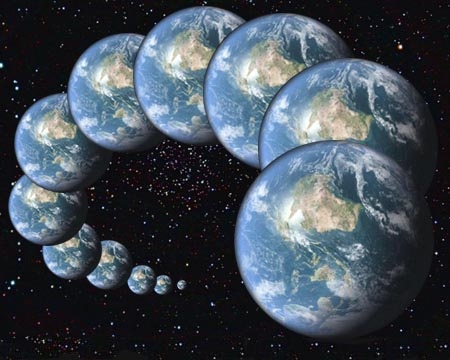
The original album cover was MC Escher’s print, Three Worlds. The point, I think, is that we don’t just live in one world. We are living in multiple worlds simultaneously, a timeless cloud of energies, perhaps even living multiple lives in parallel–or at least I am–and from time to time journeying into them, encountering myself in them and deriving a multiplicity of benefits from doing so.

Three Worlds, MC Escher.

Music is the vehicle of choice for me. Something about hearing an attenuated note dancing all the way to the edge of space, hearing a bass line erupting from beneath the ground, creativity utterly destroying predictability, screaming high notes ripping emotion from my chest, harmonies suggesting poignant intimacies even mimicking biology, lyrics awakening forgotten longings, buried images, synthesizing cultures and histories, awakening body memory, evoking lives un-lived, sending me far into the past or future. They become more compelling than anything else I could do.

As I catalog some of those lives, even trying to say what they are out loud or at least to myself, a theme emerges. I don’t fantasize about power. I am neither the occupant of the C-suite nor am I the attendant. I seek neither notoriety, adulation nor wealth. I am not a scientist or an academic. What I am is an artist…in almost all cases, a driven creative devoted to the art, whether it be music itself, poetics, monastic life, physical arts, ancient wisdom or the hieroglyphics of the future. An intrepid pilgrim journeying into the essential nature of things. Those other lives–are they from the past or future?–hover about me, weaving themselves into my consciousness intermittently, reminding me of the true dimensions and the nonlinear nature of reality. At times they help me realize the choices I’ve made in this life are made of the same stuff as the roads not taken. In this life, I become their channel. They interrupt me from time to time; they inspire me, overtake me.

Why is music relevant here? Because, as David Abram’s elucidated so well in The Spell of the Sensuous, the primal origins of language reside in the sounds of the natural world itself. The original words, the alphabet itself, might have been mimicry, imitating the sounds of the more than human world. I’m pretty sure it’s safe to say all music derives from the same thing. All instruments were once organic. So the evolution of language and music are rooted directly in the original sources of sound. And parenthetically, those sounds are disappearing . Most of what we hear now is anthropogenic sound, not unlike urban lights blotting out the stars. So music can take us down and in, way down into the thrumming, screeching, buzzing, breath-taking, expiring, creeping cackles and calls of the underworld, into the earth itself and the earth within.

Where was I going with all that? Oh yeah. I was going into the choices we make about which life we shall live. The rest of the chorus we bring along may be obscured, but my fantasies of alternate lives remain as repositories and reflections of whatever wisdom I may have gained and as consultants to this life, feeding that wisdom back to me. They are never fully silenced. Nothing we do can negate our imagination nor diminish the aspirations flowing between this material reality and any alternate scenario, nor the internal communication arising as a momentary pre-occupation with a more spacious possibility.

And anyway, all lives, if we are fortunate, lead to the same end, do they not? At least in the best of worlds they would. Every one of us would become the sum of that assemblage, deriving something of value from each, embodying a clear vision, unwavering passion and a pristine integrity of purpose. We would each have found our true voice and learned to act and speak as a channel for all the accumulated wisdom of multiple lives, past and future, accompanying and feeding us in pursuit of our unique version of being exactly what we are and nothing else. We would all enter tantric mind, the vast view of unlimited and unrestrained compassion and ever-flowing mercy, soaring and drifting like a condor, adapting, adjusting course with minimal effort on the shifting updrafts, surveying the landscape below, resting in the nature of mind, in the cracks between the lives we live and lives un-lived.

Our other possible lives are songs we are still composing, dances of memory recalling our primal nature. We can sing them to ourselves as we add chapters to this unfolding mystery, even as the great silence of our own doing descends upon this world. We can access our own dreams, ever pregnant and ever in labor, energies across time, across generations, a time-release of wisdom fueling this life, gently inching forward toward ultimate knowing.

The Inner Commons

Fortunately, attention is not a commodity to be plundered like a vein of raw material. It’s a renewable resource whose value never diminishes. The domain of the inner commons is where precious resources may be buried but not tarnished.

I’ve long thought we should all be compensated by social media for our contributions to their bottom line. Considering they regard my digital activity as a commodity to be harvested, I thought I deserved a kickback, or royalty, if you prefer. But alas, I never got one.

I thought it might be difficult, but disconnecting from sources of distraction to follow wherever my inner process might lead me was far more important; as we all know so well, it’s also necessary. Even more than necessary, with the distractions intensifying and the algorithms ever more refined as they reach into my amygdala or give me shots of dopamine, the act of unhooking has practically become an act of sedition.

Fortunately, attention is not a commodity to be plundered like a vein of raw material. It’s a renewable resource whose value never diminishes. We have the capacity to regenerate and explore the intangible wilds, connecting to the depth of existence, anticipating the unknown, a birthright of being human, where all we are and all we know becomes a springboard to all we can imagine. Deliberate acts of renewal sustain our imagination and creativity.  

Neglecting to swim in the sublime inner worlds of feeling and imagination generates distorted, disconnected, and addictive behaviors. Just as going into the enveloping silence of wilderness reveals an abundance so often ignored, or worse, never known, so descending into silence reclaims the inner wilderness. The domain of the inner commons is where precious resources may be buried but not tarnished. Continuously regenerating a capacity for uncluttered presence sustains our access to the vital wholeness and emergent nature of life.

If you think about it, competition for our attention has been ongoing forever but has only recently accelerated in reach and sophistication. The Catholic Church may have been the original multi-national corporation, as Dara Malloy calls it in The Globalizating of God, seeking broad and lifelong influence upon an individual psyche. Its function was (and remains) to define spirituality in its own image, to define religious thought, faith and ritual, to deny other manifestations of spirituality, to literally own God and influence how we focus our attention in all relations. The Church was the original wave of what is now called modernity. The Pope himself was the one who carved up the New World and decided which monarchs would receive the spoils. That enterprise presumed itself the zero-point of knowledge and morphed into the multitude of manifestations defining the vertical integration of attention and consumer behavior. The marginalization and extinction of outlying traditions was a cornerstone of empire and foretold the dominance of religion and its hegemonic designs on the inner terrain we continue to see today.

The simple act of turning off the cacophony of modernity to focus our reverence and awe on anything other than patriarchal monotheism is now a battleground. Institutional religion remains central to that conflict as a symbol (and instrument) of coloniality and exclusivity. In its most radically conservative forms, Christian Nationalism, the ‘originalism’ of Wahabbist Islam, even among ultranationalist Buddhists, it is the status quo, it is business as usual. It promotes an increasingly tortured tribal definition of prayer as devout and uncritical submission to (male) authoritarian hierarchy.

On the other hand, prayer and ritual have been part of how humans inhabited the world in all times and places we know, though it’s much more than mere submission, supplication or asking for personal favors. Prayer is invariably attended by silence, at least implicitly. It resounds with silence regardless of whatever sound, rejoicing or lamentation, may (or may not) accompany it. Supplication and prayer are all infused with stillness, a return to the primordial womb of creation. If modernity is all about doing, then prayer is a recovery of being. Prayer is an act of love, especially self-love. It leads us into the realm of paradox and movement, uncertainty and inquiry. It’s an act of reclamation and connection, bringing us closer to earth and closer to the deity, to the unity of each, whether mythological or material.

In its loosest definition, prayer is a catchword for humility, surrender, devotion and wholeness. It is an affirmation of belonging, reminding us of our place. Prayer can be a sensory adventure into hidden realms of nature, our nature. Laughter is prayer. Joy is prayer, by which we reach beyond ourselves, not to remind ourselves of a presumed personal relationship with an omniscient and omnipotent force, but to re-embed ourselves in relationship, in belonging with. It’s a perpetual doorway to the unseen. To pray is to open your heart and get out of your mind, whether nourished by ancient history, last week or this moment. It’s an invocation of the gifts of ancestors who continue to deliver their wisdom in a continuous release seeping into the soil of culture.

Rituals of allegiance and submission have become the objective of corporate presence in every aspect of life nowadays, to substitute for what once was an immediately accessible connection with our spiritual home. While churches turn increasingly into corporations, corporations have turned into churches. Instead of allegiance to a deity, we now declare fealty to brands, products, to the ubiquitous presence and seduction of ritual consumption, now framed as delivering all the same benefits we once received through family or community ritual practices restoring connection, wholeness and renewal.

This is the tragedy of the inner frontier. Such values are now associated not with places or group practices or the most intimate sanctum of mind, but with products. Patriotism substitutes for spirituality with America as the product. Starbucks is the ubiquitous church of the caramel soy latte. The supermarket houses myriad distortions of our primary connection to the true source of nourishment. Amazon has become the god of all gods, greater than Odin, Ares, Esu or Tutankhamen. Thou shalt have no other gods before me! Kneel!

(So, if you’re an agnostic, where do you go for a cup of coffee? Where do you buy a book or…….anything?)

In some quarters, the formalized practice of prayer or any of the common forms of mindfulness are being coopted as instruments of control. No wonder church attendance is declining so rapidly. There are also fewer blessings, offerings or sanctifications and a poverty of rituals grounding secular life in any ecumenical framework. Certain cultures or sects remaining true to such values, in which protecting the inheritance of overtly mystical practices in which God is immediate and personal, are deemed foreign, extreme or even dangerous. We need reminding that the nature of our god becomes the nature of our world. And it is these very disagreements about the nature of the deity, who owns it and how we use our attention to connect with wholeness which are hastening the collapse already upon us.

When our actions in the world are founded on devotion to a zero-sum lie, they become either rough, halting or tenuous. If we can face how disconnected personal and collective actions have become, we find ourselves circling around the truth of our brokenness–how truly heartbroken so many of us have become in this time of loss. Getting on our knees, figuratively or actually, may not be the (only) answer. But how do we imagine our actions can be entirely divorced from our beliefs about God, a supreme being, Pachamama, InterBeing, the Most Merciful One, ineffable spaciousness without beginning or end–or whatever its name may be? Which of your actions would you argue can be separate from any of that?

If we lived your lives connected to the inner wild while remaining connected to the outer world, how would that look? Or feel? Sitting with this question, I cannot help but see many of the expressions of devotion all around me as more bewildered and confused surrender, more disempowerment than prayer, most likely salved by another ritual visit to one of the new churches of our broken world.

Re-inhabiting the inner wilderness may not heal a broken heart, but it’s a start. It would surely remind us there’s so much more to lose, and to save.

The Easy and the Impossible

But honestly, tell me you can look into the eyes of stranger or even someone you know intimately without having this experience. Maybe not all the time, but with rising frequency. What do you see? A desperate search for signposts or guidance or truth or any modicum of trust?

My ex-wife used to say sex was either easy or impossible. There was no in-between. That was quite a declaration coming from a sex-therapist who helped people work through buried assumptions and emotional obstacles to healthy sexual relationships. I’m thinking the same principle applies to writing. It’s either real or it wanders off into strange and strained territory to become something else, like a mannequin, needing more and more layers of make-up to appear real, when actually, contrivance can never replace the spark of life. Even so, breaking through contrivance to live in reality requires more than a wish.

So it is with living nowadays as well, apparently. As the unraveling around us continues, the despair deepening and the warnings arising from diverse quarters, I spend another restless night processing the turbulence of the day in dreams, sensations, and images. I awaken without words to frame new (or ongoing) feelings, rising with aches and pains, old and new. I, like everyone else I suppose, continue to ride the rising tide of challenge and increasingly complex and fraught sense-making going on everywhere. In fact, it seems we’re all being continuously triggered and probably don’t even realize how vulnerable we’ve become.

I can’t look at anything anymore, food or energy prices, the tsunami of waste, the latest manifestations of systemic racism, nihilistic political agendas, vacuous declarations of so-called experts on cable TV, the creeping security state, looming mass evictions, the arrogance of empire giving oxygen to old tropes, the economic puppet show, the building wave of global (and domestic) refugees, the deepening divide over vaccination and especially the accelerating frequency of extreme weather events without looking at everything. Earth has a fever—we are all under its sway —and our behavior is approaching delirium.

I am unable to keep the blinders on or act unaffected. More and more comes packed into less and less, such that even the smallest encounters, like a simple hello, are loaded with import. If I applied the original adage to my current circumstance, I’d have to say with civic dialogue descending into chaos and governance hanging by a thread, with most everything we take for granted in upheaval, that life is approaching impossible. And it’s impossible to look away. If there is an answer, it’s to meet our vulnerabilities with unflagging courage, not retreat into a cocoon of falsehoods, to permit ourselves to be exposed, just as any sex therapist would suggest, remembering that hastily following impulses is a dangerous path and that love is stronger than fear.

But honestly, tell me you can look into the eyes of stranger or even someone you know intimately without having this experience. Maybe not all the time, but with rising frequency. What do you see? A desperate search for signposts or guidance or truth or any modicum of trust? Knowing we’re all undergoing a something in common, everywhere from your bedroom to your community to every place beyond, we are thirsting for the sparks of life breaking through the mirrors, the robotic or performative nonsense, and we are drawn to them instantly.

Amidst all the talk and the growing awareness of our predicament, I wonder if what I am feeling (and seeing) is the true nature of collapse. I can’t imagine how you are metabolizing this ongoing trauma overtaking us, but it’s become a pandemic in its own right. Not only are our primal rhythms under assault, but water cycles, growing seasons, the jet stream, soil viability, ocean currents, all are wavering and fueling increasing damage and desperate grasping for stability. All the boundaries that define us, most of which are enactments of coloniality, are blurring in a storm of converging data from biology, neuroscience, psychology, and spirituality, not to mention political ecology.

We are trying to birth ourselves into an as-yet-undefined world beyond right and wrong—or at least we’d better be– because nearly everything previously defined by the sham religion of modernity as right and wrong is part of the prison in which we are all held. Right and wrong are being brutalized, stripped of meaning, contorted, ignored, rendered inert by capitalism and the nation-state, shuttled off to a state-run home for advanced cases of moral equivocation. No wonder the maps are blurring and there’s extreme behavior all around us.

Are we seeking something new or are we reclaiming something as old as earth itself? Are we diverging of converging–or both? As a white person living in a (formerly?) white dominated world built on the bones and ashes of non-white cultures, where do I look for guidance? The world I grew up in, when the polarities seemed clear, when it was easy to say which side I was on, is dissolving. How we think, how easily we are triggered, the default psychic frameworks we relied upon are under reconstruction. Justice and injustice. Racism and so-called equality. Authoritarianism and so-called democracy. Sexism and so-called gender equity. Even war and peace wear rhetorical masks mocking their convergence. We can’t not notice that virtually every principle we once thought clear, activism, the definitions of problems and especially solutions all exist within the framework of modernity now under challenge. That template, with its innate violence, exclusion and systems of control, arbitrarily drawn international borders, sacred systems of law, language, commerce, faith, ritual violence and spirituality is just not working anymore.

Where are the signs of life coming from? Who knows better than anyone about the malignant appeal and tenacious grip of modernity? Who stands in starkest contrast to whiteness as the standard of humanity? Who embodies the visceral legacy of enslavement, throwing white privilege into high relief, and gives voice to the necessity of becoming a fugitive from the hegemonies of western culture? What happens to our bodies as conflict rises, as we perceive deeper layers of conditioning, peering past the constrictions of cultural and linguistic structures to a multi-colored coat of a new way? Even if I declare a tenuous independence, that my body is not for sale, to be occupied or even subtly directed, that my body cannot be taken or its treasures plumbed as just another profit center, I don’t yet fully know what that means. I only know that going deeper into the sensations of change with a willingness to notice and feel everything is required.

Very little is easy anymore, not even hello, but we have yet to arrive at a new functional baseline. But one thing is crystal clear: the impossibility of modernity, which has taken 500 years to realize, externalizes more and more and offers only faux benefits increasingly removed from lived experience. Quo bene, as they say. Who still benefits from that ongoing construction? Only a vanishingly small minority.

突破: Breaking Through

I have wandered off from the campfire. I’m roaming in the dark, placing myself at the mercy of beasts of the night, divorced from camaraderie, landmarks, scents, ancestors, teachers, children, the whirling firmament and the community of souls that brought me here.

There have been moments when I’ve fancied myself a writer. It wasn’t always that way. I crept into it slowly, writing casually for entertainment, correspondence or popular appeal. Certainly, there were moments of personal disclosure when I would be navigating complex feeling, intention, memory and association. I didn’t particularly seek those moments, but neither did I avoid them. Along the way, I found a groove, enacting devices to engage, provoke or inspire. Writing arrived with the glib pouring forth of words to describe a travel experience or when I was either so angry or sad that I didn’t have to think what to write next. Or else I fancied myself at least a passable expository writer who could present a detailed subject with some clarity.

But I am no longer traveling, and my outrage button has become exhausted, replaced by disgust at the extreme performative nature of public dialogue and a nagging resignation about the future. It all resides in a cavern of helplessness that seems to have numberless rooms to explore, places to get lost, where scant light ever ventures. If you’ve ever been in a vast cave, lit only by the artificial kind, you might already know how boring it can quickly become, especially if you tire of being reminded, everywhere you look, of how small you are in the great unwinding of time in silent darkness.

As far as expository writing is concerned, I must finally admit it’s too barren. It cannot come close to communicating the diversity and complexity of the real lives we are living in this time of the great unraveling—or how we are being lived by events and each other, by the warming oceans disrupting the primary currents, the disappearing ice. It’s thus just plain boring. I’m not journalist. It’s not my job to bring you the news in that familiar way and it’s about time to stop trying instead of using volumes of words to defend vague ideas in an impersonal way.

But where does this place me? I must learn something new all over again. Maybe I’ve been that journalist, that academic, that remote observer, that pretender to some ivory tower. But now, deciding what kind of writer I am not is not the same as becoming the kind of writer I will be. Because, really, when we get down to it, we’re talking about what kind of person I will be, how I imagine myself, how I am connecting (or not) to the world. And right now, it’s the ‘not’ connecting that’s haranguing me from the back rows, which is to say, I have wandered off from the campfire. I’m roaming in the dark, placing myself at the mercy of beasts of the night, divorced from camaraderie, landmarks, scents, ancestors, teachers, children, the whirling firmament and the community of souls that brought me here.

I haven’t been a storyteller. I’m not sure I ever set out to become a storyteller or if I even knew what it really is to tell a story. And that right there is the story, the poverty of my course, the dubious credentials I’ve claimed so far. Telling the story is not solely about someone as it is about a time, a place, a multi-dimensional thread of events creeping in from all directions and from distant peoples and times. It’s about the teachers we would not normally recognize. It’s the sensory, the cognitive, the relational, the mysterious and the unseen coming together in dynamic play, in evolutionary unfolding, in paradoxical awakenings, in pregnancies delivered just in time. Because that’s the nature of the lives we are living. Nothing will ever be straight again.

If the pandemic has taught us anything, it’s that nothing was ever straight to begin with, even though we clung to a biased fantasy of some narrow empiricism, the exclusion and violence at the heart of coloniality, the subtle catechism of modernity that all things have a place and must stay in their place as they are defined by science, religion and politics. We’ve been walking through these things as if in a hall of mirrors, wishing to see ourselves reflected back, confirming the ‘way things are.’ The entire enterprise resides in a fixed epistemology that always yields the same conclusion—the muting of nature and the supremacy of the (white) human and western ways of knowing. There, we never have to worry about the entire deck being thrown up into the air—as it is now—all the time.

When the way seems blocked, it’s time to break the mirrors. All bets are off. Empire is the Anthropocene monster eating its own tail, an exhausted enterprise shedding all but its most desperately loyal supplicants. The more they cling, the more they deny and pit themselves against the relentless and now accelerating de-westernization occurring throughout the global south and Asia, the greater the danger to us all. This beast of a nation will surely, under an authoritarian president, start an(other) entirely cynical and thoroughly corrupt (forever) war to reclaim its fantasy of supremacy, dragging a generation into hot conflict, brutalizing all dissent along the way, distracting from the rot within and the advancing consequences of its own extravagance. This will be the death throe of America—an economically and ideologically cornered giant drunk on its own self-dealing delusions and doubling down on its primary addictions.

The stage is set and the time for pretension is so over; the time to own up to my own pretensions is long past. Perhaps that’s why I am feeling so lost. Perhaps that’s why my recent gestures toward expression have felt so stale, so limited, and uninspired. Maybe it’s because the fire of my own truth burns as a small ember. I have retreated into my own incarceration. I am the jailer and the jailed. I am forgetting what I belong to. I am the sole party to the severance of my dependencies, my alliances, my symbiosis with the world. It’s time for oxygen, a return to (dare I say it) authentic spontaneity, time for a jailbreak, to explore the green glimmers of foreign and still hardy epistemologies, biding their time, and if it’s not too much of a cliche, breaking through the concrete of the dying order, revealing our true nature to ourselves and to each other.